

Your cash burn rate is the one number that tells you the exact date your company goes bankrupt. Not approximately. Exactly. If you have $1 million in the bank and you’re net negative $100,000 a month, you have ten months. After that, you’re out of cash, and out of cash means out of business — regardless of how good the product is or how fast revenue is growing.
Most founders treat burn as a vague background worry instead of a hard number they manage on purpose. That’s a mistake. Cash burn rate is the difference between running your company and your company running you. The CEOs who get this right know their runway to the month, know whether their burn is a deliberate bet or an accident, and know exactly what they’d do if the next financing round never showed up.
This guide covers cash burn rate end to end: the difference between gross and net burn, how to calculate runway the right way (using your bank account, not your P&L), the burn multiple — the efficiency metric acquirers and investors actually care about — current benchmarks by stage, and the strategic question underneath all of it: when burning cash is brilliant, and when it’s just driving the car off a cliff hoping you grow wings before you hit the ground.
What Cash Burn Rate Actually Means
Cash burn rate is the speed at which your company spends down its cash reserves. It’s measured in dollars per month. If your bank balance drops by $80,000 over a month, your burn rate is $80,000 a month. That’s it. The concept is simple — the trouble starts when people confuse the two versions of it.
There are two burn rates, and conflating them is the single most common error I see in founder financials:
| Term | Formula | What it tells you |
|---|---|---|
| Gross burn | Total monthly cash operating expenses | The full size of your cost base — what you spend before any revenue offsets it |
| Net burn | Total monthly cash out − total monthly cash in | What you actually lose each month after revenue. This is the number that sets your runway. |
Gross burn is every dollar leaving the building: salaries, rent, software subscriptions, marketing spend, contractors, hosting — the whole cost base, ignoring revenue entirely. It answers “how expensive is this machine to run?”
Net burn subtracts the cash your customers actually pay you. It answers “how fast am I draining the tank?” Net burn is the number that determines when you go bankrupt, so it’s the one that should sit on your dashboard.
A quick example. Suppose your SaaS company spends $250,000 a month on everything and collects $170,000 a month in customer cash:
- Gross burn = $250,000/month (the cost base)
- Net burn = $250,000 − $170,000 = $80,000/month (the actual drain)
Both numbers matter, but for different reasons. Net burn tells you your runway. Gross burn tells you how exposed you are if revenue suddenly drops — because in a downturn, the revenue offset shrinks and your net burn rushes back toward your (much larger) gross burn. A company with $80,000 net burn and $250,000 gross burn is far more fragile than one with $80,000 net burn and $110,000 gross burn, even though their net burn is identical today.

How to Calculate Cash Burn Rate (Use Your Bank Account, Not Your P&L)
Here’s the mistake that wrecks burn calculations: pulling the number off your profit and loss statement (P&L). The P&L runs on accrual accounting — it recognizes revenue when it’s earned and expenses when they’re incurred, not when cash actually moves. That’s the right way to measure profitability, but it’s the wrong way to measure burn. Your bank account doesn’t care about accrual rules. It cares about cash in and cash out.
Calculate burn from your bank balance, not your income statement:
Net Burn = (Beginning Cash Balance − Ending Cash Balance) − Financing Inflows
Take your cash at the start of the period, subtract your cash at the end, and strip out any financing events — a new equity round, a drawn-down loan, a line of credit — because that cash didn’t come from operating the business. What’s left is your true operating burn.
A worked example over a single month:
| Line | Amount |
|---|---|
| Cash on hand, start of month | $1,000,000 |
| Cash on hand, end of month | $950,000 |
| Raw balance change | −$50,000 |
| Less: $30,000 loan draw during the month (financing, not operations) | −$30,000 |
| True operating net burn | $80,000/month |
If you’d read that month straight off the balance change, you’d have congratulated yourself on an $50,000 burn — when you actually burned $80,000 and papered over $30,000 of it with debt. That’s how companies sleepwalk toward a cliff while their dashboard says everything’s fine.
For a less noisy number, average the last three months. A single month can be distorted by an annual software renewal, a big quarterly tax payment, or a one-time legal bill. A trailing three-month average smooths those out and gives you a burn rate you can actually plan against.
Runway: The Date You Go Bankrupt
Once you know your net burn, runway is trivial to calculate — and it’s the most important number on your dashboard.
Runway (months) = Cash in the Bank ÷ Monthly Net Burn
If you have $1,000,000 in the bank and you’re burning $100,000 a month net, you have 10 months of runway. After ten months — assuming nothing changes — you are out of cash and bankrupt. That’s not a metaphor. You can put the date on a calendar.
This is the part most founders avoid looking at directly, and avoiding it is exactly what gets companies killed. When you have negative cash flow, you can mathematically calculate when you will be bankrupt. A company with $1 million in the bank burning $100,000 a month has a hard deadline ten months out. That deadline doesn’t care about your optimism. It’s a wall, and you’re driving toward it at a known speed.
The strategic implication is brutal and clarifying at the same time: by the time you feel the cash crunch, it’s usually too late to fix it cleanly. Raising money takes three to six months. Cutting costs meaningfully takes a quarter to show up in the bank. So if you wait until you have four months of runway left to react, your only options are a fire-sale financing round (a forced round — raising on terrible terms because you have no choice) or layoffs deep enough to damage the business. Both are avoidable if you watch runway early.
This is why the question isn’t just “what’s my burn?” It’s “how many months until the wall, and what’s my plan well before I hit it?”
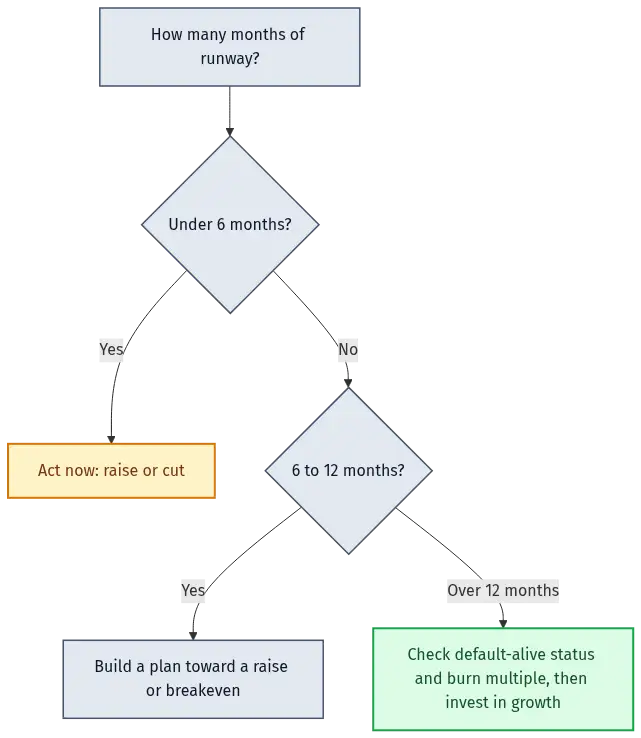
How much runway is enough? The market consensus has tightened, but the durable rule of thumb is to keep at least 12 months of runway at all times, and ideally 18 to 24 months when you’re about to do something risky (a big hire wave, a new market push, or anything that temporarily spikes burn). Eighteen-plus months means you can fundraise from a position of strength rather than desperation — and the difference between raising at 18 months of runway versus 4 months is often the difference between a clean round and giving away half your company.
A note on the specific dollar figures and benchmark ranges in this article: they’re illustrative and reflect typical conditions at the time of writing. They’re here to show relative relationships — how net burn compares to gross burn, how runway responds to a change in burn — not as current absolute targets. Verify the specific benchmarks for your stage and the current funding environment before making decisions.
The Burn Multiple: Are You Burning Efficiently?
Runway tells you how long you’ll survive. It says nothing about whether your burn is productive. You can have 24 months of runway and still be lighting money on fire if every dollar you burn produces almost no new revenue. That’s where the burn multiple comes in — and it’s the metric that sophisticated investors and acquirers reach for first when they want to know if a SaaS business is actually well-run.
The burn multiple measures how much cash you burn to generate each new dollar of recurring revenue. Lower is better.
Burn Multiple = Net Burn ÷ Net New ARR
Here, Net New ARR (Annual Recurring Revenue added in the period) is your new recurring revenue from new and expansion customers, minus the recurring revenue you lost to churn and contraction. If you added $2 million of net new ARR last year and burned $3 million of cash to do it, your burn multiple is 1.5 — you spent $1.50 of cash for every $1.00 of new recurring revenue you built.
Here’s how to read the number:
| Burn Multiple | Interpretation |
|---|---|
| < 1.0 | Amazing efficiency — you're building more ARR than you're burning |
| 1.0 – 1.5 | Great — capital-efficient growth |
| 1.5 – 2.0 | Good — typical for a healthy growth-stage SaaS |
| 2.0 – 3.0 | Suspect — you're spending too much per dollar of ARR |
| > 3.0 | Bad — unsustainable without a correction |
The burn multiple is the closest thing SaaS has to a single “are you good at this?” score. It rolls your unit economics, your sales efficiency, and your spending discipline into one ratio. Two companies can have identical revenue and identical runway, but the one with a 1.2 burn multiple is worth dramatically more than the one at 2.8 — because the efficient company can turn future capital into growth, and the inefficient one will just turn it into smoke.
For the bootstrapped or lightly funded CEO, the burn multiple is also a discipline tool. It forces you to connect every dollar of spend back to ARR produced. If you’re about to add three sales reps, the question isn’t “can I afford them?” — it’s “what will this do to my burn multiple, and how long until they pay back?” That’s the unit-economics lens applied to your whole company. (For the full picture on how acquisition cost and lifetime value drive these decisions, see SaaS unit economics and the LTV/CAC ratio.)

Gross Burn vs Net Burn: Why the Gap Matters
Most burn-rate articles tell you to watch net burn and stop there. That’s incomplete. The gap between your gross burn and net burn is a measure of how exposed you are — and it’s the thing that turns a survivable downturn into a fatal one.
Walk through two companies, both burning $80,000 net per month, both with $1 million in the bank, both showing 12.5 months of runway:
| Company A | Company B | |
|---|---|---|
| Gross burn (monthly cost base) | $110,000 | $250,000 |
| Revenue (monthly cash in) | $30,000 | $170,000 |
| Net burn | $80,000 | $80,000 |
| Runway at $1M cash | 12.5 months | 12.5 months |
On the dashboard, they look identical. But now imagine a downturn hits and both companies lose 30% of their revenue.
- Company A loses $9,000 of monthly revenue. Net burn rises from $80,000 to $89,000. Runway drops from 12.5 to about 11 months. Painful but survivable.
- Company B loses $51,000 of monthly revenue. Net burn jumps from $80,000 to $131,000. Runway collapses from 12.5 months to about 7.5 months. The same downturn that barely scratched Company A just erased five months of Company B’s life.
The bigger your gross burn relative to your revenue, the more leveraged you are to bad news. This is why a low net burn alone can be misleading — it can hide an enormous, fragile cost base that’s only “fine” as long as revenue holds. Watch both numbers. Net burn for the runway clock; gross burn for the fragility.
When Burning Cash Is the Right Call — and When It Isn’t
Here’s where most coverage of burn rate falls apart, because it treats all burn as inherently bad. It isn’t. Burning cash is a strategic choice about your risk profile, and the choice is binary in a way most founders don’t fully appreciate.
When a company burns cash intentionally, it’s making a specific bet: spend now, ahead of revenue, to capture a market faster than a more cautious competitor could. The companies you hear described with terms like “cash burn” and “burn rate” are often lighting hundred-dollar bills on fire on purpose, burning cash to get a shot at massive growth and become the next category-defining winner. The risk profile is extremely binary. They want to be billionaires or bankrupt — and that’s exactly what a venture capitalist wants, because the VC has a portfolio and only needs a few home runs.
The problem is that the binary cuts both ways. If you’re burning hard and it works — you build a runaway winner like an Uber — that’s fine. But if it doesn’t work, you’re on a death march to bankruptcy in 10, 18, or 22 months, and you will hit that wall unless you become cash-flow positive in time or raise another round. You’re driving the car off a cliff, hoping you can build wings and become an airplane before you run out of road. Sometimes you build the wings. Sometimes an investor extends the road by writing a check. And sometimes you just go off the cliff.
So the right question isn’t “is burning cash good or bad?” It’s “does my situation justify the binary bet?” Here’s the framework I use:
Burning is justified when:
- You have a proven, repeatable growth engine. You know that a dollar in sales and marketing reliably produces more than a dollar of profitable ARR. Adding fuel to a fire that’s already burning hot is the best use of capital there is — you’re just choosing to win faster and win more.
- The market is being won right now. If there’s a land-grab and the winner takes most of the value, moving slowly to preserve cash can be the riskier choice. Sometimes the cautious path is the dangerous one.
- You have a credible plan to reach the next milestone before the wall. Burn is a bridge to something — a revenue level, a milestone, a financing event. If you can’t name what’s on the other side of the bridge, you’re not investing; you’re just spending.
Burning is a mistake when:
- Growth has already stalled and you’re hoping spend will restart it. Trying to buy your way out of a growth problem you don’t understand is the classic trap. When the world’s burning down, don’t add fuel. If something changed and you’ve lost product-market fit, more spend just makes the problem worse, faster.
- You’re burning by accident, not by decision. If your burn is the residue of an unexamined cost base rather than a deliberate bet, you’re taking on bankruptcy risk without consciously choosing to. That’s the worst of both worlds.
- You have no path to the next funding event or to profitability. Burning toward a financing round you’re not confident you can raise is how forced rounds happen.
The cleanest version of this: if you’re on a rocket ship that’s working, add fuel. If the world’s burning down, don’t. Debt and equity are both fuel — wonderful on a winner, catastrophic on a loser. The discipline is in honestly diagnosing which one you’re on before you decide how hard to burn. (This is the same judgment that separates good and bad uses of venture debt and shapes every SaaS financial model worth building.)
Default Alive vs Default Dead
There’s a useful reframe that cuts through all of this. Ask one question: on your current trajectory — current burn, current growth rate, no new funding — do you reach cash-flow breakeven before you run out of money?
If yes, you’re default alive. Your existing momentum carries you to safety even if you never raise another dollar. You’re in control. You can choose to raise to grow faster, but you don’t have to.
If no, you’re default dead. On your current path, you hit the wall before you reach breakeven, which means your survival depends on something outside your control — another funding round, an acquisition, or a sudden change in trajectory. You can still be a great company. But you’re not in control of your own fate, and you should know that with total clarity.
Most founders never run this calculation, which is how they end up surprised. Run it. If you’re default dead, you have exactly two levers: grow faster (raise net new ARR enough to bend the line to breakeven before the wall) or burn less (cut costs to push the wall out past your breakeven date). Knowing which lever you’re pulling — and starting early enough that it works — is most of the job.
For the bootstrapped, capital-efficient CEO this article is written for, default alive is usually the goal, not billionaire-or-bankrupt. You’re building toward an exit in the $25M–$100M range, not trying to become the next Google. That means your burn should be a deliberate, controlled investment that keeps you default alive — not a binary bet that puts the whole company on the line. The metrics in this article — net burn, runway, burn multiple — are the instruments that keep you on the right side of that line.
Common Cash Burn Rate Mistakes
A few errors show up over and over in founder financials. Each one is avoidable.
- Calculating burn off the P&L instead of the bank. Accrual accounting hides cash timing. Your runway lives in your bank account, so calculate burn there.
- Forgetting to strip out financing inflows. A loan draw or a new equity check temporarily masks your real burn. Always subtract financing events before reading your operating burn.
- Watching net burn and ignoring gross burn. A low net burn can sit on top of a huge, fragile cost base. The gross-to-net gap is your exposure to a downturn.
- Reacting to runway too late. Fundraising takes three to six months and cost cuts take a quarter to land. If you start reacting at four months of runway, you’re already in the forced-round zone. Watch the clock from 18 months out.
- Treating all burn as bad. Disciplined burn on a proven growth engine is one of the highest-return moves available. The mistake isn’t burning — it’s burning without a plan or burning to fix a problem you don’t understand.
- Never running the default-alive calculation. If you don’t know whether your current trajectory reaches breakeven before the wall, you don’t actually know if your company is in control of its own survival.
Frequently Asked Questions
What’s a good cash burn rate for a SaaS company?
There’s no single “good” dollar figure — burn scales with company size, so $100,000 a month is reckless for a $1M ARR company and conservative for a $20M ARR company. The better question is whether your burn is efficient (measured by burn multiple — aim for under 2.0, ideally under 1.5) and whether it leaves you enough runway (ideally 18+ months). A capital-efficient growth-stage SaaS company is typically burning at a multiple between 1.0 and 2.0 while maintaining a year-plus of runway.
What’s the difference between gross burn and net burn?
Gross burn is your total monthly cash operating expenses — every dollar going out, ignoring revenue. Net burn subtracts the cash your customers pay you, so it’s your actual monthly cash loss. Net burn determines your runway; gross burn measures how exposed you are if revenue drops. Watch both.
How do I calculate my runway?
Divide your cash in the bank by your monthly net burn. $1,000,000 in the bank ÷ $100,000 monthly net burn = 10 months of runway. For a more reliable number, use a trailing three-month average net burn rather than a single month, which can be distorted by one-time payments.
What is a burn multiple and why does it matter?
The burn multiple is net burn divided by net new ARR — how much cash you burn to add each dollar of new recurring revenue. It’s the single best measure of capital efficiency in SaaS, and it’s the number investors and acquirers reach for first. Under 1.0 is amazing, 1.0–1.5 is great, 1.5–2.0 is good, and above 3.0 is unsustainable.
How much runway should a SaaS company keep?
Keep at least 12 months at all times, and ideally 18 to 24 months before any move that spikes burn. The reason is timing: raising money takes three to six months and cutting costs takes a quarter to show up. Eighteen-plus months of runway lets you fundraise from strength instead of desperation, which is often the difference between a clean round and a forced one.
Is burning cash always bad?
No. Burning cash on a proven, repeatable growth engine — where a dollar of spend reliably produces more than a dollar of profitable ARR — is one of the highest-return decisions a SaaS CEO can make. Burning is only a mistake when you’re spending to fix a growth problem you don’t understand, burning by accident rather than decision, or burning toward a funding round you can’t confidently raise. The discipline is diagnosing which situation you’re in before you decide how hard to burn.
Cash burn rate isn’t a number to fear — it’s a number to manage. Know your net burn to the month, know your runway to the date, watch the gross-to-net gap for fragility, and use the burn multiple to keep every dollar of spend honest. Above all, decide on purpose: is your burn a controlled investment that keeps you default alive, or a binary bet that puts the company on the line? The CEOs who answer that question clearly — and early — are the ones still standing when the cliff arrives.