

A down round is when you raise your next round of funding at a lower price per share than your last round — meaning the market just told you your company is worth less than it was at your previous raise. If your Series A priced shares at $10.00 and your Series B prices them at $5.00, you’ve taken a down round, and that 50% drop sets off a chain of consequences most first-time founders never see coming until they’re staring at the term sheet.
Here’s what makes a down round genuinely dangerous, and why it deserves a full guide rather than a paragraph: the headline valuation cut is the least of your problems. The real damage comes from the legal machinery that fires automatically when the price drops — anti-dilution protection that quietly transfers ownership from you to your earlier investors, often more than the simple math of the new shares would suggest. I’ve watched founders sign a down round thinking they gave up 18 points of ownership when the term sheet’s fine print actually cost them 24. This article shows you exactly how that machinery works, with the arithmetic spelled out, the alternatives you should exhaust first, and — if you have no choice — how to negotiate the least-bad version.
What a Down Round Actually Is
To understand a down round, you first need two terms that every financing conversation runs on: pre-money and post-money valuation.
Pre-money valuation is what your company is worth before the new investor’s money goes in. Post-money valuation is the pre-money plus the new cash — what the company is worth the moment the round closes. The relationship is simple:
Post-Money Valuation = Pre-Money Valuation + New Investment
The price per share in a round is set by the pre-money valuation divided by the shares outstanding before the round. So when people say a round is “up” or “down,” they’re comparing the price per share — not the headline valuation, not the dollars raised.
A down round is a financing in which the new price per share is lower than the price per share of the prior round. Think of it like a house you bought for $500,000 that now appraises for $250,000 when you go to refinance. The house didn’t shrink. The market’s assessment of what it’s worth changed, and now you’re borrowing against the lower number — with all the consequences that follow.
Here’s a concrete frame I’ll use throughout this guide. Say your company raised a Series A like this:
| Item | Series A |
|---|---|
| Price per share | $10.00 |
| New shares issued (preferred) | 2,500,000 |
| Cash raised | $25,000,000 |
| Pre-money valuation | $75,000,000 |
| Post-money valuation | $100,000,000 |
That post-money of $100M comes from $75M pre-money plus $25M of new cash. Two years later, growth has stalled and the funding market has cooled. The best term sheet you can get for your Series B prices shares at $5.00 — half the Series A price. That is a down round. The questions that matter now are why it happened, what it costs you, and what you could have done instead.

Why Down Rounds Happen
Down rounds are rarely about a single catastrophe. They’re usually the collision of an external shift you didn’t control and an internal assumption you made when the last round felt easy. There are four common causes, and most down rounds are some blend of them.
- Market multiple compression. This is the most common cause and the least personal. The price buyers and investors will pay for a dollar of recurring revenue moves with the market. When public SaaS revenue multiples fall — as they did sharply when the cheap-money era ended — private valuations follow within a few quarters. A company doing everything right can still face a down round simply because the multiple applied to its revenue compressed. If your last round was priced at 12× ARR and the market now pays 6×, you’d need to double your Annual Recurring Revenue (ARR) just to hold your prior valuation flat.
- Missed growth targets. The last round was almost certainly priced on a forecast, not on trailing results. Investors paid for the trajectory you sold them. If you projected 80% growth and delivered 35%, the next investor reprices the company against what actually happened — and against a future they now trust less. This is where the framing of risk as a multiple killer bites: the gap between your model and reality is exactly what the new investor is pricing down, and it shows up in your Rule of 40 score before it shows up in the term sheet.
- Running out of runway. Cash is the clock every other decision runs against. When your cash runway shrinks below six months, your negotiating leverage collapses. Investors know you have to close something, and a forced raise on a short timeline almost always prices worse than a raise from a position of strength. Many down rounds aren’t down because the business deteriorated — they’re down because the founder waited too long to raise and lost the leverage to hold the line.
- An overpriced prior round. Sometimes the last round was simply priced too high — a frothy market, a competitive process, a founder who optimized for the headline number. A high valuation feels like a win until it becomes the bar you have to clear at the next raise. If you couldn’t grow into the valuation you took, the correction shows up as a down round. The lesson here is one most founders learn the hard way: the valuation you celebrate today is the hurdle you have to beat tomorrow.

The Mechanics: How Anti-Dilution Protection Works
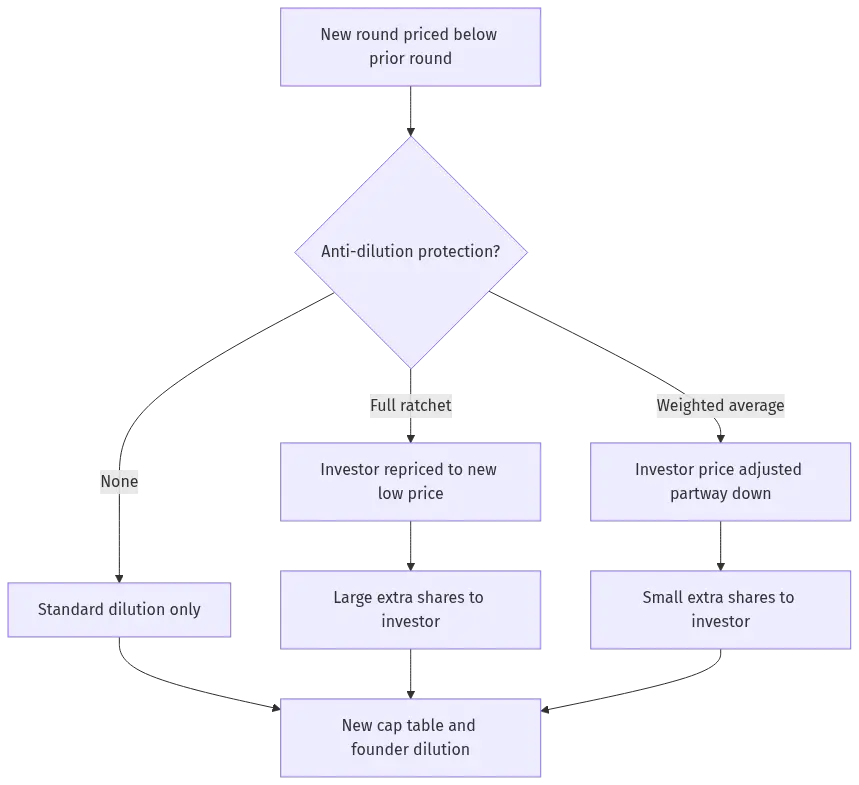
This is the section that matters most, because it’s where the hidden cost lives. When you raised your Series A, your investors almost certainly received preferred stock — a class of shares with rights that common stock (what you and your employees hold) doesn’t have. One of those rights is anti-dilution protection.
Anti-dilution protection works like a price-guarantee on a TV you just bought: if the store drops the price next week, the policy refunds you the difference. For a preferred investor, the “refund” isn’t cash — it’s extra shares. When you issue new stock at a price below what they paid, their preferred shares convert into common at a more favorable ratio, handing them additional shares to compensate for the lower price. That compensation comes directly out of everyone without the protection: you, your team, and your option pool.
There are two main flavors, and the difference between them can be worth millions to you personally.
Full-Ratchet Anti-Dilution
Full-ratchet is the investor-friendly, founder-punishing version. It resets the investor’s effective purchase price all the way down to the new round’s price, as if they had originally paid the lower price for every share they bought — no matter how few new shares actually triggered the reset.
Here’s the math on our example. The Series A investor put in $25,000,000. Under full-ratchet, their conversion price resets from $10.00 to the new $5.00 price:
Adjusted Series A Shares = Investment ÷ New Price = $25,000,000 ÷ $5.00 = 5,000,000 shares
They originally held 2,500,000 shares. Full-ratchet doubles that to 5,000,000 — purely as compensation for the price drop, before the new Series B money even creates its shares. Every one of those extra 2,500,000 shares dilutes you and your team.
Broad-Based Weighted-Average Anti-Dilution
Weighted-average is the far more common and more reasonable version — the market standard for healthy rounds. Instead of pretending the investor paid the new low price on everything, it adjusts their conversion price partially, weighted by how many new shares are actually being issued relative to the existing share base. A small down round triggers a small adjustment; only a massive dilutive issuance approaches the full-ratchet result.
The “broad-based” part means the formula counts your entire share base — common stock, the option pool, and all preferred on an as-converted basis — in the denominator. The broader the base, the smaller the adjustment, which is why broad-based is more founder-friendly than its “narrow-based” cousin. The standard formula is:
New Conversion Price = Old Price × (A + B) ÷ (A + C)
Where:
- A = shares outstanding before the new round (broad-based: 10,000,000)
- B = the new money divided by the old price ($20,000,000 ÷ $10.00 = 2,000,000) — the shares the new cash would have bought at the old price
- C = the new shares actually issued at the down-round price ($20,000,000 ÷ $5.00 = 4,000,000)
Plugging in:
New Conversion Price = $10.00 × (10,000,000 + 2,000,000) ÷ (10,000,000 + 4,000,000) = $10.00 × 12,000,000 ÷ 14,000,000 = $8.57
The Series A investor’s effective price drops only to $8.57, not all the way to $5.00. Their adjusted share count becomes:
Adjusted Series A Shares = $25,000,000 ÷ $8.57 = 2,916,667 shares
That’s an increase of about 416,667 shares — roughly one-sixth the bonus they’d get under full-ratchet. Same down round, same 50% price drop, dramatically different cost to you depending on a single clause in a term sheet you may have signed years earlier.
The Cap Table, Before and After
Numbers in isolation don’t land. Let’s put the full down round on a cap table so you can see exactly who owns what after each scenario. We start from the post-Series‑A table, then layer in the $20M Series B at $5.00 under three cases: plain dilution with no anti-dilution, broad-based weighted-average, and full-ratchet.
| Shareholder | Post-Series A | After Down Round (No Anti-Dilution) | After Down Round (Weighted-Average) | After Down Round (Full-Ratchet) |
|---|---|---|---|---|
| Founders (common) | 6,000,000 (60.0%) | 6,000,000 (42.9%) | 6,000,000 (41.6%) | 6,000,000 (36.4%) |
| Option pool | 1,500,000 (15.0%) | 1,500,000 (10.7%) | 1,500,000 (10.4%) | 1,500,000 (9.1%) |
| Series A preferred | 2,500,000 (25.0%) | 2,500,000 (17.9%) | 2,916,667 (20.2%) | 5,000,000 (30.3%) |
| Series B preferred | — | 4,000,000 (28.6%) | 4,000,000 (27.7%) | 4,000,000 (24.2%) |
| Total | 10,000,000 | 14,000,000 | 14,416,667 | 16,500,000 |
Read the founders’ row across. You start at 60%. The new money alone — the unavoidable dilution of issuing 4,000,000 new shares — takes you to 42.9%. That part you’d accept in any round, up or down. But watch what anti-dilution does on top of that: weighted-average shaves you to 41.6%, while full-ratchet drops you all the way to 36.4%. The gap between weighted-average and full-ratchet is more than five points of your company — handed to your Series A investor purely because of a clause, not because they invested another dollar.
The option pool tells the same story in miniature. Your team’s shares didn’t change in count, but their ownership percentage erodes in every scenario. That erosion is the seed of the morale problem we’ll get to next.

The Real Cost Goes Far Beyond Dilution
If a down round only cost you percentage points on a cap table, it would be a math problem. It isn’t. The dilution is the part you can calculate; the harder costs are the ones that don’t show up in a spreadsheet.
Signaling risk. A down round broadcasts a message to everyone watching: this company is worth less than it used to be. Other investors see it. Competitors see it and use it in sales cycles. The press, if you’re large enough to attract any, frames it as a stumble. Even when the cause was pure market compression — entirely outside your control — the signal reads as “something went wrong here.” Managing that narrative becomes a real job.
Underwater options and employee morale. Your team holds stock options with a strike price set at the last valuation. When the per-share value drops by half, many of those options are suddenly underwater — the strike price is higher than the current value, so exercising them would mean paying more than the shares are worth. An underwater option is a worthless lottery ticket, and your best engineers know it. This is the quiet killer of a down round: the people you most need to retain are the ones who just watched their equity evaporate. For the full picture of how employees should think about this, the guide on the truth about startup stock options is worth sending to your team.
Recruiting. The same underwater-options problem makes it harder to hire. Equity is a core part of your offer, and a candidate who does their homework will see the down round in the data room or hear about it through the grapevine. You’re now competing for talent with a diminished currency.
Customer and partner perception. Enterprise buyers run due diligence on the vendors they bet their operations on. A down round can surface in that diligence and raise the “will this company still be here in three years?” question — exactly the wrong question to be answering in a competitive deal. For SaaS companies that are becoming a system of record for their customers, that perceived fragility directly undercuts the trust the whole relationship depends on.
None of these costs are fatal on their own. Stacked together, they’re why a down round can knock a company off its trajectory for a year or more even after the cash hits the bank.
What to Try Before You Accept a Down Round
Here’s the rule I hold founders to: a down round is a decision, not an inevitability. Before you sign one, you should be able to explain, with numbers, why each of the following alternatives doesn’t work for you. Often one of them does — and even when none fully solves the problem, exhausting them improves your leverage in the down round you ultimately negotiate. Each of these deserves equal consideration.
Cut Burn to Extend Runway
The cheapest capital is the capital you don’t spend. Before raising on bad terms, the first question is always whether you can extend your runway far enough to raise later from a position of strength. If you’re burning $400,000 a month with $2.4M in the bank, you have six months. Cut burn to $250,000 a month and the same cash buys you nearly ten months — enough time to put up two more quarters of growth and reprice the conversation. Cutting burn is painful and often means hard headcount decisions, but it’s the only lever entirely within your control, and it directly attacks the runway pressure that causes most forced down rounds in the first place.
Raise a Bridge or Convertible Note
A bridge is a smaller, faster financing meant to carry you to a future priced round — to “bridge” the gap. It’s usually structured as a convertible note (debt that converts into equity later) or a SAFE (a Simple Agreement for Future Equity, a note-like instrument that converts on the next priced round). The appeal is that you don’t have to set a new price per share today — you defer the valuation question to the next round, when your metrics may justify a better number. The risk is that you’re borrowing against a future raise that has to actually happen; if it doesn’t, the note’s terms (discounts, valuation caps, sometimes interest) can compound into worse dilution than the down round you were avoiding. A bridge is a bet that you can fix the business in the runway it buys.
Take On Venture Debt
Venture debt is a loan designed for venture-backed companies that don’t yet have the predictable cash flows a traditional bank requires. It typically carries a higher interest rate than a bank loan and often includes warrants — a right for the lender to buy a small slice of your equity at a set price, working like a stock option but for the lender instead of an employee. The advantage over a down round is that debt doesn’t reprice your equity: no new low per-share price, so no anti-dilution trigger, and far less ownership given up. The catch is that debt has to be repaid on a schedule regardless of how the business performs, and lenders attach covenants (financial conditions you must maintain, such as a minimum cash balance). If you’re confident in the trajectory and just need to span a gap, debt can be dramatically cheaper than equity raised at a depressed price. If the business is genuinely struggling, adding a fixed repayment obligation to a shrinking runway is how a difficult situation becomes a fatal one.
Negotiate a Flat or Structured Round
A flat round holds the price per share at the prior round’s level — not up, but not down either, so no anti-dilution fires. Investors will often accept a flat headline price in exchange for added protections elsewhere, producing a structured round: the per-share number looks fine, but the new investor gets a richer liquidation preference (the right to get their money back first, sometimes a multiple of it, before common shareholders see anything), participation rights, or a bigger anti-dilution ratchet. A structured round can be the right trade — you protect the headline valuation, the option pool, and team morale — but read the terms with the same scrutiny you’d give a down round, because the cost has simply moved from the price line to the rights you’re granting. Sometimes a clean down round is genuinely cheaper than a “flat” round with a 2× participating preference stacked on top.
Run an Inside Round
An inside round is one led by your existing investors rather than a new outside lead. Your current backers already know the business, so the process is faster and the diligence lighter. They also have an incentive to protect their existing position, which can mean more favorable terms than a new investor demanding a deep discount to take a risk on you. The tradeoff is the absence of an external price check — an inside round can carry the perception that no outside investor was willing to lead, and you lose the validation a new lead’s capital provides. Still, when speed and certainty matter, an inside round at a fair price can beat a down round led by an opportunistic outsider. If you’re weighing whether to keep raising venture money at all, the tradeoffs in venture capital versus bootstrapping are worth revisiting at this moment.

How to Negotiate a Down Round If You Must Take One
Sometimes the alternatives genuinely don’t work and the down round is the right call — better a recapitalized company that survives than a clean cap table on a company that runs out of cash. If you’re taking one, negotiate it as a chance to reset the company’s foundation, not just absorb a hit. Three moves matter most.
Refresh the option pool and reprice underwater options. The down round that demoralizes your team can, handled well, re-energize it. Negotiate a new option pool as part of the round and reprice or refresh existing underwater grants to the new, lower strike price. Yes, this is itself dilutive — but the dilution buys retention of the exact people who will determine whether the company grows into its new valuation. Build the pool top-up into the pre-money so the cost is shared with incoming investors, not borne by you alone.
Clean up the preference stack. Each round you’ve raised has layered on its own liquidation preference, and in a down round those stacked preferences can mean that even a decent exit returns little to common shareholders. A recapitalization is the moment to renegotiate — converting participating preferences to non-participating, capping preference multiples, or having earlier investors agree to collapse their preferences into the new round. Investors who want the company to survive have a reason to cooperate, because an underwater common base means a demotivated team.
Reset the board and governance. A down round usually shifts board composition, and how those seats are allocated will shape the next two years. Don’t treat board structure as an afterthought to the valuation. The goal is a board aligned on the same plan, not one stacked to protect a preference no one believes will pay out.
The throughline: a down round forces a renegotiation of everything, so renegotiate everything, not just the price.
When a Down Round Is Actually the Right Call
It’s worth saying plainly, because the stigma can push founders into worse decisions: sometimes a down round is the correct, even savvy, move.
If the market has genuinely repriced your sector, a down round may simply mark the company to reality — and a clean recapitalization at an honest price, with refreshed incentives and a simplified preference stack, can be far healthier than clinging to a fictional valuation through a structured round loaded with toxic terms. The companies that handle down rounds well treat them as a reset: new price, new pool, new alignment, clear runway to the next milestone. Plenty of category-defining companies took a down round during a market trough, fixed the underlying business, and went on to exits that dwarfed their pre-correction valuation.
The decision hinges on one question: does the new capital, at this price, buy enough runway and alignment to reach a milestone that materially re-rates the company? If yes, take it and execute. If the down round just delays an unsolved problem by a few quarters, you’re trading ownership for time you’ll waste — and that’s the version to avoid. Connect it back to the plan you’re building toward exit: the only valuation that ultimately matters is the one at the finish line, and a down round that gets you there beats a flattering valuation that doesn’t.
Frequently Asked Questions
Is a down round always bad?
No. A down round is bad relative to an up round, but it’s often good relative to the realistic alternatives — running out of cash, or accepting a “flat” structured round stuffed with a 2× participating liquidation preference and full-ratchet anti-dilution. If the new capital buys enough runway and alignment to reach a value-creating milestone, a clean down round can be the healthiest path available. The stigma is real, but the stigma is not the same as the economics.
What’s the difference between a down round and a flat round?
A down round prices shares below the prior round’s price per share; a flat round prices them at the same level. The crucial practical difference is anti-dilution: a flat round doesn’t trigger anti-dilution protection because the price didn’t fall, so your existing preferred investors don’t receive bonus shares. That’s why investors sometimes accept a flat headline price in exchange for richer rights elsewhere — a structured round — which can quietly cost you more than a clean down round would.
How does anti-dilution work in a down round?
When you issue new shares below the price an existing preferred investor paid, their anti-dilution protection adjusts their conversion ratio so they receive additional shares as compensation. Full-ratchet resets their effective price all the way to the new low price (most punishing to founders). Broad-based weighted-average, the market standard, adjusts their price only partially — weighted by how many new shares are issued relative to your total share base — so the bonus shares are a fraction of the full-ratchet amount. The extra shares dilute founders and the option pool.
Does a down round affect employee stock options?
Yes, in two ways. First, the lower per-share value can push existing options underwater — strike price above current value — making them worthless until the company recovers. Second, the option pool’s ownership percentage erodes along with everyone else’s. A well-negotiated down round addresses both by refreshing the pool and repricing underwater grants to the new strike price, which is essential for retaining the team that will grow the company back.
Can you avoid anti-dilution in a down round?
Not unilaterally — anti-dilution is a contractual right your earlier investors hold. But you can soften it. Existing investors who want the company to survive will sometimes waive or reduce their anti-dilution adjustment as part of a recapitalization, especially if it’s paired with a preference cleanup that benefits everyone. The leverage to negotiate this comes from having credible alternatives (venture debt, a bridge, an extended runway) — which is exactly why you exhaust those options before you sit down to negotiate the round.
The share counts, prices, and valuation figures in this article are illustrative and simplified for clarity. Real term sheets contain variations — tiered preferences, carve-outs, narrow-based ratchets, pay-to-play provisions — that change the math. The examples here show the relative effects of different structures, not a template for any specific deal. This is not legal or investment advice; model your own cap table with counsel before signing anything.