

The Rule of 40 is not a benchmark you should chase. It’s a decision tool that reveals whether you’ve actually made a choice.
Most SaaS founders treat it like a score to hit — “Get to 40 and you’re healthy.” That’s wrong. The Rule of 40 is simpler and more useful: it exposes whether you’re optimizing for growth, profitability, or some unsustainable middle. Once you know what you’re doing, you can build a business that attracts capital, retains talent, and exits for a meaningful multiple.
In this article, we’ll unpack the formula, show you the real benchmarks by stage, explain why your growth rate might be an illusion, and walk through the founder decision tree that matters: When should you shift from chasing growth to printing profit?
What the Rule of 40 Actually Is
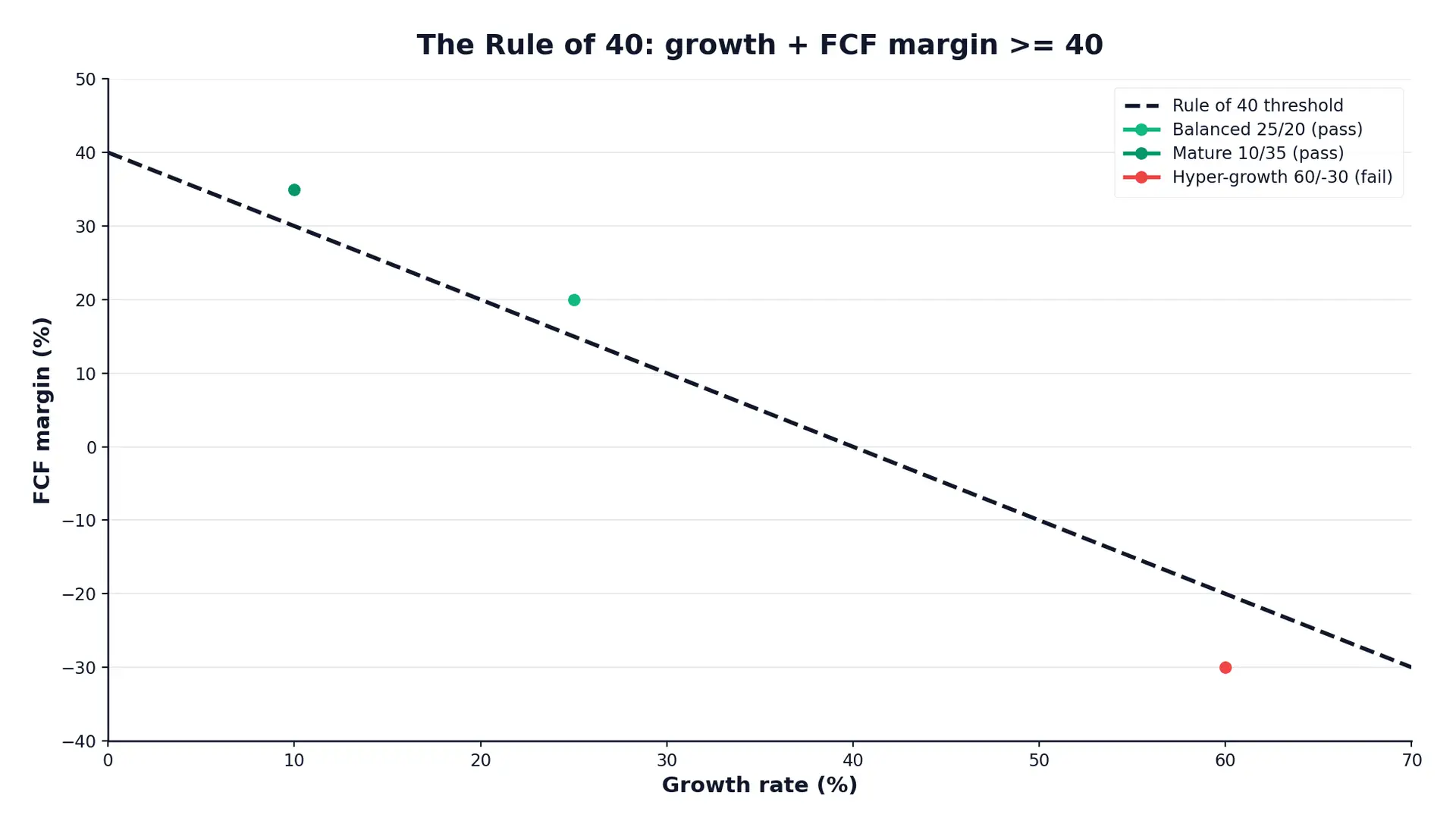
The Rule of 40 is the sum of two numbers: Growth Rate + Profit Margin = Rule of 40 Score.
Formula:
Rule of 40 Score = YoY Revenue Growth Rate (%) + Free Cash Flow Margin (%)
A company growing 30% annually with 10% free cash flow margin has a Rule of 40 score of 40. A company growing 50% with 0% margin also scores 50. A mature company growing 5% with 35% margin also scores 40.
All three are equally “healthy” — but they’re solving completely different problems.
How to Calculate Your Rule of 40 Score
The calculation is straightforward, but the inputs matter.
Step 1: Calculate Growth Rate
Take this year’s ARR (Annual Recurring Revenue) and divide by last year’s ARR. Subtract 1, multiply by 100.
Growth Rate = ((ARR This Year — ARR Last Year) / ARR Last Year) × 100
Example: $8M ARR today, $6M ARR last year = (8–6)/6 × 100 = 33% growth.
Step 2: Calculate Free Cash Flow Margin
This is where most founders stumble. Don’t use EBITDA or operating profit. Use free cash flow — the cash left after you pay your bills and fund growth.
Free Cash Flow Margin = Free Cash Flow / ARR × 100
Free Cash Flow = Operating Cash Flow — Capital Expenditures
If your company generates $8M ARR, spends $6.4M on operating costs, and invests $400K in infrastructure, your free cash flow is $1.2M.
Free Cash Flow Margin = 1.2M / 8M × 100 = 15%
Step 3: Add Growth + Profit
33% growth + 15% margin = Rule of 40 score of 48.
The Decision Framework: Growth vs. Profitability
Here’s what Bessemer Venture Partners and SaaS Capital benchmarking data reveal: the Rule of 40 is not one rule. It’s three different rules depending on where you are.
Scenario 1: Early-Stage Founder ($1M–$5M ARR)
Your Rule of 40 is probably 15–30. That’s normal.
At $2M ARR, if you’re growing 40% but running at −10% free cash flow (burning money), your Rule of 40 is 30. Investors don’t care. They expect this. What they measure is: Is your burn multiple sustainable? and Can you reach $10M ARR before capital runs out?
Your priority: maximize growth rate. Profitability is a distraction. Every 10% you sacrifice for profitability growth costs you 12–18 months of runway — time you can’t afford.
Example calculation:
- ARR: $2M, growing 40%
- Monthly burn: $100K (−10% margin)
- Runway remaining: 20 months
- If you shift to break-even: growth drops to 25% (industry norm when bootstrapped)
- Runway extends to indefinite, but you’ve signaled weakness to investors and sales team
Verdict: Stay high growth. Don’t optimize for Rule of 40. Optimize for growth while managing burn.
Scenario 2: Growth-Stage Founder ($5M–$15M ARR)
Your Rule of 40 should be 35–50. This is your transition zone.
At $8M ARR, SaaS Capital data shows: companies that pivot toward profitability too early (aiming for Rule of 40 = 40 when they could hit 50) often regret it. Growth compounds. Every percentage point of growth at $8M ARR compounds to $15M+ in revenue by year 3.
But here’s the catch: if your Net Revenue Retention is below 90%, your growth is a liability, not an asset.
Net Revenue Retention (NRR) measures how much revenue you keep from existing customers, accounting for churn and expansion.
NRR = (Starting MRR + Expansion MRR — Churn MRR) / Starting MRR
If your NRR is 85%, you’re losing 15% of your installed base annually. A 35% growth rate isn’t real — it’s just customer acquisition outpacing your churn engine.
Example:
- Starting MRR: $600K
- New customer MRR: $300K
- Churned MRR: −$90K
- Expansion MRR: $20K
- Ending MRR: $830K
NRR = (600 + 20 — 90) / 600 = 93%. Your growth is real.
Compare to a company with NRR = 80%:
- Same $300K new customer acquisition
- Churn hits $120K
- Ending MRR: $780K
- Growth looks healthy (30%) but you’re bleeding customers. Investors see this as unsustainable.
Your decision matrix:
| NRR | Rule of 40 Target | Implication |
|---|---|---|
| < 85% | 30 | Churn problem dominates. Fix retention before pursuing growth. |
| 85–95% | 35–45 | Growth is real. Pursue it. Profitability secondary. |
| > 95% | 40–50 | Your fundamentals are strong. Choose: expand or optimize? |
Verdict: Prioritize NRR > 90%, then chase Rule of 40 > 40.
Scenario 3: Scaling Founder ($15M+ ARR)
Your Rule of 40 should be 40–55. Profitability now matters.
At $15M+ ARR, the risk profile flips. Bessemer data shows: companies that remain in “growth at all costs” mode after $15M ARR face investor pressure and acquisition multiples that peak early then decline. A company with Rule of 40 = 60 at $18M ARR (50% growth + 10% margin) often commands a 2–3× valuation multiple vs. the same company with Rule of 40 = 35 (40% growth + −5% margin).
The math: a 2× multiple difference on a $100M exit = $50M lost.
Your decision:
- If Rule of 40 < 35: You’ve optimized for nothing. Fix it.
- If Rule of 40 35–45: You’re in transition. Consider a 3–5% shift toward profitability per year.
- If Rule of 40 > 45: You’re executing well. Continue.
At $20M ARR, shifting 5% of revenue spend from growth to profit (via headcount efficiency, infrastructure optimization, or sales process tightening) often moves Rule of 40 from 38 to 42 — a material shift that attracts acquirers and public market investors.
Verdict: At scale, Rule of 40 ≥ 40 is table stakes for exit readiness.
Real Benchmarking Data: What Top Performers Do
Here’s what the data says. Bessemer Venture Partners publishes annual benchmarks across 200+ private SaaS companies. SaaS Capital and Boston Consulting Group maintain similar databases.
By Company Stage
| Stage | Median Rule of 40 | Median Growth | Median Margin | Notes |
|---|---|---|---|---|
| Series A | 22 | 80–120% | −40 to −20% | Heavy burn is expected. Growth is the only metric. |
| Series B/C | 38 | 40–60% | −5 to +5% | Transition phase. Investors tolerate losses if growth is strong. |
| Series D+ | 48 | 20–35% | +10 to +20% | Approaching scale. Profitability becomes visible. |
| Bootstrapped | 35 | 15–30% | +10 to +25% | Limited capital means early profitability focus. |
By Vertical
| Vertical | Median Rule of 40 | Notes |
|---|---|---|
| Infrastructure/Platform | 45 | High growth, commoditized pricing = tough margins. Must scale. |
| Vertical SaaS | 40 | Higher margins (niche pricing power) offset slower growth. |
| Enterprise Sales | 42 | Long sales cycles = lower growth but strong NRR (>100% common). |
| SMB/Self-Serve | 38 | High churn, lower expansion = profitability harder to achieve. |
The insight: There is no universal Rule of 40 target. Your target depends on your stage, funding model, and vertical.
Why Your Rule of 40 Might Be an Illusion
Three traps. All three appear in real company scenarios.
Trap 1: Growth Without Retention
A founder grows 50% YoY but loses 18% of customers annually. The Rule of 40 score (50% growth + 10% margin = 60) looks healthy. But the business is unsustainable.
Check your NRR. If NRR < 85%, your growth is an acquisition treadmill. Growth compounds only when your base compounds — i.e., when you keep customers.
Fix: Measure NRR before you measure Rule of 40.
Trap 2: Profit Margin Without Free Cash Flow
A founder reports 15% EBITDA margins but burns cash monthly. Why? They’re carrying inventory, funding large customers via net-120 payment terms, or reinvesting capital into infrastructure.
EBITDA profit is not free cash flow. Investors know the difference.
Fix: Calculate free cash flow, not EBITDA. Free cash flow = money that actually leaves your bank account.
Trap 3: One-Time Revenue Events
A founder acquired a customer for a massive upfront annual contract ($500K). It inflates growth rate and makes profitability look better than it is.
Fix: Use ARR (Annual Recurring Revenue), not total bookings. ARR strips out one-time deals and shows real recurring baseline.
The Investor Lens: How Rule of 40 Affects Valuation
This is the real reason the Rule of 40 matters.
Bessemer and SaaS Capital research shows: SaaS companies exiting via acquisition command valuation multiples that correlate strongly with Rule of 40 score.
Exit Multiple by Rule of 40 Score:
| Rule of 40 | Median Exit Multiple | Example at $15M ARR |
|---|---|---|
| < 25 | 3–4× ARR | $45–60M exit |
| 25–35 | 4–6× ARR | $60–90M exit |
| 35–45 | 6–8× ARR | $90–120M exit |
| > 45 | 8–12× ARR | $120–180M exit |
A company with Rule of 40 = 50 at $15M ARR might exit for $150M (10× multiple). The same company with Rule of 40 = 30 might exit for $60M (4× multiple). The Rule of 40 difference created $90M in shareholder value.
Why? Acquirers optimize for predictability and cash generation. A company with Rule of 40 > 40 demonstrates both: it’s growing AND generating profit. Lower-scoring companies signal either profitability problems (high burn) or growth problems (slowing momentum). Acquirers discount for risk.
The Founder Decision Tree
Use this framework to decide where to invest your next engineering and sales dollar.
Start here: What’s your ARR?
If ARR < $5M:
- Default to growth maximization
- Rule of 40 target: 20–30 is fine
- Decision: Every $1 saved on profitability buys you ~1.2 months of runway. Use it.
If ARR $5M–$15M:
- Measure NRR first
- If NRR > 90%: chase growth (Rule of 40 > 40)
- If NRR < 90%: fix retention before growth
- Rule of 40 target: 35–45
If ARR > $15M:
- Profitability becomes a lever for exit value
- A 5% shift toward profitability can move Rule of 40 from 38 → 42
- A 2–3× multiple improvement = $30–50M+ exit value difference
- Rule of 40 target: ≥ 40
Key Metrics to Track Alongside Rule of 40
The Rule of 40 doesn’t stand alone. Layer these in:
Net Revenue Retention (NRR) — Measures whether your revenue compounds. NRR > 100% means customers are expanding; NRR < 85% means you have a churn problem.
Magic Number — (ARR this quarter — ARR last quarter) / Sales & Marketing spend this quarter. Healthy Magic Number > 0.7. Shows efficiency of growth spending.
CAC Payback Period — How many months does it take to recover your customer acquisition cost? Benchmark: < 12 months is excellent, 12–18 months is healthy, > 24 months signals inefficient growth.
Burn Multiple — Cash burn / ARR growth. High burn (5–8×) is expected early-stage; < 2× at scale signals efficiency.
All four together paint the real picture. Rule of 40 is one piece.
How to Improve Your Rule of 40 Score
You have two levers: growth and profitability. Where you pull depends on your stage.
Growth Lever (for companies with Rule of 40 < 30)
Focus on NRR and viral coefficient. If NRR > 90%, your base is compounding. Invest in scaling sales.
- Expand your sales team (hire quota-carrying reps, not coordinators)
- Double down on channels that convert (usually direct sales + mid-market for $5M–$15M ARR SaaS)
- Raise pricing if benchmarking shows your NRR can bear it
Example: Company at $3M ARR, 40% growth, −10% margin (Rule of 40 = 30). Adding 2–3 quota-carrying reps could lift growth to 55%, moving Rule of 40 to 45. Cost: $300–500K/year. Benefit: $1–2M additional ARR within 18 months.
Profitability Lever (for companies with Rule of 40 35–40)
Tighten operations without bleeding momentum.
- Move from hiring to productivity. Use contractors/outsourcing for non-core functions (customer success, financial operations).
- Optimize sales force composition. High-touch enterprise sales can deliver 15–20% margins. Thin land-and-expand models can too.
- Automate or consolidate tooling. A 10–20% reduction in SaaS tool spend (move from 5–7 tools to 3 core tools) can unlock 2–3% margin improvement.
Example: Company at $12M ARR, 35% growth, 5% margin (Rule of 40 = 40). Cutting S&M spend by 10% via hiring efficiency could drop growth to 30% but push margin to 10%. Rule of 40 stays at 40 but unit economics improve dramatically.
Common Rule of 40 Mistakes (And How to Avoid Them)
Mistake 1: Targeting Rule of 40 = 40 at $2M ARR
At early stage, this inverts priorities. You’re sacrificing growth for profitability you don’t need yet.
Fix: Target Rule of 40 = 25–30 at $2M ARR. Rule of 40 = 40 matters at $10M+.
Mistake 2: Using EBITDA Instead of Free Cash Flow
EBITDA is accounting fiction. Free cash flow is reality.
Fix: Calculate free cash flow. It’s messier but accurate.
Mistake 3: Ignoring Churn
A company with 50% growth and 20% annual churn is growing an illusion.
Fix: Make NRR > 90% a prerequisite for any growth targeting.
Mistake 4: Not Segmenting by Cohort
Your blended Rule of 40 hides cohort-level disasters. Cohort acquired 3 years ago might have NRR = 60% while new cohort has NRR = 95%.
Fix: Calculate NRR and Rule of 40 by customer cohort. Fix the older cohorts.
Rule of 40 and Your Exit Strategy
If you’re building to exit, Rule of 40 is a lever for valuation.
A founder at $20M ARR with Rule of 40 = 52 (30% growth + 22% margin) will attract more acquirer interest than a founder at $20M ARR with Rule of 40 = 35 (40% growth + −5% margin).
Why? The first demonstrates profitable growth — acquirers’ favorite profile. The second signals that profitability will be hard to achieve even at scale.
Bottom line: In your last 18 months before exit, prioritize Rule of 40 ≥ 40 and NRR > 95%. Both signal to acquirers that the business is mature, predictable, and capable of sustaining growth without fresh capital.
The Bottom Line
The Rule of 40 is not a score. It’s a decision mechanism.
Early-stage founders should ignore it and chase growth. Growth-stage founders should use it to know when to start balancing. Late-stage founders should use it to optimize exit value.
Most founders get this backwards. They chase Rule of 40 = 40 when they should be chasing Rule of 40 = 25. Or they sacrifice growth for a Rule of 40 target when they should be compounding.
Understand your stage. Measure your NRR. Then decide whether to pull the growth lever or the profitability lever. Your Rule of 40 score will follow.
Related Reading
For deeper context on the metrics that feed Rule of 40:
- LTV/CAC Ratio: The Unit Economics That Matter — Understand whether your growth is actually profitable on a unit basis.
- Annual Recurring Revenue: What It Is and Why Founders Misuse It — Avoid one-time deal inflation that distorts your growth rate.
- Net Revenue Retention: The Metric That Predicts Success — Measure whether your growth compounds or evaporates.
- SaaS Unit Economics: The 6 Metrics That Matter — Build a comprehensive picture beyond Rule of 40.
- Scale a SaaS Business Without Sacrificing Profitability — Operational frameworks for the growth + profit balance.
- Customer Lifetime Value: Calculate It Right — The denominator in unit economics.
- Prerequisites to Scaling: When Growth Fails — When profitability should come first.
- SaaS Profitability Mistakes Founders Make — Avoid common Rule of 40 traps.
Benchmark Data & Sources
Data sourced from:
- Bessemer Venture Partners Cloud Index (2024–2026) — 200+ private SaaS company benchmarks
- SaaS Capital: Growth, Profitability, and the Rule of 40 for Private SaaS Companies
- Boston Consulting Group: Rule of 40 Lessons from Top Performers in Software
All metrics reflect companies at $1M–$100M ARR.