

Most founders treat SaaS sales as a hiring problem. They believe the company is stuck at $5M annual recurring revenue (ARR) because they have not yet hired the right vice president (VP) of sales, and once they do, the curve will resume. That belief is wrong roughly nine times out of ten. The constraint is almost never the next hire. It is the unwritten sales motion, the unscored pipeline, and the unowned renewal — three things that no one rep, however senior, can fix on arrival.
SaaS sales is the disciplined process of turning a stranger into a paying customer who pays again next year. It is not the same as enterprise software sales, and it is not the same as transactional e‑commerce. The recurring-revenue model means that closing the deal is the easier half of the work — the harder half is making the customer successful enough that they renew and expand. Every part of the sales motion has to be designed with that second half in mind.
This guide walks through what SaaS sales actually is, the three pillars of a working SaaS sales engine, the five sales motions and when each one fits, the metrics that actually predict whether you will hit plan, the quota math you need before hiring your next rep, the four mistakes that quietly cap most $5M–$15M ARR companies, and a worked example showing the difference between a leaky pipeline and a tight one.
The reader who gets the most out of the next 25 minutes is a SaaS chief executive officer (CEO) somewhere between $3M and $20M ARR, who is either still founder-selling or trying to scale beyond the first three sales hires, and who has the uneasy sense that the sales team is working hard but the pipeline math no longer adds up. If that is you, this is the page.

1. What SaaS Sales Actually Is
A workable definition: SaaS sales is the repeatable, measurable process of identifying the right buyers, demonstrating quantified value, closing a subscription contract, and engineering the conditions under which that subscription renews and expands.
Three words in that definition do most of the work.
Repeatable. A SaaS sales process that depends on the founder’s intuition, the founder’s network, or the founder’s willingness to fly across the country is not a sales process — it is a personal performance. The test of whether you have a SaaS sales engine is simple: can a new rep, hired today, follow a written motion and produce predictable results within two quarters? If the answer is “only if the founder is on every call,” you do not have a sales engine yet. You have a founder selling.
Measurable. Every stage of the funnel has a quantified definition, a quantified conversion rate to the next stage, and a quantified average sales cycle length. The reader who has been honest with the numbers can predict, within ±10%, what closed-won ARR will be 90 days from today based on the pipeline they have today. The reader who has not been honest — who counts “verbal yes” as commit, or who lets reps self-grade pipeline stage — cannot predict next month, never mind next quarter.
Renews and expands. Closing a $50,000 annual contract value (ACV) deal is worth roughly $400,000 of customer lifetime value (LTV) at a healthy 8‑year SaaS customer lifespan — if the customer renews. A churned closed-won deal is worth roughly $50,000 of revenue and one quarter of CAC payback. The reader who closes hard and engineers expansion has a 5x multiplier over the reader who only closes. Everything in the sales motion below the close should be designed to make the renewal and the expansion easier.
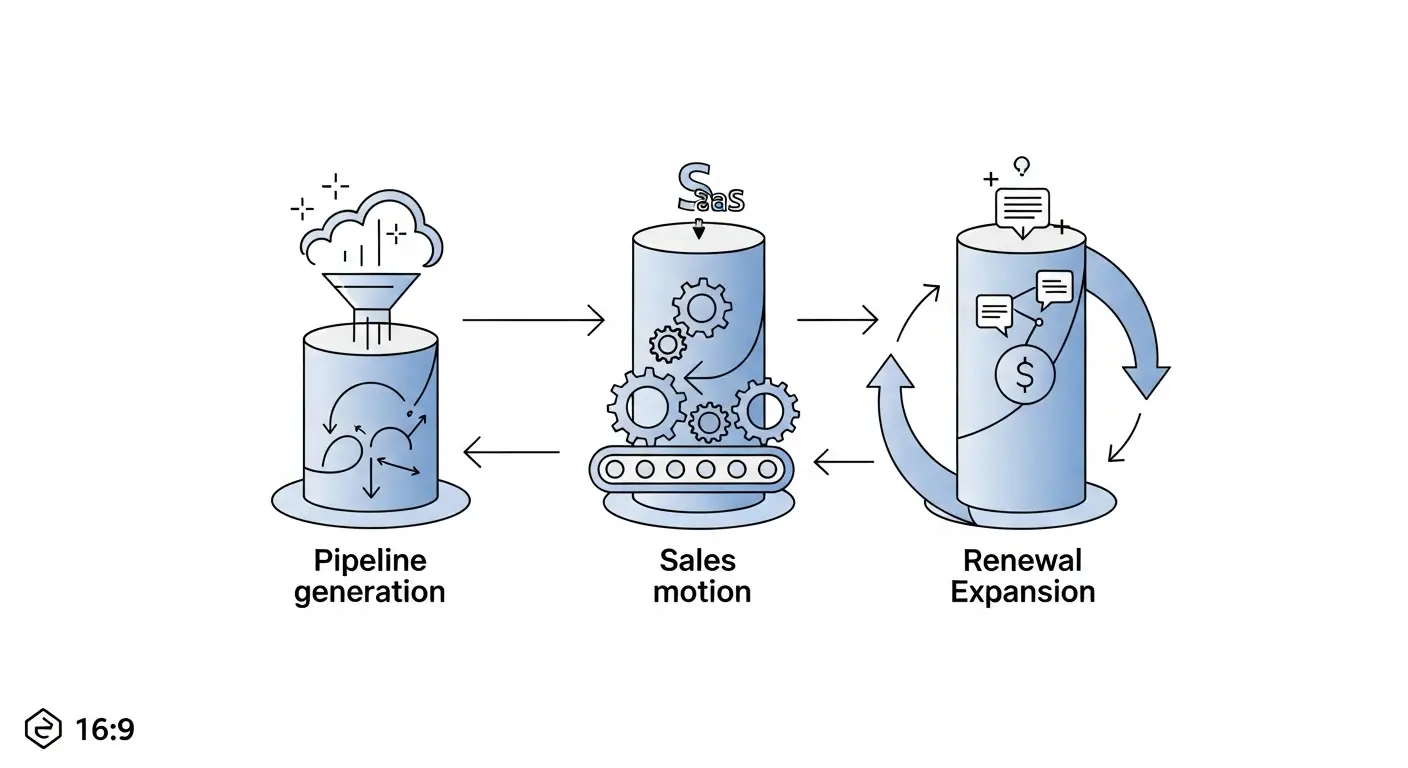
Throughout the rest of this guide, lead refers to a contact who has expressed interest but has not been qualified, opportunity refers to a qualified deal in active pursuit, pipeline refers to the aggregate dollar value of all active opportunities weighted by stage, sales motion refers to the end-to-end process from lead to close, and sales engine refers to the full system — pipeline generation, sales motion, and renewal expansion working together. Most articles on the internet use these terms interchangeably. They are not the same thing.

2. The Three Pillars of a SaaS Sales Engine
A working SaaS sales engine has exactly three pillars. They are independent in the sense that each can be measured separately, but they are interdependent in the sense that a weakness in any one of them caps the entire system.
Pillar 1: Pipeline Generation. The pipeline generation pillar produces qualified opportunities. It is fed by demand generation, outbound prospecting, partnerships, and inbound product-led signals. The metric that matters here is qualified pipeline coverage — the ratio of active pipeline dollars to the quarter’s quota. A healthy SaaS sales org runs 3x to 4x pipeline coverage of its quota. Below 2x and the team will miss; above 5x and the team is generating waste that will rot in the funnel.
Pillar 2: Sales Motion. The sales motion pillar converts opportunities into closed-won contracts. It is composed of the discovery call, the demo, the technical evaluation, the business case, the procurement step, and the close. The metric that matters here is win rate of qualified opportunities — the percentage of opportunities that reach the “qualified” stage and close-won within the average sales cycle. A healthy SaaS sales org wins 20% to 30% of qualified opportunities in its core segment. Below 15% and the qualification criteria are too loose. Above 40% and the team is leaving deals on the table by being too selective about what enters the funnel.
Pillar 3: Renewal and Expansion. The renewal and expansion pillar converts closed-won contracts into multi-year revenue with growing ACV. It is composed of onboarding, customer success engagement, expansion sale motion, and contract renewal. The metric that matters here is net revenue retention (NRR) — the percentage of last year’s recurring revenue that is still on the books this year, including expansion, contraction, and churn. A healthy SaaS sales org runs NRR above 110% in its core segment, with best-in-class companies running 120%+.
The three pillars compound. A company with strong pipeline generation but weak sales motion fills the funnel and then watches deals stall. A company with strong sales motion but weak pipeline generation produces a great closed-won rate on a tiny pipeline and grows slowly. A company with strong pipeline and motion but weak renewal expansion produces flashy new-logo bookings that get eaten by churn 14 months later. The reader who tries to fix only one pillar — and most do — fixes one symptom and never fixes the system.
The diagnostic question to ask first is: which pillar is the rate-limiter? Look at the three metrics above (pipeline coverage, qualified win rate, NRR). The pillar with the worst-relative-to-benchmark score is the one to fix first. Fixing it makes the other two more leveraged; not fixing it makes any other improvement temporary.
3. The Five SaaS Sales Motions and When Each Fits
Most articles list “sales motions” without telling you when each one fits the company’s stage and ACV. Here are the five you actually need to understand, the situation each one fits, and the failure mode each one carries.
| Motion | What It Is | Best Fit by ACV | Failure Mode |
|---|---|---|---|
| Self-serve / PLG | Customer signs up, pays by credit card, sales never touches the deal | $0–$5K ACV | Hits a price ceiling around $5K–$10K; cannot serve enterprise buyers who need procurement involvement |
| Inside sales / SMB | Inside reps qualify inbound leads, run a 1–3 call cycle, close via DocuSign | $5K–$50K ACV | Conversion rates collapse if marketing does not feed high-quality inbound; outbound is hard at this ACV |
| Mid-market full-cycle | One rep owns the deal from lead to close, with light technical support | $50K–$200K ACV | Hardest to scale; reps become bottlenecks; long onboarding ramps |
| Enterprise pod | Account executive (AE), sales engineer (SE), customer success manager (CSM), and an executive sponsor work the deal together | $200K+ ACV | High overhead; only economic if the win rate justifies the team cost; long sales cycles (6–12 months) |
| Channel / partnership | A third-party reseller, integrator, or marketplace closes the deal on your behalf | Varies — typically $25K–$500K | You give up 20%–40% margin; the partner controls the relationship; expansion is harder |
The most common mistake at $5M–$15M ARR is to try to run two motions at once without separating the teams. The same rep tries to close a $10K credit-card deal in the morning and a $250K enterprise deal in the afternoon. The compensation structure does not work, the deal economics do not work, and the rep’s time gets fragmented across deal sizes that need fundamentally different skills.
The correct path is almost always to dominate one motion before adding a second. If you are currently winning at inside sales / SMB and you want to add mid-market full-cycle, run them as two separate teams with separate quotas, separate territories, and separate compensation plans. The transition rep — the one who is asked to do both — is the most common single point of failure in a $5M to $15M sales scaling effort.
A note on product-led growth (PLG): PLG is not a separate motion so much as it is a layer that sits underneath one of the other four motions. A pure self-serve PLG company is on the first row of the table above. A PLG-assisted mid-market company runs PLG at the bottom of the funnel to feed inside sales or mid-market reps with product-qualified leads (PQLs). The reader who thinks of PLG as “the new way to do sales” is missing that PLG works because it changes who feeds the pipeline, not who closes the deal.
4. The Metrics That Actually Predict Whether You Will Hit Plan
There are roughly 40 SaaS sales metrics in common use. The reader who tries to instrument all 40 ends up with a dashboard that nobody reads. The reader who instruments the right 7 has the leading and lagging indicators they need to predict the quarter inside ±10%.
Here are the seven, grouped by which pillar they instrument.
Pipeline Generation Metrics
1. Pipeline coverage ratio. The dollar value of active pipeline divided by the quarter’s quota. Target: 3x to 4x at the start of the quarter; 1.5x to 2x at the start of the closing month. A team that enters the closing month at 1x coverage will miss; a team at 2.5x will hit; a team at 0.8x is in trouble that no amount of end-of-quarter heroics can fix.
2. Lead-to-opportunity conversion rate. The percentage of marketing-qualified leads (MQLs) or sales-qualified leads (SQLs) that become opportunities in the next 30 days. Target: 15% to 25% for inbound; 5% to 10% for outbound. A drop in this number means the lead source has degraded — usually because marketing changed a campaign, or sales relaxed qualification.
Sales Motion Metrics
3. Qualified-opportunity win rate. The percentage of opportunities that reach “qualified” and close-won within the average sales cycle. Target: 20% to 30% in the core segment; trends matter more than the absolute number. A win rate falling from 25% to 18% over two quarters is the leading indicator of a sales motion that has stopped working — usually because the competitive landscape changed, the price went up, or a new persona entered the buyer committee.
4. Average sales cycle length. The median number of days from opportunity creation to close-won. Target: stable. The absolute number depends on ACV (SMB is 30 to 60 days, mid-market 60 to 120 days, enterprise 120 to 270 days). The signal is when the number moves — a lengthening cycle on stable win rate means deals are getting harder to close; a shortening cycle on rising win rate means the message is landing.
5. ACV trend, segmented by motion. The average closed-won contract value, split by sales motion. Target: stable or rising. ACV that is rising is the single best leading indicator that the company is moving upmarket on purpose; ACV that is falling means the team is taking smaller deals to hit number — a short-term win that creates a long-term ramp problem.
Renewal and Expansion Metrics
6. Net revenue retention (NRR). Already defined above. Target: 110%+ in the core segment. NRR is the single most important SaaS sales metric because it is the one number that tells you whether the company is fundamentally growing or fundamentally decaying.
7. Gross revenue retention (GRR). The percentage of last year’s recurring revenue still on the books, excluding expansion. NRR can hide a churn problem if expansion is masking it; GRR cannot. Target: 90%+ in the core segment. A GRR below 80% is a structural product or fit problem, not a sales problem, and no amount of sales motion fix will move it.
These seven are the dashboard. Most $5M–$15M ARR companies that miss plan miss because they instrument the wrong combination of metrics — typically they over-weight lagging indicators (closed-won, bookings) and under-weight leading indicators (pipeline coverage, opportunity win rate). The reader who runs the seven above with discipline will see misses coming 60 to 90 days before they hit.

5. The Quota Math You Need Before Hiring the Next Rep
The single most expensive mistake in scaling SaaS sales is hiring a rep whose quota does not have the math to support it. The reader has seen it: the company hires a rep at $150K base / $300K on-target earnings (OTE), assigns a $1M annual quota, and is surprised 12 months later when the rep has closed $400K, missed plan, and quit.
The math the reader needs to run before signing the offer letter is the quota capacity calculation, and it has four inputs.
Input 1: Average ACV. From the table in Section 3, the inside sales / SMB motion runs $5K–$50K ACV. Let us pick the midpoint at $25K for this example.
Input 2: Win rate of qualified opportunities. From Section 4, the healthy range is 20% to 30%. Let us pick 25% — a reasonable target for a competent inside sales motion in an established market.
Input 3: Sales cycle length. From Section 4, inside sales / SMB runs 30 to 60 days. Let us pick 45 days, which means a rep can run roughly 8 cycles per year (365 ÷ 45).
Input 4: Opportunities a rep can carry simultaneously. Industry benchmark for inside sales is 20 to 30 active opportunities per rep at any given time. Let us pick 25.
Now the math. A rep carrying 25 active opportunities for an average of 45 days handles roughly 25 × (365 / 45) = 203 opportunity-cycles per year. At a 25% win rate, that is 51 closed-won deals per year. At $25K ACV, that is $1.275M in annual bookings — or roughly $1.3M of new ARR per year per rep.
That is the capacity. The quota should be set at 70% to 80% of capacity, so that the top 30% of reps can blow it out and the median rep can reasonably hit. In this case, a $1M quota on $1.3M capacity is the right shape — leaves the rep with room to overachieve, but doesn’t leave $300K of capacity unbooked.
The mistake most founders make is one of three:
- They set quota above capacity. A $1.5M quota on $1.3M capacity means even the best rep cannot hit plan. Reps quit. Morale collapses. The founder concludes “we cannot hire reps” — when the problem is that the quota math never worked.
- They set quota far below capacity. A $500K quota on $1.3M capacity means the rep clocks $600K and goes on cruise control for the rest of the year. The compensation plan is a permission slip for under-performance.
- They never run the math at all. They pick a quota number that “feels right” or matches what they remember from a prior company. Their prior company had different ACV, different win rates, different cycle lengths. None of that math transfers.
The reader who runs the quota capacity calculation before every hire — and recalibrates every 6 months as the inputs move — will not be the founder who is surprised when reps miss.
(A note on the numbers in this section: ACV, win rate, and cycle length benchmarks reflect SaaS market conditions at the time of writing. Both the absolute numbers and the relative ratios move with the broader market. The point is the structure of the calculation — capacity, quota target as % of capacity, and the four inputs — not the absolute dollar figures. Verify current benchmarks for your specific segment before using these numbers in your own planning.)
6. A Worked $5M ARR Example: Leaky Pipeline vs. Tight Pipeline
To make the metrics concrete, run the same $5M ARR SaaS company through two scenarios. Both companies have identical revenue, identical reps, and identical product. The difference is the discipline applied to the seven metrics in Section 4.
Company A — Leaky Pipeline.
- Pipeline coverage at start of quarter: 2.1x
- Lead-to-opportunity conversion: 8% (mixed inbound/outbound, not segmented)
- Qualified opportunity win rate: 17%
- Average sales cycle: 78 days (was 60 days a year ago)
- Average ACV: $22K (was $28K a year ago — sales taking smaller deals to hit number)
- NRR: 96%
- GRR: 84%
Company B — Tight Pipeline.
- Pipeline coverage at start of quarter: 3.4x
- Lead-to-opportunity conversion: 18% (inbound) and 8% (outbound), tracked separately
- Qualified opportunity win rate: 26%
- Average sales cycle: 55 days (stable for four quarters)
- Average ACV: $32K (slowly rising over four quarters)
- NRR: 114%
- GRR: 92%
Both companies enter the year at $5M ARR. Run the math forward 12 months.
Company A — Pipeline coverage at 2.1x is below the 2x mid-quarter danger line by month 2. Win rate at 17% is below the healthy 20% floor. ACV is shrinking. NRR at 96% means the existing base is decaying 4% per year. Net new ARR is approximately $5M × 24% gross new = $1.2M, but minus churn at 16% (1 − 84% GRR) on $5M = $800K, and minus contraction-net-of-expansion to get to NRR 96% = another $200K. Net ARR growth = $1.2M − $800K − $200K = $200K. End-of-year ARR = $5.2M. The company looks like it grew 4%. The board is unhappy. The founder thinks the problem is the VP of sales.
Company B — Pipeline coverage at 3.4x feeds a healthy funnel. Win rate at 26% is in the healthy band. ACV is rising, which usually means the team is winning bigger deals against stronger competition. NRR at 114% means the existing base is growing 14% per year before any new logos. Net new ARR is approximately $5M × 30% gross new = $1.5M, minus churn at 8% on $5M = $400K, plus net expansion to get to NRR 114% = $700K. Net ARR growth = $1.5M − $400K + $700K = $1.8M. End-of-year ARR = $6.8M. The company grew 36%. The board is delighted. The founder takes the VP of sales out to dinner.
The two companies started the year identical. They differ by 9x in net ARR growth. The difference is not the rep talent, the product, or the market. The difference is whether the seven metrics in Section 4 are being run with discipline.
The lesson is uncomfortable. Most $5M–$15M ARR companies look like Company A and tell themselves a story about why their growth is slower than they expected. Some combination of “the market is tough,” “we are still ramping the new VP,” and “next quarter will be better” gets repeated for four quarters in a row. The fix is not a hire. The fix is the seven metrics and the discipline of running the calculation in Section 5 every time a rep is added.
7. The Four Mistakes That Cap Most SaaS Sales Orgs at $10M
The reader who has read this far knows enough to diagnose their own org. To make the failure modes concrete, here are the four mistakes that are most common at $5M–$15M ARR, ranked by how often they appear and how much damage they do.
Mistake 1: Hiring a VP of Sales Before the Motion Is Written
Most founders hire a VP of sales somewhere between $3M and $8M ARR with the expectation that the VP will “build the sales motion.” That expectation is almost always wrong. A great VP of sales scales a working motion; they do not invent one from scratch. The motion has to be written, working, and producing at least two reps’ worth of evidence before the VP is hired, or the VP will fail — not because they are bad at their job, but because the role they were hired into does not exist yet.
The fix is to founder-sell, with a written motion, until two reps that are not the founder can hit plan. Then hire the VP to scale from 2 reps to 10. The order matters. Skipping the founder-sell phase to “save time” costs roughly 18 months and the comp package of one failed VP — usually $500K to $800K all-in.
Mistake 2: Compensating Reps on Bookings Without Tying to Renewal
A rep paid 100% on closed-won bookings has every incentive to close a deal that will churn in 13 months. The deal is closed, the commission is paid, and the rep is on to the next prospect. The customer churns, the GRR number drops, and 18 months later the company has a retention problem that the VP of sales blames on customer success.
The fix is to tie 20% to 30% of variable compensation to a measure of customer health 6 to 12 months post-close — typically gross dollar retention, NPS at month 6, or a “fit score” measured by the CSM. The reps who are good at closing the wrong customer will quit; the reps who are good at closing the right customer will be paid more. This is the desired outcome.
Mistake 3: Letting Reps Self-Grade Pipeline Stage
A pipeline that is self-graded by reps is a pipeline that is wrong. Reps optimistically promote deals from “qualified” to “commit” because the commit number gets attention. The forecasting math then becomes meaningless — the CFO sees $X in commit, multiplies by the historical commit-to-close rate, and the number comes in 40% light because the underlying commits were not actually commits.
The fix is to define stage-gate criteria in writing, with two-party agreement on stage moves. “Qualified” requires a documented business case, a champion identified by name, and a signed mutual evaluation plan. “Commit” requires verbal yes from the buyer, procurement engaged, and a signature target date. Reps cannot promote a deal between stages unilaterally — the manager has to confirm the criteria are met.
Mistake 4: Treating CS as Post-Sale Support Instead of Pre-Renewal Sales
Customer success in most $5M–$15M ARR companies is treated as a help desk — a place where customers go when something is broken. That is necessary but not sufficient. CS is also the renewal and expansion arm of the sales motion, and the reader who runs it as a cost center instead of a revenue function is leaving the entire NRR upside on the table.
The fix is to measure CS on NRR, GRR, and expansion ACV — the same metrics the sales team is measured on, applied to the installed base. Give CSMs a quota for expansion, a renewal target with teeth, and the authority to negotiate within a price band. The CSM who can negotiate is worth 3x the CSM who can only escalate. This is the single highest-leverage org-design change a $5M–$15M company can make.
8. Building Toward Repeatability: The Three Documents You Need
The reader who is ready to act has three documents to build, in order. None of these are hard to write. All three are missing in roughly 80% of $5M–$15M ARR sales orgs.
Document 1: The Ideal Customer Profile (ICP). A written, falsifiable definition of the customer segment you will sell to. Industry, company size, role, technology stack, trigger event. The ICP is the contract between marketing, sales, and product about who counts as a real prospect. Without it, marketing chases the wrong leads, sales chases the wrong opportunities, and product builds the wrong features. The ICP should be one page. It should be reviewed every 6 months. It should have a list of what an ICP is not — the segments you have decided to walk away from.
Document 2: The Sales Motion Playbook. A written, stage-by-stage description of the sales process, with criteria for each stage gate, expected duration, owned roles, required artifacts (mutual evaluation plan, business case template, technical evaluation criteria, procurement readiness checklist), and the conversion rate target between each stage. The playbook is what the new rep reads on day one and is expected to follow on day 90. The reader who does not have a playbook does not have a repeatable sales process — they have a tradition.
Document 3: The Quota Model. A written, by-rep quota assignment with the capacity math from Section 5 supporting it. Inputs (ACV, win rate, cycle length, opportunities per rep), the capacity calculation, the quota as a percentage of capacity, the on-target earnings (OTE), and the trigger that recalibrates the model. The quota model is what gets shown to the rep at the offer stage. The reader who hires reps without one is gambling.
These three documents are the difference between a sales org that scales and a sales org that stalls. They are not glamorous. They are also not optional.
9. Frequently Asked Questions
At what ARR should I hire my first sales rep? In most B2B SaaS, the answer is $1M to $2M ARR — and only after the founder has closed at least 10 customers personally with a written motion that the rep can be handed. Hiring earlier wastes the rep’s ramp and tells the founder nothing about whether the motion works without them.
What is a healthy quota attainment rate across the team? 60% to 80% of reps should be hitting at least 80% of quota. If 100% of reps are hitting 100% of quota, the quotas are too low. If less than 40% of reps are hitting, the quotas are too high or the inputs to the capacity calculation are wrong.
How do I know when to move from inside sales to mid-market full-cycle? Track ACV by deal. When more than 30% of closed-won deals are above $50K and the procurement step is taking longer than the rest of the cycle, the inside sales motion is no longer the right fit for the upper end of the funnel. Stand up a separate mid-market team with separate compensation; do not retrofit the inside sales reps.
What’s the right ratio of AEs to SDRs (sales development representatives)? For inside sales / SMB, 1:1 is typical. For mid-market and enterprise, 2:1 or 3:1 AE-to-SDR is more common because each AE works fewer, larger deals and the SDR fuels more of the top-of-funnel work per AE. The ratio should be driven by the quota capacity math, not by what other companies do.
How much should I spend on sales as a percentage of new ARR? A common benchmark is the LTV/CAC ratio above 3 and CAC payback period under 18 months. In dollar terms, this typically lands at sales-and-marketing spend of 35% to 60% of new ARR in growth-stage SaaS, depending on segment. Higher spend is fine if LTV/CAC and payback support it; lower spend is fine only if the pipeline coverage and win rate metrics are above benchmark.
Should I use a SaaS-specific CRM or build my own pipeline tracking? Use the CRM. The discipline is not in the tool — it is in the stage-gate criteria, the win-rate definitions, and the manager review cadence. A great CRM cannot save a bad sales process; a great sales process can run on any CRM, including a spreadsheet. The CRM you pick matters far less than whether the team uses it consistently.
10. The Next Step
The reader who has read this far knows what a SaaS sales engine looks like, knows the seven metrics that predict the quarter, knows the quota math that supports the next hire, and knows the four mistakes that cap most $5M–$15M ARR companies. The remaining question is what to do on Monday.
The answer is to run the audit. Take the seven metrics from Section 4 and pull the actual numbers from the CRM for the trailing four quarters. Place them in a table next to the benchmark ranges. The pillar with the worst-relative-to-benchmark score is the rate-limiter. Fix that pillar first. Do not try to fix all three at once — the team cannot absorb three simultaneous initiatives, and the diagnostic value of the audit gets lost if everything moves at the same time.
If the rate-limiter is pipeline generation, the fix is usually a combination of demand-gen investment and a tighter ICP. If the rate-limiter is sales motion, the fix is usually stage-gate criteria and a written playbook. If the rate-limiter is renewal and expansion, the fix is usually moving customer success from cost-center to revenue function with a quota.
In every case, the discipline of running the calculation, writing the documents, and tying compensation to the right metrics is what separates the SaaS sales org that compounds from the one that stalls. The reader who builds this discipline at $5M ARR has a 3x to 5x advantage by $15M ARR. The reader who does not is the founder who will be having the same conversation about “why aren’t we growing faster” in two years.
Most founders treat SaaS sales as a hiring problem. It isn’t. It’s a systems problem — and the system can be built. The seven metrics, the three documents, the quota math, and the four-mistake checklist above are the system. Start the audit on Monday.