

Most founders treat SaaS pricing strategy as a one-time decision they made when the first paying customer showed up, and they have not seriously revisited it since. That is the single most expensive habit in software. A 1% lift in price, all else equal, drops more revenue to the bottom line than a 1% gain in unit volume, a 1% reduction in churn, or a 1% improvement in customer acquisition cost (CAC) — and unlike those three, it costs nothing to ship.
A SaaS pricing strategy is the deliberate decision about what you sell, who pays, how much they pay, what unit they pay against, and how that price changes as their usage grows. The Warren Buffett test is simple — can you raise prices without losing customers? If yes, you have pricing power, and that pricing power is one of the easiest levers to expand margin without acquiring a single new customer. Most founders are pricing well below what the market would bear because they have never tested it.
This guide walks through what a SaaS pricing strategy actually is, the seven pricing strategies and the five packaging archetypes you need to understand, the three-step framework for picking your value metric, how to run a defensible price test, the five mistakes that quietly cap your annual recurring revenue (ARR), and a fully worked $5M ARR example showing the math from list price to net revenue retention (NRR) to enterprise value.
The reader who gets the most out of the next 25 minutes is a SaaS chief executive officer (CEO) somewhere between $3M and $20M ARR, who set pricing once at launch and has not touched it since, and who suspects — correctly — that the company is leaving real money on the table. If that is you, this is the page.

1. What a SaaS Pricing Strategy Actually Is
A SaaS pricing strategy is a written, falsifiable answer to five questions: what you charge for, who pays, how much they pay, what unit that price is denominated in, and how the price scales as the customer’s usage of your product grows.
Three words in that sentence do the work.
Written. A pricing strategy that lives in the founder’s head is not a strategy — it is a habit. Every sales rep, every customer success manager, and every prospect who lands on your pricing page will interpret the same conversation differently if the strategy is not written down. The discipline of writing it forces you to name your value metric, defend your price points, and decide what you will and will not negotiate. The act of writing it usually surfaces three to five contradictions you did not know were there.
Falsifiable. A real pricing strategy names conditions that could prove it wrong. “We charge for value” is not falsifiable. “We charge $50 per seat per month because our buyer is the head of sales at a $20M–$200M-revenue B2B company, and our research shows they expect to spend 1% to 3% of a rep’s fully-loaded cost on sales-tech tools” is falsifiable — you can test it, you can be wrong about it, and you can update it when the data comes in.
Scales. The price has to grow with the customer’s success. If a $50-per-seat tool serves an organization with three reps the same way it serves an organization with 300 reps, you have invented one of the most common ways to leave revenue on the table. The pricing strategy says, in advance, how the customer pays you more as they get more value — without you having to renegotiate every contract.
Throughout the rest of this guide, price refers to the dollar amount per unit, pricing model refers to the underlying structure (per seat, per usage, tiered, flat-rate, hybrid), packaging refers to which features go in which tier, and pricing strategy is the umbrella concept that encompasses all three plus the why-it-works thesis behind them. Most articles on the internet use these terms interchangeably. They are not the same thing.

2. Why Pricing Is the Highest-Leverage Lever in SaaS
To see why pricing is the most important number you control, run the math on a $5M ARR SaaS company with 80% gross margin, 5% gross annual revenue churn, and 25% net new revenue growth.
A 1% improvement in price improves ARR by $50,000 with no incremental cost. The full $50,000 falls to gross profit (margin is already on the existing cost structure), so gross profit rises by $50,000. At a 5x ARR multiple — the rough benchmark for SaaS exit values in the $5M–$15M ARR range at the time of writing — that single 1% price increase adds $250,000 of enterprise value.
A 1% improvement in volume also improves ARR by $50,000, but it costs money to win that customer. At a $5,000 blended CAC and an average $15,000 annual contract value (ACV), winning the equivalent of $50,000 of new ARR requires roughly 3.3 new customers, which costs $16,500 in CAC. So gross profit only rises by $50,000 × 80% − $16,500 = $23,500. The 1% price lift produces more than twice the gross-profit impact of an identical 1% volume lift.
A 1% improvement in churn is meaningful but slow. Moving gross annual revenue churn from 5% to 4% on a $5M ARR base preserves $50,000 of recurring revenue per year. The compounding lifetime impact over a 5‑year horizon is roughly $250,000 of preserved ARR — substantial, but it shows up over years rather than months, and you cannot price-test churn the way you can price-test price.
The lesson is not “ignore volume and churn.” The lesson is that of the levers you can pull on Monday morning, pricing is the fastest one to cash and the one you control most directly. Most founders never pull it. Some illustrative figures: data that the price-optimization firm Price Intelligently has shared shows companies spending less than 10% of the time they spend on customer acquisition. The math says you should be spending roughly the same amount.
(A note on the numbers in this section: the multiples and benchmarks above reflect SaaS market conditions at the time of writing. Comparable figures move with the broader market, and the point is the relative impact of pricing versus volume versus churn — not the absolute dollar amounts. Verify the current valuation multiples and benchmark sources before using these numbers in your own board materials.)
3. The Seven SaaS Pricing Strategies
Most articles list “pricing strategies” without telling you when each one fits. Here are the seven you actually need to understand, the situation each one fits, and the failure mode each one carries.
| Strategy | What It Is | Best Fit | Failure Mode |
|---|---|---|---|
| Cost-plus | Compute your unit cost, add a target margin | Mature commodity software with predictable margins | Ignores willingness-to-pay; almost always under-prices in SaaS |
| Competitor-based | Look at what comparable products charge; price at, above, or below | Crowded category with a clear price ceiling | Anchors you to competitors' mistakes; ignores your unique value |
| Value-based | Quantify the dollar value the customer gets from the product; capture 10–20% of it | Buyers with measurable ROI (sales tools, marketing tools, productivity tools) | Hard to measure value; often degenerates into competitor-based when sales hits a wall |
| Penetration | Launch at a deliberately low price to win market share, then raise | Markets where lock-in is high and switching cost grows over time | Hard to raise prices later; "this is the price we agreed on" becomes a permanent ceiling |
| Price-skimming | Launch at a deliberately high price to skim early adopters, then lower | Innovative products with limited initial competition | Lowers later, which trains the market to wait for discounts |
| Freemium | Free tier with limited features; paid tier removes the limit | Bottom-up adoption motions; consumer-grade B2B (e.g., communication tools) | Free users rarely convert at the rate founders expect; freemium becomes a cost center |
| Hybrid / dynamic | Combine two or more of the above; vary by segment, geography, or contract length | Mid-market and enterprise where one price cannot serve every buyer | Complexity confuses prospects; sales team resists; pricing page becomes unreadable |
The most common strategy at $5M–$15M ARR is value-based pricing with competitor sanity checks. The value-based logic gets you to a defensible price for each buyer segment; the competitor sanity check keeps you from leaving so much money on the table that buyers question why you are so cheap, or from pricing so high that you cannot have a credible conversation in a competitive deal.
A genuinely value-based price starts with a customer outcome — the dollar value your product creates — and works backward to a price that captures 10% to 20% of that value. The customer’s return on investment (ROI) is 5x to 10x, which is enough to keep them happy and to make the renewal trivial; you capture enough to fund product, sales, and a healthy margin.
The most common mistake in this segment is to default to cost-plus pricing without realizing it. The founder looks at hosting costs, support costs, and the dev team’s salaries, divides by the number of customers, and adds a “margin.” The result is almost always 30% to 60% below what the market would bear, because the founder is anchoring on what the product costs to make, not on what the product is worth to the buyer. Buyers do not care what the product cost you to make. Buyers care what the product is worth to them.

4. The Five Packaging Archetypes
Strategy decides what kind of price you charge. Packaging decides what the customer gets at each price tier. These are two different decisions, and most founders conflate them.
Five packaging archetypes account for roughly 95% of the SaaS market.
- Flat-rate. One product. One price. No tiers. Easy to communicate and easy to administer, but it cannot expand revenue as a customer grows. Best for very simple products with a narrow audience (e.g., a niche scheduling tool at $29 per month). At $5M ARR and above, flat-rate is almost always wrong — you are charging the 200-employee customer the same as the 5‑employee customer.
- Per-seat (per-user). Price scales with the number of users in the buyer’s organization. Easy to forecast, easy to expand, easy to administer. The dominant model for tools where each seat represents a unit of productive work — sales-tech, customer-relationship management (CRM), human-resources information systems (HRIS), project management. The failure mode is that buyers ration seats — they share logins to avoid paying for more users, and your usage data goes sideways.
- Per-usage (consumption-based). Price scales with how much the customer actually uses the product — application programming interface (API) calls, transactions, gigabytes (GB) of storage, kilowatt-hours (kWh) of compute. The dominant model in developer-tools and infrastructure SaaS, and it has spread to data-warehouse and observability tools. The advantage is alignment — customers only pay for what they use, so they are slow to churn and quick to expand. The failure mode is revenue volatility — when the customer has a slow month, you have a slow month, and your ARR forecast becomes a usage forecast.
- Tiered (good/better/best). Three or four packages, each at a different price point, each containing a different bundle of features. The buyer self-selects into the tier that matches their needs. The dominant model in horizontal B2B SaaS. The advantage is that it gives the salesperson a structured conversation — “you need feature X, which lives in our Pro tier.” The failure mode is that the middle tier becomes the only tier anyone buys, and your high-tier features never get a real test.
- Hybrid (platform + add-ons + usage). A base subscription that includes the core platform, plus add-on modules for additional capabilities, plus a usage component for high-volume features. The dominant model at the high end of B2B SaaS — Salesforce, Workday, ServiceNow. The advantage is that you can expand revenue along three independent axes (more users, more modules, more usage). The failure mode is discount-stacking complexity — sales reps offer discounts on the base, then on the modules, then on the usage rate, and the actual realized price is impossible to forecast.
The right packaging archetype depends on three things: the shape of your customer’s usage (does it grow linearly with users, or with transactions, or with neither?), the complexity of your buyer (a self-serve $50/month tool cannot afford hybrid pricing; a $500K enterprise deal cannot afford flat-rate), and the maturity of your product (early-stage products should start simple — flat-rate or single-tier per-seat — because complexity is a tax on a product whose value proposition is still being figured out).
5. Choosing Your Value Metric
The single most important decision inside a SaaS pricing strategy is the value metric — the unit you actually charge against. Get the value metric right and the pricing strategy almost writes itself. Get it wrong and every other decision compounds the mistake.
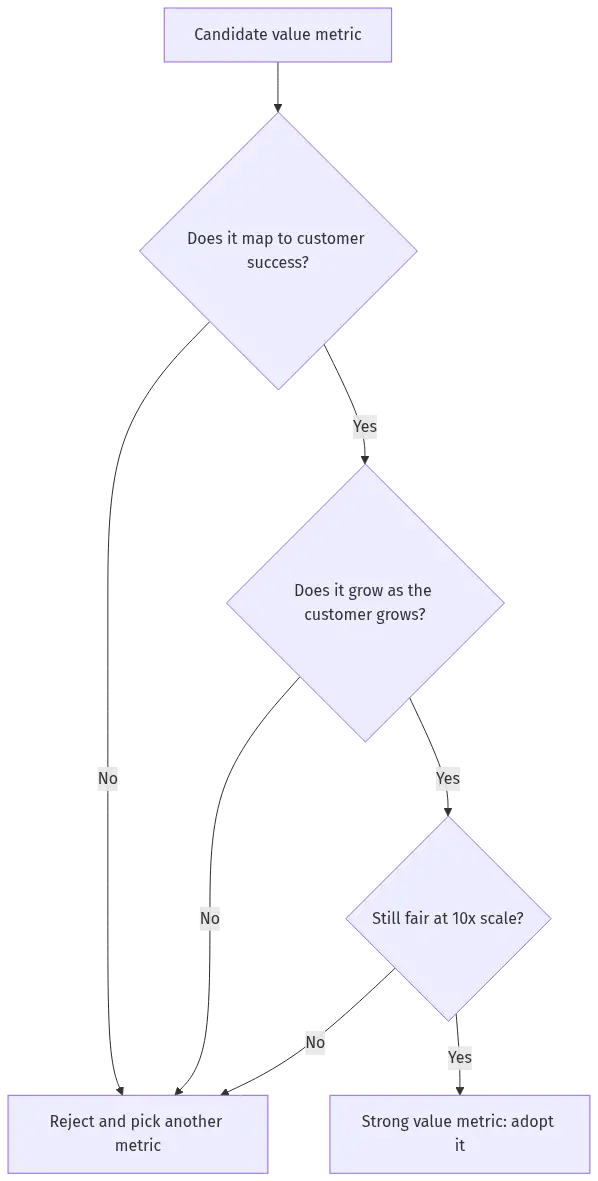
A value metric has three properties: it aligns with how the customer perceives value (the bigger the unit, the more value they got), it scales with the customer’s growth (as the customer grows, the unit count grows), and it is measurable (the customer can audit it, and you can bill against it without ambiguity).
Three examples, in increasing order of sophistication.
Per-seat for a sales tool. The customer perceives value as “my sales team got more productive.” The unit that scales with the customer’s growth is “number of salespeople.” The metric is measurable — every salesperson has a login. The per-seat metric aligns with value perception, scales with growth, and is measurable. It is the right metric for most sales tools.
Per-transaction for a payments tool. The customer perceives value as “I processed more revenue through this tool.” The unit that scales with the customer’s growth is “transaction volume.” The metric is measurable — every transaction is logged. Per-transaction (often expressed as a percentage of payment volume) is the right metric for payments.
Per-message for a customer-communication tool. This is where the choice gets interesting. The customer perceives value as “I sent more messages to my customers and reached more of them.” The unit that scales with the customer’s growth is “messages sent.” But early in the product’s life, customers are sensitive to the unit cost of each message, so the founder might choose a tiered model (5,000 messages at one price, 50,000 at another) rather than a strict per-message model. The right answer here depends on whether your customer base is mostly small-volume (tiered makes sense) or mostly high-volume (per-message scales better).
The three-step framework for picking your value metric:
- Pick the unit your customer counts when they talk about their own success. If your buyer’s success is measured in “number of pipeline opportunities created,” your value metric should be tied to pipeline. If their success is measured in “number of API requests served,” your value metric should be tied to API calls. The customer’s success metric is your value metric.
- Verify the unit grows with the customer’s business. A value metric that does not grow with the customer’s business gives you a flat ARR curve from each customer — no expansion revenue, no net revenue retention above 100%. Avoid it. A common failure: pricing a content tool per “user account” when the actual value is delivered to all the user’s customers via the content. The user account count does not grow with the business; the content consumption does.
- Stress-test the unit at 10x scale. If a customer is paying you $10,000 a year today, ask yourself: would they comfortably pay $100,000 a year ten years from now if their business grew 10x? If yes, the value metric is healthy. If no — if the unit count caps out, or if the customer would push back at $100K because the per-unit cost is too visible — you have a value-metric problem.
6. How to Run a Defensible Price Test
Most founders never test pricing because they assume the test requires segmenting their entire user base into a control group and a variant — which feels risky and slow. A defensible price test does not require that. A defensible price test requires three things: a specific hypothesis, a clearly-defined audience, and a measurable outcome.
The simplest defensible test, which any $5M–$15M ARR SaaS company can run in 90 days:
Step 1 — Pick a single customer segment. Not your whole customer base. One segment, defined by company size or industry, where you have at least 20 customers currently and at least 5 new deals coming through the pipeline in the next 60 days.
Step 2 — Pick a single hypothesis. “If we raise list price for new mid-market customers from $X to $1.2X, the close rate will drop by no more than 10%, and gross profit per deal will rise by at least 12%.” That is a falsifiable hypothesis — you can be right or wrong, and you will know in 90 days.
Step 3 — Move the list price for new deals only. Existing customers stay on their current price. New deals coming through the pipeline see the new price. This isolates the test, prevents existing-customer churn from contaminating the result, and gives you a clean read on willingness-to-pay.
Step 4 — Measure two numbers, not ten. Close rate (deals closed-won / deals at proposal) and gross profit per deal. If gross profit per deal rises and close rate stays within 10% of baseline, the test passes — the new price is your new list price. If close rate craters, the test fails — go back to the old price, learn what the buyer pushed back on, and try a different angle (different packaging, different value metric, different segment).
The pattern most founders are afraid of is “I will lose 30% of my deals if I raise prices by 10%.” The data, both ours and the industry’s, says this almost never happens for software priced at or below the 50th percentile of comparable tools. The reason is that buyers are price-sensitive at the moment of decision, but they are far more sensitive to the value proposition and the alternative. A 10% list-price increase rarely flips a “yes” into a “no” if the buyer was a “yes” at the original price.
A worked example. Say you currently sell a mid-market product at a $24,000 ACV. Close rate is 25%. You raise list price to $28,000 (a 16.7% increase). Three things can happen:
- Close rate stays at 25%. Out of 100 sales attempts, you close 25 deals at the new ACV. Gross profit per closed deal rises by $4,000 × 80% = $3,200, and 25 such deals add up to $80,000 in additional gross profit on the same 100 attempts. Test passes.
- Close rate drops to 22% (a 12% drop). Revenue from 100 attempts: previously $24,000 × 25 = $600,000. Now: $28,000 × 22 = $616,000. Gross profit goes from $480,000 to $492,800 — a $12,800 lift. Test passes — but you should investigate the 3‑percentage-point close-rate drop.
- Close rate drops to 18% (a 28% drop). Revenue from 100 attempts: previously $600,000. Now: $28,000 × 18 = $504,000. Gross profit goes from $480,000 to $403,200 — a $76,800 drop. Test fails. Go back to $24,000 and try a different angle.
The whole point of running this test is to find out which of those three worlds you live in — and most founders simply assume they live in the third world without testing.

7. The Five Mistakes That Quietly Cap Your ARR
Most ARR caps at $5M–$15M are not product problems or sales problems. They are pricing problems the company has not noticed because the symptoms look like other problems.
- Pricing once, at launch, and never revisiting. This is the most expensive mistake in SaaS. The pricing you set when you had three customers and a half-built product is almost never the right pricing once you have 200 customers and a mature product. Re-evaluate annually. The Buffett pricing-power test — “could I raise prices 10% without losing meaningful share?” — should be on the board meeting agenda once a year.
- Picking a value metric that does not scale. Every customer pays you the same fixed amount, and your net revenue retention (NRR) sits at 95% to 98% because there is no expansion mechanism. If your NRR is below 105%, look at the value metric first — not the customer success motion. The customer success team can only expand what the pricing model allows them to expand. A flat-rate product capped at one price cannot deliver 120% NRR no matter how good the customer success team is.
- Discounting without a deal desk. Every salesperson has discretion to discount. There is no discount policy, no minimum price, no approval workflow. The result is that the effective realized price is 30% to 50% below list, and you cannot tell because the salespeople do not report it cleanly. The fix is a deal desk — a single person or small team that has to approve any discount above 10%, and that tracks the realized price of every deal.
- Letting the lowest tier define the company. Your free tier or your $29/month tier exists to capture small customers and bottom-up adoption. But if 70% of your customer count sits in the lowest tier, your sales motion will start to optimize for that tier, your product roadmap will start to optimize for that tier, and your marketing will start to optimize for that tier. The fix is to be explicit about which tier is the revenue tier and which tier is the acquisition tier. Most of your revenue should come from the revenue tier; most of your customer count is fine to come from the acquisition tier.
- Pricing in the same currency, the same way, everywhere. A $50/seat price that works in San Francisco does not work in Bangalore, Buenos Aires, or São Paulo. Either local pricing (different currencies, different price points per region) or a deliberate decision to be a “U.S.-only product.” The mistake is the in-between — pricing in dollars globally and watching your international close rate quietly stay at 30% of U.S. close rate without understanding why.
If three or more of these mistakes sound familiar, you are not undersized in the market — you are underpriced in the customers you already have. The right next step is a 90-day pricing project (see SaaS unit economics for the underlying math you will need to defend your new prices), not a fundraising round to add more sales reps to chase volume that is, on a per-deal basis, less profitable than it should be.
8. A Worked $5M ARR Example: From Pricing Decision to Enterprise Value
Walk through the math on a hypothetical $5M ARR SaaS company — call it Northwind — to see what a deliberate pricing change does to enterprise value.
Starting state.
- ARR: $5,000,000
- Customers: 250
- Average annual contract value (ACV): $20,000
- Gross margin: 80%
- Gross revenue churn: 8% per year (net of upsell — call this gross logo + revenue churn, simplified for the example)
- Net new revenue growth: 30% per year
- Operating expenses (OpEx): $4,500,000 per year
- Operating margin: $5M × 80% − $4.5M = −$500,000 (slightly negative)
- ARR multiple (assumed for valuation): 5x → enterprise value ≈ $25,000,000
Pricing decisions and projected outcomes.
Northwind makes three pricing moves over a 12-month period:
- List-price increase for new deals from $20,000 to $24,000 ACV (a 20% increase). Based on a price test in their core mid-market segment, close rate drops from 25% to 23% — an 8% relative drop in close rate, well within the 10% guardrail.
- Introduction of a usage-based add-on at 15% of base subscription, which 40% of customers adopt within 12 months.
- Annual contractual price escalator of 5% per year for existing customers, applied at renewal.
The math, walking it forward to month 12. Two scenarios — one without the pricing changes (baseline) and one with all three pricing changes applied — both starting from the same $5M ARR base and assuming the same pipeline volume:
| Driver | Before (Year 0) | After 12 Months — No Pricing Change | After 12 Months — With Pricing Changes |
|---|---|---|---|
| Average new-deal ACV | $20,000 | $20,000 | $24,000 |
| Close rate | 25% | 25% | 23% |
| New ARR added (gross) | — | ~$1,650,000 | ~$1,820,000 |
| Usage add-on revenue | $0 | $0 | ~$300,000 |
| Renewal escalator on existing base | $0 | $0 | ~$230,000 |
| Gross churn (8% on base) | — | −$400,000 | −$400,000 |
| Total ARR | $5,000,000 | ~$6,250,000 | ~$6,950,000 |
| Gross profit (80%) | $4,000,000 | ~$5,000,000 | ~$5,560,000 |
| OpEx | $4,500,000 | $4,500,000 | $4,700,000 |
| Operating margin | −$500,000 | +$500,000 | +$860,000 |
| Enterprise value (at 5x ARR) | $25M | ~$31.25M | ~$34.75M |
The pricing decisions add ~$700,000 of incremental ARR ($6.95M vs $6.25M baseline) on top of the underlying growth, which translates to ~$3.5M of incremental enterprise value at a 5x multiple. The remaining $6.25M of enterprise-value lift would have happened anyway from the underlying 30% growth.
(The decomposition is approximate — the price increase compounds with the volume growth, and the usage add-on compounds with the underlying customer growth. The numbers also exclude the cost of running the pricing project itself, which the OpEx line absorbs.)
The point is not the exact dollar figure. The point is that three pricing decisions executed inside a 12-month window can add 50%+ of additional enterprise-value lift on top of underlying volume growth. No new sales rep was hired. No new product was shipped. No new market was entered. The company simply decided that what it was already selling was worth more than what it had been charging.
That is the right mental model for SaaS pricing strategy. The product you already sell is almost certainly worth more than you are charging. The strategy is the discipline to find out by how much, and to capture it before someone else does.

9. Pricing for Different Stages of ARR
The right pricing strategy at $1M ARR is not the right pricing strategy at $20M ARR. Three stages are worth naming explicitly.
$0–$2M ARR — Survive and Learn. Pricing at this stage is more about learning the value metric than about optimizing the price. Pick a simple model (flat-rate or single-tier per-seat), set a price you can defend in a conversation, and use every sales conversation as a data point about willingness-to-pay. Resist the temptation to discount your way to revenue — every discount is a data point that teaches you the wrong willingness-to-pay number. If a deal won’t close at list, lose the deal and learn from it.
$2M–$10M ARR — Productize and Tier. This is the stage where most companies should introduce real tiers, real packaging, and a real value metric. The product is mature enough that the value proposition is repeatable; the customer base is large enough that you can see segments emerging; the sales team is large enough that you cannot just rely on the founder to close every deal. Run your first formal price test in this range — the company is large enough that a 10% to 20% price increase will move the financials, and small enough that the test can be designed and executed in a quarter.
$10M+ ARR — Optimize and Defend. At this scale, the company has multiple buyer segments, multiple geographies, and multiple competitive dynamics. Pricing becomes a function — not a project. There should be a person or small team whose full-time job is pricing strategy: running tests, maintaining the deal desk, tracking realized price, benchmarking against competitors, and presenting pricing data to the executive team monthly. Hybrid packaging (platform + add-ons + usage) usually becomes the right model in this range, because no single price point can serve all the segments anymore.
10. SaaS Pricing Strategy FAQ
How often should I update my SaaS pricing strategy? Annually. Set a calendar reminder. Even if you decide not to change anything, the annual review forces you to look at the data and confirm the strategy is still right. Most companies that are underpriced are underpriced because they have not reviewed pricing in three or more years.
Should I publish my prices on my website? Yes, unless you are a true enterprise-only sale (six-figure-plus deals with multi-stakeholder buying committees and 90-day sales cycles). Published prices reduce friction at the top of the funnel, force you to defend your pricing logic in writing, and signal confidence. “Contact sales” pricing screens out a large fraction of prospects who would otherwise self-serve.
What is a good gross margin for a SaaS company? 75% to 85% is the target range for pure SaaS. Below 75% suggests you are either over-spending on hosting, providing too much professional services as part of the subscription, or under-pricing relative to delivery cost. See cost of goods sold for SaaS for the full breakdown.
Should I use freemium? Only if your customer acquisition motion is genuinely bottom-up (individual users adopt the product, then bring it into their company) AND you have done the math on what fraction of free users convert to paid. The common mistake is to launch freemium because it sounds modern, then watch the free users cost money to support without converting at a rate that justifies the cost.
How do I price an enterprise tier? Start from the value the enterprise buyer perceives — typically a multiple of what they would pay your nearest competitor, or a percentage of the dollar-value problem you solve for them. Then validate with three to five conversations with enterprise prospects. Enterprise pricing is almost always 5x to 20x the mid-market price for the same product, because the enterprise buyer values different things (security, compliance, support, integration) more highly than the mid-market buyer.
Does discounting hurt my SaaS company? Discounting is fine as a tactic. Discounting is fatal as a strategy. The line is: if discounting is the exception to the rule, it is fine; if discounting is the rule, you have a pricing problem disguised as a sales problem.
How does pricing affect my SaaS company’s valuation? Pricing affects valuation in three ways. First, pricing directly affects ARR — the most important input to a SaaS valuation. Second, pricing affects gross margin — a key quality-of-revenue signal for acquirers. Third, pricing affects net revenue retention (NRR) — the single strongest valuation multiplier in SaaS, because high NRR signals durable, expandable revenue. A company with 130% NRR will trade at meaningfully higher multiples than one with 105% NRR, and the value-metric component of your pricing strategy is the single biggest driver of NRR. See net revenue retention for the full math.
Should I price in dollars or local currency? If you have international revenue above 10% of total ARR, price in local currency for the major markets — the friction of dollar pricing outside the U.S. is real. If you are below 10%, dollar pricing globally is fine; revisit when you cross 10%.

11. Closing — The Pricing Strategy You Already Need
The reader who started this guide assumed pricing was a quarterly distraction at best and a one-time launch decision at worst. The reader who finished this guide knows that pricing is the single highest-leverage decision in a SaaS company, that the seven strategies and five packaging archetypes give you a framework for picking the right one, that the value metric is the single most important detail inside the strategy, that a defensible price test takes 90 days and almost always raises prices, and that three deliberate pricing decisions inside a 12-month window can produce more enterprise-value lift than an entire year of growth.
The strategy you need is the one you write down this week. Not the one you research for three months and then never ship. Pick the value metric, set the new list price, run the test on new deals only, measure the close rate and the gross profit per deal, and update the strategy at the end of the quarter based on what the data says.
The price you are charging today is almost certainly too low. The exercise above is how you find out by how much.
For the upstream math that informs pricing decisions, see SaaS unit economics, LTV/CAC, and the Rule of 40. For the downstream impact on retention and valuation, see net revenue retention and gross revenue retention. For the related question of which pricing models to choose from, see SaaS pricing models (this article’s companion). For the broader question of how pricing supports an eventual exit, see SaaS exit strategy.