

Most founders use the phrase SaaS sales the same way they use the phrase enterprise software sales, and that is the first mistake. The SaaS sales meaning that matters is not “selling software that lives in the cloud.” It is “selling a subscription that has to be re-earned every renewal cycle, which means the close is the easier half of the work and the harder half starts the day the contract is signed.” Once that distinction lands, almost every operating decision downstream — what to measure, how to compensate reps, when to hire a vice president (VP) of sales, what to do when growth stalls — changes shape.
This page is the definition page. If you want the full playbook for building a SaaS sales engine at $5M–$15M annual recurring revenue (ARR), the place to go is the SaaS sales playbook. What you will get here is the specific meaning of the term, the four structural properties that make SaaS sales different from every adjacent category, the five motions that the term covers in practice, and the three traps that founders fall into when they treat SaaS sales like traditional software sales.
The reader who gets the most out of the next ten minutes is a chief executive officer (CEO) or founder of a B2B SaaS company somewhere between $2M and $20M ARR, who has either just hired the first dedicated sales rep or is trying to figure out why the sales motion that worked when the founder was selling has not transferred cleanly to the team. If that is you, this is the page.
1. The Working Definition of SaaS Sales
A workable, operating definition:
SaaS sales is the repeatable, measurable process of identifying a buyer who has a recurring problem, demonstrating quantified value, closing a subscription contract, and engineering the conditions under which that subscription renews and expands.
Four pieces of that sentence do the work, and each of them is what separates SaaS sales from adjacent categories:
- Repeatable and measurable. Not artisanal. The motion can be written down, taught to a new rep in 30 days, and tracked numerically at every stage.
- Recurring problem. The customer’s pain has to repeat. If the problem is solved in one shot, the buyer does not renew. Most SaaS pricing failures trace back to selling a one-time problem on a subscription model.
- Subscription contract. Annual, monthly, or usage-based — but priced as a stream, not a lump sum. The legal structure of the deal is recurring.
- Renew and expand. The motion is not done when the contract is signed. The compensation, the success function, and the product roadmap all have to be tuned to the renewal date.
That last clause is the one most founders skip. They build a sales team that is paid to close, then wonder why net revenue retention (NRR) is below 100% two years later. The meaning of SaaS sales has to include the second half of the work, or the unit economics break.

2. Why SaaS Sales Is Structurally Different
The phrase “selling software” is doing damage in 2026. Three categories — traditional enterprise software sales, e‑commerce, and SaaS sales — all involve a buyer paying for a digital product. The structural properties are not interchangeable. Here is what makes SaaS sales its own thing:
| Property | Traditional Enterprise Software | E-commerce | SaaS Sales |
|---|---|---|---|
| Pricing structure | One-time license + annual maintenance | One-time transaction | Recurring subscription, monthly or annual |
| Buyer commitment | High up front (perpetual license) | Low (single purchase) | Low up front, renewed continuously |
| Revenue recognition | Largely up front | At point of sale | Ratable over contract term |
| Cost to acquire vs. value | Customer acquisition cost (CAC) recovered at close | CAC recovered at first purchase | CAC recovered over months of subscription |
| What kills the deal | Failure to close | Friction at checkout | Failure to renew |
| Sales-team success measure | Quota attainment | Conversion rate | Quota + net revenue retention |
| Customer success function | Optional, often skipped | Returns processing | Mandatory, often the bigger lever than sales |
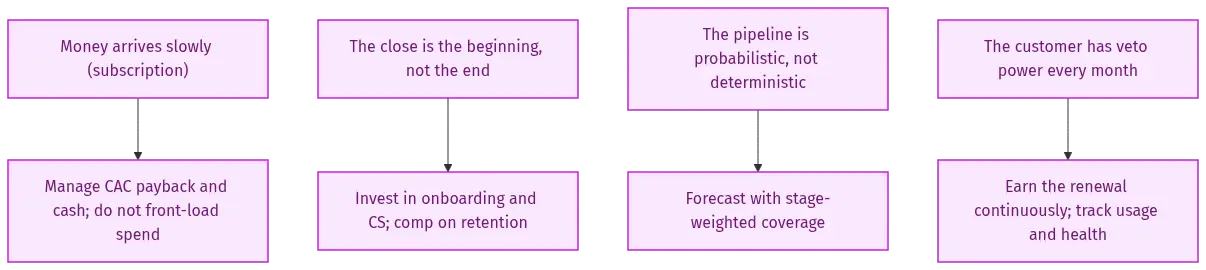
The four structural properties that matter most:
2.1. The Money Arrives Slowly
In traditional enterprise software, you close a $250,000 deal and the cash hits within 90 days. In SaaS, you close a $250,000 annual contract value (ACV) deal and the revenue arrives in 12 equal monthly slices. If your CAC was $80,000, you are upside-down on that deal for the first four months. The implication for sales operations is profound: a SaaS company cannot afford the same CAC-to-revenue ratio that a traditional software company can, because the gap between spending the CAC and recovering it is wider.
The standard benchmark: a healthy SaaS business recovers CAC within 12 months for small and mid-sized business (SMB) deals, 18 months for mid-market, and 24 months for enterprise. If your payback is longer than that, the math gets uncomfortable as you scale. This is why pricing decisions in SaaS are sales decisions — and why founders who treat pricing as a finance team’s job consistently get blindsided.
2.2. The Close Is the Beginning, Not the End
In a one-time-purchase model, the sale ends when the buyer signs. In SaaS, the sale ends when the buyer renews — and if you are doing it well, expands. That changes everything about how you design the motion. The sales rep’s job is not just to close; it is to set up the customer in a way that the renewal looks obvious 12 months later. A rep who closes a deal that does not renew has not really sold anything; they have rented revenue for a year.
The practical consequence: the sales team and the customer success team have to share information actively. A handoff document that the rep writes the day the deal closes — what the buyer promised internally, what they expect to see in 90 days, what would cause them to churn — is worth more than most CRM data. This is the half of SaaS sales that founders coming from traditional software underestimate.
2.3. The Pipeline Is Probabilistic, Not Deterministic
Traditional enterprise sales has a discrete pipeline: 12 opportunities at the half-million mark, 3 of which will close this quarter, $1.5M booked. SaaS sales has the same shape on the new-business side but adds a second pipeline behind it — the renewal and expansion pipeline. At a healthy SaaS company past $5M ARR, the renewal-and-expansion pipeline is bigger in dollar terms than the new-business pipeline. If you are only running the new-business one, you are flying half-blind.
The metric that captures this is net revenue retention: the percentage of last year’s customers’ recurring revenue that you kept and grew this year, after accounting for churn, downgrades, and upgrades. A NRR of 120% means the existing customer base alone grew the company 20% this year, before any new logos. A NRR below 100% means new sales are filling a leaking bucket.
2.4. The Customer Has Veto Power Every Month
In a one-time license, the buyer can be unhappy and you still get paid. In SaaS, an unhappy customer churns and the revenue evaporates. This shifts the bargaining power decisively toward the buyer — and toward the customer success function inside your company. A SaaS sales motion that does not include a clear customer success function is structurally incomplete. The deals will close. They will not renew.
3. The Five SaaS Sales Motions
The meaning of SaaS sales is not one motion — it is a family of five motions, each suited to a different price point and buyer type. The right motion for your company depends on your average contract value (ACV) and the complexity of the buying decision.
Motion 1: Self-Serve / Product-Led
The buyer signs up on the website, runs a free trial, and converts to a paid plan without ever speaking to a salesperson. The product does the selling. Works for ACVs typically under $1,200/year, where the cost of a human in the loop would destroy the unit economics.
Motion 2: Inside Sales (Inbound)
A marketing engine generates leads — content, search engine optimization (SEO), webinars, paid ads — and inside sales reps (working remotely, not in the customer’s office) convert them on the phone. Typical ACV $5,000–$50,000. The rep’s job is largely qualification and shepherding through the buying process; the buyer’s intent is mostly pre-formed.
Motion 3: Inside Sales (Outbound)
Sales development representatives (SDRs) prospect cold accounts, book meetings, and pass them to account executives (AEs) who close. Same remote model as Motion 2 but the demand has to be manufactured rather than caught. Typical ACV $15,000–$100,000. This is the most operationally complex motion because the SDR-to-AE handoff is where most pipeline goes to die.
Motion 4: Field Sales / Enterprise
Reps fly to the customer, present in person, navigate procurement, and close six-figure-and-up deals. Typical ACV $100,000+ with a sales cycle of 6–18 months. The economics work only when the lifetime value (LTV) of the deal justifies a fully-loaded rep cost of $250,000–$400,000/year carrying a $1M–$2M quota.
Motion 5: Channel / Partner
The deal is sold by a third party — a systems integrator, value-added reseller (VAR), or marketplace — who takes a margin. Common in vertical SaaS where the channel partner has trusted access to a buyer segment that direct sales cannot reach efficiently. Channel typically does not replace direct sales; it complements it.
| Motion | Typical ACV | Sales Cycle | When It Fits |
|---|---|---|---|
| Self-serve / product-led | <$1,200 | Minutes to days | High-volume, low-touch, broad buyer base |
| Inside sales (inbound) | $5K–$50K | 2–6 weeks | Marketing engine produces qualified leads |
| Inside sales (outbound) | $15K–$100K | 1–4 months | Buyer segment is identifiable but not searching |
| Field / enterprise | $100K+ | 6–18 months | Deal complexity requires in-person navigation |
| Channel / partner | Varies | Varies | Partner owns trusted access to a buyer segment |
If you want the trade-offs across these in more depth, the SaaS sales models breakdown goes deeper into when each one fits.
4. The Three Traps Founders Fall Into
When founders import the meaning of “sales” from traditional software or general business experience and apply it to SaaS, three traps show up repeatedly.
Trap 1: Hiring a VP of Sales to Solve a Pipeline Problem
Most founders, when growth stalls, conclude they need a VP of sales. About nine times out of ten, the constraint is not the absence of a senior sales leader; it is an unwritten sales motion, an unscored pipeline, or an unowned renewal function. A VP of sales arriving into that environment cannot fix it — they need the underlying motion to exist before they can scale it. The result is an expensive hire who leaves in 18 months. See hiring the wrong VP of sales for SaaS for the deeper analysis.
Trap 2: Compensating Reps Only on the Close
If commission is paid entirely on the close, the rep is structurally incentivized to close any deal that will sign. That includes deals that will not renew, deals with mismatched expectations, and deals where the customer does not have the operational ability to use the product. In SaaS, that is poison — every one of those deals shows up as churn in 12 months. A working SaaS compensation plan includes a renewal or NRR component, typically 10–30% of the bonus pool.
Trap 3: Treating Customer Success as a Cost Center
The first time a founder sees the customer success team’s payroll line, the instinct is to compress it. That is exactly backward. In a SaaS business at $5M+ ARR, the customer success function generates expansion revenue at a marginal CAC of nearly zero — every dollar of upsell to an existing customer is essentially pure profit compared to acquiring a new logo. Treating customer success as a renewal-prevention function rather than an expansion-generation function is the structural mistake.
5. How the Meaning Changes What You Measure
The four structural properties of SaaS sales (slow money, ongoing close, dual pipeline, monthly veto) imply a specific set of metrics. A founder who understands the meaning of SaaS sales does not measure quota attainment alone. They measure six things in parallel:
| Metric | What It Measures | Healthy Range (B2B, $5M–$15M ARR) |
|---|---|---|
| New ARR booked | New-business sales output | Plan-dependent |
| Net revenue retention | Existing-customer health | 110%–130% |
| Gross revenue retention | Pure churn signal | ≥90% |
| CAC payback | Sales efficiency | 12–24 months (segment-dependent) |
| LTV / CAC ratio | Unit economics | ≥3:1 |
| Sales cycle length | Pipeline velocity | Stable or shrinking |
If only the first metric is on the board, the company is measuring traditional software sales, not SaaS sales. The next four are what make the meaning of SaaS sales different from its cousins. If you want the deeper breakdown of which metrics matter at which ARR stage, the SaaS growth metrics reference is the place to start.
6. A Worked Example: Two Companies, Same New ARR, Different Meanings
Two companies, each at $10M ARR, each booking $4M of new ARR this year. Same quota attainment. Looks identical from a traditional-sales lens. Watch what happens when you apply the SaaS sales meaning:
Company A has a gross revenue retention of 85% and a net revenue retention of 95%. Last year’s $10M of recurring revenue shrinks to $9.5M before new business is added. New ARR of $4M lifts the total to $13.5M. Year-over-year growth: 35%.
Company B has a gross revenue retention of 92% and a net revenue retention of 120%. Last year’s $10M lifts to $12M from existing customers alone. New ARR of $4M brings the total to $16M. Year-over-year growth: 60%.
Same sales output. Nearly twice the growth rate. The difference is not in the new-business pipeline; it is in the second half of the sales motion — the half that traditional software sales does not have to think about. This is what it means in practice for SaaS sales to be structurally different.
| Company A | Company B | |
|---|---|---|
| Starting ARR | $10M | $10M |
| Gross revenue retention | 85% | 92% |
| Retained from existing | $8.5M | $9.2M |
| Expansion from existing | $1.0M | $2.8M |
| New ARR booked | $4.0M | $4.0M |
| Ending ARR | $13.5M | $16.0M |
| Growth rate | 35% | 60% |
| Implied valuation impact (at 6× ARR) | $81M | $96M |
The valuation gap — $15M — is the cash value of understanding what SaaS sales actually means. Same sales team. Same new bookings. Different operating model.
7. Frequently Asked Questions
What does SaaS sales mean in plain English?
SaaS sales means the process of selling a software subscription that the customer can cancel at any renewal cycle. Because the customer can leave, the work of selling does not end at the close — it continues through onboarding, renewal, and expansion. The plain-English version: in SaaS sales, every customer is a customer you have to re-earn every year.
How is SaaS sales different from regular software sales?
Regular (perpetual-license) software sales ends at the close, with most of the revenue arriving up front. SaaS sales is priced as a recurring subscription, so the revenue arrives over time and depends on the customer continuing to renew. That changes what gets measured, how reps are paid, how pricing is set, and how the customer success function is staffed.
Is SaaS sales B2B or B2C?
Both, but the meaning of the term is most commonly applied to business-to-business (B2B) SaaS, where annual contract values range from a few hundred dollars to seven figures. Business-to-consumer (B2C) subscriptions (think streaming or consumer software) use the same recurring-revenue mechanics but typically rely on self-serve product-led motions rather than a sales team. When practitioners say “SaaS sales” without qualification, they usually mean B2B.
What roles are involved in a SaaS sales team?
A mature SaaS sales team typically includes: account executives (AEs) who close deals, sales development representatives (SDRs) who generate pipeline, sales engineers (SEs) who handle technical demos, customer success managers (CSMs) who own renewal and expansion, a sales operations function that handles tooling and reporting, and a VP of sales who owns the overall number. Smaller companies collapse these roles; larger ones split them further.
How long is a typical SaaS sales cycle?
It depends on the motion and the ACV. Self-serve closes in minutes. Inside-sales inbound closes in 2–6 weeks. Outbound mid-market closes in 1–4 months. Enterprise field sales closes in 6–18 months. A sales cycle that is consistently lengthening within a given motion is a leading indicator that something — pricing, ideal customer profile (ICP), competitive positioning — has shifted.
What is the most important metric in SaaS sales?
There is no single answer; the meaning of SaaS sales requires measuring at least two: new ARR booked (which captures the new-business motion) and net revenue retention (which captures the renewal-and-expansion motion). A company that hits its new-ARR number but has NRR below 100% is treadmilling. A company that grows NRR above 110% while hitting plan is compounding. NRR is the metric that most distinguishes a SaaS sales operation from a traditional sales operation.
When should I hire a VP of sales?
When the founder has personally closed enough deals to have a written, repeatable sales motion that another rep can execute — and when there are at least three reps already running that motion successfully. Hiring a VP of sales before the motion exists asks the VP to invent the motion and scale it, which is two jobs. The result is usually an expensive 18-month departure.
8. The Bottom Line
The SaaS sales meaning that matters in 2026 is operational, not semantic. It is the recognition that selling a subscription is structurally different from selling a one-time product, and that difference changes the metrics, the motions, the compensation, the org chart, and the relationship between the sales team and the rest of the company. Founders who internalize the meaning of SaaS sales build companies that compound; founders who treat it as “selling software in the cloud” build companies that leak.
The fastest test of whether you have internalized the meaning is this: when growth stalls, your first question is not “do I need a new VP of sales?” It is “where in the four-stage motion — pipeline, close, renewal, expansion — is the leak?” That single reframing is worth more than any tactical playbook.
If you are ready to go deeper on the operating playbook, the SaaS sales playbook walks through how to build each stage in detail. If you want to diagnose your specific motion, the SaaS sales models page maps which of the five motions fits your stage and ACV.