

Most SaaS CEOs treat customer onboarding as a post-sale courtesy — a kickoff call, a few training videos, a check-in email from someone in support. That framing is expensive. Customer onboarding is one of the highest-leverage retention investments available to a SaaS company, because the churn that shows up on your dashboard in month nine was usually caused in week two. By the time a customer formally cancels, the decision was made months earlier — often before they ever reached real value with your product.
This article treats onboarding the way an investor or acquirer would: as a number on a chain that ends at your valuation. I’ll define the process, then spend most of our time on the part competitors skip — the math. You’ll see a worked example of what a modest onboarding improvement does to lifetime value, acquisition efficiency, and the amount of sales spend you burn each year just replacing customers you already won.
What Is Customer Onboarding?
Customer onboarding is the process of moving a new customer from signed contract to realized value — the stretch between “they bought it” and “they couldn’t run their business without it.” It typically covers account setup, configuration, data migration, training, and the customer’s first meaningful result with the product.
To be clear about scope: this is onboarding customers, not employees. Same word, completely different discipline.
It’s also worth separating customer onboarding from user onboarding. User onboarding is the in-product experience that teaches an individual user the interface — tooltips, checklists, product tours. Customer onboarding is the account-level commercial process: getting the buying organization, often with many users, to the outcome they purchased. User onboarding is a component of customer onboarding, the way a single relay leg is a component of the race. This article is about the race.
A typical B2B customer onboarding process moves through five stages:
| Stage | What Happens | Typical Failure Mode |
|---|---|---|
| Kickoff | Goals, success criteria, and timeline agreed with the customer | No measurable definition of "success" |
| Setup & configuration | Accounts created, integrations connected, data migrated | Stalls waiting on the customer's IT team |
| Training | Users learn the workflows that matter to their job | Generic training instead of role-based |
| First value | Customer achieves the first outcome they bought the product for | Nobody defined or tracked this milestone |
| Handoff | Account transitions to ongoing customer success ownership | Context evaporates; customer repeats themselves |
The stage that matters most is first value. Everything before it is cost; everything after it is compounding return. Which brings us to why this is a CEO topic and not a support topic.
One more boundary worth drawing: customer onboarding is not the free-trial conversion funnel, even though the two share vocabulary. Trial conversion is a pre-revenue sales problem — turning an evaluator into a buyer. Onboarding starts when the money is committed and the risk transfers to you: the customer has paid, the CAC is spent, and the only question left is whether the relationship becomes an asset or a write-off. SaaS onboarding done well is what makes the rest of this article’s math work in your favor.
Why Customer Onboarding Is a Revenue Problem, Not a Support Problem
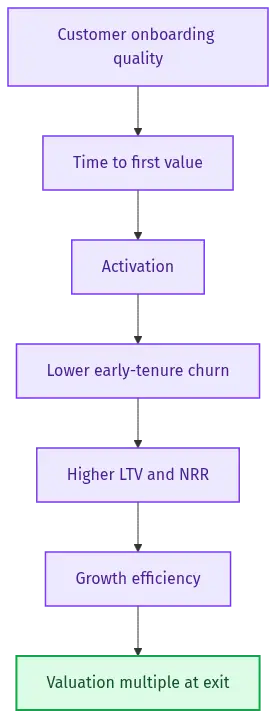
Churn is not evenly distributed across a customer’s life. When you plot cancellations by customer tenure — something most teams at $5M–$15M ARR have never actually done — the curve almost always spikes in the first few months and flattens after the first renewal. Customers who reach value stay for years. Customers who don’t, leave fast. SaaS churn is, to a large degree, an onboarding outcome measured later.
That timing has three economic consequences.
- Early churn is the most expensive churn. A customer who cancels in month four consumed your full Customer Acquisition Cost (CAC) — every dollar of sales and marketing it took to win them — and paid back almost none of it. Late churn at least amortized the acquisition cost over years of subscription revenue. Early churn is buying inventory and throwing it in the ocean.
- Onboarding gates expansion, not just retention. Net Revenue Retention (NRR) — the percentage of last year’s recurring revenue from existing customers that you keep this year, including upsells and downgrades — is the single best predictor of long-term SaaS value. A customer who never activated the first module will never buy the second one. If your net revenue retention is stuck below 100%, the expansion engine usually isn’t broken at renewal time. It’s broken at onboarding time.
- Retention compounds; acquisition doesn’t. Bain & Company’s research found that increasing customer retention rates by 5% increases profits by 25% to 95%, because retained customers cost nothing to re-acquire and tend to expand over time. A dollar invested in fixing onboarding keeps paying every year that cohort survives. A dollar invested in lead generation pays once.
The leaky bucket analogy gets overused, but it’s accurate: pouring more water into a leaky bucket is a waste of CAC dollars. If you have a churn problem, make fixing it your annual focus — and the first place to look is the first 90 days of the customer relationship, because that’s where the leak usually starts. Everything else is secondary until you reduce churn, because everything breaks until you do.
The Economics of Customer Onboarding: A Worked Example
Generic advice says onboarding “drives retention.” Let’s quantify what that’s actually worth, using numbers typical of the companies I work with.
A note on the numbers: every figure in this section is illustrative, chosen to be realistic for a B2B SaaS company in the $5M–$15M ARR range. The point is the relative impact of the changes, not the absolute values. Plug in your own numbers before making decisions.
Scenario #1: The Baseline Company
Picture a B2B SaaS company with:
- $9M in Annual Recurring Revenue (ARR) — the annualized value of all active subscriptions — which is $750,000 in Monthly Recurring Revenue (MRR)
- 500 customers, so Average Revenue Per Account (ARPA) is $1,500 per month — an $18,000 Annual Contract Value (ACV, the yearly subscription price per customer)
- 80% gross margin — of each revenue dollar, $0.80 remains after hosting and support costs
- 2.5% monthly churn (assume logo churn and revenue churn are equal, and set expansion aside for simplicity)
- $16,000 fully loaded CAC per new customer
First, lifespan. At 2.5% monthly churn, the average customer lifespan is:
Average Customer Lifespan = 1 / Monthly Churn Rate = 1 / 0.025 = 40 months
Customer Lifetime Value (LTV) — the total gross profit an average customer generates before churning — follows:
LTV = ARPA × Gross Margin % × Average Customer Lifespan = $1,500 × 0.80 × 40 = $48,000
That makes the LTV/CAC ratio $48,000 / $16,000 = 3.0 — exactly at the industry’s “healthy” threshold, with nothing to spare. The CAC Payback Period — how many months of gross profit it takes to recover the cost of acquiring a customer — is:
CAC Payback = CAC / (ARPA × Gross Margin %) = $16,000 / ($1,500 × 0.80) = $16,000 / $1,200 = 13.3 months
One more number that most CEOs have never computed. Monthly churn compounds — annual churn is 1 − (1 − monthly churn)^12, never monthly churn × 12. At 2.5% monthly:
Annual Churn = 1 − (0.975)^12 = 26.2%
So this company loses about $2.36M of its $9M ARR base every year (9,000,000 × 0.262) and must replace it before growing a dollar. In logo terms: 2.5% of 500 customers is 12.5 cancellations a month — 150 a year. At $16,000 CAC apiece, replacing them costs $200,000 a month, or $2.4M a year, in sales and marketing spend just to stand still.
And here’s the detail that should bother you most: with a 13.3‑month payback and 2.5% monthly churn, the probability that a given customer survives long enough for you to recover their CAC is (0.975)^13.3 ≈ 71%. Nearly three in ten new customers churn before they’ve paid back what it cost to acquire them. Those customers were never customers economically. They were expenses with logos.
Scenario #2: The Same Company After Fixing Onboarding
Now suppose this company invests one focused quarter in its customer onboarding process — defines a first-value milestone, assigns a single owner, instruments the funnel — and as a result, blended monthly churn drops from 2.5% to 1.8%. Not heroic. This is the kind of improvement that comes from fixing early-tenure churn specifically, since that’s where the bulk of cancellations cluster.
| Metric | Before (2.5% monthly churn) | After (1.8% monthly churn) |
|---|---|---|
| Average customer lifespan | 40 months | 55.6 months |
| LTV | $48,000 | $66,667 |
| LTV/CAC | 3.0 | 4.2 |
| Annual churn (compounded) | 26.2% | 19.6% |
| ARR lost from the $9M base per year | ~$2.36M | ~$1.76M |
| Logos lost per month | 12.5 | 9 |
| Replacement CAC spend per year | $2.4M | ~$1.73M |
| Customers surviving to CAC payback | ~71% | ~79% |
Walk through what changed:
- LTV jumped 39% ($48,000 → $66,667) without touching pricing, product, or sales. Each customer is now worth $18,667 more in lifetime gross profit.
- LTV/CAC moved from 3.0 to 4.2 — from “acceptable” to “strong” on any investor’s scorecard, which changes how aggressively you’re allowed to spend on growth. Your unit economics set the ceiling on your growth rate; this raises the ceiling.
- Replacement spend fell by roughly $672,000 a year ($2.4M → $1.73M). That’s real money that can fund net-new growth instead of refilling the bucket.
- CAC payback didn’t move — it’s still 13.3 months, because payback depends on price and margin, not churn. What changed is the share of customers who live long enough to deliver the payback: from about 71% to about 79%.
A 0.7‑percentage-point improvement in monthly churn — a number that sounds like rounding error — is worth roughly $670K a year in avoided replacement cost and a 39% increase in the lifetime value of every customer you sign from now on. That’s the lever. Almost nothing else in the company offers that return on one quarter of focused work.
Time-to-Value: The Clock That Starts at the Signature
If onboarding has a primary metric, it’s Time-to-Value (TTV): the number of days between the contract signature and the customer’s first meaningful business outcome with your product. Not the first login. Not training completion. The first moment the product did the thing they bought it to do.
The related concept is activation — a defined milestone that signals a customer has genuinely started using the product, the way a payments product might define activation as “first live transaction processed.” Pick the milestone that best predicts renewal in your data, then manage onboarding to it relentlessly.
Why does speed matter so much? Three reasons:
- Your champion’s credibility is on a timer. The person who chose your product told their boss it was the right call. Every week without visible results spends down their political capital. When the champion goes quiet, the account is already churning — the paperwork just hasn’t caught up.
- Urgency decays. At signature, the customer’s pain is vivid and the team is motivated. Ninety days later, the pain has been worked around, the project owner has new priorities, and your product is a line item someone questions at budget time.
- The renewal clock is running. On a 12-month contract, a customer with a 5‑month TTV gets seven months of value before deciding whether to renew. A customer with a 2‑month TTV gets ten. Same product, same price — 43% more value experienced at decision time.
A useful way to think about the sales-to-onboarding transition: it’s the baton pass in a relay race. Races are rarely lost in the laps; they’re lost in the handoffs. The account executive who knows why the customer bought, what they’re afraid of, and how they define success hands the account to an onboarding team that often receives none of that context. The customer then repeats their requirements to a stranger — their first post-purchase experience with your company is discovering that the right hand doesn’t talk to the left.
One structural warning for companies whose onboarding involves heavy implementation work: long, consulting-style implementations don’t just delay value — they change what an acquirer thinks your revenue is. If implementation drags on for months and requires armies of billable people, buyers start discounting your recurring revenue as professional services in disguise. Compress implementation, productize the repeatable parts, and TTV improves alongside your revenue quality.
The Three Customer Onboarding Models — and Which One Fits Your ACV
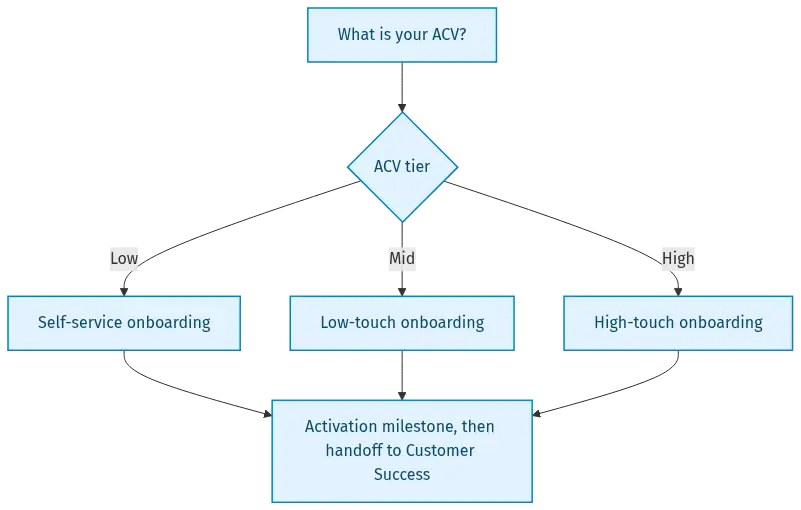
Onboarding design is an economics decision: how much human effort can each account justify? There are three standard models, and the right one is set by your ACV and product complexity. (The ACV ranges below are market heuristics, not derived thresholds — treat them as starting points.)
| Model | Typical ACV Fit | Human Involvement | What It Looks Like |
|---|---|---|---|
| Self-service | Under ~$5K | None (product does the work) | In-product guides, checklists, email sequences, knowledge base |
| Low-touch | ~$5K–$25K | Shared, one-to-many | Group kickoffs, webinars, office hours, templated success plans |
| High-touch | Above ~$25K | Dedicated, one-to-one | Named onboarding manager, custom project plan, executive check-ins |
Self-Service Onboarding
What it is: the product onboards the customer with no scheduled human contact. The investment goes into in-product engineering — setup wizards, progress checklists, contextual help — instead of headcount.
Who it’s for: high-volume, low-ACV products where the math forbids human touch. At a $3K ACV and 80% gross margin, a customer generates $200/month in gross profit; even two hours of human onboarding per account is a meaningful slice of year-one profit at scale.
The tradeoffs: cheapest per account and infinitely scalable, but you get one shot at the experience — there’s no human to recover a confused customer. It demands real product investment and disciplined funnel instrumentation, because your only churn signal is behavioral data.
When to choose it: ACV under roughly $5K, a product a motivated user can configure alone, and enough signup volume that patterns in drop-off data are statistically meaningful.
Low-Touch Onboarding
What it is: structured human help delivered one-to-many. Group kickoff calls, live training webinars, office hours, and a templated onboarding plan the customer largely executes themselves.
Who it’s for: the mid-market — and most readers of this site. At an ACV between roughly $5K and $25K, accounts justify some human attention but not a dedicated project manager per account.
The tradeoffs: dramatically cheaper than high-touch while preserving a human safety net, but it requires segmentation discipline. The temptation is to give every squeaky wheel one-to-one attention, which quietly converts your low-touch model into an unbudgeted high-touch model.
When to choose it: mid-market ACVs, moderate product complexity, and a customer base similar enough that templated plans cover 80% of cases — with an explicit escalation path for the other 20%.
High-Touch Onboarding
What it is: a named onboarding manager runs each account through a custom project plan with milestones, stakeholder management, and executive check-ins — closer to a consulting engagement than a product tour.
Who it’s for: enterprise-priced products, complex integrations, and accounts where many users and departments must change behavior for the product to deliver value.
The tradeoffs: highest cost and hardest to scale — your onboarding capacity becomes a hiring pipeline problem. But run the math before calling it expensive. An onboarding manager at $150,000 fully loaded annual cost who handles 12 new accounts a month (144 a year) costs about $1,042 per account. Against the baseline company’s $48,000 LTV, that’s 2.2% of lifetime value — and about 6.5% of the $16,000 CAC you already spent winning the account. Spending 6.5% of CAC to protect 100% of it is not a cost problem.
When to choose it: ACV above roughly $25K, multi-stakeholder implementations, or any segment where the data shows white-glove treatment measurably lifts retention.
Most companies in the $5M–$15M ARR range end up with a hybrid: high-touch for the top revenue tier, low-touch for the middle, self-service tooling underneath everything. The mistake isn’t choosing the wrong model — it’s never explicitly choosing at all, and delivering accidental high-touch to whoever complains loudest.
Who Owns Customer Onboarding?
Ask a struggling company who owns onboarding and you’ll hear “everyone touches it” — sales runs the kickoff, support answers tickets, customer success checks in eventually. “Everyone” is how a function with no owner describes itself.
There are three workable ownership models:
- Customer Success (CS) owns it. The CS team that manages the ongoing relationship also runs onboarding. Works well at smaller scale; the risk is that renewal-driven CS managers deprioritize new accounts, whose problems are months away, in favor of this quarter’s renewals.
- A dedicated onboarding/implementation team owns it. A specialized team takes every account from signature to a defined activation milestone, then formally hands off to CS. This is the right structure once volume supports it, because onboarding is a project-management skill set, not a relationship-management one.
- Product owns it (product-led onboarding). For self-service models, a product or growth team owns the activation funnel and is measured on activation rate, exactly as they’d be measured on conversion anywhere else in the funnel.
The model matters less than two rules. First: one owner, one metric. Somebody’s name is attached to time-to-value or activation rate, and they report it alongside your other customer success metrics at every leadership meeting. What gets measured by a named owner gets fixed; what’s shared gets ignored.
A note on incentives, because they quietly decide everything. If your account executives are paid entirely on bookings, they are paid to close bad-fit customers — every one of which arrives at onboarding pre-churned. If your CS team is paid on renewals, they are paid to ignore accounts that won’t renew for another ten months. Some companies fix this with a clawback on commissions for customers who churn inside 90 days; others put a small bonus on activated accounts rather than signed ones. The mechanics matter less than the principle: somebody’s compensation should improve when time-to-value improves, or it won’t.
Second: make the handoffs explicit. The sales-to-onboarding handoff should transfer, in writing, why the customer bought, what success looks like in their words, who the stakeholders are, and what was promised. The onboarding-to-CS handoff should transfer what was achieved, what’s outstanding, and where the risks are. Every handoff your customer can feel is a crack churn gets into.
How to Diagnose a Broken Onboarding Process
You cannot improve what you haven’t measured, and most companies have never actually measured onboarding. Three diagnostics, in order:
Plot the Churn Curve by Customer Tenure
Group customers into cohorts — customers who started in the same month or quarter — and plot what percentage of each cohort survives over time. (The same technique behind any retention rate calculation, applied by start date.) If the curve drops steeply in the first 90–180 days and then flattens, you don’t have a churn problem in general. You have an onboarding problem specifically — and that’s good news, because the first 90 days is the cheapest, most controllable place in the entire customer lifecycle to intervene.
Segment Everything
Company-wide onboarding metrics hide the truth the same way every blended metric does. Calculate TTV, activation rate, and early-tenure churn by segment: industry vertical, contract size, acquisition channel, geography, use case. In my experience, 100% of the time there are significant variances between segments — one vertical activates in three weeks while another stalls for three months, one channel’s customers churn at twice the rate of another’s. Often what looks like an onboarding problem is actually an ideal customer profile problem: sales is closing customers the product was never going to serve, and no onboarding process can rescue a bad-fit account.
Find the Number That Predicts Renewal — Then Study the Outliers
Here’s a worked example of why activation analysis pays. Scenario #3: a company lands 60 new customers a quarter. Pulling the data, it finds that 55% of new customers reach the activation milestone within 30 days — and that activated customers retain at 90% over their first year, while non-activated customers retain at just 55%. Blended first-year retention:
(0.55 × 90%) + (0.45 × 55%) = 49.5% + 24.75% = 74.25%
— roughly 74%, consistent with annual churn in the mid-20s. Now suppose better onboarding lifts 30-day activation from 55% to 80%, with each group’s retention unchanged:
(0.80 × 90%) + (0.20 × 55%) = 72% + 11% = 83%
Per 60-customer cohort, that’s 49.8 customers surviving year one instead of 44.6 — about 5 extra retained customers per cohort, or roughly 21 per year across four cohorts. At an $18,000 ACV, that’s about $378,000 of ARR retained annually, plus roughly $336,000 in replacement CAC you no longer spend (21 × $16,000). One funnel metric, moved 25 points, worth about $700K a year combined.
And once you’re measuring, study the outliers. Some onboarding manager, some segment, some implementation path is dramatically outperforming the rest — find the top performer, figure out what they do differently, document it, and train everyone else to do it. It’s the highest-leverage process improvement method I know, and onboarding is exactly the kind of person-dependent function where performance variance between individuals is enormous. The variance itself is the signal.
The Onboarding Metrics Worth Tracking
Six metrics cover the customer onboarding funnel. (Benchmark columns are directional heuristics observed across B2B SaaS, not derived values — and they shift over time, so verify against current data for your segment and price point.)
| Metric | Definition | Directional Target | Why It Matters |
|---|---|---|---|
| Time-to-Value (TTV) | Days from signature to first defined business outcome | Days/weeks for SMB; under 90 days for enterprise | The clock your champion's credibility runs on |
| Activation rate | % of new customers reaching the activation milestone within a set window | Track the trend; segment it | Strongest early predictor of renewal |
| Onboarding completion rate | % of customers finishing all onboarding stages | As close to 100% as the model allows | Incomplete onboarding is pre-booked churn |
| 90-day logo retention | % of new customers still active at day 90 | Higher than your blended retention | Isolates early-tenure churn from the blend |
| Early support load | Tickets per account during onboarding, by theme | Falling over successive cohorts | Recurring themes are product or process defects |
| NRR by onboarding cohort | NRR of well-onboarded vs. poorly onboarded cohorts, 12 months later | Visible gap favoring activated cohorts | Proves the expansion link to the CFO |
Two cautions. First, satisfaction surveys during onboarding — including Net Promoter Score — measure how customers feel, which is useful but lagging and polite. Behavioral metrics measure what customers do. When the two disagree, believe the behavior. Second, resist measuring onboarding by activity — calls completed, trainings delivered, tickets closed. Activity metrics reward motion. Outcome metrics (activation, TTV, retention) reward results. Teams optimize whatever you put on the dashboard.
What Most Companies Get Wrong About Customer Onboarding
A full treatment of customer onboarding best practices deserves its own article. Here, the failure patterns I see most — each one an economics error wearing an operational costume:
- Declaring victory at go-live instead of at value. The system is configured, training is delivered, the project closes — and the customer has yet to achieve a single business outcome. Go-live is your milestone. Value is theirs. Onboarding ends at theirs.
- Selling a dream and onboarding a reality. When sales overpromises to close, onboarding inherits an expectations gap it cannot configure its way out of. If the same gap appears account after account, the fix is in your sales messaging and deal qualification, not your onboarding playbook.
- Treating onboarding cost as overhead to minimize. Onboarding is the last mile of customer acquisition — the spend that converts a signed contract into a retained, expandable account. Cutting it to save roughly 2% of LTV while nearly three in ten customers churn before CAC payback is the most expensive savings in SaaS.
- No single owner, no single metric. Covered above. If you can’t name the person who owns time-to-value, nobody does.
- One-size-fits-all onboarding across segments. Your $50K-ACV enterprise accounts and your $4K-ACV self-serve signups are getting the same email sequence — which means one segment is neglected and the other is smothered, and both churn for opposite reasons.
- Letting integrations sit hostage to the engineering backlog. If customers routinely stall waiting on a data migration or an integration, your churn problem is a roadmap problem. Productize the top three integration paths and TTV drops across every cohort at once.
- Never closing the loop with sales. Onboarding sees within 30 days which deals were bad fits. If that signal never reaches sales compensation or qualification criteria, you’ll keep buying churn at full CAC.
Onboarding and Your Exit: What Acquirers Look For
If you’re building toward a sale, onboarding shows up in diligence twice — once in your numbers, once in your operations.
In the numbers, acquirers go straight to retention. They’ll compute your gross revenue retention — how much recurring revenue you keep before counting expansion — and your NRR, and they’ll cut both by cohort. A cohort chart that shows customers reaching value fast and retention curves flattening high is, mechanically, a chart of your onboarding quality. For context, Bessemer Venture Partners’ benchmarks for private cloud companies treat NRR around 120% as best-in-class — and the gap between a 95% NRR business and a 120% NRR business compounds into entirely different companies within a few years. Retention quality is a primary driver of where you land in the range of SaaS revenue multiples, because an acquirer is buying your future revenue, and retention is the evidence that the future revenue exists.
In operations, diligence teams assess risk — and risk is the gap between your forecast and your reality. An onboarding function that lives in three veterans’ heads is key-person risk an acquirer will price into their offer. A documented, person-independent onboarding playbook — where a new onboarding hire reaches 90% of veteran effectiveness within a quarter — is what systematization looks like from the outside. The test is simple: if your two most experienced onboarding people quit tomorrow, does next quarter’s cohort activate at the same rate? If the honest answer is no, you have a process that depends on heroes, and acquirers discount heroics.
The CEOs who get premium multiples don’t treat retaining customers as a department. They treat it as the operating system of the company — and onboarding is its boot sequence.
Customer Onboarding FAQ
What is customer onboarding in SaaS?
Customer onboarding in SaaS is the structured process of taking a new customer from signed contract to realized value — setup, configuration, training, and the customer’s first meaningful business outcome. It matters because early-tenure churn is the most expensive churn: a customer who leaves before reaching value consumed full acquisition cost and returned almost none of it.
What’s the difference between customer onboarding and user onboarding?
Customer onboarding is the account-level process of getting a buying organization to the outcome it purchased. User onboarding is the in-product experience teaching an individual user the interface — tours, tooltips, checklists. User onboarding is one ingredient; customer onboarding is the whole recipe, including kickoff, implementation, training, and handoff.
How long should customer onboarding take?
As long as it takes to reach first value, and no longer — measured in days for self-serve products, weeks for mid-market, and ideally under 90 days even for complex enterprise implementations (a heuristic, not a law). The diagnostic isn’t the absolute number; it’s the trend. If time-to-value is growing as you scale, your onboarding process isn’t scaling with you.
How do you measure customer onboarding success?
Lead with outcome metrics: time-to-value, activation rate within a set window, onboarding completion rate, and 90-day retention of new cohorts. Then connect them to money: compare first-year retention and NRR of customers who activated against those who didn’t. The gap between those two groups is your onboarding business case, stated in your CFO’s language.
Who should own customer onboarding?
One named owner with one primary metric — time-to-value or activation rate. Whether that owner sits in customer success, a dedicated implementation team, or product depends on your ACV and onboarding model. The failure mode isn’t choosing the wrong department; it’s “shared ownership,” which in practice means none.
How much should customer onboarding cost?
Price it against lifetime value, not against the first invoice. In the worked example above, a dedicated onboarding manager at $150,000 fully loaded handling 144 accounts a year costs about $1,042 per account — roughly 2.2% of a $48,000 LTV and about 6.5% of a $16,000 CAC. Framed that way, the question inverts: spending a single-digit percentage of CAC to protect the whole of it is one of the better trades available. The real cost discipline isn’t minimizing onboarding spend — it’s matching the onboarding model (self-service, low-touch, high-touch) to each segment’s ACV so the spend lands where it pays.
Does better onboarding actually reduce churn?
Mechanically, yes — because in most SaaS businesses churn concentrates in early tenure, and early tenure is what onboarding controls. Plot churn by customer age: if it spikes in the first 90–180 days, improving activation directly cuts your largest churn pool. In the worked example above, raising 30-day activation from 55% to 80% improved first-year retention from about 74% to 83% — worth roughly $700K a year in retained ARR and avoided replacement CAC at a 60-customer-per-quarter pace.
Fix the Bucket Before You Buy More Water
Customer onboarding is the rare lever that improves nearly every number an investor cares about simultaneously: churn, LTV, LTV/CAC, NRR, growth efficiency, and ultimately your multiple. The sequencing matters: improving onboarding before scaling acquisition means every newly acquired customer is worth more, while scaling acquisition first means buying more customers into a process that loses three in ten of them before payback.
If you do one thing this quarter, do this:
- Plot churn by customer tenure. One afternoon of analysis. If the curve spikes early, you’ve found your highest-ROI project.
- Define your activation milestone and measure time-to-value. Pick the customer outcome that best predicts renewal, and instrument it.
- Put one name on the metric. One owner, reporting TTV and activation rate at every leadership meeting, with the authority to fix what the data exposes.
Most of your competitors are spending this quarter’s board meeting debating how to acquire more customers. The cheaper move is making the customers you already acquired actually stay.