

Your cash runway is the number of months you have left before the bank account hits zero. It is the single most important number a SaaS CEO carries in their head, because it converts every strategic question — should I hire, should I raise, should I cut — into the same hard currency: time. If you have $2 million in the bank and you’re losing $100,000 a month, your cash runway is twenty months. After that, barring a change, the company is out of money and out of options.
Most founders can quote their revenue growth rate to one decimal place but go fuzzy when you ask how many months of runway they have. That’s backwards. Runway is the clock that every other decision runs against. A brilliant product roadmap is worthless if you run out of road before you ship it. This guide treats cash runway as what it actually is — not a passive readout, but a planning instrument you actively manage: how to calculate it correctly, the specific month thresholds that should trigger action, the four levers you can pull to extend it, and how to stress-test it against a bad quarter before the bad quarter arrives.
Runway and burn are two sides of the same coin, so I’ll reference burn throughout — but if you want the full mechanics of gross versus net burn and how to calculate spending rate from your bank account, that’s covered in depth in the companion guide on cash burn rate. This article is about the runway itself: the time you have, and how to get more of it.
What Cash Runway Actually Measures
Cash runway is the amount of time your company can keep operating before it exhausts its cash, assuming nothing changes about how much you’re spending or bringing in. It’s expressed in months, and the formula is deliberately simple:
Cash Runway (months) = Cash in the Bank ÷ Monthly Net Burn
Where net burn is the cash you actually lose each month after revenue — total cash out minus total cash in. (Net burn is the right denominator, not gross spending; the distinction matters enormously and is the most common place this calculation goes wrong. See the cash burn rate guide for why.)
Plug in real numbers. If you have $2,400,000 in the bank and your net burn is $150,000 a month:
Cash Runway = $2,400,000 ÷ $150,000 = 16 months
Sixteen months. That’s not an abstraction — it’s a date on the calendar. You can mark it. And once you’ve marked it, every decision you make either moves that date closer or pushes it further out. That reframe is the entire point. Runway turns “are we spending too much?” — a question nobody can answer in the abstract — into “do we have enough time to reach the next milestone?”, which is a question you can actually answer.
One refinement before we go further: use a trailing three-month average net burn, not a single month, in the denominator. Any single month can be distorted by an annual software renewal, a quarterly tax payment, or a one-time legal bill, and a distorted burn number gives you a distorted runway. Averaging the last three months smooths the noise and gives you a runway figure you can plan against.

The Runway Ladder: What Each Threshold Should Trigger
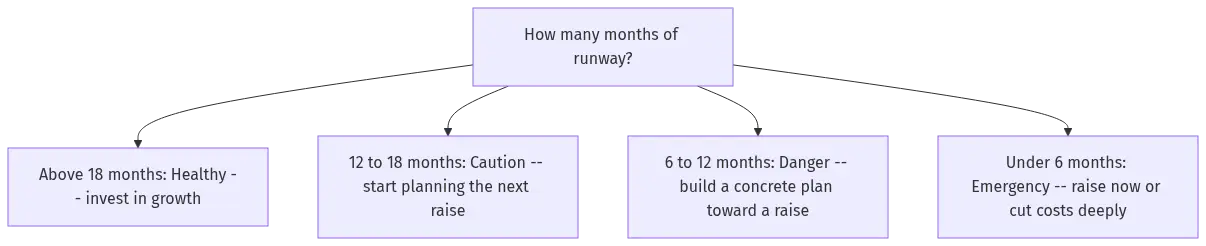
Runway isn’t a single tripwire — it’s a ladder, and where you sit on it should dictate what you do. The mistake I see most often is treating runway as a number you only look at when it’s already low. By then your options have collapsed. The CEOs who stay in control read the ladder from the top and act at each rung, not at the bottom.
Here’s the framework I use. The thresholds aren’t laws of physics, but the logic behind them is durable:
| Months of Runway | What It Means | What to Do |
|---|---|---|
| 18+ months | Position of strength | Invest deliberately; you can fundraise on your terms, not out of need |
| 12–18 months | Healthy, watch closely | Build the plan now: line up the next raise or a path to breakeven |
| 6–12 months | Caution zone | Act, don't wait. Start the raise or begin trimming the cost base |
| Under 6 months | Danger zone | Emergency mode: raise on whatever terms you can get, or cut hard and fast |
The reason these thresholds matter is timing lag. The two things that fix a runway problem — raising money and cutting costs — both take months to work. A fundraise typically takes three to six months from first meeting to cash in the bank. Meaningful cost cuts take a full quarter to show up in your actual bank balance, because severance, notice periods, and contract wind-downs all delay the savings.
Do the arithmetic on that lag. If you wait until you have four months of runway left to start reacting, you cannot finish a normal fundraise before you hit zero, and you cannot cut your way to safety fast enough either. Your only remaining options are a forced round — raising on punishing terms because you have no leverage — or layoffs deep enough to damage the business. Both are avoidable, but only if you act from the higher rungs. The whole purpose of the ladder is to make you move while moving is still cheap.
A note on the specific dollar figures and month thresholds in this article: they’re illustrative and reflect typical conditions at the time of writing. They show relative relationships — how runway responds to a change in burn, how the fundraise lag compresses your options — not fixed targets. The right runway buffer shifts with the funding environment, so verify current norms for your stage before making decisions.
The Four Levers That Extend Runway
When you decide you need more runway, there are exactly four ways to get it. Every tactic you’ve ever heard of is a version of one of these. Knowing the full set keeps you from fixating on the obvious one (raise money) while ignoring the others.
The math makes the options clear. Runway is cash divided by net burn, so you can only extend it by increasing the numerator or shrinking the denominator:
- Raise more cash (increase the numerator). New equity or debt directly adds to the bank balance. It’s the most visible lever and often the right one — but it’s also the slowest and the most dilutive, and it’s hardest to pull exactly when you need it most. Raising from a position of strength (high on the ladder) gets dramatically better terms than raising in the danger zone. For when debt is the smarter instrument than equity, see venture debt and the broader options in SaaS debt financing.
- Cut costs (shrink the denominator). Reducing your cash operating expenses lowers net burn, which stretches every remaining dollar further. This is the fastest lever you control unilaterally — but it’s also the one with the longest delay between decision and bank-balance impact, and cutting too deep can damage the growth engine you’re trying to fund.
- Grow revenue faster (shrink the denominator from the other side). Every additional dollar of monthly recurring revenue that drops to cash reduces net burn one-for-one. A company that adds $40,000 of monthly recurring revenue has cut its net burn by $40,000 without touching a single expense. This is the healthiest lever because it extends runway and builds the business — but it’s the least reliable on a short timeline.
- Improve cash timing (a hidden numerator lever). This is the one founders forget. Moving customers from monthly to annual prepaid contracts pulls a full year of cash forward into your bank account today. Tightening collections, invoicing earlier, and negotiating longer payment terms with your own vendors all shift the timing of cash without changing the underlying economics. A single large annual prepay can add months of runway overnight — pure cash-timing, no dilution, no cuts.
A worked example ties the levers together. Take our 16-month company — $2,400,000 in the bank, $150,000 monthly net burn. Suppose you trim $30,000 of monthly costs and convert two customers to annual prepay, adding $200,000 of cash up front. New net burn is $120,000; new cash is $2,600,000:
Extended Runway = $2,600,000 ÷ $120,000 = 21.7 months
Two moderate levers, neither of them a fundraise, turned 16 months of runway into nearly 22 — almost six extra months bought without raising a dollar of new equity. That’s the kind of optionality that keeps you off the bottom rungs of the ladder.

Runway and the Fundraising Calendar
The most expensive mistake in all of startup finance is raising money when you’re almost out of it. The cure is to treat your runway as a fundraising calendar, working backward from the wall.
Here’s the logic. A fundraise takes three to six months. Investors can smell desperation, and desperation craters your terms — when a VC knows you have ninety days of cash left, they hold all the leverage on price, board seats, and liquidation preferences. The way to avoid that is to start your raise while you still have leverage, which means starting from a high rung on the ladder, not a low one.
Work the timeline backward:
| If you want to close a round with… | Start the raise when runway hits… | Why |
|---|---|---|
| Comfortable buffer | ~18 months | A 3–6 month raise still leaves you 12+ months if it slips |
| Acceptable buffer | ~12 months | Workable, but a slow raise eats into your safety margin |
| No buffer (avoid) | ~6 months | You're now negotiating from weakness; terms suffer |
The pattern is the same one underneath the runway ladder: act from strength. Eighteen months of runway means you can walk away from a bad term sheet, run a competitive process, and close when the terms are right — because you don’t need the money yet. Six months of runway means you take what you’re offered. The difference between those two positions is often the difference between a clean round and giving away an outsized chunk of your company.
This is also why the bootstrapped or lightly funded CEO this article is written for has a structural advantage. If you’re capital-efficient and close to breakeven, you may never have to raise — which means when you do raise, it’s a choice made from maximum strength. Runway, in that case, isn’t a countdown to a forced decision. It’s a war chest that lets you fundraise only when it’s clearly worth it. The metrics that prove that efficiency to investors — burn multiple, LTV/CAC ratio, and the rest of your SaaS unit economics — are what turn a long runway into a strong negotiating position.
Default Alive vs Default Dead: The Runway Question Underneath
There’s a reframe that cuts through every runway calculation, and it’s worth running on your own company today. Ask one question: on your current trajectory — current burn, current growth rate, no new funding — do you reach cash-flow breakeven before your runway runs out?
If yes, you’re default alive. Your existing momentum carries you to safety even if you never raise another dollar. Your runway isn’t a countdown to a crisis; it’s a buffer that gives you choices. You can raise to grow faster, but you don’t have to.
If no, you’re default dead. On your current path, your runway runs out before you reach breakeven, which means your survival depends on something outside your control — another round, an acquisition, or a change in trajectory you haven’t engineered yet. You can still be a great company. But you are not in control of your own fate, and the most dangerous thing you can do is not know it.
The reason this matters for runway specifically: default-dead companies experience runway as a deadline, while default-alive companies experience it as a buffer. Same number of months, completely different meaning. Most founders never run the calculation, which is exactly how they end up surprised when the wall arrives faster than the breakeven date.
If you run it and find you’re default dead, you have precisely two levers — the same two from the runway-extension framework, viewed through this lens. Either grow faster (raise net new recurring revenue enough to bend the line to breakeven before the wall) or burn less (cut the cost base to push the wall out past your breakeven date). Knowing which lever you’re pulling, and starting early enough that the lag doesn’t kill you, is most of the job. For the capital-efficient CEO building toward a $25M–$100M exit rather than a billion-dollar moonshot, default alive should almost always be the goal.
Stress-Test Your Runway Before You Need To
The runway number on your dashboard today is a best-case number. It assumes revenue holds and nothing breaks. The CEOs who get blindsided are the ones who only ever look at the base case. The fix is to run a downside scenario now, while you have time to act on what it tells you.
The exercise is simple. Take your current runway and ask: what happens to it if revenue drops 30% in a downturn? Because when revenue falls, your net burn rises — the cash that was offsetting your spending shrinks, so you lose more each month, and your runway collapses faster than the revenue drop alone would suggest.
Walk through two companies, both showing 16 months of runway today, both with $2,400,000 in the bank:
| Company A (lean cost base) | Company B (heavy cost base) | |
|---|---|---|
| Monthly cash in (revenue) | $90,000 | $300,000 |
| Monthly cash out (gross spend) | $240,000 | $450,000 |
| Net burn today | $150,000 | $150,000 |
| Runway today | 16 months | 16 months |
| Revenue after a 30% drop | $63,000 | $210,000 |
| New net burn after the drop | $177,000 | $240,000 |
| Runway after the drop | ~13.6 months | ~10 months |
On today’s dashboard, these two companies look identical — same net burn, same runway. But Company B’s heavier reliance on revenue to offset a bigger cost base makes its runway far more fragile. The same 30% revenue dip costs Company A about two and a half months of runway and costs Company B a full six months.
The lesson isn’t that one company is doomed — it’s that the runway number alone hides your fragility. The bigger your gross spending relative to your revenue, the more violently your runway swings when revenue moves against you. Run the downside scenario on your own numbers. If a survivable-looking 16 months turns into a scary 10 under a moderate revenue drop, you want to know that while you still have 16 months to do something about it — not after the drop has already happened. (This same gross-versus-net dynamic is the core of how you read your overall SaaS financial model.)
Common Cash Runway Mistakes
The same handful of errors show up over and over. Each one is avoidable once you’ve seen it named.
- Calculating runway off gross spend instead of net burn. Using total expenses instead of net burn (expenses minus revenue) understates your runway and leads to panic cuts that weren’t necessary. Use net burn in the denominator.
- Using a single distorted month. One month with an annual renewal or a tax payment can make your burn — and therefore your runway — look far worse or better than reality. Always use a trailing three-month average.
- Only checking runway when it’s already low. Runway is a top-of-the-ladder tool. If the first time you look hard at it is at six months, your good options are already gone. Read it from 18 months out.
- Forgetting the fundraise lag. A raise takes three to six months. Starting it at four months of runway mathematically guarantees a forced round. Back the start date off the wall, not off your optimism.
- Ignoring cash-timing levers. Founders fixate on “raise or cut” and forget that annual prepays, tighter collections, and longer vendor terms can buy months of runway with no dilution and no layoffs.
- Never stress-testing the downside. The runway on your dashboard is the best case. If you haven’t modeled what a revenue drop does to it, you don’t actually know how much margin of safety you have.
- Never running the default-alive check. If you don’t know whether your current trajectory reaches breakeven before your runway ends, you don’t know whether your company controls its own survival.
Frequently Asked Questions
What is cash runway?
Cash runway is the number of months your company can keep operating before it runs out of cash, assuming your spending and revenue stay roughly constant. You calculate it by dividing the cash in your bank account by your monthly net burn (cash out minus cash in). If you have $2 million in the bank and lose $100,000 a month, your cash runway is 20 months. It’s the clock every other strategic decision runs against.
How do I calculate cash runway?
Divide cash in the bank by monthly net burn: Cash Runway = Cash ÷ Net Burn. For example, $2,400,000 in the bank ÷ $150,000 monthly net burn = 16 months. Use a trailing three-month average for net burn rather than a single month, which can be distorted by one-time payments like annual renewals or quarterly taxes. Net burn — not gross spending — is the correct denominator.
How much cash runway should a SaaS company have?
The durable rule of thumb is to keep at least 12 months of runway at all times and ideally 18 to 24 months, especially before any move that spikes burn. The reason is timing: a fundraise takes three to six months and cost cuts take a quarter to show up in the bank. Eighteen-plus months lets you fundraise from strength rather than desperation, which is often the difference between a clean round and a forced one.
What’s the difference between cash runway and burn rate?
Burn rate is how fast you spend money — dollars per month. Cash runway is how long that spending can continue before you run out — months remaining. Runway is simply your cash balance divided by your net burn rate, so the two are directly linked: a higher burn rate shortens your runway, and a lower one extends it. Burn measures speed; runway measures the distance to the wall.
How can I extend my cash runway?
There are four levers: raise more cash, cut costs to lower net burn, grow revenue to lower net burn from the other side, and improve cash timing by moving customers to annual prepaid contracts and tightening collections. The cash-timing lever is the most overlooked — a single large annual prepay can add months of runway with no dilution and no layoffs. Often the best move combines a modest cost trim with a cash-timing improvement rather than rushing to raise.
When should I start fundraising based on my runway?
Start your raise while you still have leverage — ideally around 18 months of runway, and no later than 12. A fundraise takes three to six months, so beginning at six months or less forces you to negotiate from weakness, which craters your terms. Starting from a strong runway position lets you run a competitive process and walk away from bad term sheets, because you don’t yet need the money.
Cash runway is the number that turns every strategic question into a question about time. Calculate it correctly off net burn, read the ladder from the top so you act while acting is still cheap, know all four levers you can pull to extend it, and stress-test it against a bad quarter before the bad quarter arrives. Above all, run the default-alive check: is your runway a countdown to a forced decision, or a buffer that gives you choices? The CEOs who can answer that — clearly, and early — are the ones who never get surprised by the wall.