

The compound annual growth rate is the single number that turns four messy years of revenue into one clean line an investor can read in two seconds. If your company went from $4 million to $12 million in three years, your compound annual growth rate (CAGR) was about 44% — and that one figure will do more to frame your valuation conversation than any individual year inside it. That’s the power of CAGR, and also its danger: it is a smoothing tool, and smoothing hides things.
Most founders can quote last year’s growth rate to one decimal place but stumble when an acquirer asks for the three-year CAGR. That’s backwards. A buyer paying you a multiple of revenue isn’t buying last quarter — they’re buying a trajectory, and CAGR is the language they use to describe it. This guide treats compound annual growth rate as what it actually is for a SaaS CEO: not a vanity stat, but a benchmarking and valuation instrument you should understand cold — including the formula, the worked math, the things it deliberately hides (churn, a decelerating final year), and exactly how it relates to ARR growth, the Rule of 40, and the forward multiple a buyer will put on your business.

What Is Compound Annual Growth Rate?
Compound annual growth rate is the steady year-over-year rate that would take you from a starting value to an ending value over a given number of years, as if you grew the exact same percentage every year. It answers one question: “If my growth had been perfectly smooth, what annual rate would have gotten me here?”
The key word is compound. CAGR doesn’t average your yearly growth rates — it compounds them, the same way interest compounds in a savings account. Each year’s growth builds on the prior year’s larger base. That’s why you can’t just add up your annual growth rates and divide by the number of years. That shortcut (the “arithmetic average”) almost always overstates your real growth, sometimes badly.
Think of CAGR like the average speed on a road trip. You may have crawled through traffic for an hour and then hit 80 mph on the open highway, but “we averaged 52 mph” is the number that actually predicts when you’ll arrive. CAGR is the average speed of your revenue — it ignores the traffic jams and the open stretches and gives you the one rate that connects where you started to where you ended.
The Compound Annual Growth Rate Formula
Here is the formula every SaaS CEO should have in their head:
CAGR = (Ending Value ÷ Beginning Value) ^ (1 ÷ Number of Years) − 1
Three inputs, nothing more:
- Beginning Value — your revenue (or ARR, or customer count) at the start of the period.
- Ending Value — the same metric at the end of the period.
- Number of Years — the count of full years between the two values, not the number of data points. This is the single most common place people get CAGR wrong, and we’ll come back to it.
The ^ (1 ÷ Number of Years) part is taking a root — it’s the mathematical move that “undoes” the compounding and hands you back the steady annual rate. You don’t need to do it by hand; any spreadsheet does it in one cell.
In Excel or Google Sheets:
=(Ending_Value / Beginning_Value)^(1/Years) - 1
Format the cell as a percentage and you’re done. There’s also a built-in RRI function: =RRI(Years, Beginning_Value, Ending_Value) returns the identical answer.

A Worked Example: CAGR in Action
Let’s run real SaaS numbers. Say your annual recurring revenue looked like this over four year-end snapshots:
| Year-End | ARR | That Year's Growth |
|---|---|---|
| Year 0 (start) | $4,000,000 | — |
| Year 1 | $6,000,000 | +50.0% |
| Year 2 | $9,000,000 | +50.0% |
| Year 3 | $12,000,000 | +33.3% |
You grew from $4M to $12M. There are three years between Year 0 and Year 3 (Year 0→1, Year 1→2, Year 2→3) — three growth steps, not four. Plug it in:
CAGR = ($12,000,000 ÷ $4,000,000) ^ (1 ÷ 3) − 1 CAGR = (3) ^ (0.3333) − 1 CAGR = 1.4422 − 1 = 0.4422, or about 44.2%
So your three-year compound annual growth rate is 44.2%. Now compare that to what you’d get by averaging the annual rates the naive way:
(50.0% + 50.0% + 33.3%) ÷ 3 = 44.4%
Close in this case — but only because the year-to-year rates were similar. Watch what happens when growth is lumpy. Suppose instead you grew 100% in Year 1, 100% in Year 2, and then a flat 0% in Year 3 (a stall). The arithmetic average says (100% + 100% + 0%) ÷ 3 = 66.7%. But the actual journey was $4M → $8M → $16M → $16M, and the true CAGR is ($16M ÷ $4M)^(1/3) − 1 = 58.7%. The simple average overstated your growth by eight full points and completely buried the fact that you stalled in the final year. That gap is the whole reason acquirers insist on CAGR instead of an average.
CAGR vs. ARR Growth Rate: Don’t Confuse Them
This trips up a lot of CEOs, so let’s be precise. CAGR and your ARR growth rate measure related but different things.
ARR growth rate is a single-period measurement: this year’s ARR versus last year’s ARR. Its formula is simpler — (Current ARR − Prior ARR) ÷ Prior ARR — and it tells you how fast you grew over one specific window. It’s the number you put on a monthly or quarterly dashboard, and it’s volatile by design: it spikes when you land a whale and sags when a big customer churns.
CAGR is a multi-period measurement that smooths several of those single-period rates into one annualized figure. It tells you the trend across years, not the result of any single year.
| ARR Growth Rate | Compound Annual Growth Rate (CAGR) | |
|---|---|---|
| What it measures | Growth over one period (usually year-over-year) | Smoothed annual growth across multiple years |
| Formula | (Current − Prior) ÷ Prior | (Ending ÷ Beginning) ^ (1 ÷ Years) − 1 |
| Volatility | High — moves with every big deal or churn event | Low — designed to flatten the noise |
| Best for | Operating dashboards, quarterly board updates | Valuation decks, multi-year benchmarking, investor pitches |
| Hidden risk | Can look alarming on a bad quarter | Can hide a bad final year inside a strong average |
The practical rule: use your single-period growth rate to run the business and CAGR to describe the business to outsiders. A buyer evaluating a five-year acquisition thesis cares far more about your three- or five-year CAGR than whether last quarter was up 6% or 9%. For the broader set of numbers that sit alongside both, see the full rundown of SaaS growth metrics and the core SaaS metrics every CEO should track.

What CAGR Deliberately Hides
CAGR is honest about the endpoints and silent about everything in between. That’s a feature when you want a clean trend line and a bug when the middle of the story matters. Three things it hides, in particular:
It Hides a Decelerating Final Year
A 40% three-year CAGR could mean you grew a steady 40% every year — or it could mean you grew 70%, then 40%, then 15%. To an investor those are two completely different companies. The first is accelerating into the exit; the second is running out of road. Because forward valuation multiples are driven by next year’s expected growth, not the average of the last three, a buyer who only sees the CAGR will dig for the year-by-year breakdown immediately. Always present the underlying years alongside the headline CAGR — if you don’t, the buyer will assume you’re hiding the deceleration, even when you’re not.
It Hides Churn
This is the one that bites SaaS CEOs hardest. CAGR is built on net numbers — your ending ARR already has churn baked out of it. A company growing ARR at a 35% CAGR while losing 20% of its revenue to churn every year is working twice as hard as a company hitting the same 35% with 5% churn, and it’s a far riskier business. The CAGR looks identical; the engines underneath are not. This is why churn never shows up in a growth-rate conversation but always shows up in a valuation conversation. Before you celebrate a strong CAGR, pressure-test it against your gross and net revenue retention — if you’re growing fast on top of heavy churn, you’re filling a leaky bucket faster, not fixing it. (For the mechanics of how small retention changes compound, the discipline is the same compounding math that drives CAGR itself — it just runs in reverse.)
It Hides How Much It Cost
A 50% CAGR bought with brutally inefficient sales spend is not the same asset as a 50% CAGR bought efficiently, even though the growth line is identical. CAGR says nothing about the EBITDA you burned to get there. That’s precisely the gap the Rule of 40 exists to close — which brings us to the most important relationship CAGR has.
How CAGR Connects to the Rule of 40
Growth rate alone is half a sentence. The Rule of 40 finishes it. The Rule of 40 says a healthy SaaS company’s growth rate plus its EBITDA margin should sum to at least 40%. A company growing 30% with 10% EBITDA margins clears the bar. So does one growing 50% while losing money at −10% margins. Any combination that adds to 40 or more counts.
Rule of 40 = Revenue Growth Rate (%) + EBITDA Margin (%) ≥ 40%
Here’s why this matters for CAGR. When you walk into a room with an investor, a bank, or an acquirer, the single most powerful sentence you can lead with is that you are a Rule of 40 company. They sit through dozens of pitches; that one line gets you to the top of the pile because it embodies a whole stack of other KPIs in four words. It tells them, instantly, that your growth isn’t being purchased with reckless losses.
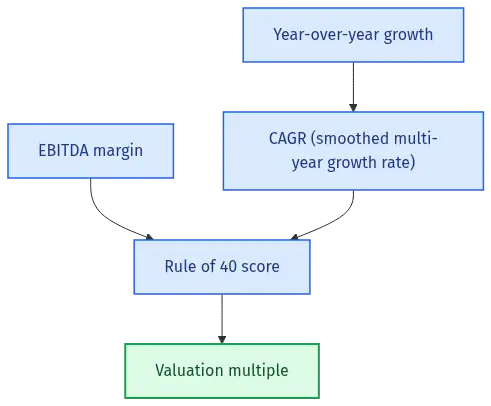
But you have to feed the Rule of 40 the right growth number. Use a single volatile quarter and the math swings wildly. Use a smoothed CAGR over your recent trailing period and you get a defensible, representative growth figure to pair with your EBITDA margin. CAGR supplies the first half of the Rule of 40 in a form that holds up under scrutiny. Think of the relationship as a chain: your year-by-year results compound into a CAGR, the CAGR plus your margin produces your Rule of 40 score, and the Rule of 40 score is the shorthand a buyer uses to decide how seriously to take you.
How CAGR Drives Your Valuation Multiple
SaaS businesses are valued on a multiple of revenue, and growth rate is one of the biggest levers on that multiple — frequently the single biggest one. A low growth rate is a documented valuation killer: if you’re not a Rule of 40 company, you get a lower multiple, full stop. Two companies with identical ARR can sell for wildly different prices, and the gap is driven by a handful of factors — gross margins, risk, and above all the durability of growth.
This is where your CAGR earns its keep. When an acquirer applies a forward revenue multiple, they’re really asking: “Can I count on this growth continuing?” A strong, steady CAGR is evidence that you can. A strong but erratic one — great years bracketing a stall — invites a discount, because erratic growth reads as risk, and risk compresses multiples. The smoothing that makes CAGR useful as a summary is exactly what makes the underlying consistency so persuasive when it’s genuinely there.
There’s a timing implication most founders miss. The growth trajectory a buyer cares about is the one leading into the sale. If you know you’ll go to market in two years, the CAGR you’re building right now is the one that will price the deal. Growth you bank today compounds into the headline number on your future data room. That’s an argument for protecting growth in the years immediately before an exit, even at some cost to short-term profit — the compounding works in your favor, and the buyer is paying for the slope of the line at the moment they look at it.
A note on benchmarks and time-sensitive figures: The growth-rate thresholds, retention ranges, and valuation-multiple references in this article are illustrative and reflect general SaaS market conditions at the time of writing. They’re included to show relative relationships — how growth, churn, and margin trade against one another — not as current market quotes. Multiples in particular move with the broader funding environment. Verify current benchmarks against recent SaaS Capital or KeyBanc survey data before pricing a real decision.
How to Calculate Compound Annual Growth Rate the Right Way
A short checklist to keep your CAGR honest:
- Pick one consistent metric. Calculate CAGR on ARR, or GAAP revenue, or customer count — never mix them across the period. Most SaaS CEOs should run it on ARR, because that’s the number buyers underwrite.
- Use clean, comparable endpoints. The beginning and ending values must be measured the same way (same definition of recurring revenue, same point in the fiscal year). A definitional change mid-period will corrupt the result.
- Count years, not data points. Going from a Year‑0 value to a Year‑3 value is three years of growth, not four. Off-by-one here is the most common CAGR error and it inflates your number.
- Match the window to the question. A three-year CAGR smooths recent performance; a five-year CAGR shows durability through a full cycle. Buyers often want both. Pick the window that honestly represents the trajectory — don’t cherry-pick a start year that happens to be a trough.
- Always show the years underneath. Present the CAGR and the year-by-year sequence. A headline rate with no supporting detail invites suspicion that you’re smoothing over a bad year.
Run those five steps and your CAGR becomes a number you can defend in a data room rather than one that unravels under the first follow-up question.
Frequently Asked Questions
What is a good compound annual growth rate for a SaaS company?
It depends entirely on stage. A company at $1M–$3M ARR should be posting a CAGR well above 60–80%, because growing fast off a small base is expected. By $10M–$15M ARR, sustaining a 40%+ CAGR is strong and increasingly rare. The more useful test isn’t the raw CAGR — it’s whether your growth rate plus your EBITDA margin clears the Rule of 40. A 35% CAGR with healthy margins beats a 45% CAGR funded by deep losses in almost every buyer’s eyes.
Can compound annual growth rate be negative?
Yes. If your ending value is lower than your beginning value, the CAGR is negative — it expresses the steady annual decline that would connect the two points. A negative CAGR over multiple years is a serious signal: it usually means churn is outrunning new sales, and it caps your valuation hard.
What’s the difference between CAGR and CMGR?
CMGR is the compound monthly growth rate — the same formula applied month over month instead of year over year. Early-stage SaaS companies often track CMGR because annual numbers are too coarse when you’re growing fast off a small base. The formula is identical; only the period changes: (Ending ÷ Beginning) ^ (1 ÷ Number of Months) − 1. As you scale past a few million in ARR, the conversation shifts back to annual figures, because that’s the cadence investors and acquirers underwrite.
Should I use CAGR or year-over-year growth on my board deck?
Both, for different jobs. Show year-over-year growth so the board sees recent momentum and can react to it. Show a trailing two- or three-year CAGR so they can see the trend without overreacting to a single noisy quarter. The combination — recent rate plus smoothed trend — is far more honest than either number alone, and it’s exactly how a sophisticated investor reads the business.
Does CAGR account for churn?
Only indirectly. CAGR is calculated on net figures, so churn is already subtracted from your ending value — but the metric never shows you how much churn you absorbed to get there. Two companies with the same CAGR can have radically different churn profiles and therefore radically different risk. Always pair a CAGR with your gross and net revenue retention before drawing any conclusion about the health of the growth.