

Two SaaS companies report the same $1.2 million of net income. One is a clean, efficient operating business that happens to carry a loan. The other is a mediocre operator propped up by a one-time tax benefit and a quarter where interest rates dipped. Net income alone cannot tell them apart — and that is exactly the problem EBIT exists to solve.
EBIT — Earnings Before Interest and Taxes — is your operating profit before the way you financed the business and the tax regime you happen to sit in distort the picture. It answers a single, sharp question: does the core operation actually make money? Strip out how you funded the company (interest) and which jurisdiction taxes you (taxes), and you are left with the profit the business produces from running, before the capital structure and the IRS get a vote.
For a SaaS CEO between $2M and $25M in annual recurring revenue (ARR), EBIT matters for two reasons that have real money attached. First, it is how acquirers and lenders measure whether your business is genuinely profitable or just looks that way. Second, getting EBIT wrong — or confusing it with EBITDA, which is the more common SaaS mistake — can swing a valuation conversation by millions. This guide gives you the formula, the worked SaaS math, the EBIT-versus-EBITDA distinction that trips up most founders, and the specific places SaaS accounting makes EBIT misleading if you do not adjust for them.

What EBIT Actually Measures
EBIT stands for Earnings Before Interest and Taxes. It is operating profit — what is left after you subtract every cost of running the business except the interest you pay on debt and the income taxes you owe.
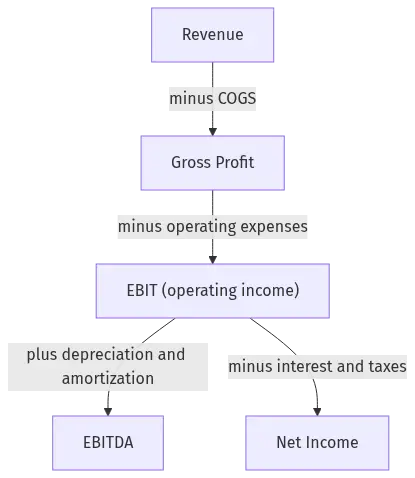
Here is the cleanest way to build it, working down from the top of the income statement (your profit-and-loss statement, or P&L):
EBIT = Revenue − Cost of Goods Sold (COGS) − Operating Expenses
Where:
- Revenue is your total revenue for the period — for most SaaS companies this is overwhelmingly recurring subscription revenue, plus any implementation or services revenue.
- COGS is the direct cost of delivering the service: hosting and infrastructure, the customer support team that keeps accounts live, third-party software embedded in your product, and direct DevOps. Subtract COGS from revenue and you get gross profit.
- Operating Expenses (OpEx) are everything else it takes to run the company: sales and marketing (S&M), research and development (R&D), and general and administrative (G&A). These are not part of delivering the product — they are part of running the business.
Subtract all three and you have EBIT. There is a second, equivalent way to arrive at the same number that is worth knowing, because it shows why EBIT is useful:
EBIT = Net Income + Interest Expense + Tax Expense
This is the “build-up” version. You take the bottom line (net income), then add back the two things EBIT deliberately ignores — interest and taxes — to recover the operating profit underneath. Both formulas give you the same number. The first shows you what EBIT is (operating profit). The second shows you what EBIT removes (financing and tax effects).
This is, at its core, the Profitability Framework every operator should have in their head: profit is just revenue minus costs, and the discipline is breaking those costs into the right buckets. EBIT is the version of profit that isolates the buckets you control as an operator — and sets aside the two big ones you mostly do not control month to month: how the business was financed and how it is taxed.

Why EBIT Strips Out Interest and Taxes
The whole point of EBIT is comparability. Interest and taxes are real cash costs — nobody is pretending they do not matter. But they say almost nothing about whether the operation is good.
Interest is a function of how you financed the company, not how well it runs. Two identical SaaS businesses can have wildly different interest expense purely because one raised equity and one took on venture debt. If you raised $5M in venture debt to extend runway, you carry interest expense that an equity-funded competitor does not — but your underlying operation is no worse. EBIT removes that difference so you can compare the two businesses on operating merit. (If debt is on your mind, the mechanics of how venture lenders structure interest and amortization are covered in our guide to SaaS debt financing.)
Taxes are a function of your jurisdiction, your loss carryforwards, and timing — not operating quality. A company sitting on years of accumulated losses might pay almost no tax this year. A profitable competitor in a high-tax state pays a lot. One could even post a higher net income purely because of a one-time tax benefit, while being the weaker operator. EBIT removes that noise too.
What is left after removing both is the number that answers the question that actually matters when someone is deciding whether to buy, fund, or lend to you: once we own this business and refinance it our way and run it through our own tax situation, how much operating profit does it throw off? That is why EBIT — and its close cousin EBITDA — sit at the center of nearly every acquisition and lending conversation.
EBIT vs. EBITDA: The Distinction That Costs SaaS Founders Money
This is the single most important section of this guide, because the EBIT-versus-EBITDA confusion is where SaaS founders lose money in valuation conversations.
EBITDA stands for Earnings Before Interest, Taxes, Depreciation, and Amortization. It takes EBIT and adds back two more things: depreciation (the accounting spread-out of the cost of physical assets over their useful life) and amortization (the same idea, but for intangible assets like capitalized software development or acquired customer lists). Both depreciation and amortization are non-cash expenses — accounting entries that reduce reported profit without any cash leaving the building this period.
The relationship is a simple ladder:
EBITDA = EBIT + Depreciation + Amortization
So EBITDA is always greater than or equal to EBIT. The gap between them is the size of your depreciation and amortization (D&A).
| Metric | What it removes from net income | What it answers |
|---|---|---|
| Net Income | Nothing — it is the bottom line | What did shareholders actually keep after everything? |
| EBIT | Interest + Taxes | Is the core operation profitable, independent of financing and tax? |
| EBITDA | Interest + Taxes + Depreciation + Amortization | Roughly, how much cash does the operation throw off before reinvestment and capital structure? |
Here is why the distinction matters for SaaS specifically. Most pure-software companies are asset-light — they own very little physical equipment, so depreciation is small. That means for a typical SaaS business, EBIT and EBITDA are often close together. When they are close, the metric you pick barely changes the answer.
But they diverge — sometimes sharply — in two SaaS situations:
- You capitalize your software development costs. Under the accounting rules, certain R&D spend on building software can be capitalized (recorded as an asset and amortized over several years) rather than expensed immediately. When you capitalize, the cost shows up as amortization in later periods. EBITDA adds that amortization back; EBIT does not. So a company that capitalizes heavily can show a much rosier EBITDA than its EBIT — and a much rosier EBITDA than a competitor that expenses the same R&D immediately. Two companies spending identical dollars on engineering can report very different EBIT and EBITDA purely based on this accounting choice.
- You grew through acquisition. Buy a company and a chunk of the purchase price gets recorded as intangible assets that amortize over years. That amortization depresses EBIT but is added back in EBITDA.
The practical takeaway: when someone quotes you a valuation “multiple,” always ask a multiple of what. SaaS businesses are usually valued on a multiple of ARR or revenue at the growth stages this guide’s reader operates in, but profitability multiples enter the conversation as you scale — and a buyer offering “6× EBITDA” is offering something very different from “6× EBIT” if you carry meaningful amortized software or acquisition intangibles. Know which number is on the table. (For how revenue and profit multiples actually get set, see SaaS valuation multiples and SaaS revenue multiples.)
A time-sensitive note on benchmarks: the specific margin percentages and multiples in this article are illustrative and reflect conditions at the time of writing. They are included to show the relative relationships — how EBIT and EBITDA move against each other, how operating leverage compounds — not as current absolute targets. Verify current benchmarks before you anchor a board conversation to them.
A Worked SaaS Example: From Revenue to EBIT
Numbers make this concrete. Take a SaaS company at $10M in revenue — squarely in the range most of this audience operates in. Here is its P&L for the year.
| Line | Amount | % of Revenue |
|---|---|---|
| Revenue | $10,000,000 | 100% |
| Less: COGS | ($2,500,000) | 25% |
| Gross Profit | $7,500,000 | 75% |
| Less: Sales & Marketing | ($3,500,000) | 35% |
| Less: Research & Development | ($2,000,000) | 20% |
| Less: General & Administrative | ($1,200,000) | 12% |
| EBIT (Operating Profit) | $800,000 | 8% |
| Less: Interest Expense | ($300,000) | 3% |
| Pre-Tax Income | $500,000 | 5% |
| Less: Taxes (21%) | ($105,000) | 1% |
| Net Income | $395,000 | 4% |
Walk it down. Revenue is $10M. After $2.5M of COGS, gross profit is $7.5M, a 75% gross margin — healthy for SaaS. Then come the operating expenses: $3.5M on S&M, $2M on R&D, and $1.2M on G&A, for $6.7M of total OpEx. Subtract that from gross profit:
EBIT = $7,500,000 − $6,700,000 = $800,000
That is an 8% EBIT margin — the operation makes 8 cents of operating profit on every revenue dollar. Now keep going. This company carries $300K of interest expense on some venture debt, leaving $500K of pre-tax income. At a 21% tax rate, taxes are $105K, leaving $395K of net income.
Notice what just happened. The business produced $800K of operating profit (EBIT), but the bottom line was only $395K — and more than half the gap is interest, a financing choice, not an operating result. An equity-funded twin with the same operations and no debt would carry no interest expense, post higher pre-tax income, and report a higher net income on an identical operation. EBIT sees through that. It tells you both companies run the same business.
Now add EBITDA. Say this company capitalized $400K of software development that is amortizing, plus $100K of depreciation on laptops and equipment — $500K of total D&A. Then:
EBITDA = EBIT + D&A = $800,000 + $500,000 = $1,300,000
That is a 13% EBITDA margin versus the 8% EBIT margin. Same company, same year, and the headline profitability number jumped 5 percentage points purely by switching which metric you quote. Neither is “wrong” — but if you do not know which one a buyer or lender is using, you are negotiating blind.

EBIT, the Rule of 40, and How Investors Read You
For the growth-stage SaaS CEO, EBIT does not live in isolation — it feeds the one shorthand investors reach for first: the Rule of 40.
The Rule of 40 says a healthy SaaS company’s revenue growth rate plus its profit margin should sum to at least 40%. A company growing 30% a year at a 10% margin (30 + 10 = 40) passes. So does one growing 50% while losing 10% (50 − 10 = 40), and so does one growing 15% at a 25% margin. The framework deliberately trades growth and profitability off against each other, because at different stages either can be the right lever.
Rule of 40 = Revenue Growth Rate (%) + Profit Margin (%)
The “profit margin” in the Rule of 40 is most often EBITDA margin — that is the convention used here on saasceo.com and the one most private-equity investors apply. But EBIT margin (and free-cash-flow margin) are used too, and the choice matters precisely because of the EBIT-versus-EBITDA gap above. In the worked example, the same company is at a 13% margin on EBITDA or 8% on EBIT — a five-point swing in its Rule of 40 score depending on which profitability number you plug in. When you quote your Rule of 40, state which margin you used. (For the full breakdown, see Rule of 40 and the broader set of SaaS KPIs investors track.)
Here is the part worth internalizing, because it comes straight from how investors actually behave. If you are a Rule of 40 company, that is the first sentence out of your mouth when you talk to an investor, a bank, or an acquirer. It is a big deal. The person across the table is sorting through dozens of pitches, and “we’re a Rule of 40 company” is the one sentence that gets you to the top of the pile — because it embodies, in a single number, both halves of what makes a SaaS business valuable: it is growing and the growth is profitable. Growth-equity and private-equity buyers specifically prize profitable growth, and EBIT is one of the cleanest ways to prove the “profitable” half is real and not an artifact of accounting.
Where SaaS Accounting Makes EBIT Misleading — and How to Adjust
EBIT is only as honest as the P&L underneath it. A few SaaS-specific items routinely distort it. When you present EBIT to a buyer or lender, expect them to “normalize” or “adjust” it for these — and you should do the same before you set your own expectations.
- Capitalized vs. expensed R&D. As covered above, whether you capitalize software development changes EBIT materially. A buyer will look through the accounting choice to understand your real engineering spend. Do not let a generous capitalization policy fool you into thinking your operation is more profitable than it is.
- Stock-based compensation (SBC). Many SaaS companies pay engineers and executives partly in equity. SBC is a real expense that reduces EBIT, but it is non-cash, so “adjusted EBIT” and “adjusted EBITDA” frequently add it back. This is the most-debated add-back in SaaS — a real cost dressed up as non-cash. Know whether your EBIT includes it, because a buyer’s “adjusted” number that strips SBC will look much stronger than your GAAP number, and you want to be the one framing that gap.
- One-time and non-recurring items. A lawsuit settlement, a restructuring charge, a one-off implementation windfall — these are not part of normal operations. Adjusted EBIT removes them so the number reflects the steady-state business. Be ready to itemize them.
- Founder or owner compensation that is above or below market. Common in founder-led companies. If you pay yourself far below market to flatter EBIT, a buyer will adjust it down to a market salary; if you pay yourself far above market, they will adjust it up. Either way the adjusted operating profit is what they value.
The discipline here is the same one that underlies all of this: profit is revenue minus costs, and the work is making sure every cost is in the right bucket and stated honestly. A clean, defensible EBIT — one you can walk a buyer through line by line — is worth more than an inflated one you cannot defend, because the moment a number does not survive scrutiny, the buyer discounts everything you have told them. (For how the rest of the financial picture fits together, see what a SaaS CFO focuses on, and for the margin most SaaS investors actually benchmark, see what counts as a good EBITDA margin.)
EBIT and Your Cost Structure: The Operating Leverage Lever
The most useful thing about looking at EBIT as a percentage of revenue — your EBIT margin — is what it reveals about operating leverage. Operating leverage is the degree to which new revenue drops to the bottom line instead of being consumed by new cost.
Go back to the worked example. Gross margin was 75%, meaning 75 cents of every new revenue dollar is available to cover operating expenses and profit. The reason EBIT margin was only 8% is that S&M, R&D, and G&A ate most of that gross profit. But here is the leverage: much of G&A and a good portion of R&D are relatively fixed — they do not scale one-for-one with revenue. So as revenue grows, if you hold those fixed costs roughly flat, a larger share of each new gross-profit dollar falls through to EBIT.
That is the entire bull case for SaaS profitability at scale. You drive top-line growth without adding proportionally to fixed overhead, and EBIT margin expands. A company at 8% EBIT margin on $10M can plausibly be a 20%+ EBIT-margin business at $30M — not because it got more frugal, but because the fixed-cost base it already paid for is now spread across three times the revenue. Watching EBIT margin trend up as you scale is the single clearest signal that your operating leverage is real. Watching it stay flat or fall as revenue grows is the warning sign that you are buying growth dollar-for-dollar and have no leverage — the same disease capital-efficiency metrics in the SaaS financial model are designed to catch.

Frequently Asked Questions About EBIT
Is EBIT the same as operating income?
For most companies, yes — EBIT and operating income are used interchangeably and usually equal each other. The subtle difference: operating income is strictly revenue minus operating costs, while EBIT technically also includes any non-operating income (like interest earned on cash) before subtracting interest paid and taxes. For a typical SaaS company with little non-operating income, the two numbers are effectively identical. If you see “operating income” on your P&L, treat it as EBIT unless your accountant flags a difference.
Is a higher EBIT always better?
Higher EBIT is better holding growth constant, but for an early-stage, fast-growing SaaS company, a low or even negative EBIT can be the right strategic choice. If you are deliberately reinvesting every dollar of gross profit into S&M and R&D to capture a market, EBIT will be thin or negative by design — and that can be exactly right if the growth and unit economics justify it. This is precisely why the Rule of 40 pairs profit margin with growth rate. The mistake is not low EBIT; the mistake is low EBIT with low growth, which signals an operation that is neither profitable nor expanding.
Should I value my SaaS company on EBIT, EBITDA, or revenue?
At the $2M–$25M ARR range, most SaaS companies are valued primarily on a multiple of ARR or revenue, because growth matters more than current profit and many companies at this stage are not yet meaningfully profitable. EBIT and EBITDA multiples become more central as you scale toward and past the point where profitability is the main value driver — and they dominate in private-equity buyouts of mature SaaS. The honest answer is that a serious buyer looks at all of them, plus growth rate, retention, and gross margin, and triangulates. Know your EBIT and EBITDA so you are never caught flat-footed when the conversation shifts from a revenue multiple to a profit multiple.
What is a good EBIT margin for a SaaS company?
It depends entirely on stage and growth rate, which is why a single benchmark is misleading. A high-growth company reinvesting aggressively might run a slightly negative EBIT margin and be perfectly healthy. A slower-growing, more mature SaaS business should show a clearly positive and expanding EBIT margin — often in the high teens to mid-twenties as a percentage of revenue once operating leverage kicks in. The trend matters more than the level: EBIT margin should be climbing as you scale. If it is flat or falling while revenue grows, your operating leverage is not working.
The Bottom Line on EBIT
EBIT is operating profit with the financing and tax noise stripped out — the cleanest read on whether your core business actually makes money. For a SaaS CEO building toward an exit, it does three jobs: it lets you compare your operation against competitors regardless of how each is funded, it feeds the Rule of 40 score investors use to triage you, and it is the number a buyer will normalize and scrutinize line by line before they decide what you are worth.
Master the two things most founders get wrong. First, know the gap between your EBIT and EBITDA — driven mostly by capitalized software and acquisition intangibles — and never let a buyer quote you a multiple without knowing which one it is on. Second, watch your EBIT margin trend as you scale; a rising margin is operating leverage made visible, and it is one of the most convincing pieces of evidence that your growth is the profitable kind investors pay a premium for.