

The net profit formula is the one piece of accounting math that decides whether your SaaS company is a business or an expensive hobby. Net profit is what’s left of your revenue after every single cost is paid — the salaries, the cloud bill, the sales team, the taxes, the interest on any debt. It’s the bottom line in the most literal sense: the last number on your income statement.
Most technical founders can recite their ARR and their growth rate cold but go quiet when asked, “What’s your net profit?” That’s a problem, because net profit is the fuel for everything you want to do next. You can’t get product-market fit at a price point that throws off enough net profit margin to invest in customer acquisition, and then never look at the resulting profit. The whole point of charging real money is to generate a surplus you can either reinvest into growth or eventually keep as the owner. This article gives you the exact formula, a worked SaaS example with realistic numbers, and — more importantly — the three things about net profit that actually move your valuation when you go to sell.
The Net Profit Formula
Here’s the formula in its simplest form:
Net Profit = Total Revenue − Total Expenses
That’s correct, but it’s too compressed to be useful. “Total expenses” hides everything that matters. The version you should actually carry in your head walks down the income statement one layer at a time:
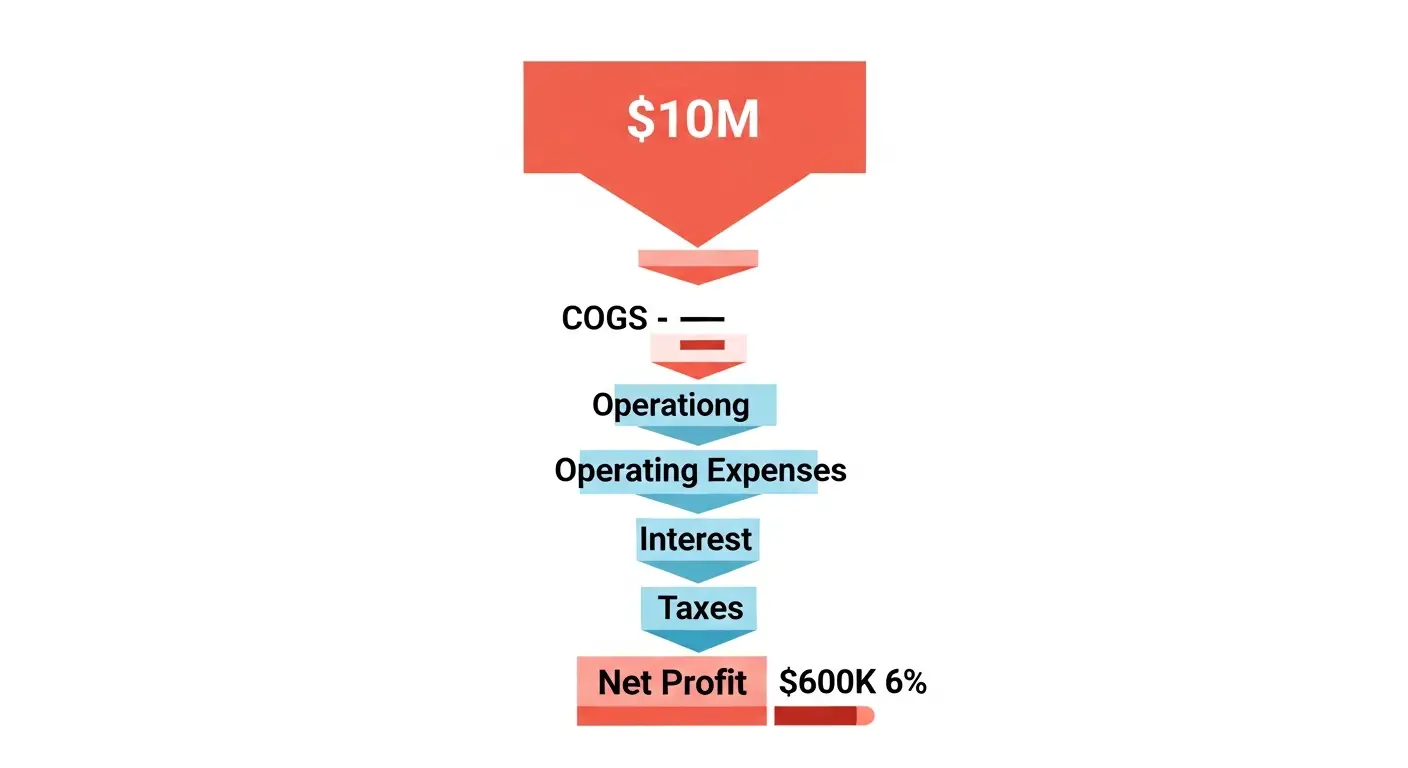
Net Profit = Revenue − COGS − Operating Expenses − Interest − Taxes
Where each term means:
- Revenue — the total recognized sales for the period. For SaaS, this is your recurring subscription revenue plus any one-time fees, recognized in the period they’re earned (not the period you got paid — more on that gap below).
- COGS (Cost of Goods Sold) — the direct cost of delivering your service. For SaaS that’s cloud hosting and infrastructure, your direct customer-support team, third-party APIs embedded in the product, and DevOps. It is not your sales team or your developers building new features.
- Operating Expenses (OpEx) — everything it takes to run the company that isn’t direct delivery: sales and marketing, research and development (your engineering payroll), and general and administrative costs (finance, legal, rent, the CEO’s salary).
- Interest — what you pay to lenders if you’ve taken on debt.
- Taxes — corporate income tax on your pre-tax profit.
Once you have net profit in dollars, you convert it to a percentage so you can compare across periods and against other companies. That’s the net profit margin:
Net Profit Margin = Net Profit / Revenue × 100%
A 10% net profit margin means that for every $1 of revenue, you keep $0.10 after all costs. The dollar figure tells you how much you made; the margin tells you how efficiently you made it. You need both.
Net Profit vs. Gross Profit vs. EBITDA — Stop Confusing Them
The single most common mistake I see founders make is using “profit” to mean three different things in the same conversation. Each layer of the income statement produces a different “profit,” and they answer different questions. Lead with the right one for the decision you’re making.
| Profit measure | Formula | What it answers |
|---|---|---|
| Gross profit | Revenue − COGS | Is the product itself economical to deliver? |
| Operating profit (EBIT) | Gross profit − OpEx | Does the core business make money before financing and tax? |
| EBITDA | Operating profit + Depreciation + Amortization | What's the cash-like operating profit, ignoring accounting non-cash charges? |
| Net profit | Operating profit − Interest − Taxes | What's actually left for the owners after everything? |
EBITDA stands for Earnings Before Interest, Taxes, Depreciation, and Amortization. It strips out two financing decisions (interest, taxes) and two non-cash accounting charges (depreciation, the gradual expensing of physical assets; and amortization, the same for intangible ones). Investors love EBITDA because it lets them compare two companies’ operating performance without getting distracted by how each one is financed or what its tax situation looks like. Net profit, by contrast, includes everything — which makes it the truest measure of what you earned, but a noisier one for comparing two different companies. You want both on your dashboard. For a deeper treatment of where the EBITDA line should land, see our guide on what a good EBITDA margin looks like for SaaS.
The practical rule: when you’re diagnosing whether your product is healthy, look at gross margin and COGS. When you’re diagnosing whether the company is healthy, look at operating profit and net profit.
A Worked SaaS Example
Numbers make this concrete. Take a B2B SaaS company at $10,000,000 in annual revenue — right in the range where most first-time CEOs are trying to figure out whether they’re actually profitable or just busy.
Here’s the income statement, line by line:
| Line item | Amount | % of revenue |
|---|---|---|
| Revenue | $10,000,000 | 100% |
| COGS (hosting, support, APIs) | −$2,000,000 | 20% |
| Gross profit | $8,000,000 | 80% |
| Sales & marketing | −$3,500,000 | 35% |
| Research & development | −$2,200,000 | 22% |
| General & administrative | −$1,300,000 | 13% |
| Operating profit (EBIT) | $1,000,000 | 10% |
| Interest | −$200,000 | 2% |
| Pre-tax profit | $800,000 | 8% |
| Taxes (25%) | −$200,000 | 2% |
| Net profit | $600,000 | 6% |
Walk it down. Revenue of $10M minus $2M of COGS gives $8M gross profit — an 80% gross margin, which is exactly where a healthy SaaS business should be. Then the three big operating buckets come out: $3.5M on sales and marketing, $2.2M on engineering, $1.3M on overhead. That leaves $1M of operating profit, a 10% operating margin.
Now the financing and tax layers. This company carries some debt, so it pays $200K in interest, dropping pre-tax profit to $800K. Apply a 25% tax rate — $200K — and you arrive at the bottom line:
Net profit = $600,000, a net profit margin of 6%.
Notice what just happened. The product is excellent (80% gross margin), the core operation is solidly profitable (10% operating margin), but by the time financing and taxes are paid, the owner is left with 6%. That’s not bad — net margins above 10% are considered strong, and many growing SaaS companies run negative net margins on purpose — but it shows how much gets stripped out between “the product makes money” and “I made money.”
Why Net Profit and Cash in the Bank Are Not the Same Thing
Here’s where founders get burned. You can run a 6% net profit margin and still watch your bank balance fall. Net profit is an accounting number; cash is a real number, and they diverge for three reasons that matter enormously in SaaS.
- Revenue recognition vs. cash collection. When a customer pays you $120,000 up front for an annual contract, you collect $120,000 in cash today — but you only recognize $10,000 of revenue this month. The other $110,000 sits on your balance sheet as deferred revenue. Your net profit this month reflects $10,000; your bank account reflects $120,000. Annual prepay is a cash-flow gift that the net profit formula deliberately ignores.
- Non-cash expenses. Depreciation and amortization reduce your net profit but never leave your bank account — the cash went out when you originally bought the asset. This is exactly why EBITDA exists: to add those charges back and approximate operating cash.
- Things that consume cash but aren’t expenses. Repaying loan principal, buying equipment, and funding growth in accounts receivable all drain cash without ever showing up on the income statement as an expense, so they don’t touch net profit.
The takeaway: net profit tells you whether the business model works; cash flow tells you whether you’ll survive the month. Track both. A company can be profitable on paper and still run out of money, and a fast-growing SaaS company can burn cash for years while building enormous enterprise value. Don’t let a healthy net profit margin lull you into ignoring your runway.

What Net Profit Means for Your Valuation
This is the part most articles on the net profit formula skip entirely, and it’s the part the reader of this site actually cares about: how does net profit affect what your company is worth when you sell it?
The counterintuitive answer is that for a growing SaaS company, low or negative net profit is often the right strategy — as long as it’s a deliberate investment, not a leak. If you can spend $1 acquiring a customer who returns $4 in lifetime value, every dollar of net profit you “give up” to fund that acquisition is buying growth that the market rewards with a higher revenue multiple. This is why so many SaaS businesses run break-even or at a controlled loss for years. The profit is being deliberately reinvested.
The framework acquirers actually use to judge this trade-off is the Rule of 40: your revenue growth rate plus your EBITDA margin should sum to 40% or more. A company growing 30% a year at a 10% margin (40 total) is just as attractive as one growing 20% at a 20% margin (also 40). Both pass. Below 40, you get marked down. This is why net profit margin can’t be read in isolation — a 5% margin is excellent if you’re growing 35%, and alarming if you’re flat. For the full mechanics, see our breakdown of the Rule of 40.
A few specific ways net profit moves your exit value:
- The trend matters more than any single year. I once analyzed a division that had posted a net loss every year for ten straight years — small losses, but losses, despite a decade of trying. No single year looked catastrophic; the trend told the whole story. Acquirers read three to five years of margin history, not one. A 6% margin climbing toward 12% is worth far more than a 12% margin sliding toward 6%.
- Margin quality reveals pricing power. A rising net profit margin at constant growth usually means you’ve found pricing power — the ability to raise prices without losing customers. That’s one of the most valuable things a SaaS business can demonstrate, because it drops almost entirely to the bottom line.
- Profitability changes who will fund you. Lenders and acquirers behave differently depending on whether you’re profitable. Banks generally require profitability and cash-flow-positive operations before they’ll lend; non-bank lenders will fund a company with a credible path to profitability but no profit yet. As you cross into real net profit, cheaper capital opens up — see our overview of SaaS debt financing for how that progression works.
When you model what your company is worth, you’re really modeling the trajectory of net profit and growth together — which is the heart of building a defensible SaaS financial model. For how the broader market translates those numbers into a price, see our guide to SaaS revenue multiples.
How to Improve Your Net Profit Margin
There are exactly four levers, and they map directly to the formula. Pull them in this order:
- Raise prices (improves revenue with near-zero added cost). A price increase flows almost entirely to net profit because it adds revenue without adding COGS or OpEx. This is the highest-leverage move available to most SaaS companies, and most founders under-price for years. Test it before you touch anything else — see our SaaS pricing strategy guide.
- Improve gross margin (cut COGS). If your gross margin is below the mid-80s, your delivery costs are too high — usually too much manual support or inefficient infrastructure. Every point of gross margin you recover is a point closer to the bottom line.
- Make sales and marketing more efficient (cut CAC, not budget). The goal isn’t to spend less on growth — it’s to spend the same and get more. Tightening your ideal customer profile and watching your LTV/CAC ratio does more for long-run net profit than slashing the marketing budget, which just slows growth.
- Restructure financing and tax (reduce interest and tax drag). Refinancing expensive debt into cheaper bank debt once you qualify, or making legitimate use of available tax treatment, recovers the last layers of the formula. These are real but smaller levers than the first three.
The order matters. Cutting expenses to manufacture short-term net profit is the easiest move and usually the worst one — it’s the move that quietly starves growth. Raising prices and tightening unit economics builds net profit that compounds.

Frequently Asked Questions
What is the net profit formula?
Net Profit = Revenue − COGS − Operating Expenses − Interest − Taxes. In its most compressed form it’s simply Total Revenue minus Total Expenses, but the expanded version is what you should use, because it shows exactly where money leaks out between the top line and the bottom line.
How do you calculate net profit margin?
Net Profit Margin = Net Profit / Revenue × 100%. Divide your net profit by your total revenue for the same period and multiply by 100. A company with $600,000 of net profit on $10,000,000 of revenue has a 6% net profit margin.
What is a good net profit margin for SaaS?
It depends entirely on your growth rate. As a general benchmark, net margins above 10% are considered healthy, and software companies tend to land well above the cross-industry average in NYU Stern’s net margin by sector data. But a fast-growing SaaS company deliberately reinvesting profit into customer acquisition may run a low single-digit or even negative net margin and still be highly valuable — provided it passes the Rule of 40 (growth rate + EBITDA margin ≥ 40%).
What’s the difference between net profit and gross profit?
Gross profit (Revenue − COGS) measures whether your product is economical to deliver. Net profit (gross profit minus operating expenses, interest, and taxes) measures what’s actually left for the owners after every cost. Gross profit answers “is the product healthy”; net profit answers “is the company healthy.”
Can a company have net profit but no cash?
Yes — and it’s common in SaaS. Net profit is an accounting figure that ignores the timing of cash. Annual prepayments, deferred revenue, loan principal repayments, and non-cash charges like depreciation all cause net profit and bank balance to diverge. Always track cash flow alongside net profit.
Related reading: Cost of Goods Sold for SaaS · What Is a Good EBITDA Margin? · The Rule of 40 · SaaS Revenue Multiples · LTV/CAC