

Every SaaS CEO knows what MRR and ARR stand for. Far fewer know which one to use in which conversation, how to compute either of them correctly, and why getting the choice wrong with an investor, an acquirer, or your own board costs real money. The honest answer to “MRR or ARR?” is that they are the same underlying metric viewed at two different time scales — but the conversations they belong in, the mistakes they invite, and the signals they send are completely different.
This guide walks through the exact definitions, the formulas, when each metric is the right one to lead with, the four most common ways founders miscalculate them (each one a real money mistake), and a $1.2M ARR worked example so you can see how the same business looks under both lenses. By the end, you’ll know which metric to put on your board deck, which to put in your fundraise, and which one your acquirer is going to recompute from scratch regardless of what you reported.
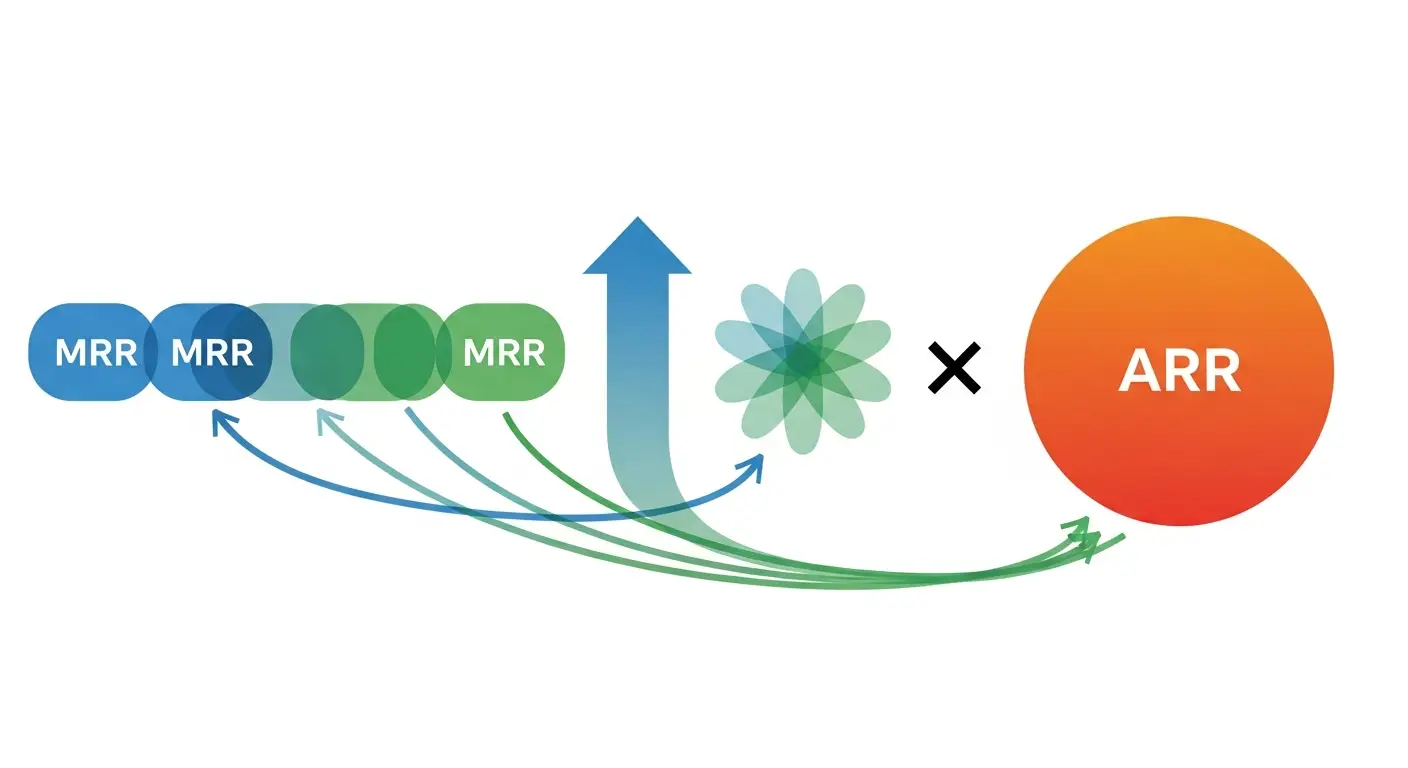
Quick Definitions: What MRR and ARR Actually Are
Monthly Recurring Revenue (MRR) is the dollar amount of recurring subscription revenue your customer base is contracted to pay you in a given month. It is the normalized, monthly view of every active subscription on your books.
Annual Recurring Revenue (ARR) is the same number expressed annually. The formula is mechanically simple:
ARR = MRR × 12
That single equation is the entire mathematical relationship between the two metrics. There is no other adjustment, no annualization factor, no smoothing. If your MRR at the end of May is $100,000, your ARR is $1.2M.
What makes MRR and ARR meaningful — and what makes them dangerous when computed sloppily — is not the multiplication. It is the definition of what counts as “recurring.” Every dollar of revenue your business takes in either belongs in the recurring bucket or it does not, and getting that classification wrong is where most miscalculations start.
What counts as recurring revenue:
- Software subscription fees billed on a contractual, repeating basis (monthly, quarterly, annual)
- Per-seat or per-user fees that renew automatically
- Contractual minimums on usage-based plans (the floor, not the variable portion above the floor)
- Recurring platform or access fees
What does NOT count as recurring revenue:
- One-time implementation fees, even if every new customer pays them
- Professional services revenue (training, consulting, custom development)
- Setup, migration, or onboarding fees
- Transaction fees that vary monthly with volume above any contractual minimum
- Hardware sales
- One-time licenses (non-renewing perpetual licenses)
The recurring/non-recurring line matters because investors and acquirers value the two streams completely differently. Recurring revenue trades at high multiples — often 5x to 12x ARR for healthy SaaS companies in 2026 — because it is predictable and self-renewing. Non-recurring revenue trades at 1x to 2x, sometimes less, because it does not show up automatically next year. Putting professional services into your ARR number does not make your business more valuable. It makes you look like you do not understand your own metrics, which makes your business less valuable.
When to Use MRR vs When to Use ARR
The two metrics describe the same underlying business reality, but they belong in different conversations. Picking the wrong one is not technically incorrect — it is a tell about how mature your operating discipline is.
| Situation | Use MRR | Use ARR | Why |
|---|---|---|---|
| Internal weekly or monthly operating reviews | Yes | No | Month-to-month deltas are the unit of management decisions; multiplying by 12 hides what just happened |
| Board deck headline number | No | Yes | Boards think in annual planning cycles and care about the trajectory, not last week's number |
| Fundraise / pitch deck | No | Yes | Investors benchmark in ARR; using MRR signals you are early-stage or have not raised before |
| Acquisition / strategic exit discussion | No | Yes | Buyers and bankers underwrite in ARR multiples; MRR is not a valuation unit |
| Sales rep quota and commission plans | Often | Sometimes | Monthly compensation cycles align with MRR; multi-year deals are sized in ARR |
| Customer cohort and churn analysis | Yes | No | Cohort behavior moves monthly; rolling up to ARR smooths the signal you need to see |
| Forecasting cash collection | Yes | No | Cash arrives monthly (or whenever billed); ARR is a contracted-not-collected view |
| Public market or investor benchmarking | No | Yes | Industry benchmarks (Rule of 40, NRR, growth rates) are quoted in ARR terms |
The rule of thumb: Run the company in MRR. Talk to the outside world in ARR. The transition happens roughly when you cross $1M ARR — below that, MRR is fine in both contexts because the numbers feel concrete (your $50K MRR business is more legible than your $600K ARR business). Above $1M, ARR becomes the lingua franca of every external conversation, and below-$10M companies that still quote MRR externally come across as small even when they are not.
The MRR Formula — and the Components That Trip Founders Up
The high-level MRR formula is trivial. The component breakdown that drives operating decisions is where the work actually happens.
Beginning MRR + Net New MRR = Ending MRR
Where Net New MRR decomposes into four components — every one of which is worth tracking separately because each one tells you a completely different thing about your business:
Net New MRR = New MRR + Expansion MRR − Contraction MRR − Churned MRR
| Component | What it measures | What it tells you |
|---|---|---|
| New MRR | Subscription revenue from new customers acquired this month | Sales and marketing engine effectiveness |
| Expansion MRR | Additional revenue from existing customers (upsells, cross-sells, seat additions) | Customer success and product expansion ability |
| Contraction MRR | Revenue lost from existing customers who downgraded | Product fit erosion or pricing pressure |
| Churned MRR | Revenue lost from customers who cancelled entirely | Retention problem — the most expensive of the four |
A business with $50K of New MRR per month feels great until you notice that Churned MRR is also $40K — the bucket has a hole in it, and you are running hard to refill it. The headline MRR growth number does not surface that. The component breakdown does.
Expansion MRR is the most under-appreciated of the four. A SaaS business with strong expansion can hit Net Revenue Retention (NRR) above 100% — meaning the existing customer base grows on its own without any new customer acquisition. That dynamic is what separates valuation outliers from average businesses and is why investors look at NRR alongside ARR before they will write a check. (We cover NRR in depth in the NRR vs ARR guide.)
The ARR Formula and the Two Common Variants
ARR mechanically rolls up from MRR:
ARR = Ending MRR × 12
That’s it. There is no other math. The two variants you will see in practice are different ways of stating the same number, not different formulas:
ARR (Snapshot): The most recently completed month’s MRR multiplied by 12. This is the standard, default meaning of “ARR” in board and investor conversations.
ARR Run Rate: Synonymous with ARR (Snapshot) in nearly all contexts. Occasionally used to emphasize that the number reflects the current month’s pace rather than the trailing full-year revenue actually collected. If you see “ARR run rate of $12M,” it means the most recent month’s MRR was $1M.
These differ from another metric that sounds similar but is not the same:
Full-Year Revenue Forecast (sometimes confusingly called “forecast ARR”): A blended figure combining actual MRR for months already completed and projected MRR for the remaining months of the calendar year. Useful for budgeting and planning, but not the same number as ARR and should not be reported as ARR. A business growing 50% year-over-year will have a full-year revenue forecast meaningfully below its ending ARR — both numbers are correct, they just measure different things.
When a CEO says “we are on pace to hit $17.5M in ARR for the full calendar year,” they mean the full-year revenue forecast. When they say “we are at $17.5M ARR” or “$17.5M ARR run rate,” they mean the most recent month × 12. These are very different numbers for a fast-growing business. Mixing them up — especially in a fundraise — destroys credibility.

The Four Most Common Ways Founders Miscalculate MRR and ARR
Most miscalculations are not arithmetic errors. They are classification errors — putting revenue into the recurring bucket that does not belong there, or counting something twice across months. Every one of the four below is a money mistake when it appears in a fundraise or acquisition diligence, because the buyer’s analyst will recompute and the discrepancy will read as either incompetence or deception. Both kill deals.
Mistake 1: Including implementation and one-time fees in ARR
The most common error. A SaaS company signs a customer for $50K/year recurring plus a $30K one-time implementation fee. The first-year revenue is $80K. Many founders report this as $80K ARR. It is $50K ARR. The $30K implementation fee does not recur next year and is not part of the recurring revenue base. An acquirer’s diligence team strips this out immediately, and the resulting discrepancy between reported and actual ARR is one of the most common reasons exit valuations come in below initial offers.
Mistake 2: Counting cancellable annual contracts at face value
A customer signs an “annual contract” worth $24K with a clause allowing them to cancel with 30 days notice. The contracted revenue is not really annual — it is monthly with a polite frame around it. Treating this as $24K of ARR is technically defensible but commercially misleading. Sophisticated investors discount cancellable contracts heavily because the actual probability-weighted ARR is closer to the monthly run rate than the stated annual commitment. The cleanest practice is to report ARR based on revenue you would still be entitled to if every customer exercised their earliest cancellation right.
Mistake 3: Annualizing usage-based revenue above the contractual minimum
A customer signs a contract with a $5K/month minimum and is currently consuming $12K/month at peak volume. The recurring, contractually guaranteed revenue is $5K × 12 = $60K of ARR. The $7K/month variable portion above the minimum is real revenue, and it may be very sticky, but it is not contracted recurring revenue and does not belong in ARR. ARR is the floor, not the run rate. When the customer’s usage drops back to the contractual minimum (and it will, in some seasons), the $7K/month does not.
Mistake 4: Compounding monthly churn to derive an “annual churn rate”
This one is subtler but lethal in cohort analysis. A SaaS founder calculates monthly churn at 2% and reports annual churn as 24% (2% × 12). This is wrong. Churn compounds; it does not multiply. The correct annual churn from 2% monthly is approximately 21.5%, computed as 1 − (1 − 0.02)^12 = 0.2153. The 12-month figure (24%) is roughly 12% too high in relative terms, and when the underlying churn is larger — say, 5% monthly — the compounded annual churn is 46%, not 60%. Using the wrong formula will make your retention look meaningfully worse than it actually is, which costs you in any valuation conversation that benchmarks against industry retention numbers.
A $1.2M ARR Worked Example
Take a real-feeling SaaS business at $1.2M ARR and watch how the same underlying numbers look under both lenses, including each of the four miscalculation traps above.
The setup:
- 200 active customers paying $500/month on average
- One enterprise customer added in May at $2K/month
- Two customers downgraded in May from $500/month to $300/month
- Three customers cancelled in May (combined revenue: $1,400/month)
- New customers paid a combined $15K in one-time implementation fees in May
- One customer on a usage-based plan has a $1K/month minimum but used $2,500 worth of capacity in May
Step 1 — Compute April Ending MRR (April was clean — no movement):
200 customers × $500 = $100,000 MRR
Step 2 — Compute Net New MRR for May:
| Component | Calculation | Amount |
|---|---|---|
| New MRR | 1 enterprise customer × $2,000/month | +$2,000 |
| Expansion MRR | None this month | +$0 |
| Contraction MRR | 2 customers × ($500 − $300) downgrade | −$400 |
| Churned MRR | 3 customers × combined $1,400/month | −$1,400 |
| Net New MRR | +$200 |
Step 3 — Compute May Ending MRR:
$100,000 + $200 = $100,200 MRR
Step 4 — Compute May Ending ARR (correct):
$100,200 × 12 = $1,202,400 ARR
Step 5 — Check what would happen under each miscalculation:
| Mistake | Miscalculated ARR | Overstatement |
|---|---|---|
| Treating the $15K of one-time implementation fees as recurring MRR | ($100,200 + $15,000) × 12 = $1,382,400 | +$180,000 (+15.0%) |
| Including the $1,500/month variable usage above the contractual minimum | ($100,200 + $1,500) × 12 = $1,220,400 | +$18,000 (+1.5%) |
| Misreporting May churn as "annualized" (3 churned customers × 12 = 36 churned/year) | Distorts retention narrative; not a direct ARR error but matches the compounding trap pattern | Varies |
The $180K overstatement from Mistake #1 alone is enough to materially change the valuation conversation. At a 6x ARR multiple (a reasonable mid-range SaaS multiple in 2026), that’s $1.08M of fictional enterprise value the founder is implicitly claiming. The acquirer’s diligence will find it, and the founder loses credibility on every other number they reported.
Note on the multiples cited above: 5x–12x ARR is the broad 2026 range for healthy SaaS businesses, and exact multiples shift with interest rates, growth rate, and segment. The numbers here are illustrative — use them to size the relative impact of mistakes, and confirm current ARR multiples with your banker or a recent comparable transaction before pricing your own business.

How Investors and Acquirers Actually Read MRR and ARR
The reader thinking about a future fundraise or exit needs to understand which audience cares about which metric and what they actually do with the number.
Venture capital and growth equity: Lead with ARR. They underwrite at the ARR multiple level (current ARR × multiple = enterprise value, modulated by growth rate, margin, and NRR). They will ask for the MRR trend chart to verify the ARR number is real and not a one-time spike, but the headline conversation is in ARR terms. They look at the Rule of 40 (growth rate plus EBITDA margin) alongside ARR to assess whether the multiple should be at the high or low end of the range.
Strategic acquirers: Lead with ARR but recompute everything. A strategic buyer’s corporate development team will pull your contracts, classify every line item, and produce their own ARR number that is almost always lower than the one you reported — typically 5–15% lower for businesses that have not gone through this exercise before. The gap reflects implementation fees you counted, cancellable contracts at face value, and usage above minimums. The founders who get the highest multiples are the ones whose self-reported ARR survives diligence unchanged.
Private equity: Sits between VC and strategic in terms of rigor. PE firms benchmark against their own portfolio of SaaS companies and have specific tolerance levels for what they will pay for at each retention and growth profile. They use ARR as the multiplication base but apply discounts for any unusual revenue classification.
Bankers running a sale process: Will normalize your ARR to a defensible number before pitching the business. If you have been reporting an inflated ARR internally, the banker’s number — which they will use in the confidential information memorandum — will look smaller than what your board has been seeing. Better to align reporting with what diligence will reveal long before you hire the banker.
Your board: Cares about ARR for narrative arc (trajectory, growth rate, milestones) and about MRR component breakdown (New, Expansion, Contraction, Churned) for operating control. A board that only sees ARR misses the operating story. A board that only sees MRR cannot tell whether the business is on track to hit the strategic plan.
What to Report Where: The Practical Checklist
For founders trying to set up clean reporting that will survive both internal scrutiny and a future fundraise or sale:
- Pick one definition of “recurring” and write it down. Document explicitly what counts (subscription, contractual minimums) and what does not (implementation, professional services, variable usage above the minimum). Share it with finance, sales, and the board.
- Compute MRR weekly or at minimum monthly, broken into the four components (New, Expansion, Contraction, Churned). The component breakdown is what surfaces operating problems; the headline number alone does not.
- Quote ARR externally in every investor, board, and acquirer conversation once you cross $1M.
- Maintain a separate full-year revenue forecast. This is the number you use for budgeting and cash planning. It is not the same as ARR, even if conversations sometimes blur them.
- Annualize churn correctly. Use 1 − (1 − monthly_churn)^12, not monthly_churn × 12. Apply the same logic to retention rates.
- Audit ARR classification quarterly. Pull the customer list, check that every line categorized as recurring meets the definition you wrote down, and pull out anything that does not belong. This is the single highest-leverage hour of finance work you can do in a quarter.
A SaaS business that gets the recurring-revenue definitions right by $5M ARR walks into its first serious fundraise or strategic conversation with credibility intact. A business that does not has to either talk down its own numbers in real time (painful and unconvincing) or watch the buyer’s diligence team do it for them (worse, and more expensive).
Frequently Asked Questions
Is ARR the same as revenue?
No. ARR is contracted, recurring revenue annualized. Total revenue includes ARR plus non-recurring items like implementation fees, professional services, and variable usage. A $1.2M ARR business with $300K of services revenue has total revenue of $1.5M but ARR of $1.2M. The ARR number is the one that drives valuation.
Is MRR × 12 always the right way to compute ARR?
For a SaaS business with monthly billing and contractual recurring revenue, yes. The formula is exact: ARR = Ending MRR × 12. The complications come from what counts as MRR in the first place (the recurring/non-recurring classification), not from the multiplication.
What is the difference between ARR and ARR run rate?
In nearly all modern usage, they are synonyms. Both refer to the most recent month’s MRR multiplied by 12. The phrase “run rate” emphasizes that the number reflects the current pace rather than trailing-twelve-months collected revenue, but the math is identical.
Should I include annual prepay contracts in ARR or only count 1/12 each month?
ARR represents the annualized recurring revenue base, regardless of billing frequency. A customer on a $24K annual prepay contract contributes $2K to MRR every month and $24K to ARR. The cash showing up in one lump in month one is a cash-flow event, not an ARR event. The metric is about the contracted recurring revenue base, not the timing of collection.
Why do investors care more about ARR than total revenue?
Recurring revenue trades at a much higher multiple than non-recurring revenue because it is predictable and self-renewing. A dollar of ARR is worth significantly more than a dollar of implementation fees because the dollar of ARR shows up again next year automatically, while the implementation fee does not. The valuation math reflects that, which is why ARR became the headline SaaS metric in the first place.
What is a good ARR growth rate?
It depends on your stage and the broader macro environment. At seed and early-stage, growth above 100% year-over-year is the bar. At $10M+ ARR, sustained 40%+ growth is strong, and 25–40% is typical for mature SaaS businesses with attractive margins. The Rule of 40 framework provides a more complete view by combining growth rate with EBITDA margin.
Do I need a sophisticated billing system to track MRR and ARR correctly?
Below $1M ARR, a clean spreadsheet is enough. Above $1M, a dedicated billing platform (Stripe Billing, Chargebee, Recurly) reduces classification errors dramatically because it forces every revenue line to be tagged correctly at the source. The first miscategorized contract you avoid in a future diligence pays for the platform many times over.
The choice between MRR and ARR is not arbitrary, and the calculation is not optional. The most expensive mistake a sub-$10M SaaS CEO can make is to treat the recurring revenue number as a marketing figure rather than the disciplined operating measure that it is — because every sophisticated counterparty downstream (investor, board, acquirer) will treat it that way, and the gap between what you report and what they compute will cost you money. Run the company in MRR, report it to the outside world in ARR, classify every dollar correctly, and the numbers will earn the multiples you want them to earn.