

Most B2B SaaS founders evaluate outbound lead generation services the same way they evaluate a marketing campaign — by reply rates, opens, and “how many meetings did we get?” That framing is wrong. Outbound is not a campaign. It is a synthetic distribution channel you are renting until you can build your own. The right question is whether outbound lead generation services for B2B SaaS make your unit economics better or worse over the next 18 months — not whether last month’s open rate hit 40%.
This guide is written for the founder-CEO of a $2M–$25M ARR B2B SaaS company who is trying to decide three things at once: whether outbound is the right channel for the company at all, whether to outsource it or build it in-house, and how to evaluate vendors like a CEO instead of like a marketing manager. Each section answers one of those decisions with numbers, not platitudes.
What Outbound Lead Generation Services Actually Do
Outbound lead generation services run the parts of a cold-outreach motion that take specialized labor and infrastructure to do well: ICP research, list building and enrichment, message sequencing, multi-channel orchestration, deliverability management, and qualified meeting handoff. The good ones operate as an extension of your go-to-market team. The bad ones operate as a content mill that emails everyone in a vertical and counts replies as wins.
A complete outbound service typically covers:
- ICP definition and refinement — narrowing your Ideal Customer Profile (ICP) by firmographics, technographics, and trigger events
- Contact list building and enrichment — pulling verified contacts from Apollo, ZoomInfo, Clay, LinkedIn Sales Navigator, and proprietary sources
- Multi-channel sequencing — cold email, LinkedIn touches, calls, and increasingly SMS or direct mail for high-ACV motions
- Domain and inbox infrastructure — warm-up, secondary domains, SPF/DKIM/DMARC, and inbox rotation to protect deliverability
- Copy and offer testing — A/B testing subject lines, hooks, and calls-to-action across personas
- CRM integration and reporting — bidirectional sync with HubSpot, Salesforce, or Pipedrive so booked meetings land where your team works
- Qualified meeting handoff — scheduling, no-show recovery, and a structured handoff that gives your closer enough context to run the call
The most useful frame: outbound services are the operations layer for a channel you don’t yet have the team or systems to run yourself. They are not a substitute for product-market fit, a defined ICP, or a closing motion. They are an accelerator for companies that have all three.
Inbound vs. Outbound: When Each Wins
Most CEOs get this comparison wrong because they treat it as a religious debate. It is not. It is a stage and economics question.
Inbound (demand generation, SEO, content, paid acquisition, product-led signups) builds an audience that finds you. It is high-leverage, but it is also slow, capital-intensive, and only works once you have enough surface area for prospects to discover. Inbound is great for scaling demand once awareness exists — and almost useless when you are sub-$5M ARR and unknown in your category.
Outbound (cold email, LinkedIn, calls, targeted account programs) is a proactive motion: you pick the accounts, you reach out, you create the conversation. It is the only growth channel where you can buy predictable pipeline within 60–90 days. It is also the only channel that gives you a usable signal about whether your ICP is real, because every conversation tells you whether the message resonates with the target.
Here is the decision matrix most founders never see:
| Situation | Inbound | Outbound |
|---|---|---|
| Sub-$2M ARR, no category awareness | Slow | Required — outbound is how you learn what messaging works |
| $2M–$10M ARR, defined ICP, no repeatable motion | Compounding but slow | Best ROI channel for the next 18 months |
| $10M–$25M ARR, organic search starting to compound | Scale this | Layer outbound on top to penetrate target accounts |
| Long sales cycle, ACV > $25K | Inbound rarely sufficient on its own | Required for enterprise penetration |
| Short sales cycle, ACV < $5K, SMB volume | Inbound usually wins | Outbound math is fragile — sender economics turn negative fast |
| Brand new market or vertical you're entering | Inefficient | Best validation channel |
The point is not “outbound is better than inbound.” The point is that for a B2B SaaS company in the $2M–$25M range with a defined ICP and an Annual Contract Value (ACV) above roughly $5K, outbound is the most controllable, fastest-feedback channel available — and that is exactly the window where outbound lead generation services for B2B SaaS make sense.
If you have not yet figured out your ICP or your product-market fit (PMF) is shaky, outbound will amplify the problem, not fix it. Sending 10,000 emails to the wrong audience does not produce qualified pipeline; it produces a damaged sender reputation.

The Real Question: Are Your Unit Economics Ready?
Here is where most articles on this topic fail and where any honest CEO conversation has to start. Outbound is a CAC-heavy channel. Every dollar you spend on a vendor, an SDR, a tool, or a list is a Customer Acquisition Cost (CAC) dollar. If your unit economics are broken, outbound makes them more broken, faster.
Run this test before you talk to a single vendor.
Step 1: Calculate your LTV/CAC ratio on your existing book of business.
LTV/CAC = (ARPA × Gross Margin % × Average Customer Lifespan) / CAC
Use fully-loaded CAC (sales comp, marketing spend, tools, allocated overhead). Use realistic lifespan — divide 1 by your monthly churn rate, then convert to months. If you have less than 18 months of data, segment the calculation by cohort.
Step 2: Compare against the rule of thumb.
- LTV/CAC ≥ 3.0× — outbound has room to work. Vendor spend has a math case.
- LTV/CAC 2.0–3.0× — borderline. Outbound has to either come in cheaper than your blended CAC or generate higher-LTV cohorts (segment-level analysis required).
- LTV/CAC < 2.0× — fix unit economics before investing in outbound. A channel that adds CAC without a path to better LTV is a hole, not a lever.
Step 3: Calculate CAC Payback Period.
CAC Payback Period = CAC / (ARPA × Gross Margin %)
In a healthy B2B SaaS company at $5M–$15M ARR, CAC Payback should be in the 12–24 month range. If your payback is already over 30 months, outbound is going to push it past 36, which is the threshold where most boards stop funding the motion.
Step 4: Segment everything.
A blended LTV/CAC of 2.5× usually hides one segment at 4.0× and another at 1.5×. Outbound’s job is to find more of the 4.0× cohort. If you can’t tell me which vertical, contract size, or persona drives your best unit economics, you are not ready to brief a vendor — you are ready to run customer analysis first.
This is the part vendor listicles will never tell you. They want you to think the question is “which vendor?” The real question is “do my unit economics support the spend?”
When to Use Outbound Services in B2B SaaS
You are ready to use outbound lead generation services for B2B SaaS when all of the following are true:
- You have a defined ICP backed by at least 20 closed-won customers showing a consistent pattern
- Your LTV/CAC on existing business is at or above 3.0×
- Your closing motion is repeatable enough that a qualified meeting has a realistic chance of converting (≥ 15% meeting-to-opportunity, ≥ 20% opp-to-close)
- Your ACV is at least $5K — preferably $15K+ — so the outbound math stays positive
- You can support more sales volume — closers have capacity or you can hire fast enough to absorb the meetings
- You have 90 days of runway to let the vendor ramp; outbound rarely produces qualified pipeline in the first 30 days
You are not ready when:
- ICP is still “anyone in our vertical”
- LTV/CAC is below 2.0×
- Your existing closers can’t yet sell the product reliably (when the product sells differently to each closer, you have a process problem, not a pipeline problem)
- ACV is below $3K and the motion is purely volume-based
- You don’t have anyone on your side to manage the vendor relationship
The last point is the one founders miss. A vendor needs a counterparty inside your company. If no one owns the relationship — reviewing weekly campaign data, approving sequence changes, attending the meetings the vendor books — you will get vendor outputs, not pipeline outcomes.
The Three Categories of Outbound Service Providers
The market has consolidated into three categories. Each fits a different stage, ACV, and operating model.
1. Appointment Setting Agencies
These are the workhorses. They run cold email and LinkedIn campaigns, sometimes light calling, and they book meetings. They typically own the list, the domains, and the sequences. You see the bookings; you may or may not see the underlying activity.
- Best for: SMB / mid-market motions, ACV $5K–$25K, you need pipeline in 60–90 days
- Typical pricing: $4K–$10K/month retainer, often with a per-meeting performance component ($150–$500 per qualified meeting)
- Watch for: Generic templates, shared sender domains across multiple clients, low-context handoffs
2. SDR-as-a-Service Firms
These firms place dedicated Sales Development Representatives (SDRs) — sometimes named, sometimes pooled — under your brand, using your domains, your CRM, and your messaging. They look and act like part of your team to prospects.
- Best for: Mid-market / enterprise motions, ACV $25K–$150K, longer sales cycles, brand sensitivity is high
- Typical pricing: $7K–$15K per dedicated SDR per month, fully loaded (rep + management + tooling + reporting)
- Watch for: Rep tenure and turnover (a 2‑month tenure means the rep is still ramping), how managers are allocated across SDRs, what percentage of the rep’s time is on your account
3. Full-Funnel Go-to-Market Agencies
These are broader operators that run outbound, inbound, content, and sales enablement together. They are the highest-cost option and the most useful when you don’t have an in-house marketing team yet.
- Best for: $2M–$10M ARR companies with no internal demand-gen capability and the budget to outsource a full GTM function
- Typical pricing: $15K–$50K/month, often with creative and strategy retainers on top
- Watch for: Whether they actually have a dedicated outbound team or are subcontracting that piece; whether outbound is a hobby or a core competency
In-House SDR vs. Outbound Service: The Honest Math
The default founder instinct is “we should build this in-house.” Sometimes that is right. Often, at $2M–$10M ARR, it is wrong — for reasons that have nothing to do with capability and everything to do with ramp time, fixed cost, and management bandwidth.
Here is the honest math. Assume you want two SDRs running outbound for a year.
Fully Loaded In-House SDR (annual, U.S., realistic 2026 numbers):
| Line Item | Per SDR | Two SDRs |
|---|---|---|
| Base salary | $65,000 | $130,000 |
| OTE variable comp | $25,000 | $50,000 |
| Benefits, taxes, equipment (≈ 25% load) | $22,500 | $45,000 |
| Tools (Apollo, Outreach, LinkedIn Sales Nav, Clay) | $4,800 | $9,600 |
| SDR Manager (allocated 0.5 FTE at $160K loaded) | $40,000 | $80,000 |
| Total annual cost | $157,300 | $314,600 |
| Monthly run rate | $13,108 | $26,217 |
Plus a hidden cost: ramp time. A typical SDR hits productive output in month 4–5. So for the first $50K of comp per rep, you are paying full price for partial output.
Vendor SDR-as-a-Service (annual, two dedicated reps under your brand):
| Line Item | Per Vendor SDR | Two SDRs |
|---|---|---|
| Monthly retainer | $9,000 | $18,000 |
| Setup / onboarding (one-time, amortized) | $700 | $1,400 |
| Tools (often included) | included | included |
| Management (included) | included | included |
| Monthly run rate | $9,700 | $19,400 |
| Annual cost | $116,400 | $232,800 |
Vendor reps are typically productive in week 3–4 because the playbook, tools, and infrastructure are already in place.
The takeaway is not that vendors are always cheaper. Vendor reps are usually less senior, carry less institutional knowledge, and have less commitment to your company over time. The takeaway is this: when you account for ramp time and management overhead, in-house is rarely cheaper in the first 12–18 months. The right time to bring outbound in-house is after the channel is proven to work — not before. That is the right sequence: rent the channel until you know the math, then build the team to own it.
This pattern mirrors my Sales Machine framing: vendors compress the path from intuition-based outreach (Stage 1) to repeatable process (Stage 3), at which point you have a documented playbook and can decide whether to absorb the team or keep renting.
The Outbound Funnel Math Most Founders Skip
Run this calculation with your specific numbers before you sign a contract. The vendor will not run it for you, because it is rarely flattering.
Assume: ACV $20,000, gross margin 80%, vendor cost $9K/month (one dedicated SDR), 90-day evaluation window.
Funnel benchmarks (mid-market B2B SaaS, 2026):
| Funnel Stage | Realistic Range | Used in This Example |
|---|---|---|
| Sends per SDR per month | 4,000–8,000 | 6,000 |
| Open rate | 25–55% | 40% |
| Reply rate | 3–10% | 6% |
| Positive reply rate | 0.8–3% | 1.5% |
| Meeting booked rate (of sends) | 0.5–1.5% | 1.0% |
| Show rate (of booked) | 65–85% | 75% |
| Meeting-to-opportunity | 20–40% | 30% |
| Opportunity-to-close | 15–30% | 20% |
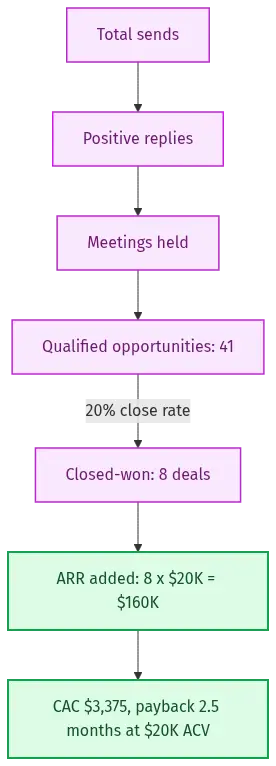
Three months of activity:
- Sends: 6,000 × 3 = 18,000
- Meetings booked: 18,000 × 1.0% = 180
- Meetings held: 180 × 75% = 135
- Opportunities created: 135 × 30% = 41
- Closed-won deals: 41 × 20% = 8 deals
- ARR added: 8 × $20,000 = $160,000
- Vendor cost in the window: $9,000 × 3 = $27,000
- Implied CAC for that cohort: $27,000 / 8 = $3,375 per customer
- CAC payback: $3,375 / ($20,000 × 80% / 12) = 2.5 months
That math works. Now run it with a $5K ACV and watch what happens:
- ARR added: 8 × $5,000 = $40,000
- Implied CAC: $3,375
- CAC payback: $3,375 / ($5,000 × 80% / 12) = 10.1 months — still fine for SaaS, but a 4× degradation
- Most SMB-focused outbound programs have lower hold and close rates (more no-shows, faster cycles), which makes the actual math worse
This is why ACV is the single biggest predictor of whether outbound services work. Below $5K ACV, you usually need either inbound or product-led growth — the math on cold outreach gets brittle fast.
What a Good Outbound Partner Actually Delivers
Stop evaluating providers on “do they send emails.” Evaluate them on these eight dimensions. This is the scorecard I’d give any CEO before they sign a contract.
| # | Dimension | What to Look For |
| — | — | — | | 1 | ICP rigor | They push back on your ICP. They want firmographic data, win rates by segment, and trigger events — not “let’s target everyone in fintech” | | 2 | Custom messaging | Sequences are written for your offer, not pulled from a template library. You should be able to read every message before it sends in the first 60 days | | 3 | Deliverability infrastructure | Dedicated secondary domains, inbox warm-up procedure documented, SPF/DKIM/DMARC verified, inbox rotation explained | | 4 | Activity transparency | You can see sends, opens, replies, and bounce rates in real time — not in a monthly PDF | | 5 | Meeting definition | Written, contractual definition of a “qualified meeting” with clawback if the meeting doesn’t meet it | | 6 | CRM integration | Bidirectional sync to your CRM, not a CSV dump. Tasks, contacts, and engagement land in the system your closers already use | | 7 | Operating cadence | Weekly campaign reviews, monthly strategy reviews, named operator who owns your account | | 8 | Contract flexibility | 90-day initial term, then month-to-month or 30-day notice. Long lockups are a red flag |
If a vendor cannot give you a written answer on each of these dimensions in the first sales call, they don’t have a real operation. They have a sales pitch.
Outbound Service Pricing Models — and Which Aligns Incentives
Pricing structures vary, and the structure tells you what the vendor will optimize for.
| Pricing Model | Typical Range | Vendor Optimizes For | Best Fit |
|---|---|---|---|
| Pure retainer | $4K–$15K/month | Activity volume, not quality | Mature buyers who can manage quality themselves |
| Pay-per-meeting | $150–$500 per qualified meeting | Meeting volume, sometimes at the expense of fit | High-volume mid-market motions |
| Retainer + per-meeting | $3K–$6K base + $200–$400 per meeting | Balanced — base covers infrastructure, performance covers output | Most aligned for SaaS at $2M–$15M ARR |
| Performance-only (pay-per-SQL or pay-per-deal) | $500–$2,000 per SQL, % of ACV per closed deal | Closeable revenue — but vendor cherry-picks easy ICPs | Niche; great when economics align, rare to find |
| Equity / revenue share | Variable | Long-term outcomes | Almost never appropriate for outbound services; treat as a red flag |
The retainer-plus-per-meeting hybrid is usually the right structure for the $5M–$15M ARR range. Pure retainer makes vendors lazy. Pure per-meeting makes them stuff your calendar with weak meetings. Hybrid pricing aligns both sides.
Benchmarks That Actually Apply to Your Business
Generic outbound benchmarks are nearly useless because the numbers move 5–10× across segments. These are realistic 2026 ranges by ACV tier for a competently-run program. Adjust expectations based on your specific motion.
| Metric | SMB ($1K–$10K ACV) | Mid-Market ($10K–$50K ACV) | Enterprise ($50K+ ACV) |
|---|---|---|---|
| Sends per SDR per month | 6,000–10,000 | 3,000–6,000 | 800–2,000 |
| Open rate | 30–45% | 35–55% | 40–65% |
| Reply rate | 2–6% | 4–10% | 5–15% |
| Positive reply rate | 0.5–1.5% | 1–3% | 2–5% |
| Meetings booked (% of sends) | 0.4–1.0% | 0.8–2.0% | 1.5–4.0% |
| Show rate | 60–75% | 70–85% | 75–90% |
| Meeting-to-SQL | 25–40% | 30–45% | 35–55% |
| Cost per qualified meeting | $200–$400 | $300–$700 | $700–$1,500 |
| Cost per SQL | $500–$1,500 | $1,000–$2,500 | $2,000–$5,000 |
| Time-to-first-meeting | 14–30 days | 21–45 days | 30–60 days |
If a vendor pitches numbers above the top of these ranges, ask for a customer reference operating at your ACV tier. Most outsize claims come from one-off campaigns or non-comparable ICPs.
Deliverability — The Hidden Killer
The fastest way to lose at outbound is to lose the inbox. Once Google or Microsoft tags your domain as a spam source, it can take 60–90 days to recover, and your branded domain may never fully recover its reputation. This is why deliverability infrastructure is not a “nice to have” — it is the entire foundation.
Any competent vendor will:
- Run outbound from secondary domains (e.g.,
tryacme.com,acme-team.com) that look like yours but isolate reputation risk from your main domain - Warm up new domains over 30–60 days before sending live traffic
- Verify SPF, DKIM, and DMARC records on every sending domain
- Rotate inboxes — typically no more than 30–50 sends per inbox per day
- Monitor bounce rates and pause campaigns above 3% bounce
- Use real-time inbox placement testing, not just delivery confirmation
If a vendor cannot describe their deliverability stack in three sentences, you are paying them to burn your sender reputation. This single dimension separates the providers worth using from the ones that will damage you.
AI in Outbound — What Actually Works in 2026
AI is now table stakes in outbound, but most of what passes for “AI outbound” is bad. Here is what the better operators actually use it for:
- Account research and personalization at the start of a sequence — pulling recent news, hiring signals, tech-stack changes, or funding events into a relevant first sentence. This works.
- Trigger-event scoring — identifying which accounts to prioritize this week based on signals (hires, product launches, leadership changes). This works.
- Reply classification and routing — automatically separating positive intent, unsubscribe, “wrong person,” and out-of-office replies. This works.
- Fully AI-generated sequences with no human review — produces homogenized, generic messages that prospects already recognize. This is killing reply rates across the industry. Avoid.
The honest version: AI is great for the research and triage layer. It is mediocre for the messaging layer. A good vendor uses AI to amplify human judgment, not replace it.
The First 90 Days With a New Outbound Vendor
If you sign a vendor and let them run on autopilot, you will get autopilot results. Here is the cadence that produces actual pipeline.
Days 0–30: Setup and calibration
- Week 1: Joint ICP working session, vertical and persona prioritization, technographic filters defined
- Week 2: Secondary domains provisioned, inboxes warmed, list of 2,000–5,000 target accounts approved
- Week 3: First sequences written and approved (founder reads every message)
- Week 4: First sends, focus on deliverability and bounce monitoring, not meeting volume
Days 31–60: Iteration
- Weekly 30-minute reviews: reply rates, positive replies, top-performing subject lines, list quality
- A/B test at the subject line and first-line level, not the whole sequence
- First batch of meetings should be booking; assess fit ruthlessly — wrong-fit meetings mean the ICP filter is wrong, not the sequence
- Closer team gives written feedback on every meeting in CRM
Days 61–90: Scale or kill
- By day 75, you should have enough data to know if the math works
- Decision point at day 90: scale (add a second SDR or expand sequences), iterate (narrow ICP or change offer), or kill (cut losses — sunk cost is not a strategy)
- Document everything you’ve learned about messaging, ICP, and objection patterns — this is the IP you’re paying for, not the meetings themselves
The CEOs who win at outbound treat the first 90 days as a structured experiment, not a passive trial. The cost of paying a vendor for 90 days is small. The cost of paying a vendor for 9 months while ignoring the data is the entire annual budget.

When to Bring Outbound In-House
Vendors are a means to an end. If the channel works for you, the right long-term move is usually to own it. The timing is not when you can technically afford to hire SDRs — it is when you have the data to operate the channel like a system, not a project.
You are ready to internalize when:
- The channel has produced positive unit economics for at least 6 consecutive months
- You have a documented playbook — sequences, ICP filters, objection handling, qualification criteria — that a new hire could pick up in 30 days
- You have a hiring manager (typically a Head of Sales Development or experienced VP of Sales) who can manage SDRs at the activity level, not just outcome level
- Your volume justifies at least 2 full-time SDRs — running a one-SDR team is a key-person risk, and the playbook decays
- You’re prepared to keep the vendor on a transitional retainer for 3–6 months while you build the team
The single biggest mistake: hiring the wrong VP of Sales to “own outbound” without ever proving the channel works. A VP who has never run an outbound experiment will run yours into the ground.
Red Flags to Walk Away From
Some signals should end the conversation before you sign anything.
- They can’t show you live messaging. If they won’t share active sequences from current accounts (redacted is fine), they don’t have any.
- They send from shared domains. Your sender reputation is mixed with whatever bad client they’re also running.
- No clear “qualified meeting” definition. “We’ll book meetings” without a written standard means you’ll fight about every one of them.
- 6–12 month lockups with no out clause. No competent vendor needs a year to prove the channel — they need 90 days. Lockups protect them, not you.
- No CRM integration. A vendor that books to their own calendar and emails you a list is not operating as part of your GTM.
- All-AI sequences with no human in the loop. Generic AI output is what every other vendor is also sending. You will compete for the same inboxes with identical-sounding messages.
- They won’t share targeting logic. If they treat their list-building as a black box, they’re either embarrassed by it or don’t have one.
- Performance comp without a base. A vendor working purely on per-meeting comp will book meetings at the lowest-friction quality bar. You’ll fight every clawback.
Frequently Asked Questions
How much do outbound lead generation services cost for B2B SaaS?
For an effective program in 2026, expect $4K–$15K per month per dedicated SDR (vendor-side), or $10K–$15K per fully-loaded in-house SDR. Appointment-setting agencies running multiple campaigns can come in at $4K–$10K/month with per-meeting performance components. Full-funnel GTM agencies range $15K–$50K/month. Pay-per-meeting alone usually runs $150–$500 per qualified meeting depending on ACV tier.
How long until outbound lead generation services produce pipeline?
Expect zero to minimal pipeline in days 0–30 (setup, warm-up, calibration). First meetings typically book in weeks 3–6. Meaningful pipeline contribution shows up in days 60–90. Any vendor promising same-week meetings is either skipping deliverability infrastructure or burning your sender reputation to hit a short-term number.
Should we use outbound lead generation services for B2B SaaS or build an internal team?
If you are $2M–$10M ARR with no proven outbound motion, use a vendor for the first 6–12 months to prove the channel and build a playbook. If you’re $10M+ with a proven channel and 2+ years of runway, build internal — the unit economics favor in-house once ramp time is amortized across multiple reps. The wrong answer is hiring SDRs before you know the math works, or staying with a vendor forever after the channel is proven.
How do you measure success of an outbound lead generation service?
Track three layers: activity (sends, opens, replies), output (qualified meetings, opportunities, pipeline), and economics (cost per qualified meeting, cost per SQL, eventual cost per closed deal). Most teams over-index on activity metrics because they’re visible early. The metric that matters is cost per closed deal compared to your LTV. If the answer is “we don’t know yet,” the answer is “we’re not ready to scale yet.”
What’s the difference between an outbound agency and SDR-as-a-Service?
An outbound agency typically runs campaigns under their own infrastructure and reports outcomes back to you. SDR-as-a-Service places dedicated reps under your brand, using your domains and CRM, looking and acting like part of your team. Agencies are typically cheaper and faster to start but lower-context. SDR-as-a-Service is more expensive and slower to set up but produces a more durable relationship with prospects — important for enterprise sales cycles.
Will outbound damage our brand if it’s done badly?
Yes. Specifically, three risks: (1) spam complaints damage your primary domain’s sender reputation, which affects everything else you send including invoices and customer communications; (2) wrong-fit outreach in your ICP creates negative impressions that follow your brand on LinkedIn and review sites; (3) generic AI-generated messages signal that you don’t take your category seriously. All three are avoidable with a competent vendor and a 90-day quality bar.
Can outbound work for product-led growth (PLG) B2B SaaS?
Yes, but the role changes. In a PLG motion, outbound is not the primary growth channel — it’s an enterprise overlay. The job is to identify high-intent companies (multiple signups from the same domain, free-tier usage patterns, target-account fit) and accelerate them to a sales conversation. Outbound for PLG looks like account-based selling, not high-volume cold email. Different vendor profile, different benchmarks.
The Bottom Line
Outbound lead generation services for B2B SaaS are not a magic pipeline button, and they’re not a vendor-listicle problem. They are a specific economic decision: rent a channel until you know the unit economics, then decide whether to keep renting, internalize, or kill.
The CEOs who win at this run the math first. They know their LTV/CAC. They know their ACV math holds at realistic outbound conversion rates. They evaluate vendors on infrastructure and operating cadence, not pitch deck quality. They treat the first 90 days as a structured experiment with a kill switch, and they document the playbook so the next phase — whether vendor expansion or internal build — runs on a system, not on intuition.
The single most useful frame is this: outbound is not how you grow forever. It is how you buy yourself the time and data to figure out how you grow forever. Treat it that way and the vendor decision becomes simple.
Related Reading:
- What Is Lead Generation? A SaaS CEO’s Framework
- Demand Generation vs. Lead Generation
- Demand Generation for B2B SaaS
- Ideal Customer Profile (ICP) Definition
- SaaS Customer Acquisition Cost (CAC)
- LTV/CAC Ratio Explained
- Repeatable Sales Process for SaaS
- SaaS Go-to-Market Strategy Template
- Marketing for SaaS
- The Wrong VP of Sales Mistake in SaaS