

Revenue retention is the single biggest lever on what your SaaS business is actually worth. Get it above 100% and the math says your ARR can grow forever without acquiring another customer. Get it below 100% and you are running an expensive treadmill where every dollar of new bookings is partly replacing a dollar you already had.
That gap — between a business whose revenue compounds on its own and a business whose revenue decays on its own — is where the multi-billion-dollar valuations live.
Most CEOs know revenue retention matters because investors keep asking about it. Far fewer have done the math on what a 5‑point change actually does to enterprise value over five or ten years. By the end of this article you will have, plus a clean mental model for the two metrics involved (gross revenue retention and net revenue retention), realistic benchmarks, and the three operational levers that actually move the number.
Let’s start with the definitions, then build to the math, then build to the strategic implications.
What Revenue Retention Actually Measures
Revenue retention measures how much revenue you keep from an existing cohort of customers over a defined period. It is a cohort metric — meaning you pick a starting group of customers (everyone paying you on January 1st, say) and you track their revenue over time. New customers acquired during the period are explicitly excluded from the calculation.
There are two flavors, and the difference matters:
| Metric | What it includes | Can it exceed 100%? | What it tells you |
|---|---|---|---|
| Gross Revenue Retention (GRR) | Starts with the cohort's revenue. Subtracts downgrades (contraction) and cancellations (churn). Ignores upsells. | No — caps at 100% | Are you keeping the revenue you already had? |
| Net Revenue Retention (NRR) | Same as GRR but also adds expansion revenue from the same cohort (upsells, cross-sells, usage growth). | Yes — can exceed 100% | Is the existing customer base growing on its own? |
The two metrics answer different questions. GRR answers “how good is my defense?” It is a clean read on whether customers are sticking and paying you the same amount. NRR answers “how good is my offense within the existing book?” It tells you whether your installed base is a growing asset or a shrinking one.
When investors talk about “revenue retention” they almost always mean NRR. But you need both numbers to diagnose what is actually happening, because they decompose the problem in two different ways.
How to Calculate Net Revenue Retention
Here is the canonical formula:
NRR = (Starting MRR + Expansion MRR − Contraction MRR − Churned MRR) ÷ Starting MRR × 100%
The denominator is the cohort’s revenue at the start of the period — not the end. This is the inversion most articles get wrong. NRR is a measure of how the cohort’s revenue moved, expressed as a percentage of where it started. End ÷ Start, never Start ÷ End.
Gross revenue retention uses the same denominator but drops the expansion term:
GRR = (Starting MRR − Contraction MRR − Churned MRR) ÷ Starting MRR × 100%
The relationship between the two is mechanical:
NRR = GRR + (Expansion MRR ÷ Starting MRR)
If your GRR is 92% and you generated 15% expansion from the same cohort, your NRR is 107%. NRR sits above GRR by exactly the expansion rate. The gap between the two is the answer to “how much of my retention story comes from upsell versus pure stickiness?”
A worked example with realistic numbers
Take a $10 million ARR SaaS company. Convert to MRR: $833,333. That is your January 1 starting MRR.
Over the next twelve months, four things happen to that cohort:
| Movement | Amount | Reason |
|---|---|---|
| Starting MRR | $833,333 | January 1 baseline (the denominator) |
| Expansion MRR | +$125,000 | 15% of the cohort upgraded plans or added seats |
| Contraction MRR | −$33,333 | A few accounts downgraded their plan |
| Churned MRR | −$66,667 | Roughly 8% of the cohort cancelled outright |
| Ending MRR (cohort only) | $858,333 | What remains of the original cohort, with upsell included |
Plug into the formulas:
- GRR = ($833,333 − $33,333 − $66,667) ÷ $833,333 = 88.0%
- NRR = ($833,333 + $125,000 − $33,333 − $66,667) ÷ $833,333 = 103.0%
Notice: this cohort lost 12% of its revenue to contraction and churn, but expansion of 15% more than offset the loss. The business is in net-expansion territory (NRR > 100%) despite a real retention problem (GRR is only 88%).
This is the diagnostic value of looking at both numbers. NRR alone would tell you “we’re growing.” GRR tells you “we’re growing because the upsell engine is masking a churn problem.” Two very different operating priorities.
What Counts as a Good Revenue Retention Rate?
Benchmarks vary by ARR stage, segment served, and contract structure. Here are working ranges that line up with what investors and operators see in the market:
GRR benchmarks (Gross Revenue Retention)
| GRR | Read |
|---|---|
| < 80% | High churn — a real retention problem; the product, the ICP, or both are off |
| 80–90% | Below average — room for improvement, common in SMB-focused SaaS |
| 90–95% | Good — typical for healthy mid-market SaaS |
| > 95% | Excellent — strong product-market fit, typical of enterprise-focused SaaS |
NRR benchmarks (Net Revenue Retention)
| NRR | Read |
|---|---|
| < 90% | Leaky bucket — net contraction even with whatever upsell you have |
| 90–100% | Stable but no organic growth from the base |
| 100–110% | Healthy — the base is growing on its own |
| 110–130% | Strong — expansion is a real growth engine |
| > 130% | Elite — significant upsell and cross-sell motion, typical of best-in-class enterprise and consumption-priced SaaS |
These benchmarks shift with segment. SMB-focused SaaS tends to run lower on both numbers because churn is structurally higher (smaller customers go out of business, change leadership, switch tools faster). Enterprise SaaS tends to run higher because contracts are multi-year and the cost of switching is real. Consumption-priced products that grow with usage can post NRR figures above 130% just by virtue of how the meter ticks. Compare yourself to your segment, not to the headline numbers from public SaaS earnings calls.
A current view of segment-level benchmarks is also published in the KeyBanc SaaS Survey, which is worth pulling for whatever year you happen to be reading this in.
A note on the numbers above: benchmarks shift over time as the SaaS market matures, segments shake out, and macro conditions change. The bands are durable; the exact thresholds will drift by a few points year to year. Use them as a directional read, not as a hard pass/fail.
Why Net Revenue Retention Over 100% Changes Everything
Now that we have the definitions and the math right, here is the part most CEOs under-appreciate.
The difference between NRR of 99% and NRR of 101% is not two percentage points. It is the difference between a business with a mathematical ceiling on revenue and a business with no mathematical ceiling at all.
NRR under 100% creates a recurring revenue ceiling
In a recurring revenue business, you collect roughly the same revenue every month from the same accounts. That is the whole appeal — predictable, contracted dollars showing up on the first of the month.
The problem comes at scale. Eventually the business gets so big that the churn dollars get enormous. Take a $100M ARR business with NRR of 90% — that base alone is losing $10M of ARR every year to net contraction. To grow, new bookings have to first replace the $10M of decay, then add growth on top.
There is a hard mathematical ceiling on a business with NRR < 100%: the point where annual new bookings exactly equal annual base decay. Past that ARR level, you cannot grow regardless of how good the sales team is, because every dollar of new bookings is being absorbed by the leak in the base.
This is why pure new-logo motion does not scale forever in a leaky business. The bigger the base, the bigger the leak, the more new bookings you need to stand still.
NRR over 100% has no revenue ceiling
When net revenue retention exceeds 100%, the math flips. Every dollar of revenue you book today not only retains, it expands. The base grows on its own, every year, forever — even if you stop acquiring new customers entirely.
The theoretical mathematical maximum revenue at maturity for a SaaS business with NRR over 100% is, when you do the math out: infinite.
In practice it does not run to infinity because something eventually changes — a competitor disrupts the category, the product hits saturation, pricing power erodes. But for any planning horizon a CEO actually operates over (5, 10, even 20 years), a business with sustained NRR > 100% and any amount of new bookings is mathematically a billion-dollar-ARR business eventually.
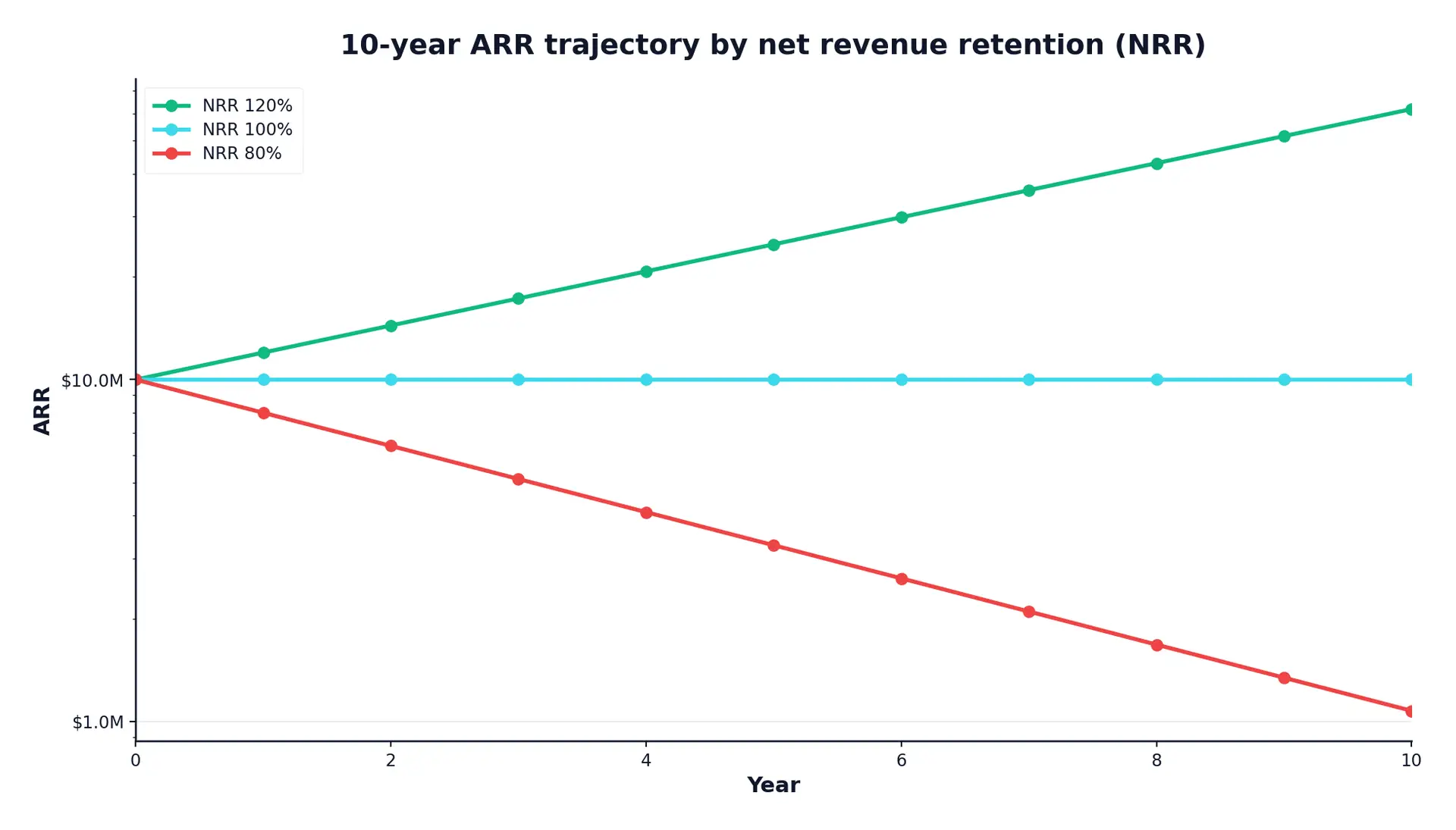
Compare two businesses, each starting at $10M ARR, neither acquiring new customers:
| Year | Business 1 (NRR 80%) | Business 2 (NRR 100%) | Business 3 (NRR 120%) |
|---|---|---|---|
| Year 0 | $10,000,000 | $10,000,000 | $10,000,000 |
| Year 5 | $3,277,000 | $10,000,000 | $24,883,000 |
| Year 10 | $1,074,000 | $10,000,000 | $61,917,000 |
| Year 15 | $352,000 | $10,000,000 | $154,070,000 |
| Year 20 | $115,000 | $10,000,000 | $383,376,000 |
Business 1 at NRR 80% loses 80% of its ARR over the first decade. Business 3 at NRR 120% multiplies its ARR by more than 6x in the same decade — without acquiring a single new customer. Same starting point, same time horizon, two completely different companies.
This is why investors and acquirers will pay a 2x or 3x multiple premium for a SaaS business with NRR above 120% versus one below 100%. The forward revenue curve is structurally different. The discounted cash flow looks different. The terminal value looks different. The risk looks different. Everything looks different.
If you look at it from a pure valuation standpoint, the multiple applied to Business 3 will be much higher than the multiple applied to Business 1 — and it gets applied to a much larger revenue number. The valuation gap compounds at both ends.
Revenue Retention’s Third-Order Effect: LTV/CAC and TAM
There is one more implication of high net revenue retention that most CEOs miss completely. It is about the LTV/CAC ratio and what it lets you do in the market.
The LTV/CAC ratio measures whether your go-to-market team can acquire customers cost-effectively. Standard rule of thumb: 3.0 or higher is healthy, below 1.0 means you are paying more to acquire a customer than you’ll ever earn from them.
Here is the plot twist most analyses miss. You can only really calculate lifetime value when customers eventually leave. What happens if customers don’t leave — and instead stay and spend more?
In theory, the LTV is infinite, or at least cannot be precisely calculated. The customer is a perpetually-growing annuity rather than a finite stream of payments.
This unlocks something powerful: the higher your effective LTV, the more you can spend to acquire a new customer. And in every market, there are low-cost acquisition channels (referrals, organic content, word of mouth) and high-cost ones (paid ads, sponsorships, outbound, live events, enterprise sales motions).
A competitor with low LTV can only economically afford the low-cost channels. They have to. Their unit economics break the moment they try to pay $5,000 to acquire a customer worth $3,000.
A business with very high LTV — fueled in large part by NRR > 100% — can afford every channel. Paid ads, sponsorships, content marketing, outbound, live events, partnerships. All of it.
This is where the strategic compounding happens. The competitor can only contact prospects their existing customers happen to know. You can contact the entire market. Same product category, but your effective TAM is multiples of theirs because they can’t economically reach the same prospects.
A business that can compete on all fronts eventually generates enough critical mass to become the de facto category leader. You become the “safe choice” because everyone else is already using you. That starts a virtuous cycle: LTV goes up further, CAC goes down because brand-driven inbound increases, the LTV/CAC ratio improves again, and you can spend even more to acquire even more customers.
This is the strategic part of being a CEO. It is playing chess and seeing five moves ahead while everyone else can see one.
Sequence: NRR > 100% drives effectively infinite LTV → infinite LTV drives an extreme LTV/CAC advantage → that advantage lets you economically pursue every acquisition channel → you can reach the entire TAM while competitors can only reach a slice of it → you win the category.
Metrics like net revenue retention are not just numbers you manage because investors care about them. They have relationships with other metrics, and those relationships have enormous implications for whether you win or lose in your category. The CEO who understands these relationships has a structural advantage over the CEO who treats them as quarterly board-deck exhibits.
The Three Levers That Move Net Revenue Retention
Knowing the importance of NRR is one thing. Moving it is another. Because NRR is a composite of four sub-flows (starting MRR, expansion, contraction, churn), every initiative to improve it has to target one of three actual levers.
Lever 1: Reduce logo churn (the cancellation lever)
Logo churn is when an account stops paying you entirely. It is the most visible and emotionally salient form of revenue loss — and often the wrong place to focus first.
The cure for logo churn is rarely “more retention emails.” It is upstream: a better fit between your ICP and the customers you are actually acquiring, faster time-to-value on the product, and operational support for the customers most at risk in their first 90 days. If you are losing customers, the diagnostic is usually that you sold to the wrong customer or that the product is not delivering what they thought they bought.
See how to reduce SaaS churn and the broader frame of retaining customers for the operational mechanics.
Lever 2: Reduce contraction (the downgrade lever)
Contraction is when an account stays but pays you less — a downgrade from Enterprise to Pro, a seat reduction, a usage cap drop. Contraction is sneakier than churn because the customer is still there, the renewal still happened, and the dashboard does not light up red.
Contraction often points to pricing-tier design problems. If many customers are downgrading from a higher tier to a lower one, the higher tier is probably overpriced for the value it actually delivers, or the lower tier is over-featured. Fix the tier structure and contraction often drops without anyone touching a single customer relationship.
The other source of contraction is contract terms. Annual contracts protect against mid-year contraction. Month-to-month contracts let contraction happen continuously. The shift from month-to-month to annual is one of the cheapest NRR improvements available to most SaaS businesses — it does not require building new features, just changing how you sell.
Lever 3: Increase expansion (the upsell and cross-sell lever)
Expansion is the only lever that can push NRR over 100%. The other two levers can stop the bleeding; expansion is the engine that takes the business into compounding territory.
There are three structural ways to build expansion:
- Pricing that grows with usage. If the customer pays per seat, per transaction, per MB, per API call, or per any other unit that scales with their success using your product — your revenue grows automatically as they grow. Consumption pricing is the cleanest path to NRR > 130%.
- A clear upsell ladder. Multiple priced tiers with meaningful capability differences between them. When the customer outgrows their current tier, the next tier is obvious, valuable, and clearly priced.
- Adjacent products to cross-sell. Once the customer trusts you in one workflow, an adjacent product becomes the natural next purchase. This is the playbook that takes a single-product SaaS to a platform.
The lever you have the most slack on depends on where you are. Below 90% NRR, focus on churn — you have an acquisition or product problem. Between 90% and 105%, focus on contraction — you have a pricing or contract problem. Above 105%, focus on expansion — you have a leverage problem worth investing in seriously.
Common Mistakes That Distort Revenue Retention Numbers
When the CEOs I work with bring me an NRR number, a surprising fraction of those numbers are wrong before we even discuss what to do about them. The math is right; the inputs are wrong. Here are the four most common mistakes:
Mistake 1: Including new logos in the cohort. NRR is a cohort metric. Customers acquired during the measurement period are excluded by definition. Including them inflates the number and hides the underlying retention story.
Mistake 2: Reporting monthly NRR and annualizing it incorrectly. Monthly NRR cannot be multiplied by 12 to get annual NRR. The compounding is multiplicative, not additive. Monthly NRR of 100.5% compounds to annual NRR of approximately 106%, not 106% by addition.
Mistake 3: Conflating customer (logo) retention with revenue retention. They are different metrics that move differently. You can have 95% logo retention and 80% revenue retention if the customers you are losing are your largest. Track both, in parallel.
Mistake 4: Ignoring the GRR/NRR gap. If your NRR is 115% and your GRR is 75%, you do not have a 115% retention business. You have a 75% retention business with a hot upsell motion masking the leak. The day the upsell motion slows down — and they always do — the leak becomes visible. Always look at both metrics together. See the breakdown in net revenue churn formula for the arithmetic detail.
How Revenue Retention Connects to Rule of 40 and Other Metrics
NRR is not a standalone metric. It connects to several other SaaS growth metrics in ways that matter for the operating story you tell investors and your board.
- Rule of 40. The Rule of 40 (growth rate + profit margin ≥ 40) is heavily influenced by NRR. A business with NRR > 110% can grow its top line faster at a given level of CAC spend, which improves both sides of the Rule of 40 equation. NRR is, in a sense, a structural input to the Rule of 40, not a parallel metric.
- LTV/CAC and unit economics. Covered above — NRR distorts LTV upward, often dramatically, because the standard LTV calculation assumes a finite customer lifetime. With NRR > 100%, lifetime is effectively unbounded.
- CAC payback period. NRR > 100% shortens CAC payback in the second and later years. A customer who pays $1,000 in year one and $1,200 in year two has a shorter effective payback than a customer who pays $1,000 in both years.
- SaaS magic number. The SaaS magic number measures sales efficiency — new ARR ÷ S&M spend in the prior period. NRR > 100% effectively boosts the magic number because some of the “new” ARR is actually expansion from the existing base, which often costs far less to capture than new-logo bookings.
The point is not to track every metric in isolation. The point is to understand which metrics are driving which other metrics. NRR is upstream of most of the other operating metrics on a SaaS dashboard. Move NRR and the downstream metrics move with it. Move a downstream metric in isolation and NRR will eventually catch up to you.
Frequently Asked Questions
Is NRR the same as Net Dollar Retention (NDR)?
Yes. NRR and NDR refer to the same metric. Different software companies and investors use the two terms interchangeably. NRR is more common; NDR appears in some investor presentations and S‑1 filings. Either is acceptable. Use one consistently in your own reporting.
How often should I measure revenue retention?
For internal operating discipline, measure monthly. For board reporting and external benchmarking, report trailing 12-month NRR and GRR, because monthly numbers are noisy. The 12-month window also matches how investors evaluate the metric.
Should I use cohort NRR or trailing 12-month NRR?
Both have a use. Cohort NRR (track a specific starting cohort over time) is the cleanest measure of underlying retention dynamics and is the right view for diagnosing the business. Trailing 12-month NRR is the comparable number for external benchmarking. Most SaaS companies that take this seriously report both internally.
Can NRR be too high?
Conceptually, no — there is no such thing as a customer base that grows too fast. In practice, NRR over 140–150% sometimes signals a measurement issue (e.g., new logos sneaking into the cohort), an over-dependence on a few mega-customers driving the expansion, or a price increase that just happened and has not yet shown up in churn. If your NRR has a 4 or a 5 in front of it, double-check the math before celebrating.
What is the difference between revenue retention and customer retention?
Revenue retention measures dollars retained from a cohort. Customer retention (also called logo retention) measures the percentage of customers who are still customers at the end of a period. They can move in opposite directions: you can lose customers (logo churn) but retain revenue (because your largest accounts expanded). Track both — they describe different parts of the same picture.
What Revenue Retention Means for How You Run the Business
Revenue retention is the highest-leverage metric on a SaaS dashboard because it sits upstream of almost everything else. It drives valuation through DCF math. It distorts LTV upward, which expands the set of acquisition channels you can economically afford. The acquisition channels you can afford define the addressable market you can actually reach. The market you can reach defines whether you become the category leader or a sub-scale alternative.
The CEOs who win the long game are the ones who get NRR above 100% structurally — by building consumption-priced products, by designing pricing tiers that have a natural upsell path, by selecting a customer ICP that grows with the company — and then ride the compounding for a decade. Everyone else is on the treadmill.
Pick a number, measure it correctly, work the three levers, and check yourself against the benchmarks once a quarter. The math will do the rest.