

Localized pricing is the practice of charging different prices for the same SaaS product in different geographic markets — based on local purchasing power, competitive intensity, and willingness to pay, not just translated currency. Most SaaS companies at $5M-$15M ARR sell the same SKU at the same dollar price everywhere, then wonder why their international conversion rates are 30% to 60% lower than US conversion rates on otherwise identical inbound traffic.
That gap isn’t a marketing problem. It’s a pricing problem the company refuses to solve because the spreadsheet feels uncomfortable.
This guide is for the technical founder running a B2B SaaS company at $5M-$15M ARR with paying customers in two or more countries — or one country today and a real plan to add a second. It lays out the four-tier segmentation framework I use with coaching clients, the math on what localized pricing actually moves, the two structures that work (and two that quietly fail), and a worked example showing how the right model lifts revenue by 15% to 40% without acquiring a single new customer. By the end you’ll know exactly which markets to localize first, what discount or premium to apply, and which implementation pitfalls erode the gain.
If your international customers are paying the same USD list price as your US customers, you are either leaving 20%+ of available revenue on the table in price-sensitive markets, or undercharging price-insensitive ones by even more.
What Localized Pricing Actually Is
Localized pricing is differential pricing by market — typically by country, sometimes by region within a country, occasionally by a non-geographic segment that correlates with willingness to pay. The same product sells at different list prices to buyers in different places, in different currencies, often through different channels.
Localized Price = Base Reference Price x Market Adjustment Factor
The reference price is usually the US list price (because the US is the most-tested, highest-volume market for most SaaS companies). The market adjustment factor — sometimes called the local price index — captures how that market’s purchasing power, competitive landscape, and customer willingness to pay differ from the reference market.
Three properties matter:
- It’s about willingness to pay, not cost. SaaS marginal cost is near zero, so cost-plus pricing doesn’t apply. Localized pricing asks one question: what is this market actually willing to pay for the value we deliver? The answer is rarely the US price translated to local currency.
- It’s a different SKU in the systems, not a discount. A discount is a deal-by-deal concession on the standard list price. Localized pricing is a posted list price that is the standard for that market. The distinction matters for sales discipline, financial reporting, and what acquirers see in due diligence.
- It compounds with currency strategy but isn’t the same thing. Selling in EUR vs USD is a currency decision (who absorbs FX risk). Selling at EUR 79 in Germany when the US price is USD 99 is a localization decision (what the market will pay). Most SaaS companies confuse the two — they bill in local currency at the spot-rate conversion of the US price, and call that localization. It isn’t.
That last point is the most common error. If your German customers see their invoice in EUR but the EUR amount is just yesterday’s spot rate applied to USD 99, you have currency display, not localized pricing. You’re still anchoring the entire market to a US price point that was set against US competitors and US salary expectations.
Why Localized Pricing Matters More Than Most SaaS CEOs Realize
Three reasons localized pricing belongs near the top of the pricing-power conversation, not buried in the international expansion playbook.
Pricing power is the single highest-leverage EBITDA lever in SaaS. A 10% lift in price drops almost entirely to gross profit because SaaS gross margins are typically 75% to 85%. A 10% lift in volume requires the company to acquire 10% more customers at the same CAC — that’s a real go-to-market investment with payback uncertainty. Localized pricing finds the price lift without the customer-acquisition cost, because the customers are already buying. They’re just paying the wrong price for the market they’re in.
Conversion rate in non-US markets is a price signal you’re misreading. When a Brazilian SaaS buyer lands on a US-pricing page that shows USD 99/month, two things happen. The buyer mentally converts to BRL (currently ~500/month — about a week’s net salary for a mid-level engineer). The buyer either drops off (most cases) or buys, but at a substantially lower contract size than they would have at a properly localized price point that anchors against local benchmarks. Either way, the US-list-price strategy is leaving money on the table.
Acquirers care about per-segment economics. When a strategic or PE acquirer looks at a SaaS company with international revenue, the first thing they ask is what the LTV/CAC ratio looks like by region. If your company sells at the same USD price in 30 countries and you’ve never measured retention or expansion by country, you don’t actually know your unit economics — you know an average that may mask wildly different segment performance. Companies that have already done the localization work tell a much more compelling segment-economics story in diligence, which lifts the multiple.
A worked example makes this concrete.
A Worked Example: The Same Product, Four Prices, 28% More Revenue
Consider a B2B SaaS company at $8M ARR selling project management software. List price: USD 99 per seat per month. Mix of US (60% of revenue), Western Europe (20%), Latin America (12%), and Southeast Asia (8%). They sell in USD everywhere with EUR/GBP/BRL/INR as currency display options.
Conversion rates on their pricing page tell the story even if their finance team isn’t listening:
| Region | Traffic Share | Conversion Rate | Revenue Share | Avg Customer Size (seats) |
|---|---|---|---|---|
| United States | 50% | 3.2% | 60% | 18 |
| Western Europe | 25% | 1.8% | 20% | 12 |
| Latin America | 15% | 0.6% | 12% | 22 |
| Southeast Asia | 10% | 0.4% | 8% | 25 |
Two patterns jump out. First, conversion drops materially in non-US markets even though average customer size (seats) is actually larger in LatAm and SEA. Second, the larger seat counts in price-sensitive markets suggest customers are buying in spite of the price, not because of it — they need the product enough to absorb the dollar list, but the friction shows up as a lower conversion rate.
A four-tier localized pricing model that adjusts the list price by market (not by currency conversion alone) might look like this:
| Region | List Price | Adjustment vs US | Rationale |
|---|---|---|---|
| United States | USD 99 / seat / month | 0% | Reference market |
| Western Europe | EUR 89 / seat / month (~USD 97) | -2% | Competitive parity with US; FX absorbed by company |
| Latin America | USD 49 / seat / month | -50% | Roughly anchored to local enterprise software benchmarks |
| Southeast Asia | USD 39 / seat / month | -60% | Aggressive on price, banking on volume |
Now run the conversion math one year out, holding traffic constant and modeling conversion lift from the price reduction. The conversion rate in price-sensitive markets responds to price: a 50% price cut in a market currently converting at 0.6% can plausibly push conversion to 2.0% to 2.5% (the price-elasticity of SaaS in price-sensitive markets is high — meaning conversion is very responsive to price; smaller cuts produce smaller lifts, large cuts unlock latent demand). Assume LatAm conversion lifts from 0.6% to 2.3% and SEA from 0.4% to 2.4%.
Region-level ARR after localization is the pre-localization ARR scaled by (new conversion / old conversion) and by (new price / old price). For LatAm: $0.96M × (2.3 / 0.6) × ($49 / $99) = $1.82M. For SEA: $0.64M × (2.4 / 0.4) × ($39 / $99) = $1.51M.
If pre-localization revenue was $8M total, post-localization revenue projects roughly as follows on a same-traffic basis:
| Region | Pre-Localization ARR | Post-Localization ARR | Change |
|---|---|---|---|
| United States | $4.80M | $4.80M | $0 |
| Western Europe | $1.60M | $1.60M | $0 (FX absorbed) |
| Latin America | $0.96M | $1.82M | +$0.86M |
| Southeast Asia | $0.64M | $1.51M | +$0.87M |
| Total | $8.00M | $9.73M | +$1.73M (+22%) |
That 22% revenue lift comes from same traffic, same product, same sales motion. The only thing that changed is the posted list price in two markets. At a 78% gross margin, that revenue lift drops about $1.35M to gross profit ($1.73M × 0.78). If the company’s S&M cost stays flat (because traffic and headcount didn’t change), most of that gross profit drops to EBITDA. On a $8M ARR business, this is a multi-million-dollar swing in enterprise value at exit — see the section on valuation impact later in this article.
The model is illustrative; actual conversion lift varies by market, product category, and competitive intensity. The point isn’t that every SaaS company will see exactly 22%. The point is that the gap between same-USD-everywhere pricing and properly localized pricing is large enough to be worth modeling carefully, and most SaaS CEOs never run the math.
A note on time-sensitive data: SaaS valuation multiples, FX rates, and regional purchasing-power benchmarks cited in this article reflect typical 2026 conditions. They’re included to show the relative shape of the levers — a ‑50% LatAm adjustment is roughly directionally right today; the exact percentage will shift with macro conditions. Re-run the numbers against current benchmarks before making a pricing decision.

The Four-Tier Segmentation Framework
The temptation when localizing is to do it country by country — generate a price for Brazil, a price for India, a price for Germany, and so on. That approach scales poorly and creates a sales-ops nightmare. The framework I use with coaching clients groups markets into four tiers, each with its own pricing posture.
Tier 1: Premium Markets (US List + 0% to +15%)
These markets have purchasing power comparable to or higher than the US reference market, competitive intensity that supports premium pricing, and customers willing to pay for category leadership. United States, United Kingdom, Switzerland, Norway, Singapore, Australia, Hong Kong, and a handful of Western European countries usually qualify.
Strategy: price at or slightly above US list. The adjustment factor is between 1.00 and 1.15. Some companies under-price these markets out of FX-volatility fear; the data usually shows these buyers are anchored against local enterprise software benchmarks that are higher than US benchmarks, not lower. Test the higher end of the range before assuming parity.
Tier 2: Parity Markets (US List — 5% to 0%)
Major Western European economies (Germany, France, Italy, Spain), Canada, Japan, South Korea, the UAE, and Israel. These markets have purchasing power broadly comparable to the US, but local competition may be slightly stronger or local enterprise software pricing benchmarks may be slightly lower. The adjustment factor sits in a tight band around parity.
Strategy: match US list at the spot rate, or trim 5% off to absorb FX volatility and improve conversion. Most companies serving these markets are already doing approximately this, even if they don’t call it localization.
Tier 3: Discount Markets (US List — 30% to ‑55%)
Most of Latin America (Brazil, Mexico, Argentina, Chile, Colombia), Eastern Europe (Poland, Czech Republic, Hungary, Romania), Turkey, South Africa, Malaysia, Thailand, and parts of the Middle East. These markets have meaningfully lower purchasing power and local enterprise software benchmarks roughly 40% to 60% below US levels.
Strategy: post a localized list price 30% to 55% below US. The exact discount depends on (a) how much the company values the volume — aggressive discounts unlock more conversion, (b) the competitive landscape (local competitors price lower; global SaaS competitors may already localize), and © whether the company can support a separate pricing tier without leakage into US markets.
Tier 4: Deep Discount Markets (US List — 55% to ‑80%)
India, Vietnam, Indonesia, Philippines, Pakistan, Bangladesh, Egypt, Nigeria, Kenya, and most of Sub-Saharan Africa. These markets have purchasing power 70% to 90% below US benchmarks. Local enterprise software pricing is dramatically lower, and the customers won’t buy at anything close to US list — the conversion rate at US list is effectively zero for most categories.
Strategy: 55% to 80% off US list. This tier is where companies most often fail to localize, because the discount feels too aggressive to operations leaders looking at the spreadsheet. The math, however, is unambiguous: at US list, conversion is near zero, so revenue is near zero, so any conversion at a deep discount is purely incremental. The question isn’t whether to localize Tier 4 — it’s whether to enter these markets at all.
| Tier | Markets | Adjustment | Examples |
|---|---|---|---|
| Tier 1 — Premium | High purchasing power, low competition | 0% to +15% | US, UK, Switzerland, Singapore, Australia |
| Tier 2 — Parity | Comparable to US | -5% to 0% | Germany, France, Canada, Japan |
| Tier 3 — Discount | Moderate purchasing power, real competition | -30% to -55% | Brazil, Mexico, Poland, Turkey, Malaysia |
| Tier 4 — Deep Discount | Low purchasing power, low local SaaS benchmarks | -55% to -80% | India, Vietnam, Indonesia, Nigeria, Egypt |
The tier framework is a starting point, not a final answer. Within each tier, the specific country adjustment depends on competitive data and the company’s strategic priorities for that market. The framework’s value is that it cuts the question from “how do we price 80 countries?” to “how do we price four tiers?” — a vastly more tractable problem.
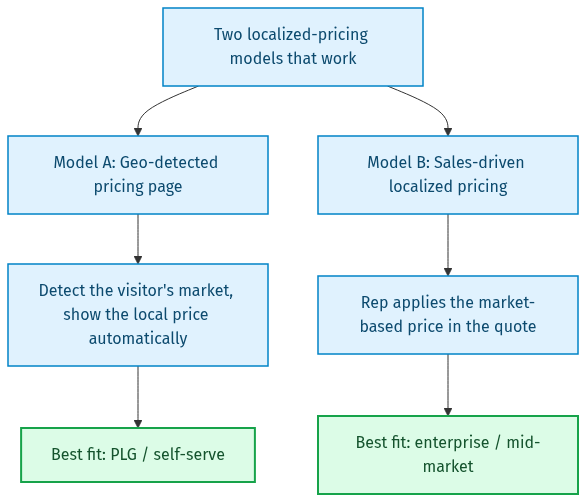
The Two Implementation Models That Work
Once the tier framework is set, the company has to decide how to deliver localized prices to customers. Two structures work in practice. Two more look attractive but quietly fail.
Model A: Geo-Detected Pricing Page (Works for PLG / Self-Serve)
The pricing page detects the visitor’s location (typically via IP, with a country selector as override) and displays the localized price for that market. The visitor sees a single price for their region, in local currency where appropriate, with no visible reference to the US price. Checkout flows in local currency and the contract is denominated in that currency.
This model works for product-led growth (PLG) and self-serve SaaS where the buyer doesn’t talk to sales. Stripe, Vercel, Linear, Loom, and many other modern SaaS companies use some version of this approach. The advantages: low operational complexity (the website does the work), clean tier separation (each market sees only its tier’s price), and easy A/B testing (each tier can be price-tested independently).
The risks: VPN leakage (sophisticated buyers in Tier 1 markets sometimes use VPNs to access Tier 4 pricing), enterprise procurement teams asking “why does our Brazilian subsidiary pay less than our US subsidiary for the same software?” (legitimate question with no clean answer), and channel partner conflict where local resellers feel undercut.
Model B: Sales-Driven Localized Pricing (Works for Enterprise / Mid-Market)
For deals that touch sales — typically anything above $10K ACV — localized pricing is delivered through the sales process rather than a website. The sales rep has a regional price book or a discounting authority that maps cleanly to the four tiers, and the localized price is presented as the standard price for that market, not as a deal-specific discount.
This model works for mid-market and enterprise SaaS where contracts are signed through DocuSign, not Stripe Checkout. The advantage: complete control over which customer gets which price, channel-partner-friendly (local resellers operate at the tier price), and clean treatment in financial reporting (the localized price is the standard for the segment, so it doesn’t show up as deal-by-deal discounting). The risk: discipline is fragile — without strict deal desk enforcement, sales reps quickly start treating Tier 3 prices as the new floor and discounting from there, defeating the purpose.
Model C: Discounted-from-US-List (Fails Quietly)
This is what most SaaS companies do when they think they’re localizing but aren’t. The list price is the US price; international buyers get a deal-by-deal discount of 20% to 40% off list, structured as a “regional accommodation” or “first-year discount.”
This model fails because (a) the discount becomes the new list price in every renewal conversation, so expansion economics suffer, (b) the company has no posted price for the market — every deal is a negotiation — so sales cycles are slower and customer acquisition costs rise, © acquirers reading the data see deal-by-deal discounting, which suggests poor pricing discipline rather than market segmentation. The same total revenue with a posted localized list is worth more in valuation than the equivalent revenue with case-by-case discounting.
Model D: Pure Currency Display (Fails Loudly)
The pricing page detects location and displays the US price converted to local currency at spot rate. EUR 92.50 in Germany, BRL 502 in Brazil, INR 8,250 in India. The product owner believes they have localized pricing. The conversion rate data shows otherwise — non-US conversion rates trail US by 40% or more, and the customer support team gets steady inbound about “why is this so expensive?”
This is currency display, not localized pricing. It changes nothing about willingness to pay. Companies that do this often have it confused on internal slides as “international pricing” — clarify the language early, because the term is doing real damage by hiding the gap.
How Localized Pricing Affects Valuation
Localized pricing is one of the cleanest examples of pricing power, which is one of the six revenue multiple drivers acquirers evaluate. Three specific valuation effects to model.
1. Revenue Multiple Lift From Better Segment Economics
When the company can show that LTV/CAC, NRR, and CAC payback are calculated and managed by segment — including by geography — the acquirer can underwrite each segment separately. Companies that show “$8M ARR, blended 3.5 LTV/CAC, 110% NRR” get one multiple. Companies that show “$8M ARR, US segment 4.2 LTV/CAC and 115% NRR, EU 3.4 and 108%, LatAm 2.8 and 102%, with localized pricing implemented in 2024 that lifted LatAm LTV/CAC from 1.8 to 2.8” get a meaningfully higher multiple, because the diligence story is sharper and the growth levers are explicit.
2. Higher Revenue Quality at the Same Topline
A SaaS company at $8M ARR with all customers on US list pricing is worth less than a SaaS company at $8M ARR with properly localized pricing across four tiers. The localized-pricing company has demonstrated that its revenue isn’t a function of accidentally hitting the right price in one market — it’s the product of a deliberate, repeatable pricing strategy. That signal of pricing sophistication shifts the multiple in the diligence conversation.
3. Acquirer-Visible Headroom
Acquirers buy growth they can underwrite. A localized-pricing company that has tested tier-by-tier price elasticity, knows its conversion-to-price curve in each tier, and can show the acquirer where the next 10% to 15% of revenue lift will come from (e.g., “we’re under-priced in Tier 1 markets and have a tested path to lift those prices 8% in year 1 post-close”) gets paid for that headroom up front. Companies that can’t articulate the next pricing move get paid only for what’s already booked.
The combined effect on valuation typically lands in the range of 15% to 25% lift in revenue multiple for a $5M-$15M ARR SaaS company that goes from no localization to a complete four-tier model. On a 6x ARR multiple base, that’s roughly a 1x multiple lift — a $5M to $15M+ enterprise value swing at the size range in this article’s reader.
What Most SaaS CEOs Get Wrong
Five common mistakes, in rough order of how much revenue each one quietly burns.
Mistake #1: Treating Currency Display as Localization
Discussed above (Model D). Fix: post a posted localized list price for each tier, in the local currency where the tier warrants it, not a spot-rate conversion of US list.
Mistake #2: Localizing Only the Tier 3 / Tier 4 Markets
The reflex is to discount down for price-sensitive markets and leave US/UK alone. But Tier 1 markets often have headroom to pay more — Switzerland, Norway, and Singapore frequently anchor against local enterprise software pricing that exceeds US benchmarks. Skipping the upward-localization opportunity in Tier 1 leaves real money on the table. Run the elasticity test in both directions.
Mistake #3: Annual-Contract Customers on Different Effective Prices Than Monthly
A US customer on a multi-year annual contract may be paying USD 79 / seat / month (annual discount), while a Brazilian customer on monthly pricing pays USD 49 / seat / month (Tier 3 list). On a per-month basis, the Tier 3 customer pays less; on a contractual-commitment basis, the US customer is providing more value to the business. The two are not directly comparable, and companies that don’t separate them in reporting end up making bad strategic calls. Always report by (a) contract type and (b) tier independently before combining.
Mistake #4: No VPN Enforcement (For PLG)
In Model A (geo-detected), without VPN enforcement, the leakage rate from Tier 1 buyers using VPNs to access Tier 4 pricing can be 5% to 15% of Tier 4 traffic. At scale, that erodes US revenue without lifting Tier 4 conversion (the VPN users were going to buy at any tier — they just optimized to the cheapest). Fix: combine IP detection with billing-address verification, payment-method-country matching, and a corporate-domain check that locks enterprise accounts to a specific tier.
Mistake #5: Treating the Tier as a Discount in Sales Compensation
If the sales comp plan pays a percentage of revenue, and a rep selling a Tier 3 deal at the localized list price gets paid the same percentage on a smaller dollar amount, the rep will deprioritize Tier 3 deals. Some companies fix this by quoting Tier 3 deals at US list and showing the localization as a discount, then paying comp on the gross-up — but this reintroduces the deal-by-deal-discounting failure mode in Model C above. Better fix: pay quota credit on a normalized “tier-adjusted” revenue figure so the comp plan rewards selling to all tiers equally.
When to Localize Pricing (And When to Wait)
Localized pricing is not the right move for every SaaS company at every stage. Five conditions that signal readiness.
- At least 15% of revenue from non-US customers. Below this, the cost of building and maintaining localized pricing exceeds the revenue lift. Run the analysis once revenue crosses the 15% threshold, not before.
- At least one full year of non-US conversion-rate data. Localized pricing requires knowing the conversion rate by region at the current US-list price. Without 12 months of clean data, the elasticity assumptions are guesses.
- A product that is genuinely usable in the target markets. No amount of pricing optimization fixes a product that doesn’t support the local language, local payment methods, or local compliance requirements. Localization of the product comes first; localization of the price comes second.
- A finance and ops team that can support multi-currency billing and multi-tier reporting. Stripe, Chargebee, and Recurly all handle this competently, but the company’s CFO and CFO-equivalent finance staff need to understand the model and report on it correctly.
- A founder willing to manage the political optics inside the company. “Why do we charge our Brazilian customers half of what we charge our US customers?” is a question that comes up in every all-hands. The answer (“because the Brazilian market won’t pay US list, and at the Tier 3 price our LTV/CAC is 2.8 and our growth rate in that market is 35%”) is correct but requires the founder to defend it publicly.
If three or fewer of those five conditions are met, the company is too early. Build the foundations first, then localize.
Comparing Localized Pricing to Other Pricing Levers
Localized pricing is one of several pricing levers a SaaS CEO can pull. Where does it stack up?
| Lever | Typical Revenue Lift | Speed to Implement | Risk |
|---|---|---|---|
| Localized pricing (multi-tier) | 15% to 40% on non-US revenue | 6 to 12 weeks | Medium (operational complexity) |
| Annual-vs-monthly price differential | 8% to 15% on annual mix | 2 to 4 weeks | Low |
| Tier restructuring (Good/Better/Best) | 10% to 25% on net new | 8 to 16 weeks | Medium (cannibalization risk) |
| Outright price increase | 5% to 12% on full base | 4 to 8 weeks | Medium (churn risk on grandfather decisions) |
| Usage-based metering add-on | 10% to 30% on power users | 12 to 24 weeks | High (product engineering load) |
| Discount discipline / deal desk | 3% to 8% on net new | 4 to 6 weeks | Low |
Compared to the other levers, localized pricing has a strong revenue lift, moderate implementation time, and a contained risk profile — most of the implementation work is finance and ops, not product engineering. The two levers that beat it on raw revenue lift (tier restructuring and usage-based metering) carry product-engineering risk that localized pricing avoids.
For most SaaS companies in the $5M-$15M ARR band with meaningful international revenue, localized pricing is one of the two or three highest-ROI pricing moves on the menu.

A Practical Implementation Sequence
For a $5M-$15M ARR SaaS company starting from US-only pricing, the implementation sequence that minimizes operational risk while capturing most of the value:
Phase 1: Foundation (Weeks 1 to 4)
- Pull 12 months of conversion-rate and pricing-page-visit data segmented by country
- Classify each country with material traffic into one of the four tiers
- Run a competitive scan: what are the top 3 SaaS competitors in each tier charging in that market?
- Build a tier-by-tier elasticity model and a revenue-lift projection
- Get executive alignment: this is a one-meeting CEO/CFO/CRO decision, not a months-long committee
Phase 2: Tier 1 and Tier 2 (Weeks 5 to 8)
- Adjust posted prices in Tier 1 markets (US, UK, AU, SG, etc.) — typically a small upward move (0% to +10%)
- Adjust posted prices in Tier 2 markets — typically a small downward move (0% to ‑5%)
- Implement local-currency display in EUR, GBP, CAD, AUD, JPY for the relevant markets
- Measure conversion-rate response over a 4‑week window
Phase 3: Tier 3 (Weeks 9 to 14)
- Introduce localized list prices for the top 5 to 10 Tier 3 markets (typically ‑35% to ‑50% from US list)
- A/B test the discount level in the two largest Tier 3 markets to refine elasticity
- Update sales collateral, marketing pricing pages, and sales-comp plans to reflect tier-adjusted revenue
- Implement VPN/proxy detection to prevent leakage from Tier 1 buyers accessing Tier 3 pricing
Phase 4: Tier 4 (Weeks 15 to 24)
- Decide which Tier 4 markets to enter at all (India and Indonesia are typically the first two for B2B SaaS, given market size)
- Set Tier 4 prices at ‑60% to ‑75% from US list
- Build dedicated localized landing pages, payment integrations (e.g., UPI in India), and sometimes a local entity or reseller relationship
- Set explicit Tier 4 success metrics: this tier should hit LTV/CAC above 2.0 within 18 months, or the company should exit the tier
The full sequence runs 6 months. Companies that try to do all four tiers simultaneously typically stall on the operational complexity. Companies that pace themselves and validate each tier before the next one tend to capture the bulk of the revenue lift in months 1 to 4.
What IS Available for SaaS Companies Below $5M ARR
The five-condition gate above will tell most sub-$5M ARR SaaS companies that they are too early to localize. That doesn’t mean nothing is available — three lighter-touch options that capture some of the value without the full implementation cost.
Option 1: Manual sales discount approval by region. Maintain US list pricing, but give the sales team a one-line “regional sensitivity” discount budget: up to 30% off for Tier 3 deals, up to 50% off for Tier 4 deals, no other approvals required. This is Model C above (it has the failure modes described), but at sub-$5M ARR the operational simplicity wins.
Option 2: Annual-only pricing for non-US markets. Require annual contracts (paid up front, with the upfront-payment discount) for any non-US buyer. This captures more cash flow per international customer, which improves CAC payback and partially offsets the conversion gap.
Option 3: Direct outreach to qualified international leads. If international traffic is small, replace the self-serve pricing page experience for non-US visitors with a “talk to sales” form. The sales rep then sets a localized price by ear for each deal. This isn’t scalable past 20 to 30 international customers, but it’s effective at the early stages.
None of these substitutes for a real tier framework. They are bridge solutions until the company crosses the readiness threshold.
FAQ
Is localized pricing legal?
Yes, in nearly every jurisdiction. Differential pricing by geography is a standard business practice — software, consumer electronics, pharmaceutical products, and physical goods all use it. The legal exposure is narrow: a few jurisdictions have specific anti-discrimination provisions for digital goods (the EU’s geo-blocking regulation, for example, restricts certain forms of geographic price discrimination within the European Economic Area for certain product types). Consult counsel before implementing in the EU specifically, but the general practice is well-established.
How is localized pricing different from purchasing power parity (PPP) pricing?
PPP pricing is one specific methodology for setting localized prices — it adjusts list price based on a country’s purchasing power relative to a reference market, typically using a published index like the IMF’s PPP exchange rate. The four-tier framework in this article is broader: it incorporates PPP as one input, but also factors in competitive intensity, willingness to pay for the specific product category, and strategic priorities (e.g., a market where the company wants to win share aggressively might price below PPP). PPP is the default tier‑3 / tier‑4 anchor for SaaS companies without competitive data; the tier framework is what to use once competitive data is available.
Should I localize pricing in the EU specifically?
The EU is unusual. Within the European Economic Area (EEA), the geo-blocking regulation (Regulation 2018/302) restricts certain forms of differential pricing for digital content. For most B2B SaaS sold to business customers, the practical impact is limited — the regulation primarily targets consumer-facing digital content like streaming media. However, posting different EUR prices to German vs Polish buyers for the same SaaS product is increasingly visible to procurement teams operating across multiple EU subsidiaries, and the legal complexity isn’t worth the revenue lift for most companies under $50M ARR. Most SaaS companies treat the entire EEA as Tier 2 with a single EUR price, then localize aggressively for non-EU European markets (Turkey, Russia, Ukraine, etc.).
How do I handle customers who move between tiers?
A US customer who relocates to Brazil and asks for the Tier 3 price is a tricky case. Best practice: lock the customer to the tier of their billing address at contract signing, not at original purchase. If the billing address changes mid-contract, honor the original tier through the current contract term, then re-tier at renewal. This balances customer flexibility with company economics.
How often should localized prices be revisited?
Annual review minimum, with mid-year adjustments for material FX moves (>10% in a major currency) or competitive shifts (a major competitor entering or exiting the market). The four-tier framework is stable over 3 to 5 years; the specific country-by-country adjustments inside each tier shift more frequently.
Won’t my US customers be angry when they find out international customers pay less?
Some will. The answer is the same one airlines, hotels, and consumer goods companies give: pricing reflects what each market will pay, and the US market chose this price. In B2B SaaS, the practical reality is that most US customers never notice — the pricing page they see only shows US prices. The exception is enterprise procurement teams operating across geographies; for those, the answer is that the localized tier reflects the company’s investment in that market and the local competitive set, not a preference for the international customer over the US customer. This works in practice when the company can articulate it confidently.
What’s the connection between localized pricing and unit economics?
Localized pricing changes both sides of the LTV/CAC ratio in non-US markets. LTV usually rises because the conversion-to-paying-customer rate goes up (more customers, same revenue per customer in the tier, equals more total LTV captured per visitor). CAC usually falls in percentage terms because the marketing spend was already being absorbed by traffic that wasn’t converting — when more of that traffic converts, the cost per acquisition drops. The net effect on LTV/CAC in price-sensitive markets is typically a 50% to 100% improvement post-localization. That’s why localized pricing shows up so prominently in acquirer diligence questions.
The Bottom Line
Localized pricing is the cleanest example in SaaS of pricing power applied to a real, addressable customer base. The math is straightforward: customers in different markets have measurably different willingness to pay; charging them all the same price either suppresses conversion in price-sensitive markets, undercharges price-insensitive ones, or both. The implementation isn’t easy — it requires segment-level data, operational discipline, and a founder willing to defend the policy internally — but the revenue and valuation lift are large enough that a $5M-$15M ARR SaaS company with meaningful international revenue can’t afford to leave it on the table.
Start with the four-tier framework. Pull conversion-rate data by country. Classify markets. Run the elasticity math. Pick the model (PLG vs sales-led) that matches the company’s motion. Pace the rollout over six months. Measure the lift.
If your company is selling at the same USD list price in 30 countries and you’ve never asked the question, you already know what the answer is going to be when you do.