

Most SaaS founders I work with at $3M to $15M Annual Recurring Revenue can quote their MRR. Far fewer can tell me what their MRR churn was last month, calculated the way an acquirer would calculate it. The ones who can usually quote the wrong number — they hand me a customer churn rate dressed up in dollar signs, or a gross figure that hides an expansion engine, or a monthly figure they multiplied by 12 and called annual. The MRR churn number sitting on the average $5M ARR board deck is wrong by enough to change the conclusion the board reaches from it.
That matters because mrr churn is the single most important retention signal in a SaaS business. New logo acquisition can paper over a leaky base for a few quarters. It cannot paper over it forever. Sooner or later — usually around the $8M to $10M ARR mark, when the absolute dollars walking out the door start to rival the absolute dollars walking in — the leak shows up in the growth rate and the board starts asking why. The point of measuring MRR churn cleanly is to see that gap years before it becomes a growth problem.
This guide walks through what MRR churn actually measures, the exact formulas for gross and net, a worked example with realistic numbers at the $5M ARR scale, the five mistakes founders make that distort their number, the benchmarks acquirers actually use, and a 90-day playbook to move your number in the right direction. By the end you will know what to put on a board slide, what to ignore on a board slide, and which lever to pull when the number is wrong.

What MRR Churn Actually Measures
MRR churn measures the percentage of your existing recurring revenue base that you lose or fail to retain during a defined period — usually a month. That definition has three parts that founders skip over and pay for later.
First, MRR churn is a revenue metric, not a logo metric. It is denominated in dollars of Monthly Recurring Revenue (MRR), not in headcount of customers. One enterprise customer at $40,000 a month who downgrades to $10,000 a month is invisible to your customer churn rate — they did not cancel — but they show up immediately and painfully in MRR churn. Twenty small customers cancelling at $200 a month each costs you $4,000; one big customer cancelling at $4,000 costs you the same. MRR churn treats them equally because the dollars are equal. Customer churn does not.
Second, MRR churn is measured against an existing base, fixed at the start of the period. The cohort is the customers you had on day one of the month. Anyone you sign on day two or later does not count toward Starting MRR, and their revenue does not count toward expansion or anywhere else in the formula. The question the metric answers is narrow on purpose: what is happening to the revenue I already had? New logo revenue is a different question, answered by a different metric.
Third, MRR churn comes in two flavors that are not interchangeable: gross and net. The gross version counts only the dollars walking out the door (cancellations and downgrades). The net version subtracts expansion and reactivation from that gross number. The gross figure tells you how leaky the bucket is. The net figure tells you whether the bucket is still filling up despite the leak. You need both, on the same page, every month. Buyers will ask for both. Showing one without the other is the SaaS equivalent of showing revenue without margin.
If you take only one thing from this section, take this: a healthy SaaS company at $5M ARR is usually running about 1% to 2% monthly gross MRR churn and zero to slightly negative monthly net MRR churn. Anything materially worse than that, at this stage, is a problem worth interrupting your roadmap to fix.
The MRR Churn Formula
The MRR churn formula has four components, plus a denominator. Get the components right and the arithmetic falls out cleanly.
Gross MRR Churn = (Churned MRR + Contraction MRR) ÷ Starting MRR
Net MRR Churn = (Churned MRR + Contraction MRR − Expansion MRR − Reactivation MRR) ÷ Starting MRR
Let me define each piece in plain English before we plug in numbers.
- Starting MRR — the recurring revenue from the cohort of customers you had on day one of the measurement period. Not new customers acquired during the period. Fixed at the start.
- Churned MRR — recurring revenue lost from customers in the cohort who fully cancelled during the period. Their MRR goes to zero.
- Contraction MRR — recurring revenue lost from customers in the cohort who stayed but reduced their spend (downgraded plan, cut seats, dropped a module).
- Expansion MRR — additional recurring revenue from customers in the cohort (upsells, cross-sells, seat additions, price increases applied to existing customers).
- Reactivation MRR — recurring revenue from previously churned customers who came back during the period. Most operators include this in expansion; I prefer breaking it out because reactivation behavior tells you something different from an upsell, and you want to see both signals cleanly.
The cohort is fixed at the start of the period. A customer you sign on day two is a new logo, not an expansion. Their revenue belongs in your new MRR line, not in any churn calculation. This rule is the single most violated rule in SaaS reporting, and it is the rule that lets a fast-growing company quietly hide retention rot inside aggregate numbers for several quarters before anyone notices.
A few mechanics worth flagging before you reach for a calculator. Use monthly recurring revenue, not Annual Contract Value (ACV) or trailing revenue, when calculating monthly MRR churn. Annual numbers are fine for year-over-year comparison, but the math gets sloppy when contracts span partial periods. And do not annualize a monthly MRR churn rate by multiplying by 12 — the correct annualization uses geometric compounding, which I will show below. Multiplying by 12 overstates annual churn by roughly 5 to 25 percentage points depending on the monthly rate. That is enough to change every conclusion you draw from the number.

A Worked Example at $5M ARR
Generic formulas blur together. Numbers do not. Walk through this slowly, because the same arithmetic will run on your business the moment you close this tab.
You run a vertical SaaS business that ended April 2026 at exactly $416,667 in MRR (that is $5,000,000 ARR ÷ 12). For simplicity assume the entire MRR comes from a stable cohort of customers who were all active on May 1. May 1 is day one of your measurement period. Through May, the following movements happen on that cohort — and only on that cohort, ignoring May new logos:
| Movement | Dollar Amount | % of Starting MRR |
|---|---|---|
| Starting MRR (May 1 cohort) | $416,667 | — |
| Churned MRR (full cancellations) | $8,333 | 2.0% |
| Contraction MRR (downgrades, seat cuts) | $2,083 | 0.5% |
| Expansion MRR (upsells, seat adds) | $12,500 | 3.0% |
| Reactivation MRR (returned churned customers) | $1,250 | 0.3% |
Plug into the gross MRR churn formula:
Gross MRR Churn = ($8,333 + $2,083) ÷ $416,667 Gross MRR Churn = $10,416 ÷ $416,667 Gross MRR Churn = 2.5%
That is the leakiness of the bucket. Two and a half percent of your existing revenue base walked out the door in May, between full cancellations and downgrades. Now the net:
Net MRR Churn = ($8,333 + $2,083 − $12,500 − $1,250) ÷ $416,667 Net MRR Churn = (−$3,334) ÷ $416,667 Net MRR Churn = −0.8%
Negative. That is the right sign. Even though 2.5% of your base leaked out, expansion and reactivation more than refilled it. The cohort is, on net, paying you 0.8% more in May than in April — with zero contribution from new logo sales. That is a self-funding base, which is exactly what an acquirer wants to see.
Translate the net number into the metric every investor will ask you about: net revenue retention. The two numbers are arithmetic mirrors:
Net Revenue Retention (NRR) = 100% − Net MRR Churn
In our example: 100% − (−0.8%) = 100.8% monthly NRR.
Now annualize properly, with compounding (not multiplication):
Annual NRR = (1 + Monthly NRR Growth)^12
(1.008)^12 = 1.1003. Annual NRR ≈ 110.0%, or equivalently, an annual net MRR churn of approximately −10.0%. That is a number that opens doors in a fundraise.
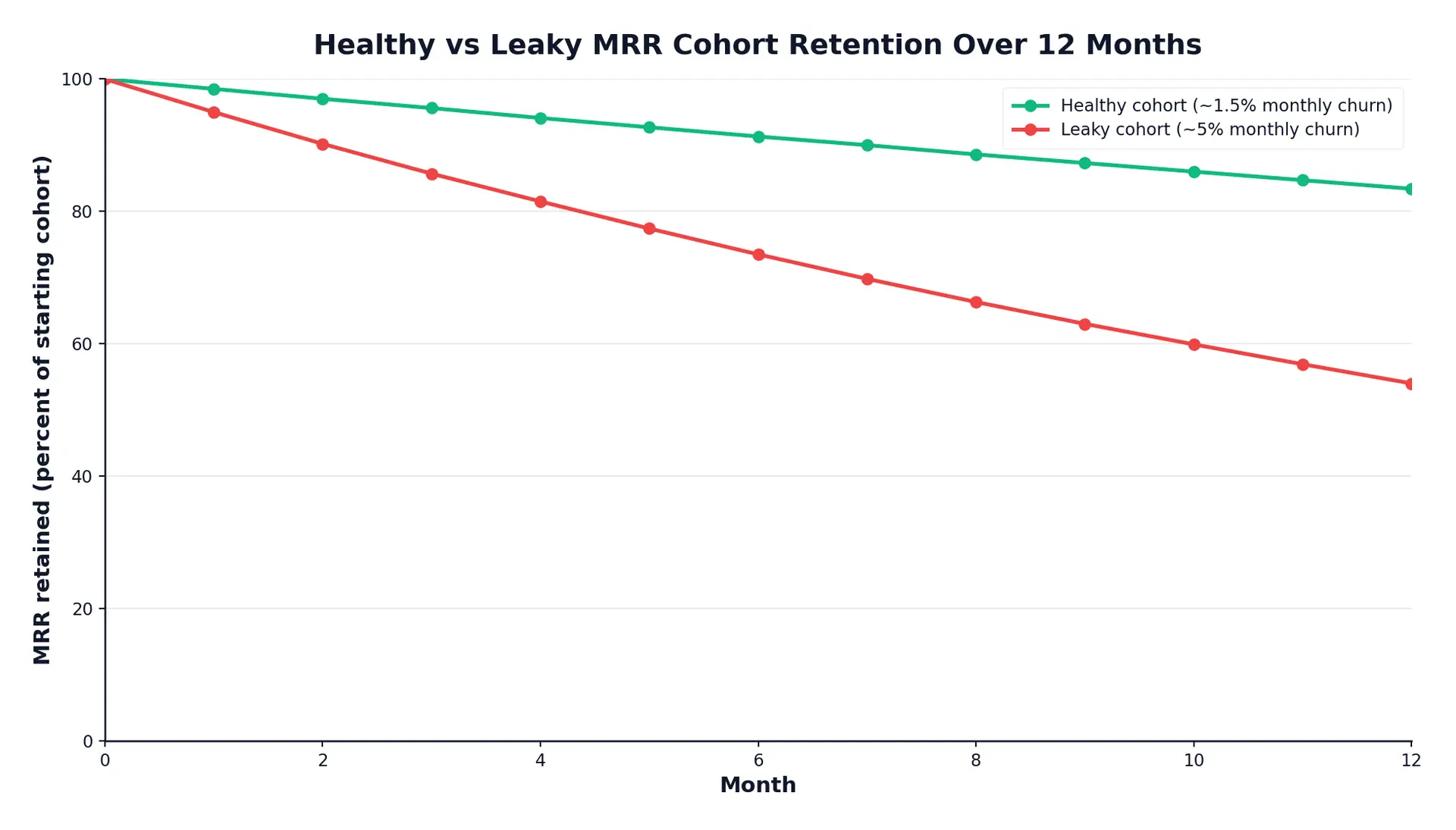
To make the comparison sting, hold every other component constant and swap the expansion and churn lines so churn doubles and expansion halves:
| Movement | Healthy Cohort | Leaky Cohort |
|---|---|---|
| Starting MRR | $416,667 | $416,667 |
| Churned MRR | $8,333 (2.0%) | $16,667 (4.0%) |
| Contraction MRR | $2,083 (0.5%) | $4,167 (1.0%) |
| Expansion MRR | $12,500 (3.0%) | $6,250 (1.5%) |
| Reactivation MRR | $1,250 (0.3%) | $625 (0.15%) |
| Gross MRR Churn | 2.5% | 5.0% |
| Net MRR Churn | −0.8% | 3.4% |
| Monthly NRR | 100.8% | 96.6% |
| Annual NRR (compounded) | 110.0% | 65.6% |
Look at the annual NRR column. The healthy cohort, left alone, grows 10% a year before you sell a single new logo. The leaky cohort, left alone, shrinks by 34.4% a year. To net to zero growth, the leaky cohort has to replace one-third of its entire revenue base in new logos every year just to stand still. That is the kind of treadmill that ends fundraising rounds.
The single biggest lever in SaaS economics is not new logo acquisition. It is the math hidden in this table.
Gross MRR Churn vs Net MRR Churn — When to Lead With Which
These are not interchangeable. They answer different questions, and presenting one without the other is how founders accidentally mislead their own boards.
| Dimension | Gross MRR Churn | Net MRR Churn |
|---|---|---|
| What it counts | Cancellations and downgrades only | Cancellations and downgrades minus expansion and reactivation |
| What question it answers | How leaky is the bucket? | Is the bucket still filling up despite the leak? |
| Healthy range at $5M ARR | 1% to 2% monthly | −1% to +1% monthly |
| What it hides | Nothing — it is the gross number | Severity of the underlying leak |
| What it reveals | Product, pricing, and onboarding problems | Expansion engine health and overall cohort economics |
| When to lead with it | Internal retention reviews, product roadmap decisions | Board meetings, investor updates, M&A diligence |
Lead with gross MRR churn when the audience is internal and the question is “what is broken.” Product fit issues, bad onboarding, mispriced contracts, a feature gap that drove a key segment to a competitor — all of these show up in gross first. A net number can be flat or negative even when gross is high, because expansion is masking it. If you only look at net, you will miss the structural problem until your expansion engine slows down for an unrelated reason and the gross losses suddenly become visible.
Lead with net MRR churn when the audience is external and the question is “is the cohort self-funding.” Investors, acquirers, and lenders care about whether your existing customer base, on its own, produces more revenue next month than it did this month. That is the question net answers. A net MRR churn of zero or below is the cleanest signal a SaaS business can send. It says the customers you already have will fund their own growth, and any new logo dollars you add on top compound on a base that is itself growing.
The mistake to avoid is presenting only one number. A board deck with only net MRR churn looks great until someone asks “what is your gross?” and the answer reveals an expansion engine papering over a 6% gross leak. A board deck with only gross looks alarming until someone calculates net and sees the cohort is actually self-funding. Always show both. Always show them on the same page. Always show the trailing six months so the trajectory is visible.
The Five Mistakes That Distort Your MRR Churn Number
Across two decades of coaching SaaS founders, these are the five errors I see most often. Each one of them, in isolation, can change your reported MRR churn by a full percentage point or more — enough to flip your number from healthy to alarming, or worse, from alarming to falsely healthy.
- Multiplying monthly MRR churn by 12 to get an annual number. Monthly and annual churn are not linear multiples. The correct conversion uses geometric compounding: Annual Churn = 1 − (1 − Monthly Churn)^12. At 2% monthly gross churn, naive multiplication gives 24% annual; the correct answer is 21.5%. At 5% monthly the gap is 60% vs 46%. At 10% it is 120% vs 71.8%. The compounding error always overstates annual churn, which means founders who use the wrong formula scare themselves needlessly — until they present the number to a buyer who corrects them, at which point they look like they do not understand their own metrics. Use the compound formula every time.
- Counting new MRR in the wrong bucket. A customer signed on May 5 is a new logo, period. Their May revenue belongs in your new MRR line. It does not belong in expansion, it does not offset churn, and it does not change Starting MRR. This rule sounds obvious. It is violated constantly, especially by founders who run a single dashboard that lumps “all MRR added in May” into one number. The fix is to build the four-component breakdown — starting, churned, contraction, expansion, reactivation, new — and report each line separately. If your billing system cannot produce that breakdown, treat that as a P1 finance problem to fix this quarter.
- Using ACV-based math for monthly calculations. Annual Contract Value is a per-deal annualized figure. MRR is a monthly run-rate figure. They are computed from the same contracts but answer different questions, and mixing them inside a monthly churn calculation produces garbage. If you have a $60,000 ACV contract that started March 15, the May contribution is $5,000 of MRR (1/12 of ACV), not $60,000 and not zero. Build the monthly run-rate cleanly from the contract terms — most billing platforms expose an MRR view already, and if yours does not, it is worth a one-week engineering project to produce one.
- Treating contraction as churn, or vice versa. A customer who downgrades from $5,000 a month to $3,000 a month is not a cancellation. They contributed $2,000 of contraction MRR and $3,000 of retained MRR. Lumping that $2,000 into Churned MRR (instead of Contraction MRR) overstates your cancellation rate and understates your downgrade rate, which makes it harder to diagnose which problem is actually worse. Pricing-driven downgrades and product-fit-driven cancellations are different failure modes with different fixes; keep them in different buckets so you can see them.
- Forgetting to break out reactivations. Reactivation MRR — customers who churned in a prior period and came back — is genuinely good news, but it is different from organic expansion. A high reactivation number can mean your product is sticky enough that people come back after they try alternatives; it can also mean your sales team is winning back customers who churned for fixable reasons. Both are useful signals, both are different from “existing customers buying more,” and both are worth a separate line in the report. Most operators bury reactivation inside expansion. I break it out by default.
There is a sixth mistake worth a brief mention: defining the cohort inconsistently from one month to the next. If May’s Starting MRR is the customers active on May 1, June’s Starting MRR has to be the customers active on June 1 — which is May 1’s cohort minus May churn plus May new logos, where May new logos now count as “starting” for June. Document the definition once and apply it every month. The worst version of any metric is the one that quietly redefines itself between quarters.
Benchmarks: What MRR Churn Should Look Like at Your Stage
The right MRR churn number depends on where you are. Asking “what is a good MRR churn rate” without a stage qualifier produces useless answers, because the same number is excellent at one scale and alarming at another. The table below shows what I see across the SaaS companies I coach and what buyers typically expect at each stage.
| ARR Stage | Healthy Monthly Gross MRR Churn | Healthy Monthly Net MRR Churn | Annual NRR (Compounded) |
|---|---|---|---|
| Pre-$1M ARR (early) | 3% to 5% | 1% to 3% | 70% to 90% |
| $1M to $3M ARR | 2% to 3% | 0% to 2% | 80% to 100% |
| $3M to $10M ARR | 1.5% to 2.5% | −0.5% to +1% | 95% to 115% |
| $10M to $25M ARR | 1% to 1.5% | −1% to 0% | 100% to 115% |
| $25M+ ARR | < 1% | < −0.5% | 110% to 130%+ |
A few important notes on this table. First, the numbers reflect monthly rates, not annual. Multiply correctly when converting. Second, the ranges are deliberately wide because end markets vary — a low-ACV SMB SaaS business should expect higher gross churn than a high-ACV enterprise SaaS business at the same ARR stage, simply because smaller customers churn more often. Third, the “healthy net MRR churn” column assumes a functional expansion motion. If you have no expansion motion at all (no upsell pathway, no seat expansion, no price ladder), your net will track your gross, and these benchmarks will look unattainable.
The most important number on this table is the net column at the $10M to $25M ARR stage. Once you cross $10M ARR, acquirers and lenders start pricing your business on the assumption that the existing customer base is, on net, self-sustaining. If your net MRR churn is positive at that stage, your terminal value gets discounted heavily. If it is at or below zero, you get full credit for the durability of the cohort, which is typically the largest single driver of valuation multiple at that scale.
(A note on time-sensitive data: the benchmark ranges above reflect typical 2026 SaaS market conditions. Specific numbers vary by vertical, end market, and competitive dynamics. The ranges are included to show relative differences between stages rather than as absolute targets — your peer set may run hotter or cooler. Always cross-check against vertical-specific benchmarks before setting a board-level target.)

What Drives MRR Churn — and What Does Not
There is a popular narrative in SaaS that customer success teams are the lever for retention. They are not the lever. They are the indicator that the lever has been pulled.
The actual drivers of MRR churn, in rough order of impact, are these:
- Pricing fit. Customers churn when the price exceeds the perceived value at their stage. A customer signed up for a $2,000/month plan because it was the cheapest option, and then realized they were only using 30% of the feature set, will downgrade or cancel. The fix is not a customer success call; the fix is a better-shaped pricing ladder.
- Onboarding completeness. Customers who reach “first value” (whatever the action is that delivers the core benefit) in the first 14 to 30 days churn at a fraction of the rate of customers who do not. The single highest-leverage retention investment most early-stage companies can make is in onboarding instrumentation: measure how many customers hit first value, set an internal target, and treat any drop below the target as a P1 issue.
- Product-stage fit. A customer at $2M ARR has different needs than a customer at $20M ARR. If your product is built for the $2M crowd and you let your sales team sell into the $20M crowd, you will see those large customers churn within 6 to 12 months because the product cannot scale with them. The fix is sales-side discipline, not customer success heroics.
- Account stability. A customer whose internal champion leaves the company within 90 days of the deal closing is at materially higher churn risk. There is no software fix for this; the fix is relationship-density — making sure more than one person on the customer side is bought in before the deal closes.
- Customer success motion. Important, but downstream of the four items above. A great customer success team can move retention by maybe 2 to 3 percentage points on the margin. A bad pricing ladder will cost you 10.
The implication is uncomfortable for many founders. If your MRR churn is too high, the answer is rarely “hire another CSM.” The answer is usually a structural change to pricing, sales targeting, or onboarding — work that is harder, slower, and more political than adding headcount. The CSM addition is what you do after you have fixed the upstream causes, to compound the gains.
A 90-Day Playbook to Bring MRR Churn Down
If you finish reading this and your gross MRR churn is meaningfully above the benchmark for your stage, here is the sequence I would run if I were sitting in your CEO chair. This is the same sequence I work through with coaching clients when their number is wrong.
Days 1–14: Diagnose. Pull the last 12 months of MRR movements and break each month cleanly into the five components — starting, churned, contraction, expansion, reactivation. Then segment each component by customer cohort (ACV band or vertical) and by tenure (under 90 days, 90 days to 12 months, 12+ months). The output of this two-week sprint is a single sheet that shows where the losses are concentrated: which segment, which tenure band, which loss type. Until you can see that sheet, every “retention initiative” is guesswork.
Days 15–45: Pick one driver and fix it. Based on the diagnostic, pick the single largest contributor — pricing fit, onboarding completion, product-stage fit, account stability, or CSM motion. Pick one. Trying to fix three at once is how 90-day initiatives become 90-week initiatives. Build a specific intervention: a pricing ladder restructure, an onboarding completion tracker, a sales playbook change, an executive sponsor program, a CSM staffing model. Whatever it is, scope it small enough to ship in 30 days and measurable enough to evaluate in 60.
Days 46–75: Measure the intervention. Track the specific cohort that experienced the intervention and compare its churn behavior to the prior trailing 90 days. Do not aggregate this with the rest of the base — the effect will get washed out. The signal you are looking for is a clear drop in the failure mode you targeted, in the cohort you targeted. If the signal is not there, the intervention did not work; cut it and try a different one. If the signal is there, prepare to scale it.
Days 76–90: Scale or restart. Either roll the working intervention across the broader base (with the same measurement discipline so you can see continued impact) or, if nothing worked, return to the diagnostic and pick a different driver. Either way, the goal of day 90 is to have a piece of evidence on a single sheet of paper that says “this intervention moved MRR churn from X to Y in this cohort.” That sheet of paper is what turns retention from a vague aspiration into a managed lever.
Three guardrails throughout. First, do not change the metric definition while you are working on the number — it is the easiest way to fool yourself into thinking the intervention worked. Second, do not stack interventions on top of each other; you will not know which one moved the number. Third, do not stop measuring. The companies that bring churn down sustainably are the ones that treat retention as a permanent metric, not a one-quarter project.
Frequently Asked Questions
What is the difference between MRR churn and customer churn?
MRR churn is denominated in dollars of monthly recurring revenue; customer churn is denominated in headcount of customers. They can diverge sharply. A SaaS business with high concentration in a few large accounts can have low customer churn (most small customers stick around) and high MRR churn (one big customer left). Always look at both. For pricing and product decisions, MRR churn is the more important signal. For top-of-funnel and brand decisions, customer churn matters more. The full breakdown is in the SaaS customer success metric guide.
Is gross MRR churn or net MRR churn the more important metric?
Gross is the leading indicator; net is the lagging indicator. Gross tells you when something breaks in the product, pricing, or onboarding — it moves first. Net tells you whether the cohort as a whole is still self-funding — it moves later, and it is what acquirers price. Run both. Internal retention discussions should usually start with gross; external investor and buyer discussions should usually lead with net. Showing one without the other is the most common mistake in SaaS reporting.
What is a good monthly MRR churn rate?
It depends on your ARR stage. Pre-$1M ARR, 3% to 5% monthly gross MRR churn is normal — you are still figuring out product fit. By $5M ARR, healthy is 1.5% to 2.5%. By $10M+ ARR, healthy is under 1.5% gross and at or below zero on net. Anything materially worse than those ranges, at your stage, is worth treating as a structural problem rather than a seasonal blip.
How do I convert monthly MRR churn to annual MRR churn?
Use the compound formula, not multiplication: Annual Churn = 1 − (1 − Monthly Churn)^12. Multiplying monthly by 12 overstates the annual rate by 5 to 25 percentage points depending on the level. At 2% monthly the correct annual is 21.5%, not 24%. At 5% monthly the correct annual is 46%, not 60%. The compounding effect matters for any decision that depends on the absolute level of the annual figure — fundraising materials, M&A models, internal forecasts.
How is MRR churn different from net revenue retention?
They are arithmetic mirrors. NRR = 100% − Net MRR Churn. If your net MRR churn is −1.0%, your NRR is 101.0%. They contain the same information and are interchangeable in any rigorous discussion. The convention is that operators talk about MRR churn (they want the number to go down) and investors talk about NRR (they want the number to go up). Either is fine; pick one and stick with it within a given report. Detailed mechanics are in the net revenue retention guide.
Should reactivation MRR be counted as expansion or as new MRR?
Most operators bundle it into expansion. I prefer breaking it out as a separate line because reactivation behavior tells you something different from organic expansion — it says either “the product is sticky enough that customers return after trying alternatives” or “the sales team is winning back fixable churns.” Both are useful, both are different from “existing customers buying more.” If you bundle it, document the choice and apply it consistently.
Does seat expansion at an existing customer count as expansion MRR or new MRR?
Expansion MRR, in essentially every framework that matters. The customer relationship is the same; the dollars are larger. The only edge case is when the expansion happens via a fundamentally new product line that the customer was not buying before — some operators argue this is “cross-sell new MRR” rather than expansion. The arithmetic does not care; the segmentation does. If you are trying to measure how well your land-and-expand motion works, treat seat expansion as expansion. If you are trying to measure how well your cross-sell motion works, break new-product cross-sells out separately.
What is the relationship between MRR churn and LTV?
Churn is the denominator of the LTV calculation. LTV = ARPA ÷ Monthly Churn Rate, where the relevant churn rate is usually gross MRR churn (or revenue churn) for the LTV-per-dollar interpretation. A 1% improvement in monthly MRR churn lengthens implied customer lifespan from 50 months to 100 months — which doubles the LTV. That is why retention work compounds in valuation impact: small improvements in the churn rate translate into large multipliers in the LTV-to-CAC ratio that buyers care about. The math is detailed in the LTV/CAC guide.
The Bottom Line
MRR churn is the most important retention metric a SaaS business reports. Get it right and you have a clean signal that lets you separate “we are growing because we are buying customers” from “we are growing because our existing customers are paying us more every month.” Get it wrong — by multiplying instead of compounding, by lumping new logos into expansion, by hiding contraction inside churn — and you produce a number that looks like a metric but functions like noise.
Three habits separate the founders whose MRR churn numbers I trust from the ones whose numbers I have to recompute on a coaching call. They report gross and net side by side, every month, with the trailing six months visible. They use the compound formula for annual conversions, every time. And they treat the number as a managed lever — diagnose, intervene in one place, measure the intervention against a specific cohort, scale what works — not as a quarterly aspiration. The math compounds; the discipline compounds harder.
If your number is wrong this quarter, do not panic and do not hire a customer success team to fix it. Pull the diagnostic, find the upstream driver, fix the structural cause. Then watch the number move. That is how SaaS economics work when they work.