

Most SaaS CEOs running a $5M to $15M business cannot tell you, off the top of their head, whether their numbers are good. They know their revenue. They might know last quarter’s growth rate. But ask them how their net revenue retention compares to a company their size, or whether their CAC payback period is where an acquirer would want it, and you get a shrug. That is the gap SaaS benchmarks close — and it is a more expensive gap than most founders realize.
Here is the uncomfortable truth I see constantly: companies under $20M ARR routinely run their sales and marketing spend, their R&D investment, and their unit economics far above or below where they should be — and they have no idea, because they never checked the benchmark. They are flying without instruments. The right SaaS benchmarks are those instruments. This guide gives you the ones that actually matter — the numbers a buyer checks first, the thresholds that separate a fundable company from a money-losing one, and, just as important, how to read a benchmark without letting it lie to you.
What SaaS Benchmarks Actually Are (and Aren’t)
A SaaS benchmark is a reference point — a number that tells you what “normal” or “good” looks like for a metric, so you can tell whether your own number is a strength, a problem, or a non-issue. Growth rate, net revenue retention, gross margin, CAC payback — each has a range the market considers healthy, and your job is to know where you sit relative to that range.
But a benchmark is a starting point for a conversation, not a verdict. There are really two kinds, and conflating them is the first mistake:
- External benchmarks compare you to other companies — industry medians, top-quartile figures, the numbers in a KeyBanc or SaaS Capital survey. They tell you how you stack up against the field.
- Internal benchmarks compare you to yourself — your best sales rep against your average rep, your best customer segment against your worst, this quarter against last. They tell you what is possible inside your own business right now.
Most founders fixate on external benchmarks and ignore internal ones. That is backwards. Your best rep closing at 50% while your average rep closes at 20% is a more actionable benchmark than any industry median, because you already have proof the higher number is achievable in your exact business with your exact product. Industry benchmarks tell you whether to worry. Internal benchmarks tell you what to do about it.

The Benchmarks That Actually Move Valuation
Not all SaaS benchmarks are created equal. A handful drive the multiple a buyer will pay; the rest are diagnostics that help you fix the ones that do. If you only internalize five, make them these.
| Benchmark | What It Measures | "Acceptable" | "Strong" | Why It Matters |
|---|---|---|---|---|
| Rule of 40 | Growth rate + profit margin | ≥ 40 | ≥ 50 | The single-sentence filter investors use |
| Net Revenue Retention (NRR) | Growth from existing customers | ≥ 100% | ≥ 110% | Determines whether you grow on autopilot |
| LTV / CAC | Return on acquisition spend | ≥ 3.0 | ≥ 5.0 | Tells you if growth is economically viable |
| CAC Payback | Months to recover acquisition cost | ≤ 12 months | < 6 months | How fast acquisition spend turns back into cash |
| Gross Margin | Revenue left after delivery cost | 70–80% | ≥ 80% | Whether the business model itself works |
The thing to understand about these five is that they are not independent. They interlock. Strong gross margin makes your LTV/CAC math work. A healthy LTV/CAC keeps your CAC payback short. NRR above 100% means your growth rate stays high without burning more on acquisition, which props up the Rule of 40. A buyer is not really evaluating five numbers — they are evaluating one connected system, and these five are the windows into it. Let’s take them one at a time.
Rule of 40: The One-Sentence Filter
If you only know one SaaS benchmark, know this one. The Rule of 40 says your annual revenue growth rate plus your EBITDA (profit) margin should add up to at least 40.
Rule of 40 = Revenue Growth Rate (%) + EBITDA Margin (%)
The elegance is that it forces a trade-off into a single number. A company growing 60% per year while burning 20% of revenue scores 40 — fine, because the growth justifies the burn. A company growing 10% but running a 30% profit margin also scores 40 — fine, because the profitability justifies the slow growth. What investors penalize is the company that does neither: growing 15% while burning 15% scores 0, and that is the profile of a business that is neither a growth story nor a cash machine.
For a $5M–$15M company, here is roughly how the market reads it:
| Rule of 40 Score | Interpretation |
|---|---|
| ≥ 50 | Elite — top-tier multiple territory |
| 40–49 | Healthy — fundable, attractive |
| 20–39 | Mediocre — survivable but discounted |
| < 20 | Problem — fix growth or burn before raising or selling |
A practical note: lead with this number when you have it. If you are Rule of 40, put it on slide one of your investor deck. It is the fastest way to signal that you understand how your business is judged. For the full mechanics, see the Rule of 40 guide.
Net Revenue Retention: The Benchmark That Determines Your Ceiling
Net revenue retention (NRR) measures how much revenue you keep and grow from your existing customers over a year — after accounting for churn, downgrades, and expansion. The formula counts only the existing base; it deliberately excludes new customers.
NRR = (Beginning MRR − Churn MRR − Downgrade MRR + Expansion MRR) ÷ Beginning MRR
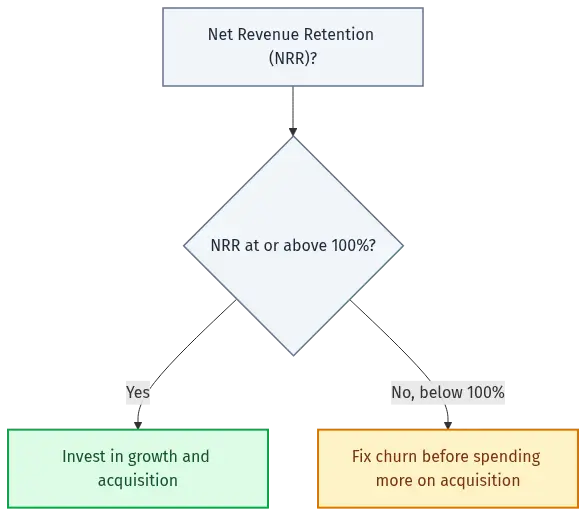
Why is this the benchmark that determines your ceiling? Because of what happens when NRR crosses 100%. Below 100%, your existing base shrinks every year, and you have to sell new business just to stand still — you are running up a down escalator. Above 100%, your existing base grows on its own, before you acquire a single new customer. That is the difference between a business with a leak and a business with a tailwind.
| NRR | What It Means |
|---|---|
| ≥ 120% | Best-in-class — the base compounds fast |
| 110–119% | Strong — expansion clearly outpaces churn |
| 100–109% | Healthy — the base grows without new sales |
| 90–99% | Leaky — new sales subsidize existing losses |
| < 90% | Serious churn problem — fix before scaling spend |
The compounding here is brutal in both directions. A business at 90% NRR loses roughly a quarter of its starting cohort’s value over three years; a business at 115% nearly grows that cohort by half over the same period — without acquiring anyone new. That swing is why acquirers treat NRR as a proxy for product stickiness and pricing power. If your NRR is below 100%, no amount of new-logo hustle fixes the underlying problem; you are pouring water into a leaking bucket. Fix churn and expansion first.
LTV/CAC and CAC Payback: The Scalability Gate
These two travel together because together they answer one question: is your growth economically viable, or are you buying revenue at a loss?
LTV/CAC is the lifetime value of a customer divided by the cost to acquire them. LTV = Average MRR ÷ Monthly Gross Revenue Churn Rate, and LTV/CAC = LTV ÷ CAC. Always in that order — lifetime value on top.
CAC payback is how many months of gross profit it takes to earn back what you spent acquiring the customer:
CAC Payback (Months) = CAC ÷ (Average MRR × Gross Margin %)
The benchmarks are clean and widely agreed on:
| Metric | Acceptable | Strong | Danger |
|---|---|---|---|
| LTV / CAC | ≥ 3.0 | ≥ 5.0 | < 3.0 |
| CAC Payback | ≤ 12 months | < 6 months | > 18 months |
Why 3.0 and not 2 or 5? Because when you layer a 3:1 LTV/CAC on top of typical SaaS cost structure — gross margin in the 70s and 80s, normal R&D and operating expense — you land on an EBITDA margin that can actually fund growth and keep you in Rule of 40 territory. Below 3.0, the math gets hard: there isn’t enough margin left after acquisition to both grow and stay healthy.
Here is the part most founders miss, and it is the most actionable use of these two benchmarks. They are not just a report-card grade — they are a capital allocation signal:
- Above the benchmark? Invest more aggressively in sales and marketing. If a channel returns LTV/CAC well above 3, you are leaving growth on the table by underspending it.
- Below the benchmark? Stop adding sales spend. Cut it if you have to, and go figure out why the economics are broken before you pour more money into a leaky channel.
I have watched founders do the exact opposite — double down on a channel that was losing money because the top-line bookings looked good — and it is one of the most expensive mistakes in SaaS. The benchmark exists precisely to stop you from scaling a loss. For the full method, see SaaS unit economics.
Spend Benchmarks: Where Your Money Should Go
Beyond the headline metrics, there is a quieter set of SaaS benchmarks that under-$20M companies get wrong constantly: how you split spending across functions, as a percentage of revenue. These don’t show up on a pitch deck, but they reveal whether a business is over- or under-invested in ways that quietly cap growth two years out.
| Function | Typical % of Revenue | What "Off" Looks Like |
|---|---|---|
| Sales & Marketing | 20–25% (higher when growing fast) | Under 15% may mean under-investing in growth; far over may mean inefficient acquisition |
| R&D / Product | 20–25% | Under 15% risks a stale product that loses competitively in 2 years |
| G&A (overhead) | 11–15% | Bloated G&A is dead weight; very lean can signal missing infrastructure |
The principle behind these: you should be in benchmark unless there is a deliberate, thought-out reason you’re not. Spending 35% on S&M because you raised capital to scale aggressively is a strategy. Spending 35% because the number crept up over two years and nobody noticed is a leak. The danger isn’t being off-benchmark — it’s being off-benchmark by accident.
One caveat worth flagging: these percentages flex with growth rate. A company growing over 50% year over year will and should run sales and marketing well above 25% — sometimes far above — because it is deliberately trading near-term profit for market share. The benchmark is a default, not a law. The point is to know your number and know why it differs.
How to Read a SaaS Benchmark Without Getting Fooled
This is the section most benchmark articles skip, and it is the most important one. A benchmark you read wrong is worse than no benchmark at all, because it gives you false confidence. Three rules.
Averages Lie — Always Disaggregate
This is the single most important habit in using benchmarks. A company-wide average hides the truth almost every time. Think of it this way: if you measured the average net worth of the ten houses on Warren Buffett’s street, you’d get something like $10 billion per household — a completely useless number, because one resident skews the whole block. Your business has the same dynamic hiding inside it.
When your overall metric looks fine, break it apart — by segment, by channel, by rep, by cohort. A blended 20% demo-to-close rate might be ten reps all at 20%, or it might be one superstar at 50% and the rest at 8%. Those are completely different businesses with completely different action plans, and the average tells you nothing about which one you have. The same goes for churn by customer segment, LTV/CAC by acquisition channel, and NRR by contract size. The insight is always in the disaggregation, never in the average.
Match the Accounting Basis
Benchmarks assume an accounting basis. Most SaaS benchmark surveys are built on accrual accounting, not cash. If you’re reading your numbers off a cash-basis QuickBooks export and comparing them to an accrual-basis benchmark, you are comparing two different things and the gap is an artifact, not a finding. Get the basis right before you draw conclusions.
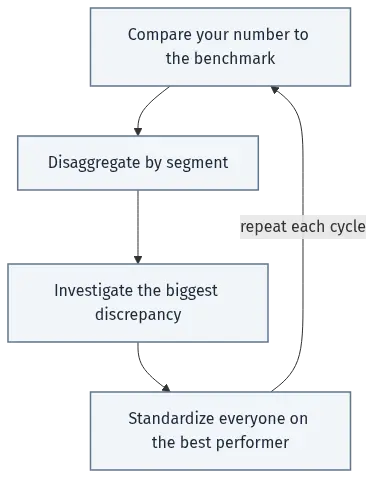
Use Benchmarks to Find Discrepancies, Then Investigate
The right workflow isn’t “compare to benchmark, feel good or bad, move on.” It’s: scan for the number that looks unusually far from the benchmark or from your own best, then go investigate why qualitatively. The benchmark is a flashlight that points you at the thing worth studying — it is never the answer itself. When you find your best-performing segment or rep, study what they do differently, document it, and train everyone else toward that internal benchmark. That is the highest-leverage move benchmarking unlocks.
SaaS Benchmarks by ARR Stage
Benchmarks shift as you grow. A 15% NRR-driven expansion rate that’s elite at $2M ARR is table stakes at $50M. Here is a rough orientation for the $5M–$15M range that most of my readers live in, with the direction of travel as you scale.
| Metric | $1M–$5M ARR | $5M–$15M ARR | $15M–$50M ARR |
|---|---|---|---|
| Growth rate | 60–100%+ | 40–60% | 30–40% |
| NRR | 95–105% | 100–110% | 105–120% |
| Gross margin | 65–75% | 70–80% | 75–85% |
| LTV/CAC | 3.0+ | 3.0–5.0 | 4.0+ |
| Rule of 40 | Growth-weighted | Balanced | Profit emerging |
Two patterns to notice. First, growth rate naturally decelerates as the base gets bigger — a company doesn’t fail because it “slows” from 100% to 50%; that’s physics. Second, the profile shifts from pure growth toward a growth-and-profit balance as you approach the size where acquirers and growth-equity firms get interested. The companies that exit well are the ones that read these stage-appropriate benchmarks correctly and stop optimizing for the wrong number at the wrong time. If your eye is on a sale, study SaaS valuation multiples alongside these operating benchmarks — the operating numbers are what produce the multiple.
Frequently Asked Questions
What is a good growth rate for a SaaS company?
It depends on your size. At $1M–$5M ARR, healthy growth is 60–100%+ per year. At $5M–$15M, 40–60% is strong. At $15M–$50M, 30–40% is solid. Growth rate naturally slows as the revenue base gets larger, so judge it against your stage, not an absolute number — and always read it together with profitability via the Rule of 40.
What’s the most important SaaS benchmark?
For valuation, the Rule of 40 (growth rate + profit margin ≥ 40) is the single fastest filter investors use. But the metric that most determines your long-term ceiling is net revenue retention — above 100% means your existing customer base grows on its own, which is the foundation everything else builds on.
What is a good LTV/CAC ratio?
3.0 or higher is the accepted threshold for economic viability; 5.0+ is strong. Below 3.0, there usually isn’t enough margin left after acquisition cost to both grow and stay healthy. Pair it with CAC payback: aim for under 12 months, ideally under 6.
Where do SaaS benchmarks come from?
Credible external benchmarks come from large recurring surveys such as the KeyBanc Capital Markets SaaS Survey and SaaS Capital’s research, plus operating data from investors and platforms. Just confirm the accounting basis (usually accrual, not cash) before comparing your numbers to theirs.
How often should I check my SaaS benchmarks?
Review the core operating benchmarks — growth, NRR, gross margin, LTV/CAC, CAC payback, and spend ratios — quarterly at minimum, segmented rather than blended. Monthly leading indicators (lead flow, demos, conversion rates) tell you whether next quarter’s numbers will hold.
Related Reading: Rule of 40 · Net Revenue Retention · LTV/CAC · SaaS Unit Economics · SaaS Growth Metrics · SaaS KPIs · SaaS Valuation Multiples