
Sales efficiency is the single number that decides whether pouring more money into sales makes you richer or just busier. It answers one blunt question: for every dollar you spend acquiring customers, how many dollars of recurring revenue come back? Get a clear answer and growth becomes a capital-allocation decision — put a dollar in, get a predictable return out, repeat. Get a fuzzy answer and you’re gambling, scaling a sales team on faith and hoping the math works out.
Most technical founders track ARR and growth rate religiously but can’t tell you their sales efficiency to one decimal place. That’s a problem, because you can never outgrow your unit economics. If it costs you $3 in sales and marketing to generate $1 of new recurring revenue, hiring more reps doesn’t fix the problem — it makes the bleeding faster. This article gives you the three formulas that actually measure sales efficiency, worked examples with realistic $5M–$15M ARR numbers, the benchmarks that separate a fundable business from a money-losing one, and the segment-level analysis that tells you exactly where to put your next sales dollar.
What Sales Efficiency Actually Measures
Sales efficiency is a broad term for how effectively your sales and marketing investment converts into recurring revenue. It’s not one metric — it’s a family of metrics that all circle the same question from different angles: am I getting an attractive return on the money I spend to grow?
Think of it the way you’d think about any investment. You go to one savings account, put in a dollar, and get four cents back in a year. You go to another, put in a dollar, and get twenty dollars back. Which account do you fund, over and over again? Sales efficiency is the metric that tells you which account your sales engine actually is. When the return is high, the answer to “should we spend more on sales?” is obvious — yes, as much as you can, as long as the return holds. When the return is low, more spend just deepens the hole.
This is why sophisticated growth investors stopped rewarding growth at all costs years ago. They want growth where the capital deployed is efficient. A company growing 40% with terrible sales efficiency is worth far less than a company growing 30% efficiently, because the efficient one can be scaled with confidence and the inefficient one can’t.
The three workhorse metrics for measuring sales efficiency are the SaaS Magic Number, CAC payback period, and the LTV/CAC ratio. They overlap deliberately — each catches something the others miss. Below, I’ll walk through all three with worked numbers.
The SaaS Magic Number
The Magic Number is the most direct sales efficiency metric. It estimates how much new annual recurring revenue each dollar of sales and marketing spend produced, with a one-quarter lag built in to account for the fact that sales spend in one quarter generates revenue in the next.
The formula:
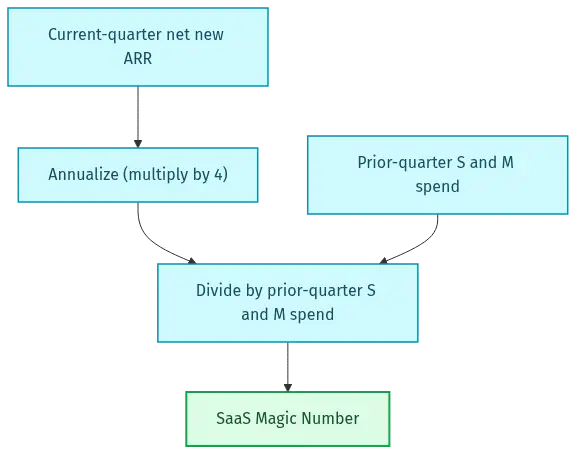
Magic Number = (Current Quarter ARR − Prior Quarter ARR) × 4 ÷ Prior Quarter Sales & Marketing Spend
The numerator is the increase in ARR from one quarter to the next, multiplied by 4 to annualize it. The denominator is the sales and marketing spend from the previous quarter — the spend that did the work to generate this quarter’s new revenue.
Let’s work an example. Your SaaS company has these numbers:
- Prior quarter ARR: $8,000,000
- Current quarter ARR: $8,750,000
- Prior quarter sales & marketing spend: $1,500,000
Net new ARR this quarter is $8,750,000 − $8,000,000 = $750,000. Annualized, that’s $750,000 × 4 = $3,000,000.
Magic Number = $3,000,000 ÷ $1,500,000 = 2.0
A Magic Number of 2.0 means every dollar of sales and marketing spend generated two dollars of annualized new recurring revenue. That’s exceptional. Here’s how to read the result against benchmarks:
| Magic Number | Interpretation | What to do |
|---|---|---|
| < 0.5 | Inefficient — your go-to-market is broken | Stop scaling. Fix the funnel before adding spend. |
| 0.5–0.75 | Improving but not yet efficient | Diagnose which segment or channel is dragging. |
| 0.75–1.0 | Good — healthy sales efficiency | Keep investing at the current pace. |
| > 1.0 | Excellent — you're under-investing | Pour more money in. The return is there. |
The counterintuitive insight: a Magic Number that’s too high is also a signal. If you’re consistently above 1.0, you’re leaving growth on the table. The market is telling you it will absorb more sales investment at an attractive return, and you’re being too conservative. A 2.0 like the example above isn’t a trophy — it’s a memo telling you to spend more.
One caveat on the Magic Number: it’s a blunt, company-wide instrument. It tells you whether your sales engine is efficient, not where the efficiency is coming from. For that, you need the next two metrics — and, ultimately, segmentation.
CAC Payback Period: How Fast You Get Your Money Back
The Magic Number tells you the return ratio. The CAC payback period tells you the speed — how many months it takes to recover the cost of acquiring a customer from the gross profit that customer generates. Speed matters because the faster you recycle a sales dollar, the more times you can redeploy it in a year, and the less outside capital you need to fund growth.
First, calculate CAC (Customer Acquisition Cost) — the full cost of landing one new customer:
CAC = Total Sales & Marketing Spend ÷ Number of New Customers Acquired
Then the payback:
CAC Payback Period = CAC ÷ (ARPA × Gross Margin %)
Where ARPA is Average Revenue Per Account (monthly) and Gross Margin % is the share of revenue left after the direct cost of delivering the service. The reason gross margin belongs in the formula is that you don’t recover CAC from revenue — you recover it from the gross profit that revenue throws off. A dollar of revenue at 80% gross margin only contributes 80 cents toward paying back CAC.
Let’s work it. Same company:
- Prior quarter sales & marketing spend: $1,500,000
- New customers acquired that quarter: 25
- Monthly ARPA: $2,500
- Gross margin: 80%
CAC = $1,500,000 ÷ 25 = $60,000 per customer
Monthly gross profit per customer = $2,500 × 0.80 = $2,000.
CAC Payback = $60,000 ÷ $2,000 = 30 months
Now read that against the benchmarks:
| Payback Period | Interpretation |
|---|---|
| < 12 months | Excellent — fast capital recycle |
| 12–18 months | Good — typical for healthy SaaS |
| 18–24 months | Acceptable if retention is strong |
| > 24 months | Concerning — capital-intensive growth |
Here’s where it gets interesting. The same company has a Magic Number of 2.0 (excellent) but a CAC payback of 30 months (concerning). How can both be true?
They measure different things. The Magic Number rewarded a large ARR jump relative to spend, but it doesn’t see that the company landed only 25 customers — meaning each one was a big, expensive enterprise deal with a long payback. The Magic Number says “the engine is efficient overall.” The payback period says “but each individual deal ties up your capital for two and a half years.” Both are correct. A company in this position isn’t broken, but it needs deep pockets or strong retention to fund the gap between spending the CAC and earning it back. This is exactly why you never rely on a single sales efficiency metric.

LTV/CAC: Is Each Customer Worth Acquiring at All?
The Magic Number and payback both look at the front end — what it costs to land revenue and how fast you recover it. The LTV/CAC ratio zooms out to the full economic life of a customer and asks the most fundamental question: across everything this customer will ever pay you, do you come out ahead of what it cost to acquire them?
LTV (Customer Lifetime Value) = ARPA × Gross Margin % × Average Customer Lifespan
Where Average Customer Lifespan (in months) = 1 ÷ Monthly Churn Rate.
LTV/CAC = Customer Lifetime Value ÷ Customer Acquisition Cost
Continuing the example, add a churn assumption:
- Monthly ARPA: $2,500
- Gross margin: 80%
- Monthly churn rate: 1.5% (0.015)
- CAC: $60,000
Average customer lifespan = 1 ÷ 0.015 = 66.7 months.
LTV = $2,500 × 0.80 × 66.7 = $133,333.
LTV/CAC = $133,333 ÷ $60,000 = 2.2
The benchmark table:
| LTV/CAC | Interpretation |
|---|---|
| < 1.0 | Losing money on every customer — unsustainable |
| 1.0–2.0 | Marginal — may not cover operational costs |
| 3.0 | Industry benchmark — healthy unit economics |
| 3.0–5.0 | Strong — efficient growth engine |
| > 5.0 | Possibly under-investing in growth |
At 2.2, this company is marginal — below the 3.0 benchmark that signals genuinely healthy unit economics. Notice the story the three metrics tell together: a great Magic Number (2.0), a worrying payback (30 months), and a marginal LTV/CAC (2.2). The single most likely culprit, given the long payback and the modest lifetime ratio, is that customers don’t stay long enough to justify their high acquisition cost. The fix isn’t more sales spend — it’s retention. Which brings us to the most important principle in this entire article.

You Can Never Outgrow Your Unit Economics
Here’s the rule that sits underneath every sales efficiency metric: these numbers define your ceiling. If your unit economics are attractive, there is effectively no ceiling — you can keep investing in sales as long as the return holds. If they’re broken, no amount of growth fixes them. You just lose money faster.
This is why founders who try to “grow their way out” of bad unit economics fail. The math compounds against them. Every new customer acquired at a loss adds to the loss. Every rep hired to sell an unprofitable product just sells more unprofitable product. Sales efficiency metrics aren’t a report card you check after the fact — they’re the constraint that determines whether scaling is even possible.
And retention is the lever that moves all of them at once. Look back at the example: the company’s LTV/CAC was marginal entirely because of churn. If that 1.5% monthly churn dropped to 1.0%:
- Average customer lifespan = 1 ÷ 0.01 = 100 months
- LTV = $2,500 × 0.80 × 100 = $200,000
- LTV/CAC = $200,000 ÷ $60,000 = 3.3
A single half-point improvement in monthly churn moved LTV/CAC from a marginal 2.2 to a strong 3.3 — without touching sales spend, pricing, or conversion rates. That’s the compounding power of retention. If you have a churn problem, fix it before you optimize anything on the sales side, because everything downstream breaks until you do. Pouring CAC dollars into a leaky bucket is the most expensive mistake in SaaS.

The Mistake That Hides in Every Blended Number
Everything above used company-wide numbers. That’s how almost everyone calculates sales efficiency — and it’s the single biggest error in the discipline. Blended, company-wide metrics average out the differences between customer segments, and those differences are where all the useful information lives.
In my experience, 100% of the time there are significant variances in sales efficiency across segments. Calculate the Magic Number, CAC payback, and LTV/CAC separately by:
- Vertical or industry — the same product often sells with wildly different economics into healthcare versus retail.
- Contract size tier — SMB, mid-market, and enterprise have completely different acquisition costs and retention curves.
- Acquisition channel — inbound, outbound, partner-sourced, and paid customers rarely share the same payback.
- Geography — different markets, different sales cycles, different efficiency.
Here’s what segmentation typically reveals. Suppose the company above breaks its blended 2.2 LTV/CAC into two segments:
| Segment | New customers | CAC | LTV | LTV/CAC | CAC payback |
|---|---|---|---|---|---|
| Inbound SMB | 18 | $25,000 | $90,000 | 3.6 | 14 months |
| Outbound Enterprise | 7 | $150,000 | $244,762 | 1.6 | 50 months |
The blended 2.2 was a lie of averages. Inbound SMB is a strong, fast-paying engine you should pour money into. Outbound Enterprise is marginal and capital-intensive — it’s subsidizing a money-losing motion with the profits from the healthy one. Without segmentation, you’d never see it. You’d look at the blended number, conclude “we’re okay-ish,” and keep funding both equally. With segmentation, the decision is obvious: double down on inbound SMB, and either fix the enterprise motion or shrink it.
To verify the blend: total CAC spend is (18 × $25,000) + (7 × $150,000) = $450,000 + $1,050,000 = $1,500,000, matching the quarter’s spend. Total LTV is (18 × $90,000) + (7 × $244,762) = $1,620,000 + $1,713,333 = $3,333,333. Blended LTV/CAC = $3,333,333 ÷ $1,500,000 = 2.2 — exactly the company-wide figure. The average was real; it was just useless for making decisions.
Study the Outliers to Improve Efficiency
Once you’ve segmented, the highest-leverage way to actually improve sales efficiency is to study your outliers. Find the top performer — the rep, the channel, the campaign with the best conversion numbers — figure out precisely what they do differently, document it, and train everyone else to do the same.
The variance itself is the signal. If one account executive is closing at a 40% conversion rate from the same lead pool where everyone else closes at 15%, that gap is the most valuable piece of data in your business. They’re doing the cold outreach differently, qualifying differently, or running the demo differently. Whatever it is, it’s already working inside your own walls — you don’t have to invent it, just spread it.
The math on this is dramatic. Imagine a ten-person sales team where one rep generates 60% of the qualified leads because they actually book five meetings a week while everyone else books half a meeting a week. If you can get the other nine to match the top performer’s activity, sales productivity doesn’t go up 10% or 20% — it can go up several hundred percent. That improvement flows straight through to every sales efficiency metric: lower CAC, faster payback, higher Magic Number. Studying outliers is the cheapest, fastest efficiency lever you have, because the best practice already exists and is proven — it just isn’t distributed yet.
Building the Sales Machine
Sales efficiency isn’t a number you measure once. It’s the output of a system you build deliberately over time. The end state every SaaS CEO should aim for is what I call the sales machine: a sales motion so well-understood and well-instrumented that you can put a known amount of money in and get a predictable amount of bookings out.
The progression runs through stages:
- Define a repeatable process. The same steps, every deal, every time. No improvisation.
- Professionalize it. Playbooks, documented best practices, an onboarding process that makes a new hire 90%+ as effective as a veteran within a reasonable ramp.
- Make it statistical. Know your conversion rate at every stage of the funnel. Instrument the process so you’re managing by data, not intuition.
- Optimize. Study the outliers, test messaging and process changes, raise the conversion rates that matter most.
- Hit your unit-economics targets. Sales efficiency metrics — Magic Number, payback, LTV/CAC — prove the machine works.
- Achieve predictability. Put $1M in, get $1M (or more) in bookings out, reliably.
When you reach that final stage, something fundamental changes. Sales stops being a people-and-process problem and becomes a capital-allocation problem. You stop talking to the VP of Sales about whether the quarter will hit and start talking to the CFO about how much to invest, because you already know the return. That’s the destination. Sales efficiency metrics are how you measure progress toward it — and how you prove to an acquirer that what you’ve built is a machine, not a collection of heroes.
Frequently Asked Questions
What is a good sales efficiency ratio for SaaS?
It depends on which metric you mean. For the Magic Number, anything above 0.75 is healthy and above 1.0 is excellent (and a signal to invest more). For CAC payback, under 12 months is excellent and 12–18 months is solid. For LTV/CAC, 3.0 is the industry benchmark for healthy unit economics. Use all three together — a single metric can hide problems the others catch.
What’s the difference between the Magic Number and CAC payback?
The Magic Number measures the return ratio on sales and marketing spend at the company level — how many dollars of annualized new ARR each spend dollar produced. CAC payback measures speed — how many months it takes to recover the cost of one customer from their gross profit. A company can have a great Magic Number and a slow payback at the same time, which usually means it’s landing large deals that are efficient in aggregate but tie up capital for a long time per customer.
How does churn affect sales efficiency?
Churn is the hidden driver of sales efficiency, because it determines customer lifespan, which determines LTV. A small improvement in monthly churn compounds into a large LTV change — in the worked example above, dropping monthly churn from 1.5% to 1.0% moved LTV/CAC from a marginal 2.2 to a strong 3.3 with no change to sales spend. If your sales efficiency is weak, check retention before you blame the sales team.
Why segment sales efficiency instead of using a company-wide number?
Because blended numbers average out the differences between customer segments, and those differences are where the decisions live. A healthy company-wide LTV/CAC often hides one segment that’s highly profitable subsidizing another that’s losing money. Segmenting by vertical, contract size, channel, and geography reveals where to invest and where to stop — information the blended number erases.
Related Reading
- SaaS Magic Number
- Calculating LTV in SaaS
- SaaS Unit Economics
- Reduce SaaS Churn
- SaaS Sales Models
- Repeatable Sales Process