

Most of the startup roadmap advice you will find online was written for someone who isn’t you. It walks a first-time entrepreneur from “I have an idea” to “I found product-market fit,” and then it stops — right at the point where your actual problems begin. If you are running a B2B SaaS company somewhere between $5M and $15M in Annual Recurring Revenue (ARR), the roadmap you need is not a map out of the garage. It is a map to a specific exit at a specific valuation, and almost nobody draws that one for you.
Here is the reframe that changes everything. A startup roadmap is not a sequence of things you do as they come up. It is a backward-planned sequence of milestones that, hit in order, produce the company you intend to sell. You start at the exit — the revenue size, the growth rate, the margin profile, the multiple — and you work backward to figure out what has to be true at each stage to get there. Most founders run their roadmap forward, reacting to whatever is on fire this quarter. The ones who exit cleanly run it backward.
This guide lays out the three stages a SaaS company actually passes through, the specific milestones that gate each one, the skipped steps that quietly cap your growth two stages later, and the four-layer planning model I use with clients to keep a roadmap from becoming a wish list. By the end you will be able to look at your own company, locate yourself on the map, and name the one or two things you have to fix before the next stage will let you in.
Why Most Startup Roadmaps Fail Founders Like You
The standard startup roadmap treats every company as if it were at the same starting line. It assumes you need help validating an idea, building a minimum viable product, and landing your first ten customers. You are years past all of that. You have revenue, a team, and customers who depend on you. Your problem is not “does this work” — it is “why isn’t this scaling the way it should, and what do I fix first.”
That is a fundamentally different planning problem, and it has a fundamentally different answer. A roadmap for a $10M ARR company is an exercise in sequencing and de-risking, not discovery. You already know the destination is an exit. The question is which constraints you remove, in which order, so that the business can grow predictably enough that a buyer will pay a premium multiple for it.
The reason this matters is compounding. The work you skip in one stage doesn’t just sit there harmlessly — it becomes the ceiling you slam into in the next stage. I see the majority of companies in the $1M–$9M range stay there forever, unable to break past $4M or $5M ARR. It is almost never because the market disappeared. It is because they skipped a step earlier — usually around their ideal customer profile, their pricing, or their unit economics — and that skipped step is now the wall.
The Three Stages of a SaaS Startup Roadmap
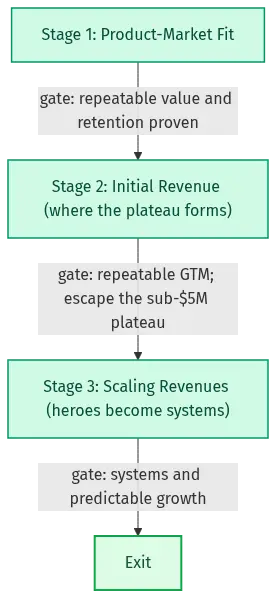
Across hundreds of SaaS companies, the path sorts cleanly into three stages. The revenue bands are loose — the boundaries blur, and you can sit in one stage on revenue but be behind on the work of the previous one. What matters is not the dollar figure but which problems you have actually solved, because each stage exists to solve a specific set of problems, and skipping them is what causes plateaus.
| Stage | Loose ARR Range | The Question It Answers | The Gating Milestone |
|---|---|---|---|
| 1. Product-Market Fit | $0 – $1M | Does the product solve a real problem people will pay for? | Customers use it, stay, and would be upset if it disappeared |
| 2. Initial Revenue | $1M – $9M | Can you acquire customers profitably and repeatably? | A sales-and-marketing model where the unit economics work |
| 3. Scaling Revenues | $10M – $100M+ | Can you grow large while staying consistent and predictable? | Person-independent systems that hold performance at scale |
The trap is the boundary between stages. You don’t graduate from Stage 2 to Stage 3 by hitting $10M ARR. You graduate by solving the Stage 2 problems — and plenty of companies cross $10M in revenue while still carrying unsolved Stage 2 problems, which is precisely why their growth stalls. The revenue is a lagging indicator. The solved problem is the real milestone.
Stage 1: Product-Market Fit
This is the stage every generic startup roadmap obsesses over, so I will be brief — most readers here are well past it. The job in Stage 1 is to prove that a customer has a real problem and that your product solves it well enough that they are happy, they stay, and they would be genuinely upset if it went away. Does the technology work? Do they want it? Do they like it? That is the entire test.
If you are at $5M ARR, you cleared this bar — at least for your original customer. The one thing worth checking is whether your product-market fit was real or whether it only worked because you were cheap. If customers loved the product at $100 per month but bail the moment you charge a market price, you didn’t solve a big enough problem. That is a hidden Stage 1 failure that masquerades as a pricing problem later. Hold that thought — it comes back in Stage 2.
Stage 2: Initial Revenue (Where the Plateau Is Built)
This is the most important stage on the roadmap, and the one where most permanent damage is done. The question Stage 2 answers is whether you can acquire customers profitably and repeatably. Four things have to line up, and they have to line up together:
- The right ideal customer profile. Most companies pick a suboptimal one — they try to serve everyone instead of defining a narrow, winnable segment. The wrong ideal customer profile (ICP) tanks everything downstream.
- Real product-market fit at a real price. Not fit that only exists because you are underpriced. If the fit evaporates when you charge market rates, the fit was never there.
- Unit economics that work. Unit economics is just the profit-and-loss statement for a single customer: what you spend to acquire one versus what they generate over their lifetime. Spend $100 to get a customer who generates $1,000, and you have a healthy 10-to‑1 return.
- A distribution channel you can afford. The channel has to be priced into your unit economics. If your margins are too thin to pay a reseller, that channel is closed to you — and you may have closed it by underpricing in step 2.
Here is why these four must move as a set. Imagine a SaaS product at $100 per month, with customers staying about 10 months, for a lifetime value (the total revenue a customer generates before they leave) of roughly $1,000. Early on, growth comes from word of mouth — happy customers refer others, and your customer acquisition cost (CAC, the total sales and marketing spend divided by the number of new customers it produced) is maybe $100. That is a 10-to‑1 return on acquisition. Wonderful — and completely unscalable, because you cannot triple word of mouth on command.
So you turn on paid advertising to find volume. Now it costs $1,000 to acquire a customer who is worth $1,000 over their lifetime. Your LTV/CAC ratio (lifetime value divided by acquisition cost — always in that order) is 1‑to‑1. You are not making money; after overhead, you are losing it. You try to fix it by doubling the price to $200 per month — but customers don’t like the increase, they churn faster, and now they stay only 5 months. Lifetime value is still $1,000. The math for the scalable channel still does not work.
That is the plateau, and notice what built it: not one bad decision but a combination — the ICP, the pricing, the unit economics, and the channel that don’t line up. This is the single most common reason SaaS companies stall in the single-digit millions, and almost nobody talks about it. If you are stuck below $5M ARR, this is the first place to look.

Stage 3: Scaling Revenues (Where Heroes Become Systems)
Once the Stage 2 math works, the Stage 3 problem is entirely different: can you get big while staying consistent? Building a bigger business that maintains its performance is genuinely hard, and it breaks in predictable places.
Sales conversion rates fall as you double and triple the sales force, because the new reps are not the original sales heroes and you have no system that makes them as effective. Customer experience degrades because the personal touch your longtime employees provided doesn’t survive contact with rapid hiring. Churn creeps up as you chase growth into worse-fit customers, or as your onboarding process cracks under volume. Unit economics that looked great can spin out of control once you double spend. And underneath all of it sits the real root cause: process immaturity. You cannot run a much larger enterprise on intuition and heroics.
The fix is to move every function from heroes to systems — person-independent processes that produce consistent results regardless of who executes them. A useful test: if your new hires aren’t 90% as effective as your veterans within a reasonable ramp, you don’t have real systems, you have heroes. A well-run company at this stage is, frankly, boring. When Starbucks pulls in $87 million in sales, they don’t call it a unicorn or a miracle — they call it Tuesday. They do it again on Wednesday. No chaos, no heroes, everything engineered for consistency at high volume. That is the Stage 3 milestone: you have engineered the business to be boring on purpose.
Run the Roadmap Backward: Start at the Exit
Now the part the generic roadmaps never get to. You should not build this roadmap forward from where you are. You should build it backward from where you want to exit.
The logic is simple. If you intend to sell at, say, $40M ARR, then every senior hire, every process investment, and every capability you build should be measured against the question: does this look like a company that runs at $40M ARR? When I hire C‑level executives for clients, one of the first things I check is whether the candidate has actually operated at the revenue size of the intended exit. The headaches in a sales department at $1M–$4M are completely different from the headaches at $20M–$40M. You can carry one or two people who are learning on the job. You cannot have an entire leadership team that has never run a company the size of the one you are trying to become — that is how growth quietly slows and plateaus, because nobody on the team knows what to do at that size.
This is the team-level version of the founder-to-CEO skill gap: the skills that run a company at one size are not the skills that run it at the next, and that applies to every leader on the org chart, not just the founder.
This is also where multi-holding-period planning comes in, and it is one of the highest-leverage ideas on the entire roadmap. You are not selling a business worth $30M today. You are selling a business capable of reaching $72M — and the more credible that future growth story is, the higher the multiple a buyer will pay. So your roadmap has to extend past your own exit and pave the road for the buyer’s next four or five years. A roadmap that ends the day you sell leaves money on the table.
There is a financial-timing wrinkle worth planning around too. The roughly 12-month profit-and-loss statement a buyer uses to value the business begins about six months before you sell. If you know that window in advance, you can time investments — front-loading expensive hires and infrastructure so the costs are absorbed early and the productivity shows up inside the valuation window. Founders who don’t plan for this make different financial decisions in their last two quarters and pay for it in the multiple.

The Four-Layer Roadmap: Problem, Product, Technical, Organizational
When founders say “roadmap,” they almost always mean the product roadmap — the list of features and releases. But the product roadmap is the third thing you should plan, not the first. Underneath it sits a layer almost nobody draws explicitly, and skipping it is why so many product roadmaps feel busy but go nowhere.
- The problem roadmap. Which problems do you want to solve, for whom, in which years? This is the prerequisite roadmap, and it should be a cross-functional agreement at the leadership level. It points two to three years out at a conceptual level, subject to change. Get consensus here first.
- The product roadmap. The problem roadmap automatically implies a product roadmap — once you know which problem you are solving for which customer in which year, the features follow. Built on top of a real problem roadmap, the product roadmap stops being a popularity contest of feature requests.
- The technical roadmap. The product roadmap implies a technical architecture to support it. The value of seeing this early is that architecture changes take time, and if you know what is coming, you can start weaving in the groundwork now. If your systems architect knows you intend to serve agencies in two years instead of single companies, the data model can be quietly shaped today to make that future cheap instead of catastrophic.
- The organizational roadmap. Each stage demands different people and different processes. The hires and the systems you need at $40M ARR are not the ones that got you to $10M — so the org roadmap sequences when you bring in operators who have run a business at your target size, not your current one.
The discipline here is sequencing. Plan the problem roadmap loosely and far out, let it imply the product roadmap, let that imply the technical roadmap, and staff the whole thing with the organizational roadmap. Most companies do this in exactly the reverse order — they ship features, discover the architecture won’t support them, and hire reactively. That reversal is expensive, and it is avoidable.
How to Build Your Startup Roadmap in Practice
You don’t need a 40-page strategic plan. You need to locate yourself honestly and fix the binding constraint. Work through this sequence:
- Name your exit. Decide the target — ARR size, growth rate, margin profile, and the rough multiple and timeframe you are aiming for. Everything downstream is measured against this. If you can’t name it, you can’t plan backward to it.
- Locate your real stage. Don’t use revenue — use solved problems. Have you genuinely solved your ideal customer profile, your pricing, and your unit economics? If not, you are doing Stage 2 work no matter what your revenue says.
- Find the binding constraint. There is almost always one thing capping growth right now — wrong ICP, broken unit economics in your scalable channel, high churn, or process immaturity. Find that one bottleneck and make it the focus.
- Check for skipped steps. Look one stage back. The most common hidden plateau is a Stage 2 problem (ICP, pricing, or unit economics) carried unsolved into Stage 3. Fix the skipped step before you pour more spend into growth.
- Build the four layers, backward. Set the problem roadmap two to three years out, let it imply the product and technical roadmaps, and sequence the org roadmap to bring in operators who have run a business at your target exit size.
- Time it to the valuation window. Front-load the investments whose payoff you want visible in the roughly 12-month P&L that begins six months before you sell.
If you want to pressure-test where you actually stand, the prerequisites to scaling a SaaS business are a useful checklist for whether you have really cleared each stage, the broader playbook on how to scale a SaaS business walks through the Stage 3 systematization work in depth, and the SaaS exit strategy guide covers how the target you name in step 1 shapes everything else. For external benchmarks on what growth and retention rates separate the companies that scale from the ones that plateau, the SaaS Capital research library publishes year-over-year operating data from hundreds of private B2B SaaS companies. (Those benchmarks shift year to year — treat any specific figure as illustrative of the gap between strong and weak performers, not as a fixed target, and verify current numbers before you plan against them.)
Common Startup Roadmap Mistakes
A few failure patterns show up again and again, and every one of them traces back to running the roadmap forward instead of backward.
- Planning from where you are, not where you’re going. A roadmap built forward optimizes for this quarter’s fire. A roadmap built backward from the exit optimizes for the multiple. Only one of them produces a clean sale.
- Treating revenue as the milestone. Crossing $10M ARR with unsolved Stage 2 problems is not graduating to Stage 3 — it is carrying a plateau forward. The solved problem is the milestone, not the dollar figure.
- Underpricing as a strategy. Cheap prices can manufacture fake product-market fit and then close off every distribution channel whose economics require real margin. Underpricing early is one of the most expensive decisions a founder makes.
- Promoting an entire leadership team from within. A reasonable instinct for individuals, but if nobody on the team has operated at your target exit size, the whole team learns on the job at exactly the moment you can least afford it.
- Letting the product roadmap lead. Features without a problem roadmap underneath them produce motion without progress. Plan the problem first.
Frequently Asked Questions
What is a startup roadmap?
A startup roadmap is a backward-planned sequence of milestones that, hit in order, produce the company you intend to sell. For a SaaS founder it is less about idea validation and more about sequencing and de-risking: starting from a target exit — revenue size, growth rate, margin, and multiple — and working backward to the specific problems you must solve at each stage to get there.
What are the stages of a SaaS startup roadmap?
There are three: Product-Market Fit (does the product solve a real problem people will pay for), Initial Revenue (can you acquire customers profitably and repeatably), and Scaling Revenues (can you grow large while staying consistent and predictable). The revenue bands are loose; what matters is which problems you have actually solved, because skipping a stage’s work builds a plateau in the next one.
How is a startup roadmap different at $5M–$15M ARR?
At this size the roadmap is an exercise in sequencing and de-risking, not discovery. You already have revenue, a team, and product-market fit. The work is finding the one binding constraint capping growth — usually a skipped step around ideal customer profile, pricing, or unit economics — and removing it so the business grows predictably enough to earn a premium multiple at exit.
Why do most SaaS companies plateau below $5M ARR?
Almost always because four things never lined up together in the Initial Revenue stage: the ideal customer profile, real product-market fit at a real price, working unit economics, and a distribution channel they can afford. When the scalable channel’s LTV/CAC ratio drops to roughly 1‑to‑1, growth stalls — and raising prices to fix it often just increases churn, leaving lifetime value unchanged.
Should a startup roadmap be built forward or backward?
Backward. Start at the intended exit and work back to what has to be true at each stage to reach it. Forward planning optimizes for the current quarter’s fire; backward planning optimizes for the valuation. Backward planning is also what surfaces multi-holding-period thinking — building a business capable of reaching a much higher number, which is what earns a higher multiple.
The Roadmap Is the De-Risking
Strip away the stages and layers and the whole startup roadmap reduces to one idea: a buyer pays a premium for a business whose future is predictable, and a roadmap is how you make the future predictable on purpose. Every milestone you hit in order removes a risk. Every skipped step you go back and fix closes a gap between your forecast and reality.
So locate yourself honestly on the three-stage map, name the exit you are building toward, find the one constraint capping you right now, and check one stage back for the skipped step that built it. Run the roadmap backward from the exit, plan the four layers in the right order, and time the investments to the valuation window. Do that, and the roadmap stops being a wish list of things you’d like to get to — and starts being the actual path to the number you intend to sell for.