

If you run a SaaS company, the fastest way to understand what is ARR is to picture it as the one number that quietly governs everything else. It sits at the top of every board deck. It’s the first figure an acquirer asks for. It’s the metric your investors track, your lenders underwrite against, and your whole company organizes itself around — often without realizing it. Yet most first-time SaaS CEOs can recite their ARR figure to the dollar and still can’t tell you what’s actually inside it.
That gap is expensive. So let’s close it. This guide explains what is ARR in plain English, what counts toward it and what doesn’t, how to calculate it without the two errors that trip up most founders, and — the part the commodity definitions skip — why an ARR business gets valued, financed, and managed differently from almost every other kind of company. Once you see that, ARR stops being a number you report and becomes a lens you make decisions through.

What ARR Actually Means
ARR stands for Annual Recurring Revenue — the amount of revenue your business can reasonably expect to collect over a 12-month period from contracts that recur. The word doing all the work in that phrase is recurring. ARR is not your total revenue, and it is not the cash that hit your bank account this year. It’s the predictable, repeating subscription revenue your business produces, expressed as an annualized run rate.
Think of it as the difference between a salary and a one-time bonus. A $120,000 salary tells you something durable about your finances — you can plan around it, borrow against it, and expect it again next year. A $120,000 bonus tells you something happened once. ARR is the salary view of your revenue. It deliberately strips out the bonuses so you can see the durable engine underneath.
The basic formula is simple:
ARR = MRR × 12
Where MRR is your Monthly Recurring Revenue — the recurring subscription revenue you bill in a single month. If your customers collectively pay you $250,000 a month in subscriptions, your MRR is $250,000 and your ARR is $3 million. (If you want the full mechanics of building MRR up from new, expansion, contraction, and churned revenue, the MRR vs ARR guide walks through it step by step.)
That formula is correct, but it hides a trap I’ll come back to: multiplying this month’s MRR by 12 only works if “this month” is genuinely representative. For now, hold onto the core idea — ARR measures the recurring engine, annualized.

What Counts as ARR — and What Doesn’t
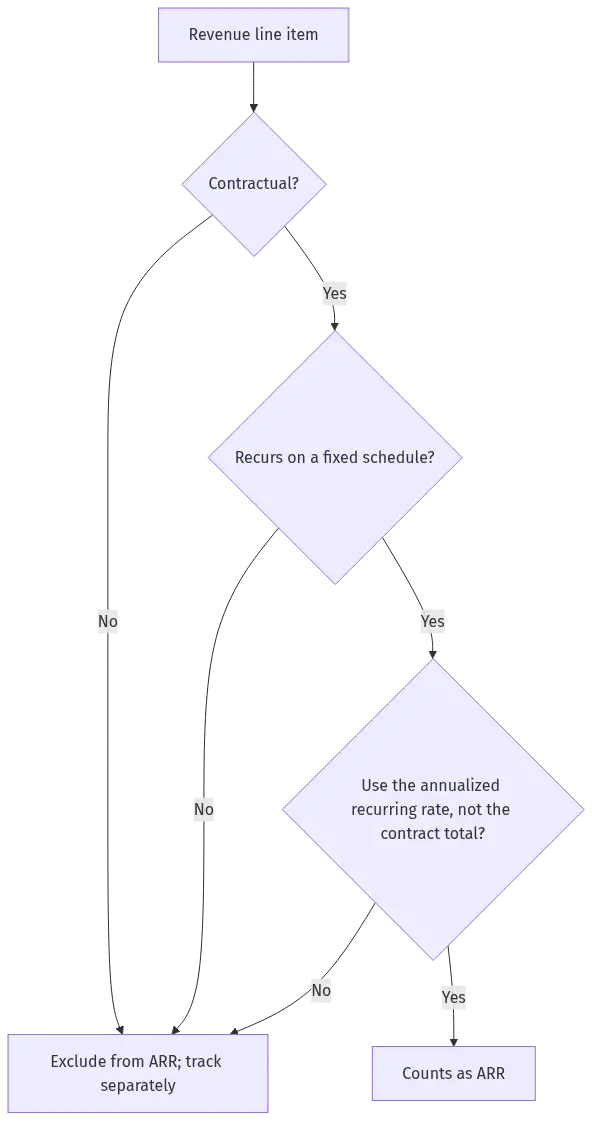
Here is where most of the real mistakes happen. What makes ARR a business metric rather than just an accounting figure is what it deliberately leaves out. Only truly recurring, contractual revenue belongs in ARR.
Include in ARR:
- Recurring subscription fees. The core of it — the monthly or annual subscription a customer is contractually committed to pay.
- Recurring add-ons and seats. If a customer pays for additional users or modules on the same recurring basis, that’s ARR.
- Committed usage minimums. If a contract guarantees a floor of usage-based revenue every period, the committed floor counts — the variable part above it does not.
- The annualized portion of multi-year deals. A three-year, $300,000 contract is $100,000 of ARR per year, not $300,000.
Exclude from ARR:
- One-time setup or implementation fees. A $30,000 onboarding charge is real money, but it doesn’t recur, so it’s not ARR. Counting it inflates your number and corrupts the exact quality that makes the metric worth tracking.
- Professional services and consulting. Unless a customer is contractually committed to buying the same services every year, this revenue isn’t predictable enough to annualize.
- Variable usage overages that aren’t committed. Month-to-month usage the customer can turn off at will is closer to transactional revenue than recurring revenue. Track it — just track it separately.
- Free trials and temporary discounts. Only converted, paying, committed revenue belongs in ARR. A trial that hasn’t converted is a prospect, not ARR.
The discipline here is the whole point of the article. An ARR business is valuable because the revenue is predictable. The moment you let one-time money inflate the number, you’ve blurred the one quality that gives the metric its power. For a deeper look at where ARR and total revenue diverge — and why the gap matters to acquirers — see ARR vs revenue.
How to Calculate ARR (Three Worked Examples)
The formula is ARR = MRR × 12, but the real skill is knowing what to feed into it. Let’s walk through three scenarios that build on each other, using realistic numbers for a company in the $2M–$15M ARR range.
Scenario #1: The Clean Subscription Business
Your company has 200 customers, each paying $1,250 per month for a pure software subscription. No setup fees, no services.
- MRR = 200 × $1,250 = $250,000
- ARR = $250,000 × 12 = $3,000,000
Clean and simple. Every dollar is recurring, so the number means exactly what it says.
Scenario #2: The Business With One-Time Revenue Mixed In
Same 200 customers paying $1,250/month, but you also booked $400,000 in one-time implementation fees this year, and you sold $200,000 of professional services.
Your total revenue this year is $3,000,000 + $400,000 + $200,000 = $3,600,000. But your ARR is still $3,000,000. The other $600,000 is real, but it isn’t recurring, so it stays out of ARR.
If you reported $3.6M as your ARR, you’d be overstating your recurring engine by 20%. An acquirer’s diligence team will find that in an afternoon, and the discovery does more than dock the $600,000 — it makes them question every other number you’ve given them.
Scenario #3: The Business With a Multi-Year Deal
Same base of $3,000,000 ARR. Now you sign a marquee customer to a three-year contract worth $360,000 total — $120,000 per year.
The right way to book this: add $120,000 to ARR (the annual recurring portion), bringing you to $3,120,000 ARR. The wrong way: add the full $360,000 and claim $3,360,000. The contract value is $360,000; the annual recurring revenue it produces is $120,000. ARR annualizes the recurring rate — it does not sum the contract.
The Two ARR Calculation Mistakes That Matter
Two errors show up again and again when I review companies at this stage. Both are easy to make and both distort the number in ways that hurt you later.
Mistake #1: Multiplying a non-representative month by 12. ARR = MRR × 12 assumes the month you’re annualizing is typical. If you just closed three enormous deals in March and annualize March, you’ll project an ARR your business doesn’t actually run at. The fix is to annualize a steady-state month, or better, build ARR up from the live contract base rather than from a single month’s billings. Use the run-rate shortcut for a quick read; use the contract base for any number you put in front of an investor. (See annualized run rate for when the shortcut is and isn’t safe.)
Mistake #2: Confusing bookings with ARR. A signed contract is a booking. The recurring revenue it produces is ARR. They are not the same number, and the gap between them is where a lot of inflated dashboards live. A $360,000 three-year booking is $120,000 of ARR. If your team reports bookings and your board hears ARR, everyone is operating on a number that’s off by a multiple. The difference between bookings and revenue is worth getting precise about before it shows up in a diligence room.
Both mistakes share a root cause: treating ARR as an accounting output instead of a deliberate measure of the durable, recurring engine. When in doubt, ask one question — would this dollar show up again next year without me selling anything new? If yes, it’s ARR. If no, it isn’t.
Why ARR Is the Number That Defines Your Business
Now for the part the dictionary definitions skip. Why does the entire SaaS world — investors, acquirers, lenders, boards — fixate on ARR specifically? Because ARR is the cleanest available proxy for the thing they’re actually buying: a predictable, self-renewing revenue engine.
I teach SaaS CEOs to think about the business as a factory. On the input side you put in an executive team, a product, a go-to-market function, mature processes, and capital. On the output side, the factory produces annual recurring revenue, healthy gross margins, and high customer retention. Every factory has an input-to-output ratio. When you can put $1,000,000 into sales and marketing and reliably get $2,000,000 of new ARR out the other end — four quarters in a row, at steady retention — you don’t have a sales team anymore. You have a machine.
That reframing is why ARR matters more than total revenue. A factory’s value isn’t the units it shipped last month; it’s the predictable rate at which it produces units going forward. ARR is the output rate of your factory. It tells a buyer what the machine produces per year, which is exactly what they’re paying for.
This is also why contractually recurring revenue earns the highest valuation multiples in SaaS. A SaaS business is typically valued one of two ways: a multiple of revenue or a multiple of EBITDA (earnings before interest, taxes, depreciation, and amortization — essentially operating profit). High-growth SaaS companies usually trade on a revenue multiple, and the more of that revenue that is contractually recurring, the higher the multiple a buyer will pay, because predictable revenue is lower-risk revenue. Two companies with identical total revenue can be worth wildly different amounts based purely on how much of it is genuine ARR. For the full picture of how recurring revenue translates into enterprise value, see SaaS company valuation and the broader set of SaaS valuation multiples.

The ARR Ceiling: Why Churn Caps Your Growth
Here’s the insight that separates CEOs who scale from CEOs who plateau. Your ARR has a ceiling, and churn sets it.
In a recurring revenue business, if a large share of your customers leaves every year, your sales effort goes toward replacing the customers you just lost rather than adding to the base. You can be selling brilliantly, and the business still won’t grow — because the outflow of lost ARR matches the inflow of new ARR. That’s the moment you hit a ceiling on your annual recurring revenue, and no amount of hiring more salespeople breaks through it.
This is why the metric that governs your ARR ceiling isn’t a sales metric — it’s Net Revenue Retention (NRR). NRR measures how much recurring revenue you keep and grow from your existing customer base over a year, including expansion and after subtracting downgrades and cancellations:
NRR = (Starting MRR + Expansion MRR − Contraction MRR − Churned MRR) / Starting MRR × 100%
The number tells a stark story:
| NRR | What happens to your ARR |
|---|---|
| Below 100% | Your base shrinks on its own. You must sell new ARR just to stand still — exponential decay. |
| Exactly 100% | The base holds. All growth must come from new customers. |
| Above 100% | Your existing base grows by itself, with zero new acquisition. New sales stack on top. |
A company with NRR above 100% has, in theory, no ceiling — the existing base compounds even if new sales stop. A company below 100% is bailing a leaky bucket. This is why I tell founders to fix retention before they pour money into acquisition: you can’t outgrow a churn problem, you can only outspend it temporarily. (Dig into the mechanics in net revenue retention and, for the specific comparison founders ask about most, NRR vs ARR.)
The compounding cuts both ways, and it’s more dramatic than most founders intuit. Annual churn is not monthly churn times twelve — it compounds: Annual Churn = 1 − (1 − Monthly Churn)^12. At 2% monthly churn, you don’t lose 24% of customers a year; you lose about 21.5%. At 5% monthly, you lose roughly 46% — not 60%. The math is less punishing than the naive multiple in the short run, but over a multi-year hold it still quietly determines how high your ARR can climb. To pressure-test your own numbers, start with reducing SaaS churn.
How ARR Changes by Stage
ARR isn’t just a number — it’s a marker of what your business needs to focus on next. The same $1 of ARR means something different at $2M than it does at $15M.
| Stage | What ARR is telling you | Where to focus |
|---|---|---|
| Under ~$1M ARR | You may have early traction but not durable product/market fit. | Get the product to genuinely work for a narrow customer. Don't scale spend yet. |
| ~$1M–$3M ARR | You're growing on good product/market fit and word of mouth. | Build a repeatable sales process before the organic tailwind fades. |
| ~$3M–$10M ARR | The early channels are tapping out. Growth gets harder, not easier. | Build new sales and distribution channels; tighten retention; segment your metrics. |
| ~$10M–$15M+ ARR | The business is a real asset; risk and predictability now drive value. | De-risk: reduce key-person and customer concentration; systematize so the factory runs without you. |
The pattern I see most often: a CEO recites his ARR figure but can’t tell you which slice is contractual versus cancellable, which is recurring versus one-time, or what the number would look like if he stopped acquiring customers tomorrow. That blind spot is what stalls companies between $3M and $10M. The fix isn’t a new tactic — it’s understanding what’s actually inside the number. (ARR growth covers the stage-by-stage playbook in depth.)
ARR vs. the Metrics It’s Often Confused With
Founders mix up ARR with several adjacent metrics. Here’s how to keep them straight.
| Metric | What it measures | How it relates to ARR |
|---|---|---|
| MRR | Recurring revenue in one month | ARR = MRR × 12. Same engine, different time unit. |
| Total revenue | All revenue, recurring or not | ARR is the recurring subset. Total revenue includes services and one-time fees. |
| Bookings | Total contract value signed | A multi-year booking is larger than its annual ARR contribution. |
| Run rate | Any metric annualized from a short period | ARR is a run rate, but only valid if the period is representative. |
| GAAP revenue | Recognized revenue under accounting rules | ARR is a forward-looking operating metric, not an accounting figure. |
The single most useful habit: whenever someone says “revenue,” ask whether they mean ARR, total revenue, or bookings. Three different numbers, three different decisions. (For a complete map of the metric landscape, the SaaS metrics overview connects them all, and SaaS KPIs shows which ones belong on your dashboard.)
Frequently Asked Questions About ARR
Is ARR the same as revenue? No. ARR is the recurring, annualized portion of your revenue. Total revenue also includes one-time fees, professional services, and uncommitted usage — none of which belong in ARR. A company can have $3.6M in total revenue and only $3.0M in ARR.
How do you calculate ARR from MRR? Multiply a representative month’s Monthly Recurring Revenue by 12: ARR = MRR × 12. The catch is “representative” — if the month included unusual one-time spikes or new deals that distort it, annualizing it overstates your true run rate. For anything you’ll show an investor, build ARR up from your live contract base instead.
Do one-time fees count toward ARR? No. Setup fees, implementation charges, and professional services are excluded because they don’t recur. Track them separately as non-recurring revenue. Including them inflates ARR and undermines the predictability that gives the metric its value.
How are multi-year contracts counted in ARR? Only the annual recurring portion counts. A three-year, $300,000 contract contributes $100,000 to ARR per year, not $300,000. The total contract value is a booking; the annualized recurring rate is ARR.
What’s a good ARR growth rate? It depends entirely on stage. Early-stage SaaS companies often grow ARR 100%+ year over year, while a $10M+ company growing 40–50% is performing well. The more useful question is whether your growth is efficient — measured against the capital you’re burning to produce it — and whether your Net Revenue Retention is above 100%, which determines whether that growth compounds or leaks.
Why do investors care so much about ARR? Because ARR is the cleanest proxy for predictable, self-renewing revenue — the thing they’re actually buying. Predictable revenue is lower-risk revenue, and lower-risk revenue earns higher valuation multiples. ARR also lets investors compare companies of different sizes and model future cash flows with confidence.
The Bottom Line
ARR is the single best summary of what a SaaS business is and what it’s worth. It measures the durable, recurring engine — not the one-time money that flatters a P&L. Calculate it from a representative base, exclude everything that won’t recur next year, and watch your Net Revenue Retention, because that’s what sets the ceiling on how high ARR can climb.
Master the number and it becomes more than a line on a dashboard. It becomes the lens you use to decide where to invest, what to fix first, and how to build a business an acquirer will pay a premium for. That’s the difference between a CEO who reports his ARR and one who actually runs the factory that produces it.