

SaaS development costs are the single line item most first-time founders underestimate, and the one acquirers scrutinize hardest when they buy you. The number you care about is rarely “what does it cost to build the product?” It’s “what does it cost to keep building the product, year after year, at a pace that outruns my competitors — and what does that spend do to my margins and my valuation?”
Here is the reframe most engineering-founders miss: your development spend is not a one-time construction project. It’s a permanent operating function, usually 15% to 30% of revenue, that you will fund for the entire life of the company. The cost of the first version is trivial next to the cost of the next ten years of versions. This article gives you the real cost ranges by build path, a worked example with realistic numbers for a company your size, and — more importantly — the three things about development spend that quietly move your exit multiple.
What “Development Cost” Actually Includes
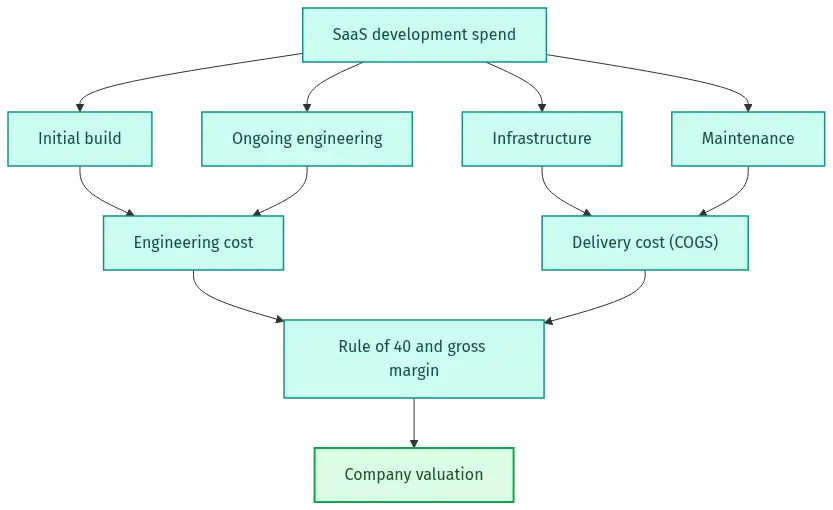
When founders ask what SaaS development costs, they usually mean the price of building the first working product. That’s the smallest part of the picture. A complete view of development cost has four buckets, and they behave very differently on your financials:
- Initial build (the MVP). The cost to get a minimum viable product into the hands of paying customers. This is a one-time, capital-like spend. For most B2B SaaS, it ranges from $50,000 to $500,000 depending on complexity and how you build it (more on the ranges below).
- Ongoing engineering (the real cost). The salaries, contractor fees, and tooling to keep shipping features, fixing bugs, and paying down technical debt. This is recurring and dwarfs the initial build within 18 months. This is what shows up as R&D (research and development) on your income statement.
- Infrastructure and delivery cost. Cloud hosting, third-party APIs embedded in the product, and the DevOps to keep it running. This is COGS (cost of goods sold) — the cost of delivering the service — not R&D, and the distinction matters enormously for your gross margin.
- Maintenance and reliability. Security patches, dependency upgrades, uptime engineering. Boring, non-negotiable, and easy to under-budget until an outage forces the issue.
The mistake that wrecks budgets is treating development as bucket #1 only. You raise or save enough to build the MVP, ship it, and then discover that buckets #2 through #4 are a permanent, growing draw on cash that nobody planned for. If you’re a non-technical founder, this is the single most important thing to internalize before you sign a build contract.
The buckets don’t just differ in size — they land in different places on your financials, and that placement is what drives the metrics buyers care about.
The Build Paths and What Each One Costs
There is no single price for SaaS development because there is no single way to build. The cost swings 5x to 10x depending on which path you choose. Here are the four realistic paths and the trade-offs of each — cost, speed, control, and risk.
| Build Path | Typical Initial Build | Effective Blended Rate | Best For | Main Risk |
|---|---|---|---|---|
| In-house senior team (U.S.) | $250K–$500K+ | $140–$200/hr loaded | Core IP, long-term product | Highest cash burn; hardest to hire |
| Offshore team (e.g., India, LatAm) | $60K–$200K | $35–$60/hr loaded | Scaling capacity on a defined spec | Management overhead, time zones |
| Dev agency / shop | $80K–$300K | $100–$175/hr | Speed to first version | You own no team; handoff risk |
| Low-code / no-code + light dev | $15K–$80K | Varies | Validating before you commit | Hits a ceiling; rebuild often needed |
The dollar figures above are illustrative and reflect typical 2026 conditions. They’re here to show the relative spread between paths, not to quote a fixed price — verify current market rates before you budget, because engineering labor pricing moves with the cycle.
A few things worth saying plainly, because the generic “cost to build an app” articles won’t:
Offshore is roughly one-quarter the loaded cost of U.S. senior engineering — but only if you can manage it. I’ve watched founders run teams of 20 to 30 offshore developers at about a quarter of the U.S. cost per head, and it works. The catch is in that phrase “if you can manage it.” Offshore talent without strong in-house technical leadership falls off in productivity quickly. You have to have someone — a senior engineer or technical lead on your payroll — actively managing the work, the spec, and the quality. The savings are real; the management tax is also real. Budget for both.
Agencies buy you speed and cost you a team. A good development shop gets you to a first version faster than you could hire for. But when the engagement ends, you own no engineering capability — just a codebase you didn’t write. For a product you intend to keep building, the agency path usually becomes the most expensive option over three years, because you eventually rebuild the team anyway.
Low-code is a validation tool, not a destination. Low-code and no-code platforms are excellent for proving someone will pay before you spend real money on engineering. They are not where a venture-scale product lives long-term. Plan to rebuild once you’ve validated — and treat the low-code spend as the cost of de-risking, not the cost of the product.
A Worked Example: The Real Three-Year Cost
Numbers make this concrete. Take a B2B SaaS company that just crossed $5M in ARR (annual recurring revenue) and is deciding what to budget for development. Generic advice says “spend 20% of revenue on R&D.” Let’s actually walk the math, because the headline percentage hides the real decision.
At $5M ARR, an R&D budget of 20% of revenue is $1,000,000 per year. Twenty percent sits right in the middle of where private SaaS companies actually land — benchmark research from firms like SaaS Capital consistently shows R&D running in the high teens to high twenties as a percentage of revenue for growing private SaaS companies. Here is what that buys and how it splits across the four buckets:
| Development Bucket | Annual Spend | % of R&D Budget | Lands On |
|---|---|---|---|
| Ongoing engineering (salaries + contractors) | $760,000 | 76% | R&D (operating expense) |
| Engineering tooling and licenses | $90,000 | 9% | R&D (operating expense) |
| Net-new feature initiatives | $150,000 | 15% | R&D (operating expense) |
| Total R&D budget | $1,000,000 | 100% | Income statement: R&D |
Note what’s not in that table: your cloud hosting and infrastructure. At this stage, infrastructure might run another $200,000 per year, but that’s COGS, not R&D. It hits your gross margin, not your operating expense line. Counting it as “development cost” in your head is fine; counting it as R&D on your financials is an error that will confuse every investor who reads your statements.
Now the part that matters. That $1M is not the cost of building features — it’s the cost of capacity. The strategic question isn’t “how much should I spend?” It’s “how is the $1M allocated, and toward what?”
Here’s a move most founders never make: you can reallocate within a fixed R&D budget far more aggressively than you can grow it. Say 20% of your engineering budget currently serves your strongest customer segment. It is very hard to quadruple your overall R&D budget — you can’t afford to take it from $1M to $4M. But it is entirely feasible to take the portion aimed at that winning segment from 20% of the budget to 80% of the budget. That’s a 4x increase in firepower on your best opportunity, funded entirely by reallocation, with no new cash. This is a discipline-and-choice decision, not a financial-constraint decision — and at your size, it’s one of the highest-leverage moves available.
How Development Costs Connect to Unit Economics
Development spend doesn’t live in a vacuum. It’s one of the two big levers — alongside customer acquisition — that determines whether your unit economics can support scale.
The link runs through gross margin. Your infrastructure-and-delivery cost (bucket #3) is COGS, and COGS sets your gross margin:
Gross Margin % = (Revenue − COGS) ÷ Revenue
Healthy SaaS gross margins run 70% to 85%. If your infrastructure cost per customer is climbing faster than revenue per customer, your gross margin compresses, and every downstream metric — CAC payback, LTV, the cash you can reinvest — gets worse. So the development decision that quietly protects your business is keeping infrastructure cost per customer flat or declining as you grow:
Infra Cost per Customer = Total Cloud / Hosting Spend ÷ Total Paying Customers
If that number rises with scale, your architecture isn’t earning its keep. If it falls, every new customer is more profitable than the last — which is the entire point of building software instead of selling services.
On the R&D side, the metric that tells you whether your development spend is getting more efficient over time is cost per unit of output:
R&D Cost per Story Point = Total Engineering Spend ÷ Total Story Points Delivered
You want this trending down over time. A team that delivers more output per dollar each quarter is compounding. A team whose cost-per-output rises is a warning sign — usually of accumulating technical debt, poor management of an offshore team, or an organization that’s grown headcount faster than throughput.
What Acquirers See When They Look at Your R&D
This is where the development-cost conversation pays off, because it’s where most founders are flying blind. When you go to sell, a buyer reads your R&D spend through three lenses — and how you’ve managed development cost shows up directly in your exit multiple.
Lens 1: Rule of 40. Investors use a single-sentence filter:
Rule of 40 = Revenue Growth Rate (%) + EBITDA Margin (%) ≥ 40%
R&D is a major chunk of operating expense, so it sits right inside your EBITDA margin. Spend too little and growth stalls (hurting the first term); spend too much without growth to show for it and your margin craters (hurting the second). The art is spending enough R&D to drive growth while keeping the combined figure at or above 40 — the same efficient-growth discipline Bessemer lays out in its Scaling to $100 Million framework. A buyer wants to see that you understand this balance — not that you’ve maximized one term at the expense of the other.
Lens 2: Capitalization is mostly noise — don’t game it. You may hear that capitalizing software development costs (spreading them across years rather than expensing them immediately) can lift your reported EBITDA margin. It can, on paper. But sophisticated acquirers see through it. The honest take: whether or not you capitalize, a serious buyer normalizes the numbers their own way when they value you. Don’t contort your accounting to dress up the Rule of 40 by a point or two — buyers care whether you’re broadly in the 40s versus the teens, not whether you’re at 38 versus 41. Spend your energy on the underlying business, not the presentation.
Lens 3: Is the IP yours, and is it person-independent? This is the lens that quietly kills multiples. If your product was built entirely by a development agency you no longer work with, or sits in the head of one irreplaceable engineer, the buyer sees risk — the gap between your model and reality. A product built by a documented, systematized team that a new hire could join and be productive in is worth more than the identical product trapped in one person’s brain. How you’ve spent on development — building a real, transferable engineering capability versus renting one — directly affects how durable, and therefore how valuable, your company looks.
Common Mistakes That Blow Up Development Budgets
After watching a lot of SaaS companies fund development through scale, the same expensive errors recur:
- Budgeting the build, not the operation. Planning for the one-time MVP cost and getting blindsided by the permanent, growing engineering operating cost. The build is the down payment; the operation is the mortgage.
- Miscounting infrastructure as R&D. Putting cloud and hosting in the R&D bucket instead of COGS. It muddies your gross margin and confuses every investor who reads your financials.
- Going offshore without in-house leadership. Chasing the one-quarter cost without budgeting for the senior technical manager who makes offshore actually work. The savings evaporate when productivity falls off unmanaged.
- Treating an agency build as a permanent solution. Getting to v1 fast, then realizing three years later you own a codebase but no team, and rebuilding from scratch.
- Growing the R&D budget when you should reallocate it. Asking “how do I spend more?” when the higher-leverage question is “how do I aim the budget I already have at my best segment?”
- Ignoring R&D efficiency over time. Never measuring cost per story point or epic, so a team that’s getting less efficient hides inside a flat-looking budget line.

Frequently Asked Questions
How much does it cost to build a SaaS product from scratch? For most B2B SaaS, the initial MVP build runs $50,000 to $500,000 depending on complexity and build path. Offshore and low-code paths land at the low end; in-house U.S. senior teams at the high end. But the initial build is the smallest part of total SaaS development costs — ongoing engineering, infrastructure, and maintenance dwarf it within 18 months.
What percentage of revenue should a SaaS company spend on R&D? A common benchmark is 15% to 30% of revenue, with around 20% as a typical midpoint for a growing company. The exact figure depends on your stage and growth ambition. What matters more than the percentage is whether the spend is driving growth (keeping you Rule-of-40 positive) and whether your cost per unit of engineering output is improving over time.
Is offshore development worth it for SaaS? It can cut your loaded engineering cost to roughly a quarter of U.S. rates — but only if you have strong in-house technical leadership managing the spec and quality. Without that management layer, offshore productivity falls off and the savings disappear. Treat the management overhead as part of the true cost.
Should infrastructure costs count as development cost? In your head, yes — cloud and hosting are part of delivering software. On your financials, no. Infrastructure is COGS (cost of goods sold), which affects gross margin, while engineering salaries are R&D (an operating expense). Mixing them up distorts your unit economics and confuses investors.
Do development costs affect my SaaS valuation? Directly. R&D spend sits inside your EBITDA margin (and therefore your Rule of 40), and how you built the product — a transferable team versus one irreplaceable engineer or a departed agency — affects how risky and durable a buyer judges your company to be. Well-managed development spend that built a real, systematized engineering capability raises your multiple.
The Bottom Line
SaaS development costs aren’t a price tag on a project — they’re a permanent operating function you’ll fund for the life of the company, typically 15% to 30% of revenue. Get three things right and you’ll be ahead of most founders your size: budget the operation and not just the build, keep your infrastructure cost per customer flat or falling as you grow, and aim your fixed R&D budget at your strongest segment instead of trying to grow the budget itself. Do that, and your development spend stops being a cash drain you survive and becomes the compounding engine that drives both your growth rate and, eventually, your exit multiple.