

There is one number that an acquirer asks for before almost any other, and it is ARR in SaaS — your annual recurring revenue. It is the figure on the first line of your board deck, the number a private equity associate plugs into a valuation model, and the metric your whole company quietly organizes itself around whether you intend it to or not. Yet most first-time SaaS CEOs treat ARR as a simple dashboard readout — multiply this month’s recurring revenue by twelve and move on — when it is actually the single best one-line summary of what your business is worth.
Here is the part that should get your attention: a dollar of ARR is typically worth roughly six dollars of enterprise value at the time of writing. A dollar of one-time services revenue is worth closer to one to three dollars. So if you misclassify $500,000 of implementation fees as ARR, you are not making a $500,000 accounting error — you are inflating your perceived company value by roughly $3 million, and a sophisticated buyer will catch it in the first week of diligence and quietly mark down the rest of your numbers too. ARR is not a vanity metric. It is the lens through which your company gets financed, valued, and run, and getting it precisely right is one of the highest-leverage things you can do as a CEO.
This guide covers what ARR in SaaS actually means, what counts and what doesn’t, how to calculate it correctly, the mistakes that quietly distort it, and — most importantly — why this one number drives your valuation more than revenue, profit, or almost anything else on your financials.
What ARR Means in SaaS
Annual recurring revenue (ARR) is the annualized value of the contracted, recurring subscription revenue your business is generating right now. The key words are recurring and right now. ARR answers a specific question: if every active subscription you have today simply continued for the next twelve months with no new sales and no cancellations, how much recurring revenue would you collect?
The standard formula is straightforward:
ARR = Current MRR × 12
where MRR is your monthly recurring revenue — the normalized monthly value of all your active recurring subscriptions. If your active subscriptions add up to $500,000 per month in recurring fees, your ARR is $500,000 × 12 = $6,000,000.
The most important and most frequently misunderstood thing about ARR is this: ARR is a snapshot, not a trailing total. It is not “the revenue you booked over the last twelve months.” It is a forward-looking annualization of where you are today. A company that did $4M in recognized revenue over the trailing year but exited the year at $600,000 MRR has $7.2M in ARR — because ARR reflects the run rate of the business as it stands now, not its history. This distinction trips up nearly every founder who comes from a non-subscription background, and it matters enormously, because buyers and investors care about your forward run rate, not your rear-view mirror.
ARR is the annual sibling of MRR, and the two are mathematically locked together — if you want the monthly view of the same picture, see our breakdown of MRR vs ARR and the underlying mechanics of annual recurring revenue. For most B2B SaaS companies selling annual contracts, ARR is the headline number; MRR is the more useful operating metric for month-to-month management.

What Counts as ARR (and What Doesn’t)
The formula is the easy part. The discipline is in deciding what gets to be called “recurring.” This is where the real money is made or lost, because every dollar you legitimately classify as ARR is worth several dollars of enterprise value — and every dollar you illegitimately classify as ARR is a landmine that detonates in diligence.
Here is the dividing line. Recurring means a customer has committed to pay it again, predictably, without a new sales decision. Non-recurring means it happened once, or it depends on a variable the customer controls, or it requires a fresh purchase decision each time. Only the first kind belongs in ARR.
| Revenue Type | Counts as ARR? | Why |
|---|---|---|
| Annual or monthly subscription fees | Yes | The core of recurring revenue — contracted and predictable |
| Recurring add-on modules and seats | Yes | Contracted, recurs each period |
| Committed minimum usage / contractual true-ups | Yes (the committed floor) | The guaranteed portion recurs; only the committed minimum counts |
| One-time setup, onboarding, implementation fees | No | Happens once; never recurs |
| Professional services and consulting | No | Project-based, requires a new purchase decision each time |
| Uncommitted usage / overages | No | Variable and customer-controlled — not predictable |
| Pilot or trial revenue not yet converted | No | No commitment to continue exists yet |
| Hardware or one-time license sales | No | Not a recurring subscription |
The single most common mistake is treating implementation and professional services revenue as ARR. I understand the temptation — that revenue is real, it hits the bank account, and excluding it makes your ARR look smaller. But an acquirer values a dollar of services revenue at a fraction of a dollar of subscription revenue, because services revenue does not recur and does not scale the way software does. Inflating ARR with services doesn’t make your company more valuable; it just teaches the buyer that your numbers need scrubbing.
A second trap is multi-year contract math. A three-year deal worth $300,000 in total is not $300,000 of ARR. ARR is annual, so that contract contributes $100,000 of ARR ($300,000 / 3 years). The full $300,000 is the contract’s total contract value (TCV) — the entire dollar value over the life of the agreement — which is a different metric serving a different purpose. Confusing the two will overstate your ARR by 3x on every multi-year deal you sign.
And what about that implementation and services revenue you can no longer count as ARR? It is not worthless — it is simply tracked separately as services or one-time revenue, and it still funds onboarding and improves retention. The point is not to hide it; it is to be precise about which bucket each dollar lives in, so that the recurring number stays clean and credible.
ARR vs. Annualized Run Rate: A Costly Acronym Collision
Here is a distinction that causes more diligence confusion than almost any other line in an early-stage model: ARR can mean two different things, and people use the same three letters for both.
- Annual Recurring Revenue — the annualized value of recurring subscription revenue only. This is the SaaS definition, and the one this entire article uses.
- Annualized Run Rate — you take any recent period’s total revenue (recurring and one-time) and multiply it up to a yearly figure. A business with $250,000 in total revenue last month has a $3M annualized run rate.
The difference is not pedantic. Annualized Run Rate sweeps in one-time fees, services, and lumpy non-recurring revenue, then projects it forward as if it will repeat. For a SaaS company, that overstates the durable, recurring value of the business — which is exactly the value a buyer is paying a premium multiple for. When a founder tells me “we’re at $5M ARR” and the real recurring number is $3.5M with $1.5M of services annualized on top, that’s not ARR. That’s a run rate wearing an ARR costume, and every experienced investor will undress it in the first diligence call.
When you say ARR, mean Annual Recurring Revenue, and make sure the person across the table means the same thing. The cleanest way to avoid the trap: build your ARR from contracted recurring subscriptions only, and report run rate — if you report it at all — as a clearly separate line.

How to Calculate ARR Correctly
Let’s walk through a realistic calculation for a SaaS company in the $5M-$15M ARR range, building it from the components rather than waving at “MRR times twelve.”
Imagine a B2B SaaS business with three customer cohorts:
- 120 customers on annual plans at $5,000/year each = $600,000 of annual recurring value.
- 400 customers on monthly plans at $500/month each = $200,000/month, which annualizes to $2,400,000.
- A committed usage floor across enterprise accounts of $300,000/year (the guaranteed minimum — uncommitted overages above this are excluded).
The recurring base is $600,000 + $2,400,000 + $300,000 = $3,300,000 of ARR.
Now suppose this same company also booked $400,000 in implementation fees and $250,000 in consulting projects this year. A founder in a hurry reports “$3.95M ARR.” A disciplined CEO reports $3.3M ARR plus $650,000 of separately tracked services revenue. The second version is the one that survives diligence — and, counterintuitively, the one that earns a higher valuation, because the buyer trusts every number on the page.
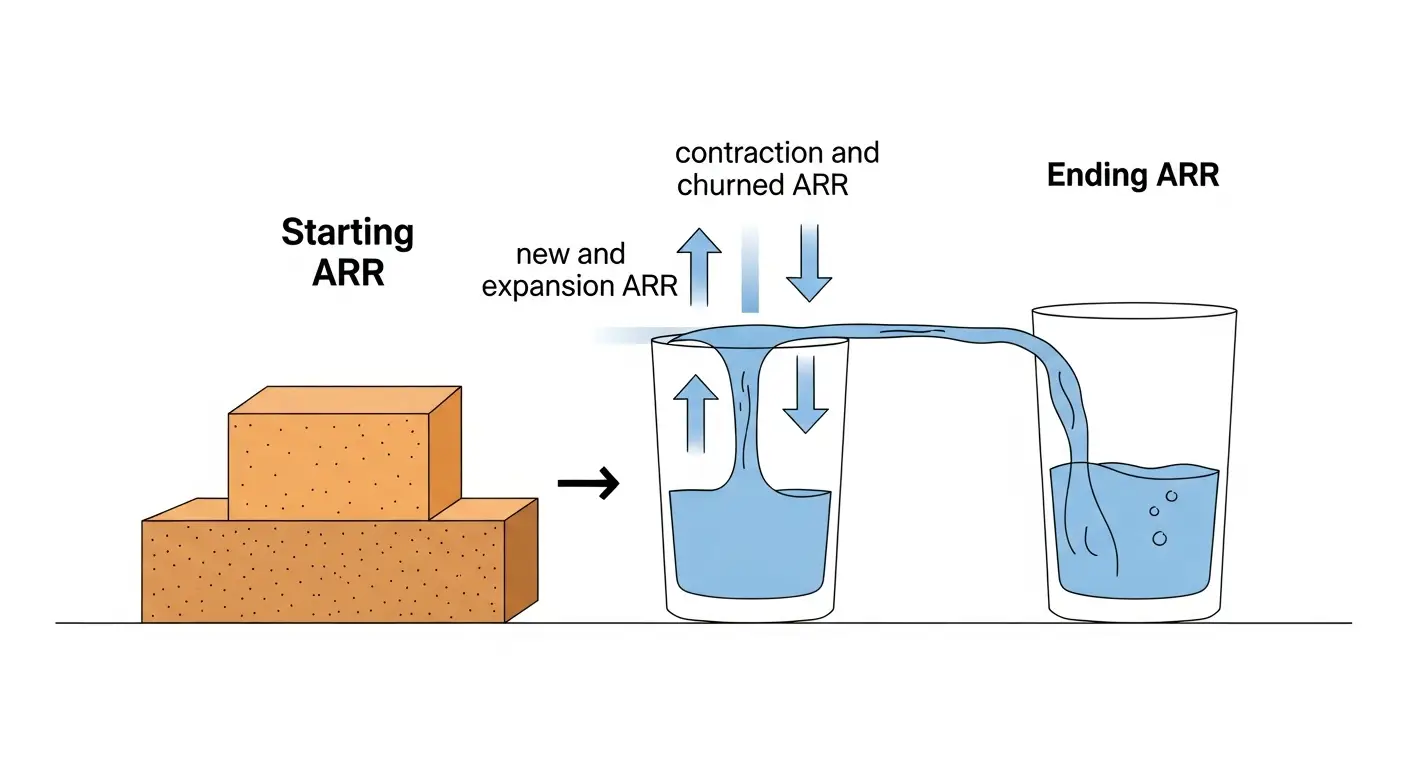
To track how ARR moves over time, you decompose the change into its drivers using Net New ARR:
Net New ARR = New ARR + Expansion ARR — Contraction ARR — Churned ARR
- New ARR — recurring revenue from brand-new customers.
- Expansion ARR — upsells and cross-sells to existing customers (more seats, higher tiers, added modules).
- Contraction ARR — existing customers who downgraded but stayed.
- Churned ARR — recurring revenue lost when customers cancelled entirely.
If our company added $900,000 of New ARR, $400,000 of Expansion, lost $150,000 to Contraction, and lost $350,000 to Churn over the year, its Net New ARR is $900,000 + $400,000 — $150,000 — $350,000 = $800,000. That single number tells you how much the recurring engine actually grew, net of everything working against it.
The relationship between expansion and churn is where compounding lives. When your expansion from existing customers consistently outruns your losses, your net revenue retention climbs above 100%, and your ARR grows even if you never sign another new logo. That is the most powerful, least appreciated lever in SaaS — and it is invisible unless you decompose ARR into its drivers.
Why ARR Drives Your Valuation More Than Revenue or Profit
This is the part most founders underweight, and it is the reason ARR deserves obsessive precision. SaaS companies are valued as a multiple of ARR, not a multiple of profit. This feels strange to anyone trained in traditional business, where companies trade on earnings. But recurring revenue is so predictable, and so scalable, that buyers will pay for the revenue stream itself.
The valuation multiple moves with market conditions, but for illustration, assume a company is valued at 6x ARR — a representative figure at the time of writing. Then:
- $1M of ARR implies roughly $6M of enterprise value.
- $10M of ARR implies roughly $60M of enterprise value.
A note on the numbers: The 6x multiple and the dollar figures throughout this section are illustrative and reflect conditions at the time of writing. SaaS valuation multiples move constantly with interest rates, growth expectations, and the broader market — fast-growing companies can command far higher multiples, and a soft market can compress them well below 6x. The point is the relative relationship — recurring revenue is worth a multiple of its annual value, while one-time revenue is worth roughly its face value. Verify current multiples before making any decision that depends on them.
Now you can see, in dollars, why classification matters so much. At a 6x multiple, every $1 you correctly move from “services” into “recurring” adds about $6 of enterprise value. And every $1 you incorrectly park in ARR is a $6 overstatement that a buyer will reverse — then dig deeper, suspicious of what else is inflated. Precision in ARR isn’t accounting hygiene. It’s valuation strategy.
There is a second, less obvious force at work: the multiple itself rises with ARR size. This is a step function, not a smooth line. The most common threshold sits around $10M in ARR. A business at $10M ARR is typically worth meaningfully more than the combined value of ten separate $1M-ARR businesses doing identical work — because doing one big deal is far more efficient for an investor than doing ten small ones. Diligence on a large acquisition can run several hundred thousand dollars in consultants, accountants, and technical reviewers; that overhead is the same whether the target is $2M or $20M, so larger targets are simply more economical to buy. Many funds are also contractually prohibited from investing below a certain size — frequently right around $10M ARR. Cross that line and a whole new tier of better-capitalized, higher-paying buyers becomes eligible to bid on you.
The practical takeaway: the gap between $8M and $10M of ARR is worth far more than the $2M of revenue it represents, because crossing the threshold can re-rate your entire ARR base to a higher multiple. This is why I push CEOs approaching that line to keep pushing — the marginal ARR near a threshold is the most valuable ARR you will ever add.
To go deeper on how multiples are actually set and negotiated, see our guides on SaaS valuation multiples and SaaS revenue multiples.

The Common ARR Mistakes That Quietly Distort Your Numbers
Most ARR errors aren’t dramatic. They are small, defensible-seeming choices that compound into a number nobody can trust. Here are the ones I see most often, and how to avoid each.
- Counting one-time fees as recurring. Setup, onboarding, and implementation fees feel like revenue because they are — but they happen once. Track them separately as services revenue.
- Including services and consulting in ARR. Project work requires a new sales decision every time. It belongs in a different bucket and earns a far lower multiple.
- Overstating multi-year contracts. A $300,000 three-year deal is $100,000 of ARR, not $300,000. Divide total contract value by the number of years.
- Counting customers who have given notice. If a customer has formally announced they’re leaving, their revenue is already gone from a forward-looking ARR view — even if the contract hasn’t lapsed yet. Remove it.
- Including pilots and unconverted trials. No commitment to continue exists, so there is no recurring revenue to count. Wait until the pilot converts to a paid, committed subscription.
- Annualizing uncommitted usage. Only the contractually committed minimum is recurring. Variable overages the customer controls are not predictable and don’t belong in ARR.
- Confusing run rate with ARR. Annualizing total revenue — recurring plus one-time — and calling it ARR is the costliest version of all, because it bundles every other mistake into one inflated headline.
The discipline underneath all seven is the same: recurring means the customer has committed to pay it again without a new decision. Run every dollar through that test before it earns the right to be called ARR.
ARR by Stage: What the Number Means as You Grow
ARR doesn’t just measure your business; it changes what your business needs to do, stage by stage. The number that’s appropriate to obsess over at $2M ARR is not the same number that matters at $15M.
| ARR Stage | What ARR Tells You | The Strategic Question |
|---|---|---|
| Under $2M | You have early product-market fit at some price | Is your pricing high enough to fund growth later? |
| $2M-$5M | Your recurring engine is real and repeatable | Can you grow without your cheapest acquisition channels saturating? |
| $5M-$10M | You're approaching the valuation step-function | What gets you across the $10M threshold fastest? |
| $10M+ | You're eligible for a higher multiple and bigger buyers | How do you keep NRR high so ARR compounds on its own? |
One pattern is worth calling out, because it stalls so many companies. A lot of SaaS businesses cluster in the $1M-$3M ARR range and then drop off sharply after $5M. The usual cause isn’t a sales problem — it’s a pricing problem disguised as one. Product-market fit is specific to price. A company with strong fit at a $1,000/year price point may have no fit at the higher price points required to afford the more expensive sales and distribution channels you need to grow past $5M. Underprice early, and you cap your ability to scale ARR later, because you can’t fund the go-to-market motion that the next stage demands. The ARR number looks healthy right up until the growth ceiling, then it just stops.
This is why ARR is best read not as a score but as a diagnostic. The size tells you which stage you’re in; the composition and growth drivers tell you whether you can reach the next one. For the operating metrics that surround ARR at each stage, see our guides on SaaS KPIs and SaaS growth metrics.
How ARR Connects to the Rest of Your Metrics
ARR sits at the center of a web of SaaS metrics, and reading it in isolation is how CEOs get fooled. A few of the most important connections:
- ARR and ACV. Your annual contract value (ACV) is the average annualized recurring value of a single customer contract. ARR is the sum across all customers; ACV is the per-deal average. Rising ACV with flat customer count still grows ARR — and usually signals you’re moving upmarket.
- ARR and retention. Two companies with identical ARR can be worth wildly different amounts if one retains 95% of its revenue and the other 80%. Gross revenue retention and net revenue retention determine whether your ARR is a leaky bucket or a compounding asset.
- ARR and growth rate. A $5M-ARR company growing 80% year over year is worth far more than a $5M-ARR company growing 15%, because the buyer is paying for the future run rate. Your ARR growth rate — (Current ARR — Prior ARR) / Prior ARR — is often weighted as heavily as the ARR figure itself.
- ARR and the Rule of 40. The Rule of 40 — ARR growth rate plus profit margin should exceed 40% — is the standard shorthand for whether your ARR growth is healthy or bought at an unsustainable cost.
The lesson: ARR is the headline, but the subheadings — retention, growth rate, contract value, efficiency — are what tell a buyer whether the headline is real and durable.
Frequently Asked Questions About ARR in SaaS
What is ARR in SaaS, in one sentence? ARR is the annualized value of your contracted, recurring subscription revenue as it stands today — a forward-looking snapshot of how much recurring revenue your active subscriptions would generate over the next twelve months.
How is ARR different from revenue? Revenue (on your income statement) is what you actually recognized over a past period, including one-time fees and services. ARR is a forward run rate of recurring subscription revenue only. A company can have high revenue and low ARR if much of its income is non-recurring. See our deeper comparison of ARR vs revenue.
Is ARR the same as MRR? They measure the same recurring revenue at different time scales. ARR = MRR × 12. MRR is more useful for month-to-month operating decisions; ARR is the headline metric for annual contracts and valuation conversations.
Does ARR include one-time fees? No. Setup, onboarding, implementation, and consulting fees are one-time and do not recur, so they are excluded from ARR and tracked separately as services revenue.
How do multi-year contracts affect ARR? You annualize them. A $300,000 three-year contract contributes $100,000 to ARR, not $300,000. The full $300,000 is the total contract value (TCV), a separate metric.
What’s a good ARR growth rate? It depends heavily on stage, but as a rough benchmark, early-stage SaaS companies often target 100%+ year-over-year growth, while companies past $10M ARR commonly grow 30–50% and still command strong multiples — especially when paired with high net revenue retention. The Rule of 40 is the cleanest test of whether your growth is healthy.
The Bottom Line on ARR in SaaS
ARR in SaaS is deceptively simple to calculate and surprisingly easy to get wrong — and getting it wrong is expensive, because this one number is the multiplier on your entire company’s value. Count only what genuinely recurs. Keep services, one-time fees, and uncommitted usage out of it. Annualize multi-year deals correctly. Decompose ARR into its drivers so you can see whether your recurring engine is actually compounding or quietly leaking.
Do that, and ARR stops being a number you report and becomes the lens you make decisions through — the clearest read you have on what your business is worth today, and the most honest signal of where it’s headed. At a representative 6x multiple, the discipline of getting ARR right isn’t accounting hygiene. It’s the highest-leverage valuation work a SaaS CEO can do.
For the authoritative cross-industry definition and reporting conventions, the SaaS Metrics Standards Board’s ARR definition and Stripe’s guide to annual recurring revenue are both solid external references.