

Only 1 in 5 sales reps actually change their behavior after a standalone training event, and 73% of organizations watch their methodology decay within 90 days. So when you approve a SaaS sales training budget, the default outcome is that roughly 80% of the money produces nothing. That is not a content problem. It is a systems problem — and as the CEO, it is yours to fix.
Most articles on SaaS sales training hand you a ranked list of vendors and walk away. That list matters, but it answers the wrong question. The question is not “which course should I buy?” It is “how do I build a training system that makes a new rep 90% as productive as my best rep, and does it without me in the room?” Get that right and training stops being an expense line and becomes one of the highest-leverage moves you can make on customer acquisition cost (CAC) and, ultimately, your exit valuation.
This is the version of SaaS sales training written for a founder-CEO running a $2M–$25M ARR business, not for a sales manager shopping for a workshop. We will cover what makes SaaS selling structurally different, the math that tells you whether training is working, the six-stage system for turning sales into a predictable machine, and a 30–60-90 rollout you can run yourself.
Why SaaS Sales Training Is a Different Animal
Selling SaaS is not selling software. When a customer buys perpetual-license software, the deal closes and the relationship is mostly over. When a customer buys SaaS, the deal opens a multi-year relationship in which most of the revenue arrives after the first signature. That single fact reshapes what a rep has to be good at.
A SaaS rep is not just hunting new logos. They are setting up a relationship that has to renew and expand. Industry data now shows expansion revenue making up roughly 40% of new annual recurring revenue (ARR), and more than half of new revenue for companies above $50M, according to Benchmarkit’s annual SaaS performance benchmarks. A rep who closes a poorly-fit customer has not won — they have manufactured future churn. Generic sales training, built around one-time transactions, never teaches this. It optimizes for the signature and ignores the eighteen months that determine whether the deal was actually profitable.
This is why I treat sales training as a unit-economics decision, not a soft-skills decision. Every rep you train is a bet: you are spending money now to change behavior that shows up later in your sales efficiency and your LTV/CAC ratio. If the training doesn’t move those numbers, it didn’t work — no matter how good the reviews were or how energized the room felt afterward.
A SaaS-specific training program has to build four capabilities that generic programs skip:
- Discovery that qualifies for fit, not just for budget. The rep has to surface whether this customer will succeed with the product, because a customer who fails will churn and erase the deal’s value.
- Demo and proof-of-concept execution. SaaS buyers want to see it work on their data, with their use case, before they commit.
- Multi-threaded deal navigation. Most SaaS deals above a few thousand dollars in annual contract value (ACV) involve a buying committee, not a single decision-maker.
- Clean handoff to onboarding and customer success. What the rep promises in the sale becomes the bar the customer measures you against. A sloppy handoff is the first domino in churn.
If your training doesn’t explicitly build these four, you are running generic sales training with a SaaS logo on the cover.

The Metric That Tells You Training Worked
Here is the discipline most companies skip: decide before you train what number proves it worked. Training that can’t be measured is entertainment.
The cleanest measure for a SaaS sales org is ramp time — how long it takes a new rep to reach full productivity — combined with the productivity gap between your average rep and your best rep. I use a simple test, drawn from a broader principle that systematization is what de-risks a business: if your new hires aren’t reaching 90% of a veteran’s effectiveness within a reasonable ramp, you don’t have a real system. You have a collection of talented individuals, which is a very different and much more fragile thing.
Why does ramp time matter so much in dollars? Because a rep you are paying but who isn’t yet producing is pure CAC with no return. Shortening ramp directly improves the efficiency of every sales dollar you spend.
Let me show the math with realistic numbers for a $10M ARR company.
Ramp Cost = Fully-loaded monthly cost of a rep × Months of ramp
Suppose a fully-loaded rep (salary, benefits, tools, management overhead) costs $12,000/month. Compare two ramp scenarios:
| Scenario | Ramp Time | Ramp Cost per Rep | Cost for 6 Hires/Year |
|---|---|---|---|
| Ad hoc onboarding (shadow a veteran, figure it out) | 9 months | $108,000 | $648,000 |
| Systematized training program | 5 months | $60,000 | $360,000 |
| Difference | 4 months faster | $48,000 saved per rep | $288,000 saved per year |
Cutting ramp from 9 months to 5 months saves $48,000 per rep in pure carrying cost — before counting the revenue those reps generate four months sooner. Across six hires a year, that is $288,000 that drops toward the bottom line, every year, simply because the training system works. That is the real return on SaaS sales training, and it is why I tell founders to stop thinking of training as a course and start thinking of it as a ramp-time reduction program.
The second number — the gap between average and best — is where the largest gains hide. In most sales teams, performance is wildly uneven: a small number of reps generate a disproportionate share of results. The highest-leverage thing you can do is not hire more average reps. It is study what your best rep does differently, document it, and train everyone else to do the same. If you can move your median rep even partway toward your top performer, you get an outsized lift without adding a single dollar of headcount cost. We will come back to this — it is the engine of the whole system.
The Six-Stage Sales Machine
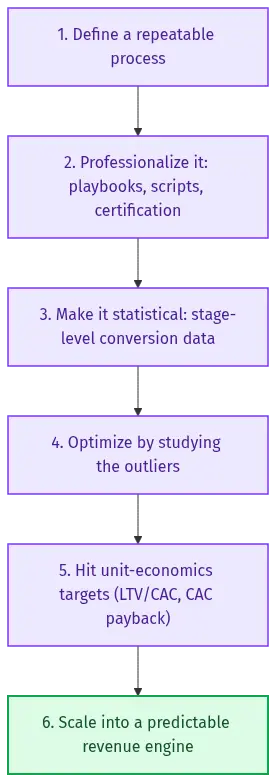
Strong SaaS sales training doesn’t live in a course. It lives inside a system that evolves your sales org from improvisation to a predictable engine. I think about this in six stages. Training is the mechanism that moves you from one stage to the next.
- Define a repeatable process. Before you can train anyone, you need something to train them on. Document the steps a deal moves through — the same steps, every time. This is the foundation of a repeatable sales process, and without it, “training” is just sharing opinions.
- Professionalize it. Turn the process into playbooks, call scripts, objection-handling guides, and a certification checklist. New reps should be able to learn the motion from documents, not just from osmosis next to a veteran.
- Make it statistical. Instrument the process so you know your conversion rate at every stage — lead to meeting, meeting to opportunity, opportunity to close. Once you have stage-level conversion data, training becomes targeted: you fix the stage that’s leaking, not the rep’s general “skills.”
- Optimize by studying the outliers. Find your top performer. Figure out precisely what they do differently at the leaking stage. Document it. Train everyone to it. This is where most of your improvement comes from.
- Hit your unit-economics targets. A working sales motion proves itself in LTV/CAC and CAC payback. If the math doesn’t clear your thresholds, the motion isn’t ready to scale — pouring more money in just loses it faster.
- Become predictable. The end state: you can put $1M of sales-and-marketing spend in and reliably get a known amount of bookings out. At that point you stop talking to your VP of Sales about tactics and start talking to your CFO about capital allocation.
Notice what training is doing across these six stages. It is not a one-time event that happens at stage 2. It is the connective tissue that lets you move a new rep — or your whole team — from one stage to the next without losing the gains. A company that “did sales training last year” and stalled almost always skipped the instrumentation in stage 3, so they had no idea what to actually train on.
Study Your Outliers — The Highest-Leverage Training Input
I want to dwell on stage 4, because it is the part founders most often skip and the part that pays the most.
In nearly every sales team, performance is not evenly distributed. You will have a rep — sometimes one or two — who consistently outperforms the rest by a wide margin. The instinct is to celebrate them and move on. The far more valuable move is to treat that variance as a signal and mine it.
Here is the leverage. Imagine a 10-person team where one rep generates the lion’s share of qualified meetings because they prospect relentlessly and the others barely prospect at all. If the top rep books 5 quality meetings a week and the rest book closer to half a meeting a week, the gap isn’t talent — it’s a behavior the others haven’t adopted. Document exactly what the top performer does — their call cadence, their opening lines, their follow-up rhythm — and train the team to match it. Moving the other nine reps from near-zero prospecting up toward the top performer’s level can lift team-wide meeting volume many times over. No new headcount. No new CAC. Just the systematic transfer of one person’s behavior to everyone else.
This is why “buy a generic course” is the wrong first move. The single best curriculum for your team is already sitting inside your own organization, in the head of your best rep. External training fills gaps your top performer can’t teach — formal methodology, advanced negotiation, technical discovery — but it should sit on top of an internal playbook built from your own outliers, not replace it.
To do this well, you need the instrumentation from stage 3. You can’t study the outlier if you can’t see, stage by stage, where they pull ahead. That is the practical reason the stages run in order: each one makes the next one possible.

Choosing a Methodology Before You Choose a Program
Before you evaluate any external SaaS sales training program, pick a sales methodology. The methodology is the operating system your team runs on; the program is just the delivery vehicle for it. Buying a program without a chosen methodology is how you end up with reps speaking five different sales languages.
There is no single best methodology — there is a best fit for your deal type. Here is how the major frameworks map to SaaS contexts.
| Methodology | Core Idea | Best Fit for SaaS |
|---|---|---|
| SPICED | A recurring-revenue framework (Situation, Pain, Impact, Critical event, Decision) built for land-and-expand | Product-led to mid-market SaaS scaling a repeatable motion |
| MEDDICC | A qualification framework for complex, multi-stakeholder deals | Enterprise SaaS with long cycles and buying committees |
| Challenger | Teach the buyer something new; lead with insight | Disruptive or category-creating products |
| SPIN | Uncover needs through structured questioning | Trust-based, consultative mid-market and enterprise deals |
| Gap Selling | Quantify the gap between current and desired state | Deals where buyers must justify cost of inaction internally |
For a typical $5M–$15M ARR SaaS company building a repeatable motion, SPICED or SPIN usually fits best, because both are consultative and both translate cleanly into the discovery-heavy, fit-first selling that recurring revenue demands. If you are moving upmarket into enterprise SaaS sales with six-month cycles and committees, MEDDICC earns its keep as a qualification discipline.
But here is the blunt truth: the specific methodology matters far less than the consistency of its adoption. A mediocre methodology that every rep uses on every deal beats a brilliant one that lives in a slide deck nobody opens after onboarding. Pick one. Commit. Enforce it through coaching and your CRM. Stop shopping for the perfect framework — the shopping itself is a form of avoidance. Your sales methodology is only as good as your enforcement of it.
Internal Build vs. External Program
Once you have a process and a methodology, you face a build-vs-buy decision on the training itself. Both have a place, and the right answer is usually a layered one. Treat each option with the same depth so you can choose deliberately.
Internal training (build). This is the playbook you assemble from your own repeatable process and your own outliers. It is the foundation and it is non-negotiable — nobody else can teach a new rep how your product wins your deals. The cost is your time and your best rep’s time to document and deliver it. The tradeoff: it is slow to build and it only contains what your team already knows. It will not teach skills your org hasn’t yet developed.
External programs (buy). These fill the gaps your internal playbook can’t — formal methodology certification, advanced negotiation, technical discovery, modern AI-assisted prospecting. Self-paced libraries run roughly $180–$1,000 per user per year. Live, instructor-led methodology programs run $1,500–$5,000 per person, and full custom team engagements can reach $10K–$50K+. The tradeoff: external content is generic by design, and without internal reinforcement it decays inside 90 days. You are buying raw material, not behavior change.
The decision rule I use: build the foundation internally, buy the gaps, and never buy a program you don’t have a reinforcement plan to make stick. An external program with no internal coaching cadence behind it is the single most common way SaaS companies waste training money. If you can’t commit to the reinforcement, don’t spend on the program — spend the same money on freeing up your best rep to coach.
Making Training Actually Stick: The 30–60-90 Rollout
Training fails on the rollout, not the content. The 1‑in‑5 behavior-change statistic is almost entirely a reinforcement failure, not a learning failure. Here is the system that turns a training investment into durable behavior change. You can run this yourself, and for a company your size, you should.
Days 1–30 — Install the foundation.
- Document the repeatable process and the methodology into a single playbook a new rep can actually read.
- Build a certification checklist: a new rep is “ramped on fundamentals” only when they can demo the product, run a discovery call against your methodology, and handle your five most common objections without notes.
- Set the baseline metrics you will measure: stage-by-stage conversion rates and current ramp time. You cannot prove improvement against a number you never recorded.
Days 31–60 — Build the coaching cadence.
- Block 30 minutes per rep per week for structured coaching. Reps who get regular structured coaching dramatically out-attain those who don’t. This is not pipeline review — “what’s the next step?” is forecasting, not coaching. Coaching is reviewing how the rep ran the call against the methodology.
- Start grading real calls. Record them, score them against the methodology, and share examples of both excellent and poor calls. Reps learn faster from real recordings than from role-plays.
- Run methodology-based deal reviews every two weeks, using your framework as the review structure.
Days 61–90 — Enforce and measure.
- Wire your methodology into required CRM stages. If a rep can advance a deal without completing the qualification fields, they won’t complete them — and your pipeline data degrades under quota pressure. Make the fields a gate, not a suggestion.
- Run your first 90-day adoption audit. Are reps using the framework? Is ramp time dropping? Is stage conversion improving? If not, the content didn’t fail — the reinforcement did.
- Re-measure ramp time and the average-to-best gap against your day‑1 baseline. This is your proof of ROI, and it is the number you should bring to your board.
The pattern across all 90 days: training is the starting gun, and everything after it determines whether you wasted the money. Coaching, call grading, CRM enforcement, and quarterly audits are not optional add-ons. They are the program. The two-day workshop is the cheap part.
Common Mistakes SaaS CEOs Make With Sales Training
I see the same handful of errors repeatedly when founders approach SaaS sales training. Most are failures of system, not of effort.
- Training before there’s a process to train on. If your sales motion isn’t documented and repeatable, training just spreads inconsistency faster. Build the repeatable process first.
- Buying a program with no reinforcement plan. The 73% 90-day decay rate is the predictable result. Budget at least as much management attention for reinforcement as you spend dollars on content.
- Skipping instrumentation. Without stage-level conversion data, you’re guessing at what to train. You’ll fix the rep’s confidence when the real problem was a leak at the demo stage.
- Hiring a VP of Sales to “own training” too early. Founders often expect a senior hire to install a system that doesn’t exist yet. If you bring in the wrong VP of Sales before you have a repeatable process, they inherit chaos and usually can’t fix it. Build the foundation first, then hire someone to scale it.
- Ignoring the sales-to-success handoff. A rep trained only to close, with no training on setting up a clean onboarding handoff, manufactures churn. In SaaS, the sale isn’t won until the customer succeeds.
- Treating training as an event instead of a system. The single biggest one. A workshop is a moment; a training system is a permanent capability that compounds with every new hire.
How SaaS Sales Training Connects to Your Exit
Everything above ladders up to one thing that should matter to a founder building toward a sale: a systematized sales org is a de-risked sales org, and de-risked businesses command higher multiples.
When you can put a dollar of sales-and-marketing spend in and predict the bookings that come out, your revenue stops looking like a series of lucky individual performances and starts looking like an engine. The gap between median and top-quartile growth is enormous — SaaS Capital’s benchmarking of 1,000+ private companies puts median bootstrapped growth around 20% while the top decile more than doubles it — and a predictable sales engine is a large part of what separates the two. Acquirers pay a premium for engines and a discount for hero-dependent teams, because an engine survives the departure of any single person. A SaaS sales training system — built on a repeatable process, fed by your outliers, enforced through coaching, and proven in your unit economics — is precisely what turns “we have some great salespeople” into “we have a predictable revenue machine.” The first is a risk an acquirer discounts. The second is an asset they pay up for.
That is the real reason to take SaaS sales training seriously. Done as an event, it’s a line item that mostly evaporates. Done as a system, it shortens ramp, lifts CAC efficiency, and quietly raises the multiple you’ll eventually sell for. As the CEO, that system is the thing you’re actually building. The course is just one ingredient.
Frequently Asked Questions
How much does SaaS sales training cost?
Self-paced programs run roughly $180–$1,000 per user per year. Live, instructor-led methodology programs run $1,500–$5,000 per person, and full custom team engagements reach $10K–$50K+. But the cost that matters most isn’t the program fee — it’s the management time for reinforcement. Budget for 3–6 months of structured coaching alongside any program, or the content won’t stick.
How long before SaaS sales training shows ROI?
Plan on three to six months before behavior change shows up in the numbers, and measure it through ramp time and stage-level conversion, not through how reps felt about the session. Without coaching and reinforcement, most programs produce no measurable change at all — that’s the 1‑in‑5 statistic in action.
Should I build training internally or buy an external program?
Build the foundation internally from your own repeatable process and top performers — nobody else can teach how your product wins your deals. Buy external programs to fill specific gaps like formal methodology or advanced negotiation. Never buy a program you don’t have a reinforcement plan to make stick.
What’s the difference between SaaS sales training and general sales training?
General sales training optimizes for the signature on a one-time deal. SaaS sales training has to account for recurring revenue: qualifying for customer fit, multi-threaded buying committees, land-and-expand motions, and a clean handoff to onboarding. A SaaS rep who closes a poor-fit customer hasn’t won — they’ve created future churn.
Do I need a VP of Sales to run training?
Not at first, and hiring one too early is a common mistake. Until you have a documented, repeatable sales process, a senior hire inherits chaos rather than a system to scale. Build the foundation yourself, prove the unit economics, then hire someone to scale what’s already working.