

Most SaaS founders I work with between $5M and $15M Annual Recurring Revenue (ARR) treat the ACV metric as a number their finance team produces once a quarter and nobody questions. That is a mistake. Annual Contract Value (ACV) — the annualized recurring revenue of a single customer contract — is the number that quietly decides what kind of company you are allowed to build. It dictates whether you can afford a salesperson, whether account-based marketing makes sense, how long your sales cycle can run, and how much you can spend to keep a customer happy. Get the ACV metric wrong by 20% and you will make a string of go-to-market decisions that are all internally consistent and all pointed in the wrong direction.
Here is the part most people miss. ACV is not a reporting metric you glance at on a dashboard. It is a constraint. Everything downstream — your CAC budget, your sales model, your customer success staffing, even how you choreograph an upsell — has to “scale to your ACV.” When a founder asks me whether they should hire an account manager, put a rep on a plane, or run a quarterly business review, my first question is almost always: what is your ACV? Because the answer changes completely at $3,000 versus $30,000 versus $300,000.
This guide covers what the ACV metric actually measures, the exact formula and how it differs from the metrics people confuse it with, the five mistakes that distort it, a worked example you can hold against your own dashboard, the benchmark ranges that matter, and — most importantly — how to read your ACV as a strategic instruction rather than a quarterly fact.
What the ACV Metric Actually Measures
Annual Contract Value (ACV) is the annualized recurring revenue of a single customer contract, normalized to a one-year period. It answers one question: how big is a deal, measured over a year?
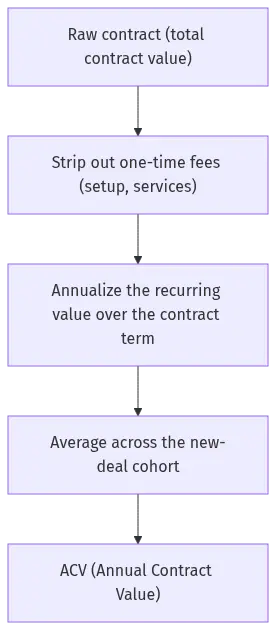
The word “annualized” is doing the heavy lifting. If a customer signs a three-year contract worth $90,000 of recurring subscription revenue, the ACV is not $90,000 — it is $30,000, because you spread that recurring value across the three years of the term. ACV takes a contract of any length and expresses it as a yearly run rate so you can compare a one-year deal and a three-year deal on the same footing.
Two things are deliberately excluded from a clean ACV calculation:
- One-time fees. Implementation, onboarding, setup, migration, and professional services are not recurring, so they do not belong in ACV. A $50,000/year subscription that ships with a $20,000 implementation fee still has an ACV of $50,000, not $70,000. The implementation fee belongs in Total Contract Value (TCV), not ACV.
- Variable usage you cannot count on. Pure consumption revenue — overage charges, per-transaction fees, anything that swings month to month — is typically excluded unless you have a consistent, defensible policy for treating a predictable usage floor as recurring.
The reason for the exclusions is simple: ACV is meant to measure the durable, repeatable value of a customer relationship. The moment you let one-time fees leak in, you are no longer measuring how big the customer is — you are measuring how big the first invoice was, which is a different and far less useful thing.
The ACV Formula
There are two ways to compute the ACV metric, and confusing them is the first place founders go wrong.
For a single contract:
ACV = Total Recurring Contract Value ÷ Contract Term in Years
A $120,000 contract signed for two years has an ACV of $120,000 ÷ 2 = $60,000.
For a cohort or your whole book (the version that goes on a dashboard):
ACV = Total Annualized Recurring Value of a Cohort of Contracts ÷ Number of Contracts
This is the average ACV across a group of deals. In practice, you almost always want to calculate this on a rolling 12-month cohort of new deals, not on your entire historical customer base. A trailing-twelve-month window smooths out the lumpiness of any single big or small deal and tells you what a typical new customer is worth right now — which is the number that should drive your current go-to-market spend.
A subtle but important point: average ACV and first-year ACV are often different numbers, and high-growth SaaS companies watch both. If you sell on a land-and-expand motion — small initial deal, deliberate upsells later — your first-year new-logo ACV will be lower than your blended book-wide ACV. One coaching client of mine had a book-wide average ACV around $23,000 but a first-year new-logo ACV closer to $13,500. Those two numbers tell completely different stories: the $13,500 says “this is what a new relationship costs to start,” and the $23,000 says “this is what it grows into.” If you budget your sales spend against the $23,000 figure, you will overspend to acquire customers who only justify $13,500 on day one.
ACV vs. the Metrics It Gets Confused With
The ACV metric sits in a cluster of revenue measures that people use interchangeably and shouldn’t. Each answers a different question.
| Metric | What It Measures | Includes One-Time Fees? | Unit |
|---|---|---|---|
| ACV (Annual Contract Value) | Annualized recurring value of one contract | No | Per deal, per year |
| TCV (Total Contract Value) | Full value over the entire contract life | Yes | Per deal, total |
| ARR (Annual Recurring Revenue) | Annualized recurring value of the whole book | No | Company-wide, point in time |
| ARPA (Average Revenue Per Account) | Average recurring revenue per active account | No | Per account |
| ASP (Average Selling Price) | Average value of a newly closed deal | Sometimes | Per new deal |
The three distinctions worth burning into memory:
ACV vs. TCV. TCV is the total value over the full life of the contract including one-time fees. Take a customer who signs a three-year deal at $40,000/year recurring plus a $30,000 implementation fee. The TCV is ($40,000 × 3) + $30,000 = $150,000. The ACV is $40,000. TCV is the right number when you are talking about bookings or cash; ACV is the right number when you are talking about the durable size of the relationship.
ACV vs. ARR. ACV is a per-deal metric. ARR is a portfolio metric — the sum of annualized recurring revenue across every active subscription, measured at a point in time. ACV tells you how big the average customer is; ARR tells you how big the entire recurring-revenue book is. If you want the full breakdown of how those two relate, see the dedicated guide on ACV vs. ARR. Mechanically, if you have N active customers at an average ACV of $A, your ARR is roughly N × A — but “roughly” hides churn, expansion, and deal-mix shifts.
ACV vs. ARPA. These are close cousins and sometimes identical, but ACV is anchored to the contract (the annualized value of what was signed) while ARPA is anchored to the account as it bills today. A customer can sign a $50,000 ACV contract and, after a mid-term downgrade, have an ARPA of $40,000. For a stable book they converge; for a book with a lot of mid-contract movement, they diverge.
A note on definitions: ACV, ASP, bookings, and TCV are defined slightly differently from company to company. There is no universal standard the way there is for, say, gross margin. What matters far more than matching some external definition is that your entire organization calculates ACV the same way every single period. Pick a definition, write it down, and lock it so your board deck, your sales reporting, and your finance model all mean the same thing when they say “ACV.”

A Worked Example: ACV at a $10M ARR Company
Numbers make this concrete. Take a B2B SaaS company with $10M ARR that closed 100 new customers over the trailing twelve months.
Assume the new-deal book breaks down like this:
| Segment | New Deals | Recurring Value per Deal (annualized) | Segment ACV Contribution |
|---|---|---|---|
| SMB | 60 | $8,000 | $480,000 |
| Mid-market | 30 | $35,000 | $1,050,000 |
| Enterprise | 10 | $140,000 | $1,400,000 |
| Total | 100 | — | $2,930,000 |
The blended new-logo ACV metric is:
ACV = $2,930,000 ÷ 100 = $29,300
Now watch what that single blended number hides. The company-wide ACV of $29,300 does not describe a single real customer. Sixty percent of the new logos came in at $8,000 — barely a quarter of the blended figure — and ten percent came in at $140,000, nearly five times it. If you build a go-to-market plan around “our ACV is ~$29K,” you will design a sales motion that fits none of the three segments well: too expensive for the SMB deals, too thin for enterprise.
This is the single most important habit with the ACV metric: segment it. Calculate ACV separately by deal size, vertical, channel, and geography. In my experience there are always meaningful variances between segments — and the blended average is the number most likely to lead you astray, precisely because it looks so clean and authoritative on a slide.
One more layer. Suppose the enterprise segment carries a 30% one-time implementation fee on top of the recurring value. A founder who lets that fee leak into the ACV calculation would report enterprise ACV as $140,000 × 1.30 = $182,000 instead of the correct $140,000 — overstating the segment’s recurring size by 30% and, worse, overstating the CAC budget the segment can support.
The Five Mistakes That Distort the ACV Metric
Each of these is a real money mistake, not a rounding error. Each one I have seen distort a real company’s go-to-market decisions.
- Letting one-time fees leak into ACV. Implementation, setup, and services fees inflate ACV and make every downstream ratio — CAC payback, LTV/CAC, the budget you’ll spend to acquire the next customer — look healthier than it is. Keep one-time fees in TCV; keep them out of ACV.
- Failing to annualize multi-year deals. Counting the full multi-year contract value as a single year’s ACV is the inverse error. A $90,000 three-year deal is $30,000 of ACV, not $90,000. Treating it as $90,000 triples the apparent deal size and corrupts every per-deal comparison.
- Reporting MRR-derived numbers as ACV. I have sat in meetings where a founder presented what was technically Monthly Recurring Revenue per account and labeled it ACV. Either switch the calculation to a true annualized figure or relabel it as MRR — but do not mix the two. A number that’s off by a factor of twelve is not a metric, it’s a landmine.
- Using one blended ACV for a multi-segment business. The company-wide average hides the truth when your book spans SMB and enterprise. A blended $29,300 ACV is useless for staffing the SMB sales team or budgeting the enterprise one. Segment everything.
- Confusing first-year ACV with blended book ACV in a land-and-expand model. If you deliberately land small and expand, your new-logo ACV is structurally lower than your mature-customer ACV. Budget acquisition spend against the first-year number, not the expanded one, or you will overspend on day one for value that only materializes in year two.
What the ACV Metric Tells You About Your Sales Model
This is where the ACV metric stops being a reporting number and becomes a strategic instruction. ACV sets the ceiling on what you can afford to spend to acquire and serve a customer — and that ceiling dictates the entire shape of your go-to-market.
The principle is blunt: everything has to scale to your ACV. You cannot afford to put an account manager on a plane to run an in-person business review with a customer paying you $3,000 a year. The math doesn’t work. But the principle behind that business review still applies — you just deliver it differently. At a low ACV, the ROI proof that would be an in-person quarterly meeting at high ACV becomes an automated email, a dashboard splash screen, or a short video link. Same message (“here’s the value you got”), radically different cost structure, scaled to the deal size.
Here is how I think about what each ACV band lets you do:
| ACV Band | Viable Sales Model | What You Can Afford |
|---|---|---|
| Under ~$5,000 | Self-serve / product-led, low-touch | Automated onboarding, email-based success, no dedicated rep per account |
| ~$5,000–$25,000 | Inside sales / structured repeatable process | A rep can own the deal; success is pooled, not 1:1; light-touch QBRs by email |
| ~$25,000–$100,000 | Field-leaning inside sales, structured sales cycle | Dedicated reps, named account managers, real onboarding, periodic live reviews |
| $100,000+ (six/seven figures) | Full enterprise sales with account-based marketing | In-person reviews, ABM spend per account, executive sponsorship, dimensional mail |
Account-based marketing is the clearest example of ACV as a gate. ABM only makes economic sense when the price point can absorb it. At a $20/year WordPress-plugin ACV, ABM is absurd. When your ACV reaches the high five figures and into the seven figures, you can justify spending hundreds of dollars per target account per year — physical mail, retargeting, in-person dinners — and win against competitors with marketing budgets a hundred times larger, because you’ve cherry-picked a narrow ICP and gone deep instead of wide. The ACV metric is what tells you which game you’re allowed to play.
The same logic governs the upsell. A high-ACV customer justifies a choreographed, in-person value-delivery process where you schedule the ROI-verification meeting at the moment of sale and weave the expansion conversation into it. A low-ACV customer gets the automated version. Either way, the upsell exists — because net revenue retention is one of the largest levers on valuation — but how you execute it is set by the ACV.

How ACV Connects to Valuation and Unit Economics
ACV is not just a sales metric. It feeds directly into the unit economics that determine whether you can scale and what your company is worth.
Start with Customer Acquisition Cost (CAC) payback. The fully loaded cost to land a customer has to be recovered out of the gross profit that customer generates — and ACV is the engine of that gross profit. A higher ACV gives you a bigger annual gross-profit contribution per customer, which shortens CAC payback and lets you spend more to acquire each one. This is why a $140,000-ACV enterprise customer can support a sales process that would bankrupt you at $8,000 ACV: the same dollars of sales effort are amortized against a far larger annual contribution.
It also feeds Lifetime Value (LTV). LTV in its decision-useful form is built on gross profit per customer and retention — and the gross-profit input traces straight back to ACV. Raise ACV (through pricing, packaging, or moving upmarket) and you raise LTV mechanically, which improves the LTV/CAC ratio that investors use as a first-pass filter on whether your growth is healthy.
And at exit, ACV shapes the conversation in two ways. First, larger, more durable contracts read as lower-risk recurring revenue, and risk is one of the biggest levers on the valuation multiple. Second, a rising new-logo ACV is evidence you’re successfully moving upmarket — a growth signal acquirers pay for. The recurring nature of that revenue is what earns the premium multiple in the first place; ACV is the per-customer expression of it. For the full picture of how recurring revenue translates into a sale price, see the guide on SaaS company valuation.
A point on the numbers above: specific ACV bands, benchmark ranges, and valuation multiples shift with market conditions. The figures here are illustrative and meant to show relative differences — what changes between a $5,000 and a $100,000 ACV — not fixed thresholds. Verify current benchmarks against a recent source before you set targets. Independent research firms such as SaaS Capital publish updated ACV, retention, and efficiency benchmarks each year.

Frequently Asked Questions About the ACV Metric
Does ACV include one-time fees?
No. A clean ACV calculation excludes one-time fees — implementation, setup, onboarding, and professional services. Those are non-recurring and belong in Total Contract Value (TCV), not ACV. ACV measures the durable, recurring annual value of the relationship; folding in a one-time fee overstates how big the customer actually is on a recurring basis.
What is the difference between ACV and TCV?
ACV is the annualized recurring value of a contract for a single year. TCV is the total value over the contract’s entire life, including one-time fees. A three-year deal at $40,000/year recurring plus a $30,000 setup fee has an ACV of $40,000 and a TCV of $150,000. Use ACV to describe the durable size of a customer; use TCV for bookings and cash discussions.
How do you calculate average ACV across customers?
Sum the annualized recurring value of every contract in the group and divide by the number of contracts. For a go-to-market dashboard, calculate it on a rolling 12-month cohort of new deals rather than your entire history — this smooths out lumpy individual deals and tells you what a typical new customer is worth right now.
Is ACV the same as ARR?
No. ACV is a per-deal metric — the annualized value of one contract. ARR is a portfolio metric — the annualized recurring revenue of your entire active book at a point in time. If you have N customers at average ACV $A, your ARR is roughly N × A, but churn, expansion, and deal mix make that an approximation, not an identity.
What is a good ACV for a SaaS company?
There is no universal “good” ACV — it depends on your model. What matters is that your ACV is high enough to support your sales motion. A self-serve product can thrive at a few thousand dollars; an enterprise field-sales model needs an ACV in the tens or hundreds of thousands to cover the cost of reps, account managers, and in-person engagement. The right question is not “is my ACV high?” but “does my ACV justify the way I sell?”