

Ask ten first-time SaaS CEOs what their revenue is, and most will quote you their ARR. That instinct is right — ARR is the number the whole SaaS world organizes around — but it also hides a trap. The ARR revenue meaning that most founders carry in their heads is subtly wrong, and the gap between what they think ARR measures and what it actually measures shows up at the worst possible moment: in a diligence room, when an acquirer’s analyst pulls the number apart and finds it’s smaller than the headline.
So let’s be precise. ARR is not your total revenue. It’s not the cash that landed in your bank account last year. And it’s not the sum of your last twelve months of invoices. ARR is a snapshot of your recurring revenue, annualized — and the discipline of what you include and exclude is the entire reason the metric is worth tracking. Get that discipline right and ARR becomes the single most useful number you have for running and eventually selling your company. Get it wrong and you’ll inflate a figure that a buyer will simply discount back down.
I’ve reviewed plenty of SaaS companies in the $2M–$15M ARR range, and the ones with the cleanest exits almost always share one trait: the CEO can tell you not just what the ARR number is, but exactly what’s underneath it. This article gives you that clarity.
What ARR Revenue Actually Means
ARR stands for Annual Recurring Revenue. It is the annualized value of the recurring revenue your business is generating right now — the predictable, repeating subscription revenue you can reasonably expect to keep collecting over the next twelve months, expressed as a yearly figure.
The canonical formula is deliberately simple:
ARR = Current MRR × 12
Where MRR is your Monthly Recurring Revenue — the recurring subscription revenue you bill in a single month. If your customers collectively pay you $300,000 per month in subscriptions, your MRR is $300,000 and your ARR is $3.6 million. (If you want the full mechanics of building MRR up from new, expansion, contraction, and churned revenue, the MRR vs ARR guide walks through it line by line.)
Two words in that definition carry all the weight: recurring and current.
Recurring is what separates ARR from ordinary revenue. Only revenue that repeats on a contractual subscription basis belongs in ARR. One-time fees, services, and uncommitted usage don’t qualify — more on that below.
Current is the word almost everyone misses. ARR is a snapshot, not a trailing total. It’s calculated from your MRR as of a specific day — usually the last day of the month or quarter — and then multiplied out to an annual run rate. It describes the revenue your business is positioned to earn over the coming year at today’s run rate, not the revenue you actually booked over the past year. That distinction is the heart of the ARR revenue meaning, and it’s where most of the confusion lives.
ARR Revenue vs. Total Revenue: The Distinction That Matters
Here’s the cleanest way to hold the difference in your head. Total revenue (the GAAP revenue on your income statement) is a historical measure — it answers “how much did we actually earn over this period?” ARR is a forward-looking run-rate measure — it answers “at our current recurring run rate, how much are we positioned to earn over the next year?”
They are not the same number, and they’re not supposed to be. The table below shows where they diverge.
| Dimension | ARR (Annual Recurring Revenue) | Total Revenue (GAAP) |
|---|---|---|
| What it measures | Forward run rate of recurring revenue | Historical revenue actually earned |
| Time orientation | Snapshot of today, annualized | Trailing period (month, quarter, year) |
| Includes one-time fees? | No | Yes |
| Includes services / consulting? | No (unless contractually recurring) | Yes |
| Includes uncommitted usage? | No | Yes (as earned) |
| Primary audience | Operators, investors, acquirers | Accountants, auditors, the IRS |
| Why it exists | To value predictability | To report what happened |
A worked example makes the gap concrete. Suppose a company closes the year with:
- $3,000,000 in recurring subscription revenue (MRR of $250,000 as of December 31)
- $400,000 in one-time onboarding and implementation fees collected during the year
- $300,000 in professional-services and consulting revenue
That company’s total revenue is $3,700,000. But its ARR is $3,000,000 — the recurring slice only. The $700,000 of one-time and services revenue is real money, it shows up on the income statement, and it pays salaries. It simply isn’t ARR, because it won’t recur predictably next year without the company going out and earning it all over again. An acquirer paying a multiple of ARR will pay for the $3M, not the $3.7M. If you’ve been quoting $3.7M as your ARR, you’ve just learned why the diligence room is uncomfortable.
For a deeper treatment of where ARR and reported revenue split apart — and the accounting mechanics behind it — see ARR vs revenue and the related breakdown of annual recurring revenue vs revenue.
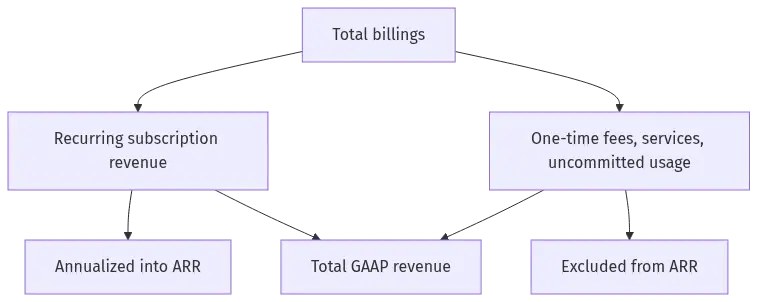
What Counts as ARR — and What Doesn’t
The value of ARR comes entirely from its discipline. The moment you let non-recurring money inflate the number, you’ve blurred the exact quality — predictability — that makes the metric worth anything. Here’s what belongs in ARR and what gets excluded.
Belongs in ARR:
- Committed subscription revenue. A customer on a $2,000/month plan contributes $24,000 to ARR. This is the core of the number.
- Annual or multi-year contract value, annualized. A customer who signs a two-year, $48,000 contract contributes $24,000/year to ARR — the annual run rate, not the full contract value.
- Recurring expansion. When an existing customer upgrades a tier or adds seats on a recurring basis, the incremental recurring amount adds to ARR.
Excluded from ARR:
- One-time setup and implementation fees. A $30,000 onboarding charge is real revenue, but it doesn’t recur, so it’s not ARR.
- Professional services and consulting. Unless a customer is contractually committed to buying the same services every year, this revenue isn’t predictable enough to annualize into ARR.
- Uncommitted usage and overages. Variable, month-to-month usage the customer can switch off at will is closer to transactional revenue than recurring revenue. (Committed usage minimums are a gray area — if the customer is contractually obligated to a floor, that floor can count.)
There’s also a timing subtlety worth flagging, because it trips people up. ARR is built from MRR, which is an accrual concept — it reflects the recurring revenue you’re contractually entitled to bill, not the cash that has cleared. Early-stage founders who run their business off the bank balance often conflate the two and end up with an ARR figure that wobbles with payment timing. ARR shouldn’t move when a customer pays late; it should move only when a customer is added, upgraded, downgraded, or lost. If your ARR jumps around with cash collection, you’re measuring cash, not recurring revenue.
A note on the numbers in this article. The dollar figures, benchmark multiples, and valuation ranges below are illustrative and reflect rough market conditions at the time of writing. They’re here to show relative relationships — how ARR compares to total revenue, how predictability earns a premium — not to serve as current quotes. Verify live benchmarks before making a decision.
Why ARR Revenue Gets Valued Differently
Now the question that actually matters to a founder building toward an exit: why does anyone care about ARR more than total revenue? Because ARR measures the one thing a buyer is really purchasing — predictability.
Think of your SaaS company as a factory. On the input side you feed in an executive team, a product, a go-to-market function, and capital. On the output side, a well-run SaaS factory produces a very specific set of outputs: annual recurring revenue, healthy gross margins, and high customer retention. The reason the SaaS business model commands premium valuations isn’t that the revenue is large — plenty of low-multiple businesses are large. It’s that the output is recurring and predictable. A buyer who acquires $3M of clean ARR is buying a revenue stream that shows up again next year without anyone having to resell it.
That’s the Recurring Revenue Premium: contractually recurring revenue earns the highest multiples in the market precisely because it’s the most predictable — a pattern documented year after year in private-company valuation research from firms like SaaS Capital. The same dollar of revenue is worth dramatically more when it’s recurring than when it’s one-time. A consulting firm doing $3.7M in project revenue might sell for roughly 1x revenue, because every dollar has to be re-won next year. A SaaS company with $3M of sticky, recurring ARR can sell for several multiples of that ARR — often 5x to 10x ARR depending on growth rate, retention, and margins — because the buyer is paying for the years of revenue the factory will keep producing. (For how those multiples are actually set, see SaaS valuation multiples and SaaS revenue multiples.)
This is also why an acquirer will strip the one-time and services revenue out of your headline number during diligence. They’re not being difficult — they’re paying for predictability, and one-time revenue isn’t predictable. Every dollar of inflated ARR you quote going in is a dollar they’ll discount coming out, and it erodes your credibility on everything else in the deal.
How ARR Revenue Shapes the Way You Run the Company
Once you understand the ARR revenue meaning correctly, it stops being a number you report on a dashboard and becomes a lens you make decisions through. Three shifts matter most.
First, you start protecting the recurring base before chasing new logos. Because ARR is a run-rate snapshot, anything that erodes it — churn, downgrades — silently drags the number down even while your sales team is adding new customers. A company adding $1M of new ARR while losing $1.2M to churn has negative net ARR growth, no matter how busy sales looks. This is why retention metrics like net revenue retention and gross revenue retention sit right next to ARR on any serious operator’s dashboard. ARR without a retention lens is a vanity metric.
Second, you get disciplined about what you sell. When services and one-time revenue don’t count toward the metric the market values, you think harder about whether a big custom-implementation deal is actually building enterprise value or just generating cash that won’t recur. Cash matters — but if your goal is a high-multiple exit, the recurring slice is what compounds into valuation.
Third, you measure ARR by segment, not just in aggregate. A company-wide ARR figure hides the truth. The ARR you’re adding from your best-fit customer segment may be sticky and expanding, while the ARR from a poorly-targeted segment churns out within a year. Segmenting ARR by vertical, contract size, and channel tells you which parts of the factory are actually producing durable output — and which are leaking. (The broader dashboard of metrics that surrounds ARR is covered in SaaS metrics and SaaS growth metrics.)
ARR Revenue Meaning: Frequently Asked Questions

Is ARR the same as revenue? No. Revenue (total or GAAP revenue) is the historical amount your business actually earned over a period, including one-time fees and services. ARR is a forward-looking snapshot of just your recurring revenue, annualized. ARR is almost always smaller than total revenue, because it deliberately excludes the non-recurring slice.
Is ARR the last twelve months of revenue? No — this is the most common misconception. ARR is not trailing-twelve-months revenue. It’s calculated from your current MRR (a single point in time) multiplied by 12. It describes your run rate today, not what you earned over the past year. A company that doubled its MRR in December would show that growth fully reflected in its ARR, even though its trailing revenue wouldn’t catch up for months.
Does ARR include one-time fees? No. Setup fees, implementation charges, and professional services are excluded because they don’t recur. They’re real revenue and belong on your income statement, but they aren’t part of ARR.
Can a non-subscription business have ARR? Only to the extent it has genuinely recurring, contractual revenue. A business with purely transactional or project-based revenue has no ARR — and that’s exactly why such businesses trade at lower multiples than SaaS companies. If you have some recurring revenue, you can report ARR on that slice. See businesses with recurring revenue for the broader landscape.
What’s a good ARR growth rate? It depends heavily on stage. Early-stage SaaS companies (under ~$5M ARR) are often expected to grow ARR 80–100%+ year over year, while companies above $10M ARR are strong at 40–60%. The Rule of 40 — growth rate plus profit margin summing to 40% or more — is the filter investors apply once you’re at scale. For the mechanics of measuring it, see ARR growth.
The Bottom Line
The ARR revenue meaning comes down to one idea: ARR is the annualized snapshot of your recurring revenue, and its entire value is the predictability that discipline protects. It is not your total revenue, it is not your trailing twelve months, and it is not your cash collections. Keep the number clean — recurring only, accrual-based, measured by segment — and it becomes the truest summary you have of what your business is worth and how healthy it is. Let one-time money creep in, and you’ve traded the one quality that made the metric worth tracking for a headline figure a buyer will simply correct.
Understand it correctly and you’ll run the company differently: protecting the recurring base, getting disciplined about what you sell, and building the kind of predictable revenue factory that earns a premium when it’s time to exit.