

Most founders treat volume pricing as a sales concession — a discount you hand over to close a bigger deal. That framing is exactly why so many SaaS companies quietly destroy their own unit economics while believing they’re “winning on volume.” Volume pricing is not a discount. It is a structural decision about how your revenue scales relative to your cost-to-serve, and if you get the tiers wrong, every large customer you sign makes your business worth less, not more.
Here is the uncomfortable truth: a poorly designed volume pricing model can cut your gross margin by 10–15 points on your best accounts — the exact accounts an acquirer scrutinizes first. This article shows you the math behind every volume discount tier, the single most expensive mistake (the “pricing cliff”), how volume pricing differs from tiered pricing, and the decision framework for when volume pricing actually belongs in your business versus when it’s just leaving money on the table.
What Volume Pricing Actually Is
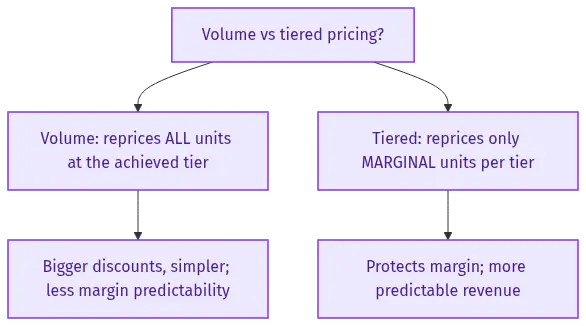
Volume pricing is a pricing structure where the price per unit drops as the total quantity purchased rises, and — this is the part that matters — the lower price applies retroactively to every unit, not just the units above a threshold.
Say you sell a product at $10 per seat. Under a volume pricing model, you might set it up like this:
| Seats Purchased | Price Per Seat | Applies To |
|---|---|---|
| 1–50 | $10.00 | All seats |
| 51–200 | $8.00 | All seats |
| 201–500 | $6.50 | All seats |
| 501+ | $5.00 | All seats |
A customer buying 250 seats pays $6.50 for all 250 — not $10 for the first 50, $8 for the next 150, and $6.50 for the rest. Cross a threshold, and the new, lower rate reprices your entire account. That single design choice is what separates volume pricing from its close cousin, tiered pricing, and it has enormous consequences for your margin (more on this below).
The appeal is obvious. Volume pricing rewards customers for buying more and gives your sales team a clean, defensible reason to push for a bigger commitment: “Get to 200 seats and your per-seat price drops 20%.” It’s transparent, it’s easy to explain on a pricing page, and it nudges buyers toward the next threshold. Companies like Zapier (cost per automated task falls as monthly task volume rises) and Chargebee (per-license rates drop with larger subscription quantities) use volume mechanics precisely because they make expansion feel like a reward rather than a tax.
But the mechanic that makes volume pricing attractive to buyers is the same one that makes it dangerous to operators. Let’s look at why.
Volume Pricing vs. Tiered Pricing: The Distinction That Costs Founders Millions
These two terms get used interchangeably in casual conversation, and that confusion is expensive. They are different models with different margin profiles. Mixing them up — or copying a “volume” structure from a billing vendor’s template without understanding which one you’ve actually built — is how founders end up with revenue that grows while gross profit shrinks.
Here is the difference in one table:
| Dimension | Volume Pricing | Tiered Pricing |
|---|---|---|
| How the discount applies | The unit price for the customer's entire quantity changes once they cross a threshold | Each band of units is priced separately; only units inside a band get that band's rate |
| 250 seats, using the table above | 250 × $6.50 = $1,625 | (50 × $10) + (150 × $8) + (50 × $6.50) = $2,025 |
| Revenue predictability | Lower — crossing a threshold drops the whole bill | Higher — total bill always rises with quantity |
| Margin protection | Weaker — early units lose their full price | Stronger — early units always command full price |
| Buyer perception | "The more I buy, the cheaper everything gets" | "The more I buy, the cheaper the next units get" |
Look at the worked example. The same 250-seat customer pays $1,625 under volume pricing and $2,025 under tiered pricing — a $400 difference, or 20% of the bill, on a single account. Multiply that across every large customer in your base and you understand why this distinction is not academic.
The reason the gap exists: under tiered pricing, the first 50 seats always cost $10 each, no matter how big the customer gets. Under volume pricing, the moment that customer crosses into the $6.50 band, those first 50 seats get repriced from $10 to $6.50 — you retroactively give back margin you had already earned. Tiered pricing protects the profit on your early units; volume pricing surrenders it.
This is why most B2B SaaS companies default to tiered pricing for their published plans and reserve true volume pricing for negotiated enterprise deals where a single large commitment justifies the all-units discount. If you want the deeper menu of structures, see our breakdown of SaaS pricing models and how to choose between them in our SaaS pricing strategy guide.
The Pricing Cliff: The Most Expensive Mistake in Volume Pricing
The single most dangerous flaw in a volume pricing model is the pricing cliff — a point where a customer can lower their total bill by buying more. It sounds impossible, but the all-units mechanic makes it not just possible but common.
Return to our table. A customer buying 50 seats pays 50 × $10 = $500. A customer buying 51 seats crosses into the $8.00 band, so they pay 51 × $8 = $408. The customer who buys one more seat pays $92 less. That is a pricing cliff.
Two things go wrong here, and both hurt you:
- Customers game the threshold. A buyer sitting at 50 seats figures out that adding a 51st seat — even a dummy seat nobody uses — saves them $92. You’ve just trained your customer to add phantom usage to pay you less. Your revenue per customer becomes unpredictable, and your billing data gets polluted with usage that doesn’t reflect real value delivered.
- You lose margin at exactly the wrong moment. The cliff transfers profit from you to the customer precisely as the account grows, which is the opposite of how healthy unit economics should behave. As a customer expands, your gross margin — (Revenue − COGS) / Revenue — should hold steady or improve because your fixed costs spread across more revenue. A cliff inverts that.
The fix is the marginal (incremental) approach — which is, functionally, switching to tiered pricing. Instead of repricing all units when a customer crosses a threshold, you only apply the lower rate to the units above each threshold. The 51st seat costs $8; the first 50 still cost $10. The total bill always rises with quantity, the cliff disappears, and customers have no incentive to game the system. The smooth curve also reads better on a pricing page: every additional unit costs something, so there’s no weird dead zone where buying more costs less.
If you take one thing from this article: never let your total price decrease as quantity increases. Run every proposed volume tier through a simple check — does the bill at the bottom of the new band ever come out lower than the bill at the top of the previous band? If yes, you’ve built a cliff. Smooth it before it ships.
The Margin Math: What Every Volume Discount Actually Costs You
Founders set volume discount tiers by feel — “20% off at 200 seats sounds about right” — and that instinct is where margin goes to die. Volume pricing decisions belong in a spreadsheet grounded in your unit economics, not in a gut call during a sales negotiation.
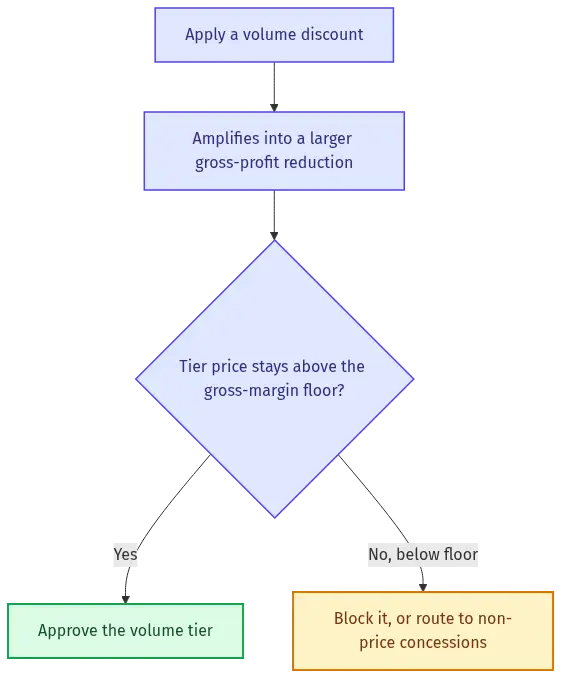
Here’s the principle most founders miss: a price cut is far more expensive than it looks, because it comes straight out of gross profit, not revenue.
Work through it. Suppose your SaaS product carries a 75% gross margin — for every $100 of revenue, $75 is gross profit and $25 is cost-to-serve (hosting, support, third-party APIs embedded in the product). Now you offer a 20% volume discount to land a bigger deal.
- A $100/month subscription becomes $80/month.
- Your cost-to-serve doesn’t change — it’s still $25.
- Your gross profit drops from $75 to $55.
That 20% headline discount just cut your gross profit by 27% ($75 → $55). The discount looks like a 20% concession on the price tag, but on the number that actually matters — the profit you keep — it’s a 27% hit. The lower your gross margin to begin with, the more violent this leverage gets. At a 60% gross margin, a 20% price cut takes gross profit from $60 to $40 — a 33% reduction.
This is why the “you need to sell 38% more to break even on a 5% price cut” rule of thumb exists: discounts compound against you through the margin. A volume discount only makes sense if the incremental volume it unlocks more than covers the gross profit it surrenders on units you would have sold anyway.
| Headline Volume Discount | Price ($100 base) | Gross Profit at 75% Margin | Gross Profit Lost |
|---|---|---|---|
| 0% | $100 | $75 | — |
| 10% | $90 | $65 | 13% |
| 20% | $80 | $55 | 27% |
| 30% | $70 | $45 | 40% |
| 40% | $60 | $35 | 53% |
Read the right-hand column. A 40% volume discount — the kind of number that gets thrown around to win a marquee logo — wipes out more than half of your gross profit on that account. For that deal to be margin-accretive rather than margin-dilutive, the customer has to buy more than twice the volume they otherwise would have. That’s a high bar, and most “volume” deals don’t clear it.
The discipline here is simple to state and hard to practice: set a gross margin floor and never let a volume tier breach it. Decide, before any negotiation, the lowest per-unit gross margin you will accept — say 65% — and back-calculate the deepest discount that floor allows. When a customer pushes past it, you say no, or you trade the discount for something that protects your economics: a longer contract term, an annual prepayment, a case study, an expansion commitment. Price is the easiest thing to give away and the hardest to claw back.
How Volume Pricing Changes Your LTV and Payback Math
A volume discount doesn’t just dent this month’s gross profit — it ripples through the metrics acquirers and investors use to value your company. Two in particular move: Customer Lifetime Value (LTV) and CAC Payback Period.
LTV is driven by gross-margin-adjusted revenue:
LTV = ARPA × Gross Margin % × Average Customer Lifespan
Where ARPA is Average Revenue Per Account (monthly) and Average Customer Lifespan = 1 / Monthly Churn Rate. When a volume discount lowers ARPA and the gross margin embedded in that revenue, it compresses LTV on two axes at once. A 20% volume discount that drops a $1,000/month account to $800/month, at 75% gross margin and a 24-month average lifespan, takes LTV from $18,000 to $14,400 — a $3,600 reduction in the lifetime value of that customer, even though they’re “bigger.”
The CAC Payback Period — how many months of gross profit it takes to recover what you spent acquiring the customer — moves the wrong way too:
CAC Payback Period = CAC / (ARPA × Gross Margin %)
Lower ARPA means lower monthly gross profit, which means it takes longer to pay back the same acquisition cost. If your volume discount stretches payback from 12 months to 15 months, you’ve made the account more capital-intensive to acquire — you’re fronting more cash for longer before the customer turns profitable.
The point isn’t that volume pricing is bad. The point is that it’s a lever connected to your most important metrics, and pulling it without modeling the downstream effect on LTV and payback is how founders end up “growing” into worse unit economics. For the full picture of how these numbers fit together, see our guide to SaaS unit economics and the deeper mechanics of calculating LTV for SaaS.
When Volume Pricing Belongs in Your Business — and When It Doesn’t
Volume pricing is a tool, not a default. It fits some businesses and actively harms others. Here’s the decision framework.
Use Volume Pricing When:
- Your cost-to-serve genuinely falls per unit at scale. If serving 500 seats costs you meaningfully less per seat than serving 50 — because of infrastructure efficiencies or amortized support — then a lower per-unit price still protects your margin. The discount is sharing a real cost saving, not just giving away profit.
- You sell to buyers making a single large commitment. Enterprise procurement teams negotiating one big contract respond well to a clean, all-units volume discount. It’s simple, it’s defensible internally, and it closes deals.
- Volume is the primary lever of value. If your product’s value scales directly with quantity (transactions processed, data stored, messages sent), volume pricing aligns price with the thing the customer cares about.
Avoid Volume Pricing When:
- It erodes margin without unlocking incremental volume. If a customer would have bought the same quantity anyway, a volume discount is pure margin leakage. You discounted units you’d have sold at full price.
- You sell a premium or differentiated product. Discounting trains the market to see your product as a commodity. If you’ve built real pricing power — the ability to raise prices and keep customers — volume discounting actively undermines it. Many founders are priced below what the market would bear; reflexive volume discounts make that worse.
- Your buyers have uneven or unpredictable usage. Customers whose demand swings month to month are poorly served by a model that rewards crossing a threshold. They’ll churn or game the tiers. Graduated tiered pricing serves them better.
What to do if volume pricing isn’t a fit: you still have strong alternatives that grow account value without surrendering margin. Tiered pricing (marginal, not all-units) captures expansion while protecting your early units. Seat-based or usage-based pricing ties revenue to value delivered. Annual prepayment discounts trade a smaller, one-time concession for cash up front and lower churn. And the highest-leverage move of all — for most SaaS companies — is improving retention and expansion so your existing base grows on its own, which brings us to the metric that volume pricing should never be allowed to damage.
Protect Net Revenue Retention Above All
Here’s the strategic frame that ties this together. The single metric that most determines a SaaS company’s valuation ceiling is Net Revenue Retention (NRR) — the percentage of recurring revenue you retain and grow from your existing customer base, after expansion, contraction, and churn.
NRR = (Starting MRR + Expansion MRR − Contraction MRR − Churned MRR) / Starting MRR × 100%
NRR above 100% means your existing customers generate more revenue over time without you acquiring anyone new — the closest thing to compounding growth a SaaS business has. NRR below 100% means you’re decaying, running on a treadmill just to stay flat.
Volume pricing intersects NRR directly. When an expanding customer crosses a volume threshold and their entire account reprices downward, that retroactive discount registers as contraction — even though the customer is buying more. You can engineer a situation where a growing customer lowers your NRR. That’s the volume pricing cliff showing up at the portfolio level, and it’s exactly the kind of structural drag that caps a company’s multiple at exit.
The discipline is to design your volume tiers so that expansion always increases the account’s total contribution — never decreases it. If a customer buying more can ever reduce your revenue from them, you’ve built a model that fights your own retention. Pair smart pricing with the fundamentals in our reduce SaaS churn playbook and our deep dive on net revenue retention, and you protect the metric that protects your valuation.
For external benchmarks on where healthy SaaS gross margins and retention sit, KeyBanc’s annual SaaS survey and OpenView’s SaaS benchmarks are the most-cited primary sources operators reference.
A Worked Example: Designing a Margin-Safe Volume Model
Let’s pull it all together with a realistic scenario. You run a $10M ARR SaaS company. Your product is priced at $100 per seat per month at list, and your blended gross margin is 78%. A prospect wants 300 seats and is pushing hard for a discount.
Step 1 — Set the floor. You decide your gross margin floor is 68% — you will not let any account fall below it. At $100/seat and 78% margin, your cost-to-serve is $22/seat. A 68% margin floor means the lowest price you can accept is $22 / (1 − 0.68) = $68.75/seat. That’s the deepest discount on the table: about 31% off list.
Step 2 — Build the model marginally, not all-units. Rather than reprice all 300 seats, you structure it as tiered bands so early seats hold full price and the cliff never appears:
| Seat Band | Price Per Seat | Margin at $22 cost |
|---|---|---|
| 1–100 | $100 | 78% |
| 101–250 | $85 | 74% |
| 251–500 | $72 | 69% |
Step 3 — Check the blended margin. For the 300-seat customer: (100 × $100) + (150 × $85) + (50 × $72) = $10,000 + $12,750 + $3,600 = $26,350/month. Their blended price is $87.83/seat, and the blended gross margin is ($87.83 − $22) / $87.83 = 75% — comfortably above your 68% floor.
Step 4 — Confirm no cliff. A customer at 100 seats pays $10,000. A customer at 101 seats pays $10,000 + $85 = $10,085. The bill always rises. No cliff, no gaming, no contraction risk when the account expands.
Compare that to the naive all-units volume model where crossing into the 251+ band would have repriced all 300 seats to $72 — yielding 300 × $72 = $21,600/month, a blended 69% margin, and a guaranteed cliff at every threshold. The margin-safe design earns $4,750 more per month from the same customer ($26,350 vs. $21,600) while eliminating the cliff entirely. That’s $57,000 a year, on one account, from getting the structure right.
Frequently Asked Questions
What is volume pricing in simple terms?

Volume pricing is a model where the price per unit drops as the total quantity a customer buys increases, with the lower price typically applying to all units once a threshold is crossed. The more a customer buys, the lower their per-unit cost — the model rewards bulk purchases.
What’s the difference between volume pricing and tiered pricing?
Under volume pricing, crossing a threshold reprices the customer’s entire quantity at the new lower rate. Under tiered pricing, each band of units is priced separately, so only the units inside a given band get that band’s rate while earlier units keep their original price. Tiered pricing protects more margin and avoids the pricing cliff.
What is the pricing cliff in volume pricing?
A pricing cliff is a point where a customer can lower their total bill by buying more, because crossing a threshold retroactively discounts every unit. It incentivizes customers to game the threshold and transfers margin to them at exactly the wrong moment. The fix is to apply discounts marginally — only to units above each threshold — so the total bill always rises with quantity.
Does volume pricing hurt gross margin?
It can, significantly. Because a price cut comes out of gross profit rather than revenue, a 20% volume discount on a product with a 75% gross margin reduces gross profit by 27%, not 20%. Always set a gross margin floor and model the margin impact of every tier before launching it.
When should a SaaS company use volume pricing?
Use it when your cost-to-serve genuinely falls per unit at scale, when buyers are making a single large commitment, or when volume is the primary driver of value. Avoid it when it erodes margin without unlocking incremental volume, when you sell a premium or differentiated product, or when buyers have unpredictable usage — in those cases, tiered or usage-based pricing serves you better.
Is volume pricing the same as a volume discount?
In practice, yes — “volume pricing” and “volume discount” both refer to lowering the per-unit price as quantity rises. The important nuance is how the discount applies: all-units (true volume pricing, which creates cliffs) versus marginal/incremental (effectively tiered pricing, which protects margin). The label matters less than the mechanic underneath it.