

The first VP of Sales is the single most expensive mis-hire a first-time SaaS CEO makes. SaaStr’s Jason Lemkin, who has watched hundreds of these hires up close, calls it the #1 most common misfire in SaaS — and notes that the majority of first VP Sales don’t make it twelve months. Roughly 70% don’t. You’ll burn six figures in salary, blow nine to twelve months of runway, demoralize the reps you already have, and end up exactly where you started — except now you’re gun-shy about the one hire that’s supposed to take selling off your plate.
Here’s the part nobody tells you: the candidate almost never fails. You set the hire up to fail. You hire a VP of Sales to fix a problem only you can fix first — an un-repeatable sales process. This article is the version of the VP Sales conversation I have with the CEOs I coach: what the role actually does, the one prerequisite before you hire, the ARR signals that tell you it’s time, how to interview for it, what to pay, and what the first 90 days should look like. By the end you’ll know whether your next move is to post the job — or to go close five more deals yourself.
What a VP of Sales Actually Does
Strip away the title inflation and a VP of Sales does one thing: builds a sales machine that produces revenue predictably, without the founder in every deal. Everything else is a subset of that.
In practice the role covers four jobs. The mistake first-time CEOs make is assuming a single hire is equally good at all four — they almost never are.
| Responsibility | What it means day-to-day | What "good" looks like |
|---|---|---|
| Process & playbook | Codify how deals get won into steps anyone can run | A new rep can follow it without shadowing the founder |
| Pipeline & forecasting | Own the number; call the quarter within ~10% | Forecast accuracy you can take to a board |
| Hiring & ramping reps | Recruit, onboard, and ramp account executives (AEs) | New reps hit quota inside the ramp window |
| Coaching & performance | Raise the floor of the whole team, not just close deals | Bottom reps improve; top reps don't leave |
Notice what’s not on that list: personally closing your biggest deals. A VP of Sales who’s still carrying a bag a year in isn’t scaling your sales org — they’re an expensive senior rep. That distinction is the whole game, and it’s why the prerequisite below matters more than anything else in this article.

The One Prerequisite: A Repeatable Sales Process You Validated Yourself
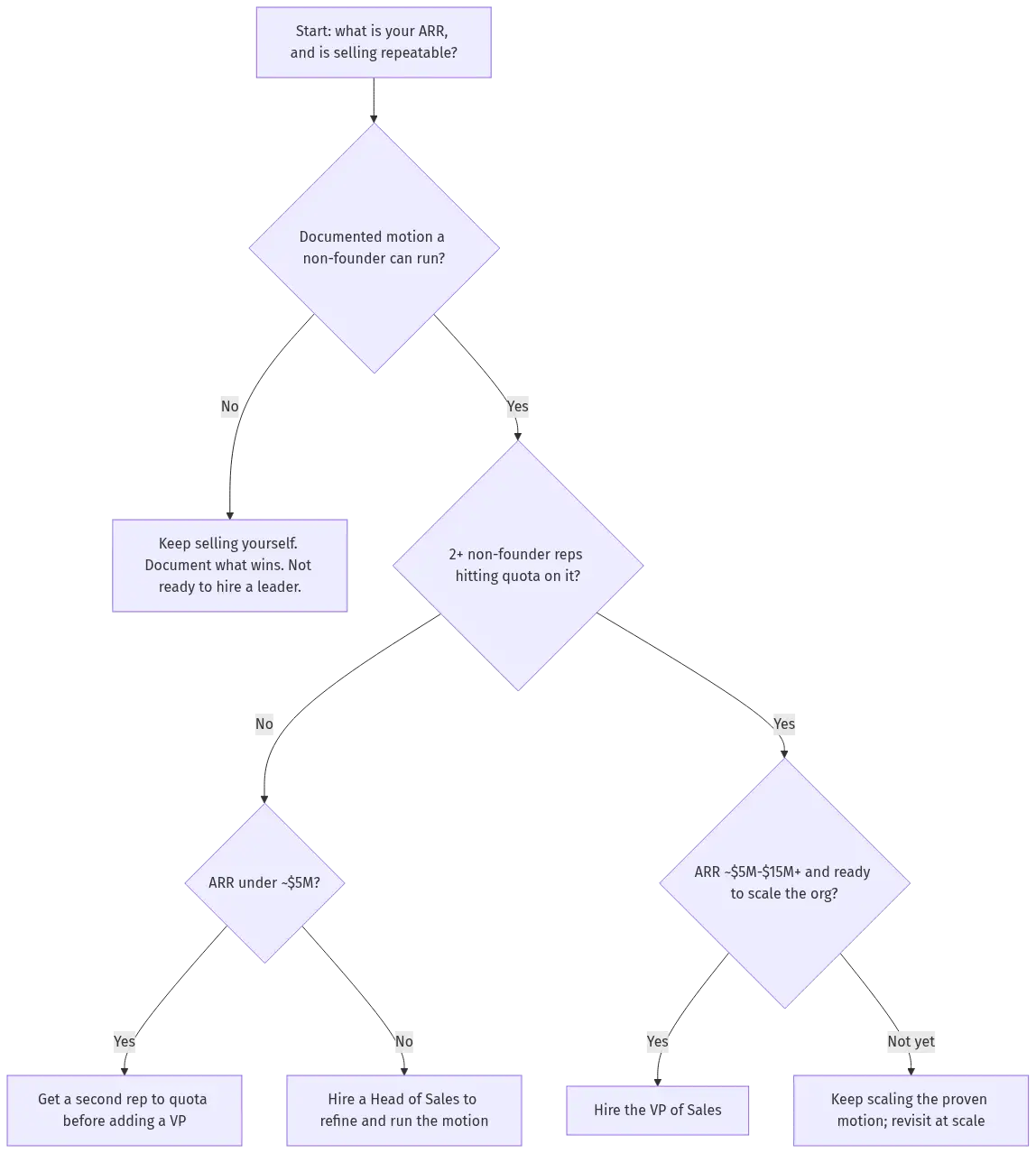
Before you hire a VP of Sales, you need a repeatable sales process — and you need to have validated it by closing deals with your own hands.
This is the contrarian spine of the entire VP Sales decision, so let me be blunt about it: most sales leaders are wired to scale what already works, not to invent what works from scratch. That’s not a knock on them. It’s their job. A great VP of Sales takes a motion that produces, say, one closed deal for every five qualified opportunities and gets it to produce reliably across ten reps. What they cannot do — what almost no one in that role can do — is figure out whether selling your product even works when you yourself haven’t cracked it.
Early sales are founder-led. You close on reputation, network, and the fact that you can answer any technical question in the room. That gets a lot of SaaS companies to $1M–$2M ARR. But none of that transfers. You can’t clone yourself, and you can’t hand “be the founder” to a VP as a playbook.
So the real prerequisite isn’t “have some sales.” It’s this:
A repeatable sales process = a documented motion that a person who is not you can run and still win deals at a predictable rate.
If you’ve only ever won deals because they were your deals, you don’t have a sales process. You have a founder. And handing that to a VP of Sales is like handing someone a recipe that just says “cook it like I do.”
There is one exception, and it’s rare. A small number of sales leaders are what I call sales R&D mad scientists — people who genuinely can invent a motion from nothing through experimentation and first-principles thinking. They think more like a CEO than a VP. They exist, but they’re maybe one in fifty of the people who’ll apply for your role, they’re expensive, and you can’t reliably identify them with a normal interview. Betting your runway on hiring one is not a plan. Building the process yourself first is.
If you want the deeper mechanics of building that motion before you hand it off, I’ve written the full breakdown in why most SaaS startups hire the wrong VP of Sales — read it before you post the job.

When to Hire a VP of Sales: The ARR and “2 Reps” Signals
“When should I hire a VP of Sales” is really two questions: Is the process ready? and Is the company big enough to support the role? You need both. Here’s how the signals line up by stage.
| Stage | ARR range | Sales reality | Right move |
|---|---|---|---|
| Founder-led | Under ~$2M | You close everything; no documented motion | Keep selling. Document what works. |
| Early team | ~$2M–$5M | First reps hired; motion is forming but founder-dependent | Sales Manager or Head of Sales, not a VP |
| Scaling | ~$5M–$15M | 2+ reps hitting quota on a documented motion | Hire the VP of Sales |
| Scaled | $15M+ | Multi-segment, multi-channel sales org | VP or CRO, plus second-line leaders |
The ARR ranges are guardrails, not gospel — what actually gates the decision is the readiness test, not the revenue. The cleanest single signal I know is this:
The “2 reps making quota” test: before you hire a VP of Sales, at least two non-founder reps should be hitting quota on the same documented motion.
Why two, and why non-founder? Because two reps succeeding on the same playbook is the first real evidence that your motion works because of the process, not because of the person. One rep hitting quota could be a hero — a study-the-outliers situation where one talented AE is carrying the number on raw ability. Two reps hitting the same number on the same motion is a system. A VP of Sales scales systems. They cannot scale heroes, and they certainly can’t scale you.
If you can’t pass the 2‑reps test yet, hiring a VP of Sales is premature no matter what your ARR is. The fix isn’t a bigger title — it’s getting one more rep to repeat what the first one did.
VP of Sales vs. Head of Sales vs. Sales Manager
These three titles get used interchangeably, and the confusion costs founders real money — you hire one expecting another and the mismatch shows up as a failed hire six months later. They’re different roles for different stages.
| Sales Manager | Head of Sales | VP of Sales | |
|---|---|---|---|
| Primary job | Manage a small team day-to-day | Run sales hands-on, still sells | Build the scalable sales engine |
| Carries a quota? | Sometimes | Usually, partly | No (owns the team number) |
| Right at | ~$1M–$3M ARR | ~$2M–$7M ARR | ~$5M–$15M+ ARR |
| Builds process? | Runs it | Refines it | Owns and systematizes it |
| Reports to | Head of Sales / Founder | Founder / CEO | CEO |
| Comp tier | Lowest | Middle | Highest |
The practical read: if your motion is still forming and you mostly need someone to run reps and tighten what you’ve already figured out, a Head of Sales is the cheaper, lower-risk hire — and it’s the right one for most companies under $5M ARR. The VP of Sales title (and price tag) is for when you have a proven motion and the job is genuinely to build an org around it. Hiring a VP when you needed a Head of Sales is how you end up overpaying for someone who’s bored and underperforming inside two quarters.
How to Interview and Hire a VP of Sales
Most VP Sales interviews test for the wrong thing. They probe charisma and a track record of “scaling a team to $X” — both of which can be borrowed from a company that already had product-market fit, a strong brand, and a working motion. You need to test whether this person can build your engine. Run the candidate through concrete scenarios and listen for how they think, not how they present.
Here are the scenarios I’d put in front of any VP of Sales candidate:
- “Walk me through the last sales process you built from a blank page.” You’re separating builders from inheritors. A candidate who only ever scaled an existing motion will describe optimizing conversion rates and hiring reps. A builder will describe diagnosing why deals were won and lost, then codifying it. If they can’t point to a motion they personally constructed, they may be a great operator of your process — but they won’t fix a process that’s still broken.
- “Two of my reps hit quota and three don’t, on the same playbook. What do you do in your first 30 days?” Listen for diagnosis before action. A strong answer studies the outliers — what are the two doing that the three aren’t? — and works to lift the floor. A weak answer jumps straight to firing the bottom three or rewriting the comp plan.
- “My SaaS sales cycle is 90 days and my CAC payback is 14 months. How does that change how you’d build the team?” This tests whether they think in unit economics or just activity. A VP who doesn’t connect sales motion to Customer Acquisition Cost (CAC) — the fully-loaded cost to win one customer — and payback period will happily spend you into a growth ceiling you can’t outrun.
- “Sell me on why a founder should still be in the room for enterprise deals — or why they shouldn’t.” There’s no single right answer; you’re testing judgment about when founder involvement is leverage versus a crutch. The best candidates have a clear, defensible point of view and adapt it to your stage.
- “Show me how you’d forecast next quarter with the data we have today.” Forecasting discipline is the clearest proxy for whether they’ll give you a number you can run a company on. Vague answers here predict vague forecasts later.
Two more hiring rules that save founders from the 70%-fail trap. First, reference the ramp, not the résumé — call people who reported to this candidate and ask whether new reps actually hit quota under them. Second, weight relevant motion over logo prestige: someone who scaled a self-serve, low-touch motion is often the wrong hire for your enterprise sales motion, and vice versa. The shape of the motion they’ve built has to match the shape of yours.

VP of Sales Compensation: How to Structure the Package
A VP of Sales is paid like a revenue producer, not an executive on salary alone. The package is built around On-Target Earnings (OTE) — total pay if they hit 100% of the number — split between a guaranteed base and a variable bonus tied to team performance.
The convention most SaaS companies land on:
OTE = Base Salary + Variable (commission/bonus), typically a 50/50 split at the VP level.
So a $300K OTE means roughly $150K base and $150K variable, with the variable earned by the team hitting its quota — not by the VP personally closing. That 50/50 ratio is the signal you’re hiring a leader, not a senior rep; an individual contributor’s split skews more heavily to variable (think 40/60 or worse).
Here’s how the package typically scales with company stage. Treat these as illustrative ranges for U.S. B2B SaaS at time of writing — verify against current market data before you make an offer, because comp benchmarks move year to year.
| Company stage | Typical OTE | Base / Variable | Equity |
|---|---|---|---|
| ~$5M ARR | $220K–$280K | 50/50 | 0.5%–1.5% |
| ~$10M ARR | $260K–$340K | 50/50 | 0.3%–0.8% |
| $15M+ ARR | $300K–$400K+ | 50/50 to 60/40 | 0.2%–0.5% |
Two structural details that matter more than the headline number:
- Accelerators above quota. Pay a higher commission rate on bookings over 100% of target — for example, the standard rate up to quota, then 1.5× that rate beyond it. Accelerators align the VP with overachievement instead of sandbagging the number so it’s easy to hit.
- Tie variable to team bookings, not personal deals. If you pay the VP on deals they personally close, you’ve financially incentivized them to keep carrying a bag instead of building the machine. Pay them on the team’s number. The comp plan should make the behavior you want — building a scalable org — the most profitable thing they can do.
One caution on equity: the percentages above are illustrative and depend heavily on your stage, your cap table, and how much cash comp you’re trading against. An earlier-stage company with less cash to offer leans harder on equity; a more established one leans on OTE. Don’t anchor on a number from a blog post — anchor on what makes the total package competitive for the caliber of person you’re trying to land.
The First 90 Days: What Good Looks Like
A VP of Sales who’s still “getting up to speed” at day 90 is a warning sign, not a normal ramp. Here’s the rough shape of a successful first quarter — and what each phase tells you.
| Phase | Focus | Signal of a good hire |
|---|---|---|
| Days 1–30 | Diagnose | Listens to calls, reads won/lost deals, talks to every rep before changing anything |
| Days 31–60 | Stabilize | Owns the forecast, fixes the most obvious process leaks, earns the team's trust |
| Days 61–90 | Build | Ships a documented playbook, has a hiring plan, calls the next quarter with a real number |
The single best 90-day signal isn’t a closed deal — it’s a forecast you’d stake the company’s planning on. When a VP can tell you what next quarter will produce and then hit it within ~10%, you’ve hired someone who’s building a predictable engine. That predictability is the whole point. Once sales is genuinely systematized, the conversation shifts: you stop asking the VP “can we hit the number?” and start asking your finance lead “if we put another dollar of sales spend in, how much comes out?” That’s the end state — sales as a capital-allocation decision, not a heroics problem.
If you want the broader picture of how sales fits into the company’s commercial engine, the SaaS go-to-market strategy framework shows where the VP of Sales sits relative to marketing, product, and customer success.
Failure Modes and Warning Signs
Knowing why VP Sales hires fail is the cheapest insurance you can buy. Here are the patterns that account for most of the 70%.
- You hired before the process was repeatable. The biggest one, by far. You handed a builder’s job to a scaler — or a scaler’s salary to someone now expected to invent the motion. Either way, the mismatch is fatal. This is your failure, not theirs, and no candidate quality fixes it.
- You hired the logo, not the motion. The candidate scaled sales at a company with a strong brand, a mature sales methodology, and product-market fit already in hand. None of that transfers to your stage. Past success at a different motion shape predicts very little.
- You never let go. You hire a VP of Sales and then stay in every deal, override their decisions, and protect your favorite reps. The VP can’t build an engine they don’t actually control. Founder dependency is a multiple-killer at exit, and it shows up first as a VP who quietly disengages.
- You bought a senior rep, not a leader. Six months in, the VP is your top closer and the team is no better than the day they joined. Pleasant to watch, but you’re paying executive comp for individual-contributor output, and the org isn’t getting more predictable.
- You expected miracles on the wrong timeline. A real sales engine takes two-to-four quarters to show up in predictable bookings. If you fire at month four because Q1 was soft, you’ll churn through VPs forever and never let any motion compound.
The through-line across all five: the VP of Sales hire only works when you’ve done your job first. Build the repeatable motion, prove it with two reps, then hire someone to scale it. Do it in that order and the role does what it’s supposed to. Do it backwards and you join the 70%.
Frequently Asked Questions

What does a VP of Sales do in a SaaS company?
A VP of Sales builds a scalable, predictable sales engine: they own the playbook, the pipeline and forecast, rep hiring and ramping, and team coaching. The defining feature is that they make revenue predictable without the founder in every deal. If they’re still personally closing your biggest deals a year in, you’ve hired a senior rep, not a VP of Sales.
When should a SaaS startup hire a VP of Sales?
When you have a documented, repeatable sales process and at least two non-founder reps hitting quota on it — usually somewhere around $5M–$15M ARR. ARR is a guardrail; the real gate is readiness. If you can’t pass the “2 reps making quota” test, a VP Sales hire is premature regardless of revenue, and a Head of Sales is the better, lower-risk move.
What’s the difference between a VP of Sales and a Head of Sales?
A Head of Sales runs sales hands-on, often still carries some quota, and refines an existing motion — right for roughly $2M–$7M ARR. A VP of Sales owns and systematizes the whole engine, doesn’t carry an individual quota, and is right for roughly $5M–$15M+ ARR. Hiring a VP when you needed a Head of Sales means overpaying for someone who’ll be underused.
How much should I pay a VP of Sales?
Most U.S. B2B SaaS VPs of Sales land at $220K–$400K+ in On-Target Earnings (OTE), typically a 50/50 split between base salary and variable, plus equity that shrinks as the company matures. Tie the variable to team bookings with accelerators above quota — never to deals the VP personally closes. Verify against current market data before making an offer.
Why do so many VP of Sales hires fail?
Roughly 70% don’t last twelve months, and the most common reason is that the CEO hired before the sales process was repeatable — handing a scaling job to someone now expected to invent the motion from scratch. The other big failure modes: hiring for logo prestige over motion fit, never actually letting the VP own sales, and firing too early before a real engine can compound.
Can I just promote my best rep to VP of Sales instead?
Sometimes, but be careful. Your best rep is, by definition, a hero — and the VP role is about building systems, not being the hero. Promoting a top closer who can’t coach, forecast, or codify a playbook usually costs you your best individual contributor and leaves the leadership gap unfilled. Promote only if they’ve shown they can lift other reps’ numbers, not just their own.