

Most SaaS founders I work with between $5M and $15M Annual Recurring Revenue (ARR) can recite their ARR, their churn, and their CAC payback from memory — but go blank when I ask what their ARPU is. ARPU (Average Revenue Per User) is the average recurring revenue a single user generates over a period, and it is the quiet lever that decides whether your next 1,000 users make you richer or just busier. A company can double its user count and watch revenue grow more slowly than headcount, support load, and infrastructure cost — and the only metric that exposes that trap early is ARPU. If you are not watching it, you are flying a growth plan blind to whether each new user is actually worth acquiring.
Here is the part most people get backwards. They treat ARPU as a vanity number to report, when it is really a constraint that governs your entire go-to-market. Your ARPU sets the ceiling on what you can spend to acquire a user, how much human touch you can afford to give them, and which pricing model is even viable. A $40/month ARPU and a $400/month ARPU are not the same business with different decimal points — they are two completely different companies that happen to both call themselves SaaS.
This guide covers what ARPU actually measures, the critical distinction between ARPU and ARPA that trips up most B2B founders, the exact formula and the mistakes that corrupt it, a worked example you can hold against your own dashboard, the benchmark ranges that matter, and — most importantly — the specific levers that raise ARPU without you having to find a single new customer.

What ARPU Actually Measures
Average Revenue Per User (ARPU) is the average recurring revenue generated by a single user over a defined period — usually a month. It answers one blunt question: on average, how much is each user worth to you per month?
The word “recurring” is doing the heavy lifting, exactly as it does everywhere else in SaaS. ARPU is built from your subscription revenue — the predictable, repeatable revenue you can count on next month. One-time fees, implementation charges, and professional services do not belong in it. If you let a $20,000 implementation fee leak into the period’s revenue, you will report an ARPU that describes the first invoice rather than the ongoing relationship, and you will badly overstate how valuable each user really is.
The word “user” is doing even more work — and this is where the metric gets genuinely tricky for B2B companies. A “user” is a single seat, login, or individual person inside a customer organization. That is a different unit from an “account,” which is the whole paying company. When you sell to a 40-person company on a per-seat plan, that is one account and forty users. The distinction sounds pedantic until you realize it changes the metric by a factor of forty — and changes which decisions the number is good for. We will pull that apart in the next section, because getting it wrong is the single most common ARPU mistake in B2B SaaS.
For now, hold the core idea: ARPU isolates the economic value of one unit of consumption (a user) so you can ask whether that unit is growing more valuable over time, holding steady, or quietly shrinking while your user count climbs.
ARPU vs. ARPA: The Distinction That Actually Matters
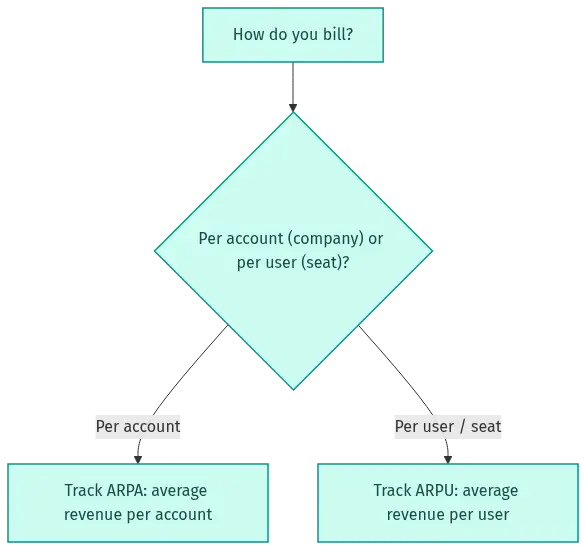
This is the most important section in the article, so I am going to be precise about it. In our house definitions, the primary account-level revenue metric is ARPA (Average Revenue Per Account) — the average recurring revenue per paying account. ARPU (Average Revenue Per User) is the per-user variant you reach for specifically when your billing unit is the individual user, such as a per-seat plan. They are siblings, not synonyms, and they answer different questions.
| Metric | Denominator | The Question It Answers | Best For |
|---|---|---|---|
| ARPA (Average Revenue Per Account) | Total active accounts (paying companies) | How much is a typical customer worth per month? | B2B planning, sales economics, account-level CAC |
| ARPU (Average Revenue Per User) | Total active users (seats/individuals) | How much is a typical seat worth per month? | Per-seat pricing, B2C, expansion-by-user analysis |
The reason the distinction is not academic: in B2B, one account can contain many users, so the two metrics can differ by an order of magnitude or more. Consider a company billing 200 accounts that together hold 4,000 seats. If those accounts generate $600,000 in Monthly Recurring Revenue (MRR), the account-level view (ARPA) is $600,000 ÷ 200 = $3,000 per account per month, while the user-level view (ARPU) is $600,000 ÷ 4,000 = $150 per user per month. Same company, same revenue, same month — two numbers that are 20× apart. Quote the wrong one in a board meeting and every downstream estimate built on it (CAC budget, payback, expansion targets) inherits the error.
So which should you anchor on? Here is my rule:
- If you bill by the account (a flat platform fee, a tier the whole company shares), ARPA is your primary planning metric. The account is the unit you acquire, the unit you sell to, and the unit that churns. Your CAC is spent per account, so the revenue you compare it against should also be per account.
- If you bill by the seat (price scales with the number of users), ARPU becomes the sharper instrument, because each additional user is a discrete unit of revenue and the path to growth runs through getting more seats live inside each account.
- Most B2B SaaS companies between $5M and $15M ARR should watch both — ARPA to understand the economics of landing a customer, and ARPU to understand whether you are successfully expanding inside the accounts you already have. When ARPA is rising but ARPU is flat, you are landing bigger logos but not deepening seat penetration. When ARPU is rising but ARPA is flat, individual seats are getting more valuable but your accounts are shrinking in headcount. Those are different problems with different fixes, and only watching both metrics tells them apart.
If you take one thing from this article, take this: ARPU and ARPA are not interchangeable, and the choice of which to lead with is dictated by your billing unit, not by which number sounds bigger. (For broader B2C-style products billed straight to individuals, ARPU is simply the natural metric — there is no separate “account” layer to worry about.)
The ARPU Formula
There is one formula, and it is mercifully simple — which is exactly why people get sloppy with the inputs.
ARPU = Total Recurring Revenue in the Period ÷ Total Active Users in the Period
If you work in monthly terms (the default), that becomes:
Monthly ARPU = MRR ÷ Total Active Users
And the account-level sibling, for contrast, is the same shape with a different denominator:
Monthly ARPA = MRR ÷ Total Active Accounts
A few precision points that separate a clean number from a misleading one:
- Use recurring revenue in the numerator, not total revenue. Strip out one-time implementation fees, setup charges, and professional services. Those are real money, but they are not recurring, and folding them in inflates ARPU and makes every ratio built on it — CAC payback, LTV/CAC — look healthier than it is.
- Match the period on both sides. Monthly MRR over monthly active users gives monthly ARPU. If you want annual ARPU, use ARR in the numerator (ARR = MRR × 12) and keep the user count consistent. Do not divide a monthly revenue figure by an annual user count or you will produce a number that means nothing.
- Define “active user” once and hold it. Is a deactivated-but-still-paid-for seat a user? Is a free guest seat a user? There is no universal right answer, but there is a universal wrong move: changing the definition between periods so the trend line lies to you. Pick a definition, write it down, and lock it.
- Decide paid-only vs. all-users deliberately. Some teams compute ARPU over paying users only; others over all users including free-tier accounts. Paying-user ARPU tells you how much you extract from a monetized user; all-user ARPU (sometimes called ARPU blended with free) tells you how well your free-to-paid funnel converts. Both are legitimate — just label which one you are showing, because they can differ wildly for a freemium product.
The formula is trivial. The discipline around the inputs is what makes the metric trustworthy.
A Worked Example: ARPU at an $8M ARR Company
Numbers make this concrete. Take a B2B SaaS company at $8M ARR — squarely in the range where these decisions bite. That is about $666,667 in MRR ($8,000,000 ÷ 12). Suppose the company bills on a per-seat model and currently has 250 paying accounts holding 5,500 active paid seats between them.
The two headline numbers fall straight out of the formulas:
Monthly ARPU = $666,667 ÷ 5,500 = $121.21 per user
Monthly ARPA = $666,667 ÷ 250 = $2,666.67 per account
So the average account pays about $2,667/month, and the average seat inside those accounts is worth about $121/month. The ratio between them — $2,666.67 ÷ $121.21 = 22.0 — is just the average number of seats per account (5,500 ÷ 250 = 22.0). That ratio is itself a useful number: it tells you, on average, how deep you have penetrated each customer’s organization.
Now watch what the blended ARPU hides. Suppose the book actually breaks down like this:
| Segment | Accounts | Paid Seats | MRR | ARPU (per seat) |
|---|---|---|---|---|
| SMB | 180 | 1,440 | $144,000 | $100.00 |
| Mid-market | 60 | 2,400 | $312,000 | $130.00 |
| Enterprise | 10 | 1,660 | $210,667 | $126.91 |
| Total | 250 | 5,500 | $666,667 | $121.21 |
The blended ARPU of $121.21 does not describe a single real user. SMB seats come in at $100, mid-market seats at $130, enterprise seats at about $127. The variance is not huge in this particular book — but the seat counts per account are wildly different: SMB averages 8 seats per account (1,440 ÷ 180), mid-market 40 (2,400 ÷ 60), enterprise 166 (1,660 ÷ 10). That means a 5% lift in seat-level ARPU is worth far more in the enterprise segment, where each account carries 166 seats, than in SMB, where it carries 8. If you are going to invest in raising ARPU, the segmented view tells you where a point of improvement actually moves the most money.
This is the habit that matters most with ARPU: segment it. Calculate it separately by deal size, plan tier, vertical, and acquisition channel. In my experience there are always meaningful variances — and the blended average is the number most likely to lead you astray precisely because it looks so clean on a slide.
One more layer, to show how a mistake propagates. Suppose the enterprise segment charges a one-time onboarding fee equal to 25% of its annual recurring value, and a careless analyst lets that fee land in the month it was billed. Enterprise MRR for that month would appear as $210,667 × 1.25 = $263,333, pushing reported enterprise ARPU to $263,333 ÷ 1,660 = $158.63 instead of the correct $126.91 — a 25% overstatement that would tell you enterprise seats are far more valuable than they are, and tempt you to overspend acquiring them.

ARPU Benchmarks — and Why the Range Is So Wide
Founders always want a single “good” ARPU number. There isn’t one, and anyone who hands you a universal target is selling something. ARPU is almost entirely a function of who you sell to and how you price. A self-serve product billed to individuals and an enterprise platform billed per seat can both be excellent businesses with ARPUs two orders of magnitude apart.
That said, rough bands are useful for sanity-checking where you sit. Here is a directional map for monthly per-user ARPU by segment:
| Segment | Typical Monthly ARPU Range | What Drives It |
|---|---|---|
| Self-serve / individual (B2C-style) | ~$20–$50 | Low-touch, credit-card signup, single-user plans |
| SMB B2B | ~$50–$200 | Per-seat plans, small teams, light onboarding |
| Mid-market B2B | ~$200–$2,000 | Larger seat counts, tiered features, some sales touch |
| Enterprise B2B | ~$2,000–$10,000+ | High-value seats, premium tiers, full sales motion |
A point on these numbers: specific ARPU bands and benchmarks shift with market conditions, pricing-model trends, and how each source defines a “user.” The figures here are illustrative and meant to show relative differences between segments — not fixed thresholds. Verify current benchmarks against a recent source before you set targets. The right question is never “is my ARPU high?” in the abstract — it is “is my ARPU high enough to support the way I acquire and serve users?” A $40 ARPU is outstanding for a self-serve product with near-zero acquisition cost and disastrous for a business that puts a salesperson on every deal.
External benchmark publications can help you locate your segment. Paddle’s ARPU resource is a solid primer on the metric and its variants, and Bessemer Venture Partners’ scaling guidance for cloud businesses puts per-user economics in the broader context of building toward a nine-figure outcome.
How ARPU Connects to Unit Economics and Valuation
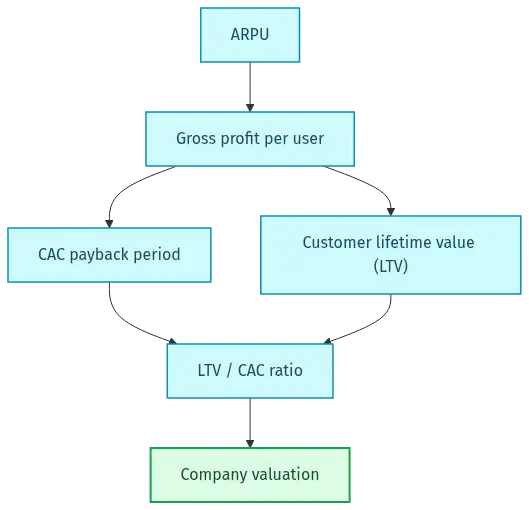
ARPU is not a standalone vanity stat. It feeds directly into the unit economics that determine whether you can scale and what your company is worth at exit. Trace the connections and you will never treat it as a reporting afterthought again.
Start with Customer Acquisition Cost (CAC) payback. The fully loaded cost to acquire a user has to be recovered out of the gross profit that user generates — and ARPU is the top of that gross-profit stack. A higher ARPU means each user throws off more monthly gross profit, which shortens payback and lets you spend more to acquire the next one. Concretely, with our $121.21 ARPU and a 75% gross margin, each user contributes $121.21 × 0.75 = $90.91 of gross profit per month. If it costs $545 in fully loaded sales and marketing to acquire that user, the CAC payback period is $545 ÷ $90.91 = 6.0 months — fast enough to recycle capital aggressively. Raise ARPU to $150 at the same margin and the same $545 CAC now pays back in $545 ÷ ($150 × 0.75) = 4.8 months. You did not touch acquisition spend; you simply made each user worth more, and the whole engine sped up.
It also feeds Lifetime Value (LTV). In its decision-useful form, LTV = ARPU × Gross Margin % × Average Customer Lifespan, where average lifespan is 1 ÷ monthly churn. Take the same $121.21 ARPU, 75% margin, and a 2% monthly churn rate. Average lifespan is 1 ÷ 0.02 = 50 months, so LTV per user is $121.21 × 0.75 × 50 = $4,545. Against a $545 CAC, that is an LTV/CAC ratio of $4,545 ÷ $545 = 8.3× — well above the 3.0× benchmark for healthy unit economics, which signals you can likely afford to invest more aggressively in growth. (Note that 2% monthly churn does not mean 24% annual churn; churn compounds, so annual churn is 1 − (1 − 0.02)¹² = 21.5%. Always compound it — never multiply by twelve.)
And at exit, ARPU shapes the conversation in two ways. First, a rising ARPU is direct evidence you have pricing power and an expanding relationship with each user — both of which read as durable, high-quality recurring revenue, and quality of revenue is one of the largest levers on the valuation multiple. Second, growing ARPU lets you grow revenue faster than user count, which means faster growth without a proportional increase in support and infrastructure load — exactly the margin-expansion story acquirers pay a premium for. For the full picture of how recurring revenue translates into a sale price, see the guide on SaaS company valuation.
The Five Mistakes That Distort ARPU
Each of these is a real money mistake, not a rounding error — and each one I have watched quietly corrupt a real company’s growth decisions.
- Letting one-time fees leak into the numerator. Implementation, setup, and services fees inflate ARPU and make every downstream ratio look healthier than it is. Use recurring revenue only; keep one-time fees out.
- Confusing users with accounts. Reporting ARPA and calling it ARPU (or vice versa) is the cardinal B2B sin. The two can differ by 20× or more. Decide which unit your billing model makes primary, label it correctly, and never let the two numbers get swapped in a deck.
- Using one blended ARPU for a multi-segment business. A company-wide average hides the truth when your book spans self-serve and enterprise. The blended number is useless for deciding where to invest. Segment by tier, deal size, vertical, and channel.
- Mixing free and paid users without saying so. All-user ARPU and paying-user ARPU answer different questions and can differ enormously for a freemium product. Pick one for the decision at hand and label it; do not let the denominator silently shift between reports.
- Mismatching the period. Dividing monthly revenue by an annual user count (or annual revenue by a monthly count) produces a meaningless number that nonetheless looks authoritative. Match the period on both sides of the formula, every time.
How to Raise ARPU Without Finding New Customers
This is where ARPU stops being a metric and becomes a growth strategy. Raising ARPU is one of the highest-leverage moves available to a SaaS company between $5M and $15M ARR, because it grows revenue without the cost and risk of acquiring a single new logo. Every dollar of ARPU lift drops onto the user base you already have. Here are the levers, roughly in order of how reliably they work.
Raise prices on a base that won’t leave. The bluntest lever is also the most under-used. Most founders price below what the market will bear because they have never tested otherwise. If you can raise prices and keep your users, you have pricing power, and a price increase flows almost entirely to ARPU and gross profit. Test it on new customers first, watch conversion, then roll it to renewals. Even a 10% increase that holds is a 10% ARPU lift you did not have to earn through acquisition.
Build a tiered structure that pulls users up. A single flat price leaves money on the table from the users who would happily pay more for more. A good-better-best tier ladder lets users self-select into higher-value plans as their needs grow, mechanically raising ARPU over time as your base matures into the upper tiers. The tiers should be built around the value metric that scales with how much the customer gets out of the product — seats, usage, advanced features — so that growing customers naturally migrate upward.
Drive seat expansion inside existing accounts. On a per-seat model, ARPU and account depth grow when you get more of each customer’s team actually using the product. This is the lever where ARPU and net revenue retention meet: a customer-success motion that drives adoption across an organization adds seats, lifts ARPU, and pushes NRR above 100% — the threshold where your existing base grows on its own without new acquisition. Watch ARPU and NRR together; rising ARPU driven by genuine expansion is one of the strongest signals a SaaS business can show.
Add usage-based or consumption components. Layering a usage-based element on top of a subscription lets revenue grow as customers get more value, without a renegotiation every time. Done well, it ties your ARPU directly to customer success: the more they use, the more they pay, the more committed they become. Be precise about which part of that revenue is genuinely recurring versus variable when you report it.
Cross-sell adjacent products and premium features. Once a customer trusts you, selling them an additional module or a premium capability is far cheaper than acquiring a new customer for that revenue. Each successful cross-sell raises the revenue per user without changing the user count — a direct ARPU lift that also deepens switching costs and makes you harder to displace.
The through-line across all five levers: ARPU growth is expansion-driven growth, and expansion-driven growth is the most capital-efficient growth there is. Fix your retention first — pouring effort into ARPU while users churn out the bottom is wasted motion — but once churn is under control, raising ARPU is very often the highest-return project on the table.
Frequently Asked Questions About ARPU
What is ARPU in SaaS?
ARPU (Average Revenue Per User) is the average recurring revenue a single user generates over a period, usually a month. You calculate it by dividing recurring revenue (MRR) by the number of active users in that period. It tells you how much economic value each individual seat or user contributes, which in turn governs how much you can afford to spend acquiring and serving them.
What is the difference between ARPU and ARPA?
ARPU divides revenue by users (individual seats or people); ARPA (Average Revenue Per Account) divides revenue by accounts (paying companies). In B2B, one account often contains many users, so the two numbers can differ by 20× or more. Use ARPA as your primary planning metric when you bill per account, and ARPU when you bill per seat. Many B2B companies watch both — ARPA for the economics of landing a customer, ARPU for expansion inside accounts.
How do you calculate ARPU?
Divide your total recurring revenue for the period by the number of active users in that period: ARPU = MRR ÷ Total Active Users for a monthly figure. Use recurring revenue only (exclude one-time implementation and services fees), match the period on both sides of the formula, and hold your definition of “active user” constant between periods so the trend is comparable.
Should ARPU include free users?
It depends on the question you are answering. Paying-user ARPU (paying users only in the denominator) tells you how much you extract from a monetized user. All-user ARPU (including free-tier users) tells you how well your free-to-paid funnel converts. Both are legitimate — just label which one you are presenting, because for a freemium product they can differ dramatically.
What is a good ARPU for a SaaS company?
There is no universal “good” ARPU — it is almost entirely a function of who you sell to and how you price. Self-serve products can thrive around $20–$50/month per user; enterprise per-seat models often run into the thousands. The right question is not whether your ARPU is high, but whether it is high enough to support your acquisition and service model. A number that is excellent for a low-touch self-serve product would be ruinous for a sales-led enterprise motion.
Does ARPU include one-time fees?
No. A clean ARPU calculation uses recurring revenue only and excludes one-time fees — implementation, setup, onboarding, and professional services. Those are non-recurring, and folding them into the numerator overstates how valuable each user actually is on an ongoing basis, which then distorts every ratio (CAC payback, LTV/CAC) built on top of ARPU.