

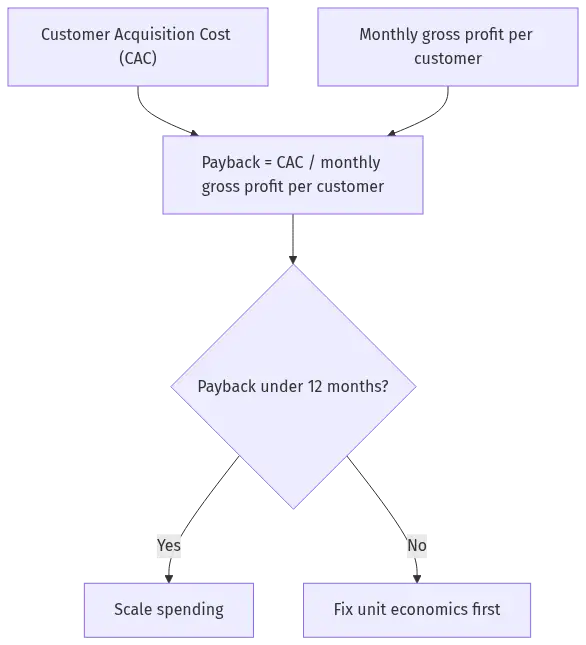
Of the three numbers people use to judge whether a SaaS company can scale, the CAC payback period is the one I trust most. It answers a question your bank account actually cares about: how many months of revenue does it take to earn back what you spent to win a customer? Get a customer for $1,000, earn $100 a month from them, and you wait ten months to break even. That is a ten-month CAC payback period — and if you can get it under twelve, you have permission to step on the gas.
I prefer it over the more famous LTV/CAC ratio for one blunt reason: lifetime value is a forecast, and forecasts lie. CAC payback is a stopwatch on real cash. Below I will define it precisely, show you the two formulas (and when each one fools you), walk through worked examples with numbers from companies in the $5M–$15M ARR range, give you current benchmarks by deal size, and name the mistake that quietly wrecks this metric for most first-time CEOs. By the end you will be able to calculate your own number, segment it the way an acquirer will, and know whether it is telling you to scale or to stop.
What the CAC Payback Period Actually Measures
The CAC payback period is the number of months it takes to recover your Customer Acquisition Cost (CAC) — the fully loaded cost of winning one new customer — out of the gross profit that customer generates. Think of it as the break-even line on a single customer. Before that line, the customer is a hole in your bank account. After it, the customer is pure fuel.
Two terms do the heavy lifting in every version of this calculation, so let me define them in plain English first.
- Customer Acquisition Cost (CAC) is everything you spent to land a customer, divided by the number of customers you landed. “Everything” means all sales salaries and commissions, all marketing spend, the software both teams use, and a fair slice of the overhead that supports them. Spend $1,500,000 on sales and marketing in a quarter and sign 50 new customers, and your CAC is $30,000. (The full breakdown of what belongs in the numerator lives in the guide to SaaS customer acquisition cost.)
- Average Revenue Per Account (ARPA) is your monthly recurring revenue divided by your number of paying accounts — the typical monthly check a customer writes you. If 600 customers pay you $1,200,000 in Monthly Recurring Revenue (MRR) — the predictable subscription revenue that renews every month — your monthly ARPA is $2,000.
There is a third term that turns a rough number into an honest one: gross margin, the share of each revenue dollar left after the direct cost of delivering the service (hosting, support, third-party software baked into the product). At 80% gross margin, a $2,000 monthly subscription only puts $1,600 of real, spendable profit in your pocket. That gap is exactly why the simple version of this metric runs too optimistic, which is the next thing to sort out.
The Two Formulas, and Why the Difference Matters
There are two common ways to calculate the CAC payback period. They look almost identical, and the difference between them is the single most common reason two founders quoting “12 months” are actually describing very different businesses.
The Simple Version (CAC ÷ MRR)
The quick version divides what you spent by the monthly revenue a customer pays you:
CAC Payback Period (simple) = CAC ÷ Monthly ARPA
This is the back-of-the-napkin number. It is fine for a gut check and it is the version many investors reach for first because revenue-per-customer is easy to find. But it pretends every dollar of revenue is profit, which is never true. It will tell you you have broken even before you actually have.
The Gross-Margin-Adjusted Version (the one to use)
The honest version divides what you spent by the monthly gross profit a customer generates:
CAC Payback Period = CAC ÷ (Monthly ARPA × Gross Margin %)
The result is in months. This is the version I use, the version Benchmarkit reports against, and the version that matches how the cash actually shows up. It accounts for the fact that you have to keep paying to deliver the service while you wait to be paid back. Whenever someone tells you their payback period without telling you whether it is gross-margin-adjusted, assume it is the rosier simple version and mentally add a few months.
Here is the same customer run through both formulas so you can feel the spread:
| Input | Value |
|---|---|
| CAC | $30,000 |
| Monthly ARPA | $2,000 |
| Gross Margin | 80% |
| Simple payback (CAC ÷ ARPA) | 15.0 months |
| Gross-margin-adjusted payback (CAC ÷ (ARPA × 80%)) | 18.75 months |
Same business, two numbers nearly four months apart. The 18.75-month figure is the truth. The 15-month figure is the story you tell yourself right before you run out of runway. For the rest of this article, “CAC payback period” means the gross-margin-adjusted version unless I say otherwise.
A Worked Example for a $6M ARR SMB Business
Numbers make this concrete, so let me walk two scenarios that build on each other — the way I do it with the CEOs I coach.
Imagine a company at roughly $6M ARR selling a focused product to small businesses, acquired mostly through inbound marketing. The economics for a typical new customer:
- CAC: $4,500
- Monthly ARPA: $750
- Gross Margin: 82%
The simple payback is $4,500 ÷ $750 = 6.0 months. The honest, gross-margin-adjusted payback is $4,500 ÷ ($750 × 0.82) = $4,500 ÷ $615 = 7.3 months.
A 7.3‑month CAC payback period is excellent. When a customer pays back in about seven months, you only need roughly seven months of working capital tied up before that customer starts funding your next one. That is what “capital efficient” actually means in practice — your money comes home fast enough to send it back out the door. A business like this can pour fuel on acquisition with confidence, because every dollar it spends comes back inside a single fiscal year.
A Worked Example for an $8M Enterprise-Leaning Business
Now take a company at roughly $8M ARR selling a larger product through a direct sales team. The deals are bigger, but so is the cost to win them:
- CAC: $30,000
- Monthly ARPA: $2,000
- Gross Margin: 80%
Gross-margin-adjusted payback: $30,000 ÷ ($2,000 × 0.80) = $30,000 ÷ $1,600 = 18.75 months.
At first glance 18.75 months looks alarming next to the SMB example’s 7.3. But raw payback months are not comparable across deal sizes — and this is where most first-time CEOs draw the wrong conclusion. An 18.75-month payback on a $24,000-a-year enterprise contract that renews for five years can be a far better business than a 7‑month payback on a $9,000-a-year SMB account that churns in eighteen months. The payback number tells you how fast the cash comes home; it says nothing about how long the customer stays once it does. You have to read it alongside retention, which is the trap I will come back to.
The two scenarios side by side:
| Metric | SMB Inbound ($6M ARR) | Enterprise Direct ($8M ARR) |
|---|---|---|
| CAC | $4,500 | $30,000 |
| Monthly ARPA | $750 | $2,000 |
| Gross Margin | 82% | 80% |
| Monthly gross profit per customer | $615 | $1,600 |
| CAC payback period | 7.3 months | 18.75 months |
| Verdict in isolation | Excellent | Borderline |
| Verdict with strong retention | Excellent | Strong (capital-intensive) |
What a Good CAC Payback Period Looks Like
Here is the benchmark grid I use, and it is the first thing to understand: there is no single “good” number, because the CAC payback period is tightly correlated with deal size. Bigger deals cost more to win and take longer to pay back — and that is often fine.
| CAC Payback Period | Interpretation |
|---|---|
| Under 6 months | Elite — top-quartile capital efficiency; consider spending more |
| 6–12 months | Excellent — fast capital recycle, scale with confidence |
| 12–18 months | Good — typical for healthy SaaS; the median lives here |
| 18–24 months | Acceptable if retention is strong and deals are large |
| Over 24 months | Concerning — capital-intensive; fix before scaling |
For broader market context, the 2025 Benchmarkit SaaS Performance Metrics report put the median CAC payback period for private B2B SaaS in the mid-teens of months — up from the 12-to-14-month range that prevailed a few years ago, as paid acquisition got more expensive across the board. The same research is emphatic on the point I just made: this metric “is highly correlated to ACV” — Annual Contract Value (ACV), the yearly dollar value of a contract — so you should always read it against deal size rather than against a single industry average.
Segment-level benchmarks make the deal-size effect impossible to miss. Drawing on Benchmarkit’s by-ACV data and First Page Sage’s 2025 SaaS CAC payback benchmarks, the rough shape looks like this:
| Deal size (ACV) | Typical CAC payback period |
|---|---|
| Under $5K | 8–11 months |
| $10K–$25K | ~12 months |
| $25K–$50K | ~14 months |
| $50K–$100K | 18–22 months |
| Over $250K | ~24 months |
Notice the counterintuitive wrinkle in the recent data: the very largest deals (over $250K ACV) often show better underlying acquisition efficiency than mid-six-figure deals, because enterprise customers, once won, expand and stay. A long payback period on a sticky enterprise account is a feature, not a bug. A long payback period on a leaky SMB account is a fire.
A note on the numbers above: benchmarks shift year to year as acquisition costs and market conditions change. Treat these as directional — useful for seeing the relative gap between SMB and enterprise payback, not as fixed targets. Pull current figures before you set a goal.
Why I Trust This Metric More Than LTV/CAC
There are three standard ways to judge whether a sales motion is financially scalable: the LTV/CAC ratio (lifetime value divided by acquisition cost; healthy above 3.0×, excellent above 5.0×), the SaaS Magic Number, and the CAC payback period. My favorite is the CAC payback period, and the reason is a failure mode I see constantly.
Picture a company with extraordinarily low churn — customers who almost never leave. On paper its LTV/CAC ratio looks spectacular, because lifetime value runs to the moon when customers stay for fifteen years. But dig into the cash and you find it takes six years to recover the acquisition cost on each customer. That is a business where, yes, the lifetime economics are gorgeous, and also you need six years of working capital sitting idle before a customer funds the next one. You cannot scale that with anything short of a war chest.
The CAC payback period catches this where the LTV/CAC ratio hides it. LTV/CAC is a long-term, total-value lens; CAC payback is a short-term, cash-flow lens. When your payback period is genuinely good — cash back in six months — all you need is six months of working capital and you can scale the machine. The long-term ratio matters too, which is why I look at both, but if I could keep only one number to decide whether to expand the sales and marketing budget, it is this one. It is the number most directly tied to how fast you can recycle a dollar.
This connects to a rule I hold firm: get your unit economics above the threshold before you invest heavily in scaling. Concretely, get LTV/CAC over 3.0 and your CAC payback period under 12 months before you expand sales and marketing. If you scale spend while the payback period is bad, you are not buying growth — you are lighting money on fire at a bigger and faster rate. The economics do not fix themselves at scale; they get worse, because the weaknesses in how sales is run only show up once you add people and pressure. For a fuller treatment of how these numbers interlock, see the guide to SaaS unit economics.
The Mistake That Wrecks This Metric: One Blended Number
Here is what most people get wrong, and it is not a math error — it is a level-of-detail error. They calculate one company-wide CAC payback period, look at a healthy-looking figure, and stop. That blended number is almost always lying to them, because it averages a profitable segment together with a money-losing one and reports the mush in the middle.
One hundred percent of the time, when you break the metric apart by segment, there are significant variances. So break it apart. Calculate the CAC payback period separately by customer segment — by vertical, by deal size, by acquisition channel, by geography — and then, as I tell CEOs, get a highlighter out and mark your sweet spots. The segments that pay back fast are where you pour fuel. The segments that pay back slowly are where you either fix the economics or stop spending.
Let me show you how badly the blend can mislead. Take a $10M ARR company acquiring two very different kinds of customers:
| Segment | Customers won | CAC | Monthly ARPA | Gross Margin | CAC payback |
|---|---|---|---|---|---|
| SMB inbound | 100 | $6,000 | $1,000 | 85% | 7.1 months |
| Enterprise outbound | 20 | $60,000 | $5,000 | 75% | 16.0 months |
| Blended (all 120) | 120 | $15,000 | $1,666.67 | 80% | 11.25 months |
The blended CAC payback period is 11.25 months — comfortably “good,” the kind of number that ends the analysis for most teams. But the blend is hiding two completely different businesses. The SMB segment pays back in 7.1 months and could absorb far more spend tomorrow. The enterprise segment takes 16.0 months — fine if those customers stay and expand for years, but a serious problem if they do not. A founder staring only at 11.25 months makes neither decision well. A founder who has segmented knows exactly where to push and where to investigate. (The same segmentation discipline is what separates good SaaS growth metrics reporting from vanity dashboards.)
The math behind the blend, so you can reproduce it: total sales and marketing attributed to these customers is (100 × $6,000) + (20 × $60,000) = $600,000 + $1,200,000 = $1,800,000, across 120 customers, for a blended CAC of $15,000. Total MRR is (100 × $1,000) + (20 × $5,000) = $100,000 + $100,000 = $200,000, across 120 accounts, for a blended ARPA of $1,666.67. Revenue-weighted gross margin is ($100,000 × 85% + $100,000 × 75%) ÷ $200,000 = 80%. Blended payback is $15,000 ÷ ($1,666.67 × 0.80) = $15,000 ÷ $1,333.33 = 11.25 months.
Track It in Months, Never Years
A small discipline with a large payoff: always express the CAC payback period in months, never in years. When a number drifts past twelve and someone starts quoting it in years — “about a year and a half,” “two-ish years” — the unit change quietly launders a bad number into a tolerable-sounding one. I have seen a company report a payback period of four and a half years and only realize how dire it was when we converted it to 54 months and put it next to the under-12 benchmark. In months, the alarm is loud. In years, it is a shrug.
My rule of thumb on the months: under 12 is the goal. When you start drifting to 13 or 14 months, get nervous — it may be trending the wrong way. Once you cross into the 12-to-18 range and keep climbing, pause acquisition spending and troubleshoot before you add another dollar. Forty-eight or fifty-four months is a number I have almost never seen survive contact with reality; it means the acquisition motion is broken, not slow.
How to Shorten Your CAC Payback Period
If your number is too long, there are only a handful of levers, and they map directly to the formula. You either spend less to acquire (lower CAC), earn more per customer faster (raise ARPA or pull revenue forward), or keep more of each dollar (improve gross margin). In order of how often they move the needle for the $5M–$15M ARR companies I work with:
- Raise prices or fix underpricing. This is the fastest lever and the most underused. A bad CAC payback period is very often a pricing problem in disguise — you are not charging enough to generate the revenue that would pay back the acquisition cost quickly. Test a price increase before you assume the market will not bear it; most founders are priced below what their customers would happily pay. See SaaS pricing strategy for how to approach it.
- Improve gross margin. Because gross margin sits inside the formula, every point you add shortens the payback directly. Trim cloud and hosting costs, streamline how you deliver support, and watch the services drag. Lower delivery cost, faster payback. The mechanics live in cost of goods sold for SaaS.
- Pull revenue forward with annual, prepaid contracts. This one is close to magic for cash payback. If a customer pays a full year up front instead of monthly, you collect a year of revenue on day one — and on a cash basis you recover most or all of the acquisition cost immediately. Take the $8M enterprise example: 18.75 months on monthly billing, but if that same customer prepays twelve months, you collect $24,000 in cash on day one against a $30,000 CAC, recovering the bulk of it before the customer has used the product for a week. The more you can move customers to annual prepay, the shorter your effective cash payback.
- Cut CAC by reallocating spend across channels. Calculate the CAC payback period by channel and shift your investment mix toward the channels that pay back fastest — exactly the way a portfolio manager rotates capital toward the best risk-adjusted returns. The worst channels are often quietly dragging the blended number down. Pair this with tighter targeting through a sharper ideal customer profile.
- Improve retention so the payback actually completes. A payback period only pays back if the customer is still around when the break-even line arrives. Reducing churn does not shorten the months on paper, but it guarantees you reach them — and it is the difference between a metric that describes profit and one that describes a slow loss. Start with reducing SaaS churn and the broader picture in revenue retention.
The Limits of the Metric
The CAC payback period is the number I trust most, but trust is not worship. It has two real blind spots, and an honest operator names them.
First, it ignores the time value of money — a dollar recovered in month 18 is worth less than a dollar spent in month zero, thanks to inflation and the return you could have earned on that capital elsewhere. A stated 12-month payback is, in true economic terms, a little longer than it looks.
Second, and more important, the formula ignores churn. It quietly assumes the customer survives to the break-even line. If your payback period is 14 months but a meaningful share of customers cancel before month 12, you never recover the CAC on those accounts — you just dug the hole deeper. This is exactly why the metric must be read alongside churn and Net Revenue Retention (NRR) — the percentage of revenue you keep from existing customers after expansion, contraction, and cancellations. A longer payback period is safe when retention is high and dangerous when it is not. The number is a stopwatch, not a crystal ball; it tells you when you should break even, not whether you will.
Frequently Asked Questions
What is a good CAC payback period for B2B SaaS?
Under 12 months is the target, and under 6 months is elite. But the honest answer is that “good” depends on your deal size: small-deal SMB businesses should be paying back in well under a year, while enterprise businesses selling six-figure contracts can run 18–24 months and still be excellent if those customers stay and expand. The recent market median for private B2B SaaS sits in the mid-teens of months. Always compare yourself to peers at your deal size, not to a single industry number.
How do you calculate the CAC payback period?
Use CAC Payback Period = CAC ÷ (Monthly ARPA × Gross Margin %), which gives the answer in months. Calculate CAC as total sales and marketing spend divided by new customers acquired in the same period. Calculate monthly ARPA as your MRR divided by your number of active accounts. Multiply ARPA by your gross margin percentage to get the monthly gross profit a customer generates, then divide CAC by that. The gross-margin-adjusted version is the one to use; the simpler CAC ÷ MRR version skips gross margin and reports too short.
What is the difference between the simple and gross-margin-adjusted CAC payback period?
The simple version divides CAC by monthly revenue per customer (ARPA), treating every revenue dollar as profit. The gross-margin-adjusted version divides CAC by monthly gross profit per customer (ARPA × gross margin %), which reflects the cash you actually keep after delivering the service. The adjusted number is always longer and always more honest. For a customer at $2,000 monthly ARPA and 80% gross margin, the simple payback on a $30,000 CAC is 15 months, but the true gross-margin-adjusted payback is 18.75 months.
Is CAC payback period the same as LTV/CAC?
No. The CAC payback period measures how fast you recover acquisition cost, in months — a short-term cash-flow lens. The LTV/CAC ratio measures how much total lifetime value a customer returns per acquisition dollar — a long-term, total-value lens. A business can have a great LTV/CAC ratio and a terrible payback period at the same time (very low churn, very long recovery), which is exactly why I look at both and trust the payback period more for scaling decisions.
What is a good LTV to CAC ratio to pair with CAC payback?
Aim for an LTV/CAC ratio above 3.0×, with 5.0× and higher considered excellent. The standard rule of thumb is to clear both gates before scaling spend: LTV/CAC over 3.0 and CAC payback under 12 months. If only one is healthy, you are not yet ready to expand the budget — dig into which input is dragging the weak metric down.
How does churn affect the CAC payback period?
The formula itself ignores churn — it assumes the customer survives to break-even. That is its biggest limitation. If customers churn before the payback line, you never recover their CAC. So a payback period is only meaningful next to your churn rate and NRR: a 14-month payback is fine when customers stay three-plus years, and a disaster when a chunk of them leave inside a year. Fix churn and the payback period you calculate becomes a payback period you actually realize.
Should I calculate one CAC payback period for the whole company?
No — this is the most common mistake. A single blended number averages profitable and unprofitable segments together and hides where the business actually makes and loses money. Calculate it separately by segment (deal size, vertical, acquisition channel, geography). One hundred percent of the time there are significant variances. The segmented view tells you where to spend more and where to stop; the blended view tells you almost nothing actionable.