

A safe note is the five-page document that lets an investor wire you money today in exchange for equity they will receive later — and it is the single easiest way for a founder to give away far more of their company than they think they are. The reason it is dangerous is exactly the reason it is popular: a safe note (SAFE stands for Simple Agreement for Future Equity) is fast, cheap, and skips the hard conversation about what your company is worth. You sign, the cash arrives, and nothing visible changes on your ownership. Then, eighteen months later, all of those quiet little agreements convert at once in your priced round, and you discover you own less of your business than you planned — sometimes by ten or fifteen points. The instrument is simple. The dilution it creates is not.
This guide is for the technical SaaS founder somewhere between $5M and $15M Annual Recurring Revenue (ARR) who raised on safe notes early — or is about to — and never had the conversion math laid out in plain English. By the end you will understand exactly what a SAFE is, how a valuation cap and a discount turn into shares, why a pre-money SAFE and a post-money SAFE dilute you very differently, what happens when you stack several of them, and when a SAFE is the wrong tool entirely. I will define every term as it comes up, because this is venture finance dressed in deceptively friendly vocabulary, and nobody should have to nod along to “post-money MFN with a pro rata side letter” while pretending they followed it.
This is educational, not legal or financial advice. I am walking you through how a safe note works so you can have an informed conversation with the people who do this for a living — not so you can paper your own round. A SAFE is a binding securities contract, and the right structure depends on your stage, your cap table, how much you are raising, and your jurisdiction. Engage a qualified startup attorney, and run anything material past your own financial advisor before you sign.
What a SAFE Note Actually Is
Start with what it is not. A safe note is not a loan, even though the word “note” makes it sound like one. A traditional loan has an interest rate and a date by which you must pay it back. A SAFE has neither. There is no interest accruing, no maturity date, and no obligation to ever return the cash. In that sense the name is a small trap — most people hear “note” and picture debt, when a SAFE behaves much more like a coupon for future stock.
Here is the cleanest analogy. A safe note works like a pre-order for equity. The investor pays today for shares the company has not issued yet, at a price that will be settled later, when a real financing event puts a number on the business. Y Combinator — the startup accelerator that created the SAFE in 2013 and still publishes the standard templates — designed it specifically to let early-stage companies raise money before anyone had to argue about valuation. At the seed stage, that argument is mostly guesswork anyway, so the SAFE defers it to a moment when there is actual evidence: your first priced round (a financing where investors and the company formally agree on a per-share price and the investor buys stock outright — more on this below).
So what does the investor actually get for their money? Not stock — not yet. They get a contractual right that converts into shares when a triggering event happens. The trigger is almost always your next equity financing of a certain size. When that round closes, the SAFE “converts,” and the investor receives shares based on terms you agreed to months or years earlier. Those terms — the valuation cap and the discount rate — are the entire ballgame, and they are where founders get hurt. We will take them one at a time.
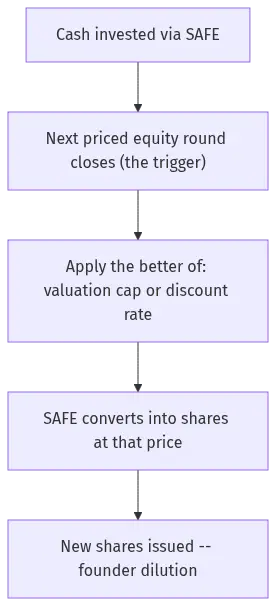
The Two Terms That Decide Everything: Valuation Cap and Discount
A safe note has almost no moving parts. The two that matter are the valuation cap and the discount rate. Understand these two and you understand 90% of what a SAFE does to your cap table (the cap table is simply the running record of who owns what percentage of your company).
A note on the numbers in this guide. The caps, discounts, and round sizes below are illustrative examples chosen to make the math clear, not current market quotes. Real terms move with the funding climate, your traction, and your geography — a 2026 pre-seed cap looks nothing like a 2021 one. Use these to understand the mechanics and the relative effects; verify live norms with your attorney and investors before you set your own terms.
The Valuation Cap
The valuation cap is the maximum company valuation at which the investor’s money converts into equity — a ceiling on the price they pay per share, no matter how high your next round is priced. Think of it as a reward for showing up early. The investor is taking the most risk, so the cap guarantees they convert as if the company were worth no more than a set number, even if you later raise at a much higher valuation.
The mechanic is easiest to see with a post-money SAFE (the version Y Combinator switched to in 2018, and the dominant form today — I will explain post-money versus pre-money in its own section). With a post-money SAFE, the cap translates directly into an ownership percentage:
Ownership % = SAFE Investment ÷ Post-Money Valuation Cap
If an investor puts in $1.5M on a safe note with a $10M post-money cap, they have locked in 15% ownership ($1.5M ÷ $10M = 15%) on a fully diluted basis. That percentage is fixed the moment they sign — not at conversion. Whether you raise your Series A at $20M or $60M, that investor converts as if the company were worth $10M, and walks away with 15% before the new round’s dilution. The higher you raise, the better their deal looks relative to the new money coming in.
The Discount Rate
The discount rate gives the SAFE investor a percentage off the price per share that the next round’s investors pay. It is the other way of rewarding early risk: instead of (or in addition to) a cap, the investor simply buys in cheaper than the people who show up at the priced round.
The math is a single subtraction. If a safe note carries a 20% discount and your Series A investors pay $2.00 per share, the SAFE converts at $1.60 per share ($2.00 × (1 − 0.20) = $1.60). Same shares, lower price — which means more shares for the same dollars. Discounts on SAFEs typically land somewhere in the 10% to 25% range, but again: that is an illustrative range, not a rule.
What Happens When a SAFE Has Both
Most SAFEs carry a cap and a discount. When both are present, the standard rule is simple and worth memorizing: the SAFE converts at whichever term gives the investor more shares (equivalently, the lower price per share). The investor does not get to stack both — they get the better of the two.
Here is the comparison worked out. Suppose an investor holds a $500K safe note with an $8M post-money cap and a 20% discount, and you raise a Series A at a $16M pre-money valuation with a share price of $2.00.
| Conversion path | How it prices | Effective price per share | Investor's resulting stake |
|---|---|---|---|
| Valuation cap | $500K converts as if the company is worth $8M | $1.00 (half the round's $2.00, because the $8M cap is half the $16M round price) | ~6.25% ($500K ÷ $8M) |
| Discount | 20% off the $2.00 round price | $1.60 | ~3.13% ($500K ÷ $16M, then adjusted for the discount) |
The cap path gives the investor a $1.00 price; the discount path gives them $1.60. Lower price wins, so this SAFE converts on the cap, and the investor lands near 6.25% instead of ~3.13%. The pattern is general: in a strong, high-priced round the cap usually wins; in a flat or modestly-priced round the discount can win. When you negotiate a SAFE, you are really negotiating which of these two scenarios you are handing the investor — and the cap is almost always the term that costs you more, so it deserves the most scrutiny.

Pre-Money vs. Post-Money SAFE: The Distinction That Quietly Costs Founders Points
This is the single most expensive thing founders misunderstand about safe notes, so slow down here. The difference between a pre-money SAFE and a post-money SAFE sounds like accounting trivia. It is not. It changes who absorbs the dilution from other SAFEs, and it can swing your final ownership by several points.
First, the underlying terms. Pre-money valuation is what your company is worth before new investment goes in. Post-money valuation is the pre-money value plus the new money — it is what the company is worth the instant after the round closes. The names of the two SAFE types refer to which of these the valuation cap is measured against.
- A pre-money SAFE (Y Combinator’s original 2013 version) measures the cap against your pre-money valuation. The crucial consequence: when several pre-money SAFEs convert together, they dilute each other. The pie of “SAFE ownership” is fixed, and each SAFE holder’s slice depends on how many other SAFEs showed up. Your dilution as a founder is real but capped by the group.
- A post-money SAFE (the 2018 redesign, now the default) measures the cap against the post-money valuation — specifically, a post-money figure that includes all the SAFE money but not the next priced round. The crucial consequence: each post-money SAFE holder’s percentage is locked and protected. When you add another SAFE, it does not dilute the existing SAFE holders. It dilutes you.
That last sentence is the whole point. The 2018 post-money SAFE made conversion math gloriously simple for investors — they can read their guaranteed percentage straight off the document ($1M on a $10M post-money cap is 10%, full stop). But simplicity for the investor came at the founder’s expense. Under post-money SAFEs, every additional dollar of SAFE you raise comes out of your pocket, not the earlier investors’. The investors are insulated from each other; the founder absorbs all of it. This is why so many founders who raised a “quick, founder-friendly” stack of post-money SAFEs arrive at their Series A owning meaningfully less than they assumed.
| Dimension | Pre-money SAFE | Post-money SAFE |
|---|---|---|
| What it is | The original 2013 Y Combinator SAFE | The 2018 redesign, now the market default |
| Cap measured against | Pre-money valuation | Post-money valuation (includes all SAFE money) |
| Who can read their % off the doc | No one — it depends on total SAFEs raised | The investor, exactly, at signing |
| Who absorbs dilution from new SAFEs | All SAFE holders share it | The founder absorbs all of it |
| Conversion complexity | Higher (interdependent) | Lower (each SAFE is independent) |
| Net effect on founders | More forgiving when stacking | Less forgiving — stacking hits you directly |
The takeaway is not “pre-money good, post-money bad.” Post-money SAFEs are the standard and you will almost certainly be offered one. The takeaway is that post-money SAFEs make your dilution your problem alone, which means you have to model the stack yourself — because nobody else at the table has any incentive to.

The Dilution Trap: What Happens When You Stack SAFEs
Here is where founders actually get hurt, and it is worth doing the math out loud because the trap is invisible until it springs. Raising on safe notes feels free in the moment. There is no priced round, no new line on the cap table that screams “you just sold 10% of your company.” So founders do what feels efficient: they raise a SAFE, then another, then another, each at a different cap as traction improves. Every individual SAFE looks reasonable. The sum is brutal.
Walk through a realistic stack. You start owning 100% of your company with your co-founders, and you raise three post-money SAFEs over eighteen months:
| Round | Amount raised | Post-money cap | Investor ownership (Amount ÷ Cap) |
|---|---|---|---|
| SAFE 1 (pre-seed) | $500K | $5M | 10.000% |
| SAFE 2 (six months later) | $750K | $8M | 9.375% |
| SAFE 3 (the "final" top-up) | $1M | $12M | 8.333% |
| Combined SAFE ownership | $2.25M | — | 27.708% |
Each SAFE in isolation looked fine — 10% here, 9% there. But because these are post-money SAFEs, the percentages add up against you: combined, these investors have locked in 27.708% of your company, leaving the founders with roughly 72.292% before the Series A investors take their share. Raise your priced round on top of that — say the Series A buys 20% of the post-round company — and the founders’ stake gets multiplied down again, landing the team well under 60%. A few “small, friendly” SAFEs quietly became more than a quarter of the company.
This is the dilution trap, and it has a specific cause: SAFEs defer the visible cost. With a priced round, you feel the dilution immediately and price accordingly. With a stack of SAFEs, the bill arrives all at once, at conversion, after the money is long spent. There is a blunt way to say it: if you do not do the math in business, you pay the stupid tax — and a thoughtless SAFE stack is one of the more expensive versions of it. One number, buried in a document you signed a year ago, can quietly cost you millions at the exit.
The fix is not to avoid SAFEs. It is to maintain a live conversion model from your very first SAFE — a simple spreadsheet that shows your fully diluted ownership after every instrument converts, updated each time you sign a new one. If you cannot see, on one screen, what you will own at the Series A, you are flying blind toward your own dilution. Keeping that model current is the same discipline as keeping a clean cap table; the SAFE stack is exactly the part most likely to surprise you in seed round funding.
SAFE vs. Convertible Note vs. Priced Round
A safe note is one of three common ways to raise early capital, and choosing among them is a real decision — not a default. Each gets equal treatment here, because the right answer depends entirely on how much you are raising and how much structure you can stomach. The honest summary: SAFEs win on speed and simplicity, priced rounds win on clarity and finality, and convertible notes sit in between with debt-like teeth.
The Convertible Note
A convertible note is the SAFE’s older cousin, and the key difference is one word: it is debt. A convertible note is a loan that converts into equity at your next round — but until it converts, it carries an interest rate and a maturity date (the deadline by which it must either convert or be repaid). Like a SAFE, it usually has a valuation cap and/or a discount. Unlike a SAFE, it accrues interest the whole time, and that interest converts into additional shares — a small extra slug of dilution founders routinely forget to model.
Work the interest. A $500K convertible note at 6% simple annual interest that takes 18 months to convert accrues $45,000 in interest ($500,000 × 0.06 × 1.5 years = $45,000), so it converts on $545,000, not $500,000. That extra $45K buys the investor more shares at conversion — modest, but real, and it is on top of whatever the cap or discount already gives them.
The maturity date is the sharper edge. If your note matures and you have not raised a qualifying priced round, the loan is technically due. Most startups cannot repay a $500K note on demand, which hands the investor leverage exactly when you are weakest — the moment you have failed to raise. This is also where the structure can be weaponized: I have heard founders describe investors who deliberately set covenants (performance conditions in a debt agreement that, if breached, let the lender call the loan due) tight enough that the company trips them, so the lender can convert on punishing terms or take control. A SAFE has none of this — no interest, no maturity, no covenants, no repayment leverage. That is its genuine advantage.
The Priced Round
A priced round is the grown-up version: you and your investors agree on a real valuation, fix a per-share price, and the investors buy preferred stock (shares that carry extra rights — like getting paid back first in a sale — that common shareholders do not have) outright. The terms of these deals are standardized enough that the National Venture Capital Association publishes model documents the whole industry negotiates from. There is no deferral and no conversion later; the ownership is settled the day the round closes. Priced rounds cost more in legal fees and take longer to negotiate, but they buy you something valuable: everyone knows exactly who owns what, immediately. Dilution is transparent from day one instead of hidden until conversion.
For a founder building toward an exit, that transparency compounds. The deeper mechanics — liquidation preferences, anti-dilution provisions, the order in which money comes out in a sale — live in the term sheet and shape what you actually pocket, which is why a priced round connects directly to your eventual SaaS exit strategy. A priced round at the seed stage is heavier than a SAFE, but it forces a discipline the SAFE lets you skip — and skipping it is what creates the dilution trap above.
Side-by-Side
| Dimension | SAFE | Convertible Note | Priced Round |
|---|---|---|---|
| Legal nature | Contract for future equity (not debt) | Debt that converts to equity | Equity sold today (preferred stock) |
| Interest | None | Yes — accrues and converts to shares | None |
| Maturity date | None | Yes — repay or convert by a deadline | Not applicable |
| Valuation set now? | No (deferred to next round) | No (deferred to next round) | Yes — a real per-share price |
| Speed & cost | Fastest, cheapest | Fast, low cost | Slowest, highest legal cost |
| Dilution visibility | Hidden until conversion | Hidden until conversion | Transparent immediately |
| Repayment risk to founder | None | Real — note can come due | None |
| Best when | Seed rounds, typically under ~$5M raised | Bridge financing between priced rounds | Larger raises where clarity matters |
The rough rule practitioners use: reach for a safe note for genuinely early, smaller raises where speed matters and the amounts are modest. Use a convertible note when you specifically want debt-like seniority or are bridging between two priced rounds. Move to a priced round once the dollars are large enough that the dilution deserves to be visible to everyone from the start. As the check sizes grow, the case for the priced round’s discipline grows with them.

The Fine Print Founders Wave Through: MFN, Pro Rata, and Side Letters
The base SAFE is genuinely simple. What turns it complicated — and occasionally costly — are the extra clauses investors attach. Three come up constantly, and each is the kind of thing a founder racing to close a round will agree to without fully pricing the consequence.
- MFN (Most Favored Nation). This clause lets a SAFE investor automatically claim the best terms you later give any other SAFE investor. It works like a price-match guarantee in reverse: if an investor signs at a $10M cap with MFN, and you later give a different investor a $7M cap, the MFN investor can reset to the $7M cap too. On a rolling seed round with several SAFEs, MFN can cascade in ways that quietly improve everyone’s terms at your expense. Read it carefully — “just standard MFN” is not harmless boilerplate.
- Pro rata rights. This gives an investor the right — but not the obligation — to invest more in your next round to maintain their ownership percentage. The standard Y Combinator SAFE does not include pro rata by default; it comes via a separate side letter. The trap is granting it too broadly: if a dozen small angels each hold pro rata rights, they can collectively crowd out the marquee lead investor you actually want in your Series A. Best practice is to limit pro rata to investors above a meaningful check size.
- Side letters. A side letter is a supplementary agreement attached to a SAFE that grants extra rights — pro rata, information rights, board observer seats, cap resets. Individually each can be reasonable. Collectively, ungoverned, they become a tracking nightmare: at conversion you discover you promised information rights, observer seats, and pro rata to people you forgot about. If you grant side letters, keep one central tracker of who has what. The administrative burden of not tracking them is how “simple” SAFEs stop being simple.
The through-line: the SAFE itself is rarely where founders get hurt on terms — the attachments are. Treat every clause beyond cap and discount as something to be priced and tracked, not nodded through.
How a SAFE Note Connects to Your Bigger Picture
A safe note is a seed-stage instrument, but its consequences land years later, at the exit you are actually building toward. Every point of ownership you give away on a SAFE is a point you do not have when the company sells — and at a $25M to $100M+ outcome, single points are large numbers. The reason to take the conversion math seriously at $500K isn’t the $500K. It is what that dilution compounds into across every future round and the final sale.
This is the same lens that should govern every financing decision: a known, modeled cost weighed against the value it protects. Raising on SAFEs is often the right call early — the speed and the avoided legal fees are real, and a clean, well-modeled SAFE round is a perfectly responsible way to fund the gap before a priced Series A funding round. The mistake is treating the instrument as free because the dilution is deferred. It is not free; it is invoiced later, in equity, at the worst possible time to be surprised. The founders who navigate this well are the ones who, from the first SAFE, can answer one question on demand: after everything converts, what do I own? If your finance function cannot produce that number quickly, it is a sign your equity hygiene deserves a dedicated owner — often the moment a scaling company needs a real SaaS CFO.
Common Mistakes Founders Make With SAFE Notes
The same handful of errors show up again and again, and every one of them is avoidable with a spreadsheet and a little discipline.
- Treating the SAFE as free because the dilution is invisible. The cost is real; it is just deferred to conversion. Model it from the first dollar.
- Stacking SAFEs without a running conversion model. Each one looks small; the sum is not. Update your fully diluted ownership every time you sign.
- Mistaking the valuation cap for your company’s value. A cap is a conversion ceiling for one investor, not a floor for your next round’s price. Founders who anchor their Series A expectations on an old cap negotiate against themselves.
- Ignoring the pre-money versus post-money distinction. Under the now-standard post-money SAFE, every new SAFE dilutes you, not the earlier investors. If you do not know which version you are signing, you do not know who absorbs the next raise.
- Waving through MFN, pro rata, and side letters. The attachments, not the base SAFE, are where terms quietly turn against you. Price every clause and keep a central tracker.
The through-line is the same discipline you already apply to churn, CAC, and pricing: do the math before you sign, not after. A safe note is a small, fast, genuinely useful tool — right up until it is the reason you own less of your company than you meant to.
Frequently Asked Questions
What is a SAFE note in simple terms?
A SAFE note (Simple Agreement for Future Equity) is a contract where an investor gives a startup money now in exchange for the right to receive equity later — usually when the company raises its next priced round. It is not a loan: there is no interest and no repayment deadline. Think of it as a pre-order for stock at a price that gets settled at the next financing, using a valuation cap and/or a discount agreed in advance. Y Combinator created it in 2013 to let early-stage companies raise money before fixing a formal valuation.
How does a SAFE note convert to equity?
It converts at your next qualifying priced round. The SAFE’s valuation cap and discount each imply a price per share, and the SAFE converts at whichever gives the investor more shares (the lower price). With a post-money SAFE, the investor’s ownership percentage is simply their investment divided by the post-money cap — for example, $1M on a $10M post-money cap converts to 10% — and that percentage is locked when they sign, before the new round dilutes everyone.
What is the difference between a valuation cap and a discount on a SAFE note?
A valuation cap sets the maximum company valuation at which the investor converts, guaranteeing them a minimum ownership percentage no matter how high your next round prices. A discount simply gives them a percentage off the next round’s per-share price — a 20% discount on a $2.00 share means they pay $1.60. Most SAFEs have both, and the investor gets the better of the two, not both stacked. In a high-priced round the cap usually wins; in a flat round the discount can.
What is the difference between a pre-money and post-money SAFE?
A pre-money SAFE measures its cap against your valuation before new money goes in, so multiple SAFEs dilute each other and share the pain. A post-money SAFE — Y Combinator’s 2018 redesign and today’s default — measures the cap against the valuation after all SAFE money is in, so each investor’s percentage is locked and protected. The critical consequence: under a post-money SAFE, every additional SAFE you raise dilutes the founders, not the earlier investors. That is why stacking post-money SAFEs hits your ownership harder than founders expect.
Is a SAFE note better than a convertible note?
It depends on what you want. A SAFE is simpler and safer for the founder: no interest, no maturity date, no risk of the instrument coming due if you fail to raise. A convertible note is debt — it accrues interest that converts into extra shares, and if it matures before you raise a priced round, you technically owe the money back, which hands investors leverage. SAFEs are usually preferred for clean early raises; convertible notes make sense when an investor specifically wants debt seniority or you are bridging between rounds.
How much dilution does a safe note cause?
The instrument itself does not set the dilution — the valuation cap and the amount raised do. With a post-money SAFE, your dilution from one instrument is simply the investment divided by the post-money cap (e.g., $500K on a $5M cap is 10%). The danger is stacking: raise three SAFEs at different caps and the percentages add up against you, often landing well above 25% combined before your priced round even starts. Always keep a live model showing your fully diluted ownership after every SAFE converts.
When should a founder use a priced round instead of a SAFE?
Move to a priced round when the amount you are raising is large enough that the dilution deserves to be transparent to everyone from day one. A priced round fixes a real valuation and per-share price, so ownership is settled immediately instead of hidden until conversion. It costs more in legal fees and takes longer, but it forces the discipline a SAFE lets you skip — and that discipline is exactly what prevents the dilution trap that catches founders who stack too many SAFEs.