

Most founders raise their seed round funding at the worst possible moment: when they’re running low on cash and out of options. That’s exactly backwards. The best time to raise is when you don’t need the money — because that’s the only time you have leverage. The moment you need the round, the terms turn against you, and seed round funding stops being fuel and starts being a trap.
I’ve advised SaaS founders for about 30 years, and I’ll tell you something most fundraising guides won’t: for the kind of B2B SaaS company most of you are building — bootstrapped or lightly funded, $2M to $15M in Annual Recurring Revenue (ARR), aimed at a $25M to $100M+ exit — venture capital is rarely the best path. That doesn’t mean a seed round is wrong. It means you have to understand exactly what you’re buying, what you’re giving up, and whether there’s a cheaper way to get the same result.
This guide walks through what seed round funding actually is, how much to raise, what it costs you in ownership, the four types of investors you’ll meet, and — most important — how to decide whether you should raise at all.
What Is Seed Round Funding?
Seed round funding is the first meaningful round of outside investment a startup raises, typically after the founders have already put in their own money. It sits between the earliest “pre-seed” capital (personal savings, credit cards, friends and family) and a larger Series A round.
Here’s how the capital stages actually line up over the life of a company:
| Stage | Typical Source | What It Funds | What Investors Expect |
|---|---|---|---|
| Pre-seed | Founder savings, friends and family, credit cards | Build the first version, get a few customers | A working idea and a committed founder |
| Seed | Angel investors, seed-stage VC firms | Reach product-market fit, build the core team | Early revenue and retention signals |
| Series A | Venture capital | Scale a proven go-to-market motion | Repeatable, growing revenue (~$1M–$3M ARR) |
| Growth | Growth equity, venture debt, bank debt | Accelerate an already-working business | Profitable or near-profitable, fast-growing |
| Late / Exit | Private equity, strategic acquirers | Cash out founders, fund a transition | A durable, lower-risk business |
A few decades ago when a company started up, the path was personal savings, friends and family, maybe credit cards, and then “maybe a seed round if you’re going to go get outside capital.” That’s still the typical pattern. What’s changed is how much money is sloshing around at the seed stage and how casually founders take it — often without doing the math on what it costs them.
The mechanics matter, but they’re not the point. The point is whether the money moves you toward your goal — a profitable business you control and eventually sell — or away from it.

How Seed Round Funding Works: Priced Rounds, SAFEs, and Notes
When you raise seed round funding, you’re selling a piece of your company. The three common structures differ mostly in when the price gets set.
- Priced equity round. You and the investor agree on a valuation today. They wire money; you issue new shares at that price. Clean and unambiguous, but it requires negotiating a valuation early, which is hard when there’s not much to value yet.
- SAFE (Simple Agreement for Future Equity). The investor gives you money now in exchange for the right to get shares later — usually when you raise your priced Series A. A SAFE is not a loan. There’s no interest and no maturity date. It just converts into equity down the road.
- Convertible note. Like a SAFE, but it’s structured as debt — it carries an interest rate and a maturity date, and it converts into equity at a later round. I’ve sat across from founders mid-raise on a convertible note who didn’t realize their “investor” was really a lender with conversion rights.
Two terms show up constantly with SAFEs and notes, and you need to understand both because they directly determine how much of your company you give away:
- Valuation cap. A ceiling on the valuation at which the investor’s money converts to equity. A lower cap is better for the investor (they get more shares) and worse for you. This is where a lot of founders get quietly diluted — the cap is set “in such a way to intentionally” hand the investor a bigger slice than the headline number suggests.
- Discount. A percentage break the investor gets on the price when their money converts, rewarding them for investing early.
The lay-person version: a SAFE or note lets you take money today and figure out the exact price later. That’s convenient. It’s also how founders end up surprised at their Series A when all those caps and discounts convert at once and their ownership is lower than they expected. If you can’t model the conversion yourself, hire an attorney who has done it — this is a full-time job, and the math is not intuitive.
A note on the numbers below: seed valuations, round sizes, and dilution percentages move with the market. The figures here are illustrative and reflect conditions at the time of writing. They’re included to show the relationships between round size, valuation, and ownership — not as current market quotes. Verify live benchmarks before you negotiate.
How Much Seed Round Funding Should You Raise?
The wrong way to answer this is to pick a round number because it sounds impressive or because “that’s what everyone raises.” The right way is bottom-up: figure out what you need to hit the next milestone, add a cushion, and raise that.
For most SaaS companies, the next milestone after seed is a Series A, and the bar for a Series A is roughly $1M to $3M in ARR with healthy retention. So the real question is: how much capital, on top of your operating cash flow, do you need to get from where you are to that bar — plus enough runway that you’re never raising from a position of weakness? (Y Combinator’s guide to seed fundraising makes the same point: raise enough to reach a meaningful milestone, plus a margin of safety.)
Here’s a simplified worked example for a SaaS company currently at $600K ARR, burning cash, trying to reach $2M ARR.
| Line Item | Monthly | 18 Months |
|---|---|---|
| Gross cash burn (team, tools, hosting) | $150,000 | $2,700,000 |
| Less: gross profit from existing revenue (75% margin on $600K ARR ≈ $50K MRR × 75%) | $37,500 | $675,000 |
| Net monthly burn | $112,500 | $2,025,000 |
| Plus: 6-month closing cushion (avoid the "smell of desperation") | — | $675,000 |
| Suggested raise | ≈ $2.7M |
Walk through the logic. The business burns $150K a month in gross costs but brings in about $37.5K a month in gross profit from its existing $600K ARR (at a 75% gross margin). That nets to $112,500 of true monthly burn. Over an 18-month plan to reach $2M ARR, that’s about $2.025M. Then add roughly six months of extra cushion — about $675K — so that when you go to raise your Series A, you do it with money still in the bank and time to walk away from a bad term sheet. Total: a seed round of about $2.7M.
That cushion is not optional padding. It is the single most important line in the table, and here’s why.
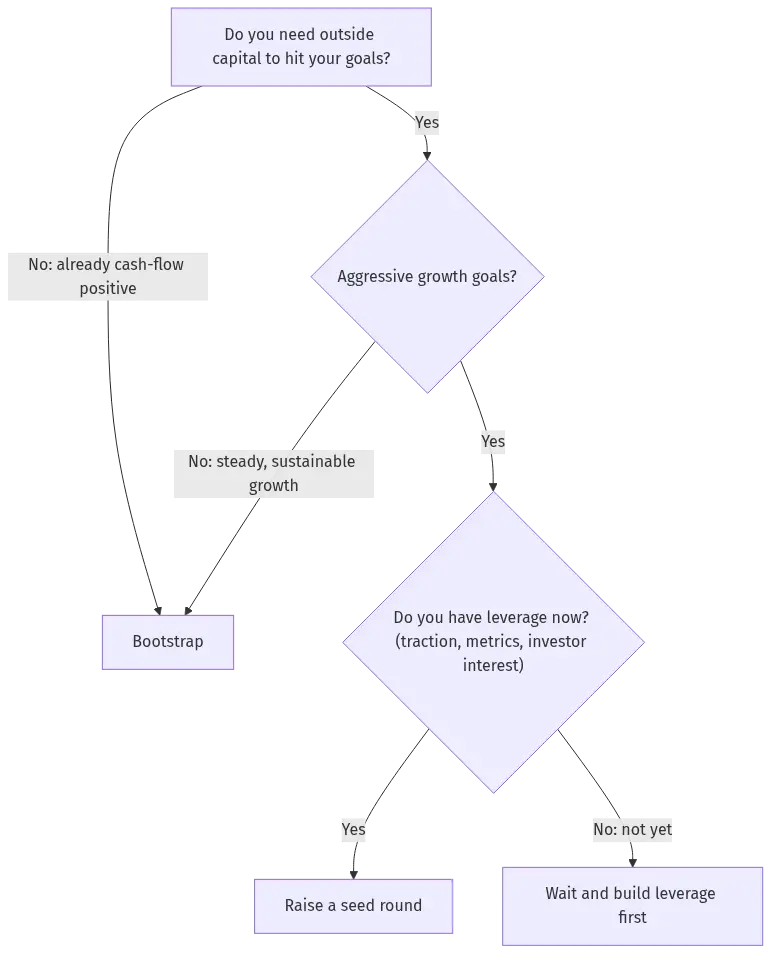
Decision flow: should you raise a seed round now, wait, or stay bootstrapped? The branches below describe the logic in prose so the section stands on its own.
The decision comes down to three questions, in order. First: are you cash-flow positive or close to it? If more money is coming into the bank account every month than going out, it’s nearly impossible to go out of business — and you have the luxury of raising only if it accelerates something already working. Second: does outside capital actually accelerate a proven motion, or is it covering up a problem? You never want to use outside capital to cover up the sins of poor management decisions; that’s a recipe for blowing things up. Third: do you have leverage right now? If you’d be raising because you’re about to run out of money, stop — that’s the forced round, and it’s where founders lose control.
The Real Cost of Seed Round Funding: Dilution
Every dollar of seed round funding costs you a piece of your company. That’s the trade. The mistake founders make is treating dilution as a one-time event instead of a compounding one.
Here’s the math that matters. Suppose you raise a $2.7M seed round at a $13.5M post-money valuation. The investor gets:
Ownership Sold = Amount Raised / Post-Money Valuation = $2.7M / $13.5M = 20%
So you’ve handed over 20% of the company. Fine — if that’s the only round you ever raise. But seed round funding is rarely the last round. Watch what happens across a typical financing path, assuming the founders start owning 100% and take dilution at each stage:
| Round | Ownership Sold | Founder Ownership After |
|---|---|---|
| Start | — | 100% |
| Seed | 20% | 80% |
| Series A | 20% | 64% |
| Series B | 15% | 54.4% |
| Option pool top-ups + a down round provision triggering | ~10% | ~49% |
By the time you’ve raised a few rounds, you can easily be below 50% ownership — and that’s in the good scenario where everything goes smoothly. Each round multiplies against what you have left: 80% × 80% × 85% × 90% ≈ 49%. Dilution compounds the same way churn or retention compounds — multiplicatively, not by simple subtraction.
And the smooth scenario is not the one to plan for. In the real world, stuff happens — a bad economy, a pandemic, a regulatory change. When you’re highly dependent on outside capital and not financially self-sustaining, all those provisions the attorneys argued over kick in when things go wrong, and they kick in by taking more of your equity to keep the investor whole through a down round. I’ve watched founders build companies worth several hundred million dollars and walk away with almost nothing because of compounding dilution and down-round provisions. I’ve also seen founders sell for $200M — not a unicorn — and personally keep $100M, because they raised little and kept control. The difference was rarely the quality of the business. It was the cap table.
The Four Types of Investors at the Seed Stage and Beyond
“Investor” is not one thing. There are four types you’ll encounter, and conflating them is how founders end up with the wrong money. Three of the four are professional, institutional investors, and each has a fundamentally different goal.
Angel Investors
Angel investors are people the founder knows personally who put in money early — often grouped with friends and family. They’re usually not active managers and not on the board. They invest because they believe in you. Angels frequently anchor a seed round, and they’re often the most founder-aligned capital you’ll ever take, precisely because they’re not running a fund with return targets to hit.
Venture Capital
Venture capital is institutional money with a very specific, intentional strategy: invest in companies that can become mega-winners. A VC firm is happy to have nine of ten investments go to zero as long as the tenth becomes the next category-defining giant. Their mantra is “go big or go home” — they want a billion-dollar outcome or a bankruptcy, not a comfortable mid-sized win. That has three consequences you need to internalize:
- Misaligned incentives. Most SaaS founders I work with want a profitable business they can sell and personally capture the value from. VCs want maximum growth and market share, even at a sustained loss. Those are not the same goal, and the gap between them shows up in every major decision.
- Dependence on more capital. The VC playbook is grow fast, lose money, then come back for more. Each time you come back, they invest more — and take more ownership and more control.
- Excessive dilution. Constant raising means your ownership percentage falls and falls. Under perfect conditions that’s fine. In the real world, the down-side provisions transfer even more equity to the investor when conditions sour.
Venture capital genuinely makes sense in a narrow set of circumstances — a highly disruptive technology where it’s not even clear the market exists yet, the way search engines didn’t really exist before Google. That’s the classic VC deal. It’s far less common than most founders assume.
Growth Equity
Growth equity investors back companies that are fundamentally profitable, or could be, and want to grow faster. They’re targeting something like a 300% return over a couple of years — not a moonshot — and they explicitly don’t want you running at a permanent loss or becoming dependent on outside capital. In my experience, most SaaS founders are far better aligned with growth equity than with venture capital. It usually shows up after seed and Series A, once the business is working.
Private Equity
Private equity typically arrives later, when you’re ready to sell some or all of your shares. The key distinction: a growth equity check goes into the company’s bank account to fund growth, while a private equity check can go into your personal bank account to buy your shares. Private equity is how many SaaS founders get their actual liquidity event. (For the deeper comparison, see strategic vs. financial buyers.)
The practical takeaway: when you evaluate any investor, find out which of these four they are, look at their website and their portfolio, and ask what kind of return profile they’re built around. Their financial DNA determines how they’ll want you to run the company.
When NOT to Raise: The Bootstrapping Alternative
If you take one thing from this guide, take this: raising seed round funding is a choice, not a requirement. The most common — and often the best — way to build a SaaS company is through operating cash flow: make money from customers, treat them well, and reinvest the profit. This isn’t glamorous. It’s also been working for 2,000 years.
When you’re bootstrapped, you protect a cash cushion — typically three to six months of reserves — and you never drop below it. When you’re funded and someone hands you a couple million dollars, the instinct is to spend it, fast. That difference in behavior is exactly why so many funded companies burn through their runway and end up raising again under pressure. (For more on the runway and break-even math, see your SaaS financial model and what a good EBITDA margin looks like.)
There’s also a structural advantage to SaaS economics most founders underuse. If you bill annually and collect upfront, you can be cash-flow positive even while breaking even on an accrual basis — your bank balance grows because customers pay a year ahead. That self-funds growth without a single outside dollar.
Capital should accelerate a business that already works — not start one that doesn’t. Once your customers are happy, you know how to sell to them, you know how to onboard them, and they stay for a long time, then outside capital can pour fuel on a proven fire. Before that, it usually just helps you make mistakes faster and more expensively. If debt rather than equity fits your stage, venture debt and SaaS debt financing can fund growth without selling ownership at all — useful when the business is fundamentally profitable but has a timing lag between acquiring a customer and earning the cash back.
Avoiding the Forced Round (and the Down Round)
The single worst outcome in fundraising is the down round — raising money at a lower valuation than your previous round. Down rounds trigger anti-dilution provisions that crush founders and often wipe out employee stock options. I know someone who held options in a seemingly successful company doing $80M a year in sales for 20 years; the options ended up worth nothing because of down rounds in the middle that wiped out the founding team and employees.
Here’s the key insight: you avoid the down round by avoiding the forced round. And you get forced into a round exactly one way — you run out of money. When you run out of money, your options collapse and you raise on whatever terms you can get, which are usually terrible.
So the defensive playbook is straightforward:
- Know whether you’re cash-flow positive. When more cash enters the bank account each month than leaves it, it’s nearly impossible to go out of business. That’s your strongest negotiating position.
- Raise with runway to spare. Build the six-month cushion into the raise (see the worked example above) so you can always walk away from a bad term sheet.
- Raise when you don’t need it. The best time to raise is from strength — proven traction, money in the bank, multiple options. The worst time is when the bank balance is shrinking and you have no choice.
Leverage in a fundraise comes from not needing the money. Everything in seed round funding flows from that one fact.
Frequently Asked Questions
What is seed round funding in simple terms?
It’s the first significant round of outside investment a startup raises, usually from angel investors or seed-stage venture firms, after the founders have already invested their own money. The goal of a seed round is to fund the company to product-market fit and enough revenue to raise a larger Series A round.
How much should a SaaS startup raise in a seed round?
Build it bottom-up rather than picking a round number. Calculate your true net monthly burn (gross costs minus the gross profit from existing revenue), multiply by the months needed to reach your next milestone — typically $1M–$3M ARR for a Series A — then add about six months of cushion so you never raise from a position of weakness. For many SaaS companies that lands in the low single-digit millions.
How much equity do you give up in a seed round?
Ownership sold equals the amount raised divided by the post-money valuation. A $2.7M raise at a $13.5M post-money valuation is 20% of the company. The trap is that dilution compounds across rounds — raising several times can easily push founders below 50% ownership, and down-round provisions can take even more when things go wrong.
What’s the difference between a SAFE and a convertible note?
Both let you take money now and set the share price later, but a SAFE is not a loan — no interest, no maturity date — while a convertible note is structured as debt with an interest rate that converts to equity at a later round. Both typically include a valuation cap and a discount that determine how much equity the investor ultimately receives.
Should I raise a seed round or stay bootstrapped?
Stay bootstrapped if you can grow through operating cash flow, especially if you bill annually and collect upfront. Raise only when outside capital would accelerate a business that already works — happy customers, a repeatable sales motion, strong retention — and only when you have the leverage of not actually needing the money. Capital should pour fuel on a proven fire, not start one.
When is venture capital the right choice?
Venture capital fits a narrow case: a highly disruptive technology chasing a market so large that “go big or go home” aligns with your goals, where running at a sustained loss to capture a category is the rational strategy. For the typical B2B SaaS founder aiming at a $25M–$100M exit while keeping control, growth equity, debt, or staying bootstrapped is usually the better-aligned path.
The mechanics of seed round funding are easy to find anywhere. What’s hard — and what actually determines whether you keep your company or lose it — is the judgment about whether and when to raise. Raise from strength, raise the amount the math demands and not a dollar more for ego, and never let yourself get forced into a round. Do that, and capital works for you. Get it wrong, and you’ll spend years building value that ends up in someone else’s pocket.