

Most explanations of the SaaS business model stop at the definition: software delivered over the cloud, paid for by subscription instead of a one-time license. That is true, and it is also nearly useless. It tells you what the model looks like from the outside without telling you why it prints money for some companies and quietly bleeds others to death. The model itself is not the advantage. The economics underneath it are — and most founders running a $5M to $15M ARR company have never actually done the math on their own business.
Here is the part that matters. The SaaS business model is a machine that converts a large upfront cost (acquiring a customer) into a stream of high-margin recurring revenue that, if the customer stays long enough, returns several times what you spent. Whether that machine works depends entirely on four numbers: how much it costs to acquire a customer, how much gross margin each customer throws off, how long they stay, and how much they expand over time. Get those four right and you have a business that compounds. Get them wrong and no amount of cloud architecture or slick onboarding saves you.
This article walks through the actual mechanics — the revenue equation, the unit economics, the pricing archetypes, the retention math, and the reason recurring revenue commands a premium when you sell. I have spent most of my career working with SaaS companies precisely because this model, when the economics line up, is one of the best businesses ever invented. But it is unforgiving to anyone who treats the subscription as the strategy rather than the starting point.

What the SaaS Business Model Actually Is
Strip away the jargon and a SaaS (Software-as-a-Service) business model is simply this: you build software once, host it centrally in the cloud, and rent access to it on a recurring basis — monthly or annually — instead of selling a perpetual license. The customer never installs anything on their own servers, never buys a box, and never owns the software. They pay to keep using it, and the moment they stop paying, access ends.
That single structural change rewires the entire economics of a software company. Under the old perpetual-license model — which is how I sold software at the start of my career — you closed a big one-time deal, recognized the revenue, and then went hunting for the next deal. The customer relationship effectively ended at the signature. Under SaaS, the signature is where the relationship begins. You only earn the full value of a customer if you keep them, which means the model forces you to keep delivering value month after month.
This is the part I find genuinely elegant, and it is why I have devoted most of my career to this model. The recurring structure creates a financial incentive for the vendor to keep the customer happy, because the vendor only gets paid if the customer stays. Customers get more value because the company is motivated to keep earning the renewal. And the company gets better financial value because recurring revenue businesses command much higher valuation multiples than transactional ones. It is a genuine win-win — the rare business structure where doing right by the customer and maximizing your own enterprise value point in the same direction.
But that win-win is conditional. It only holds if your unit economics work. A SaaS company with bad retention or upside-down acquisition costs gets all of the model’s obligations (constant value delivery, ongoing infrastructure cost, support load) and none of its rewards. The model is a promise, not a guarantee.

The Core SaaS Revenue Equation
Every SaaS business, regardless of size or vertical, runs on the same forward-looking revenue equation. Traditional financial statements are backward-looking — they tell you what happened last quarter. SaaS demands a forward-looking number, because the whole point of recurring revenue is that you can see next year’s baseline today.
The equation is:
Ending ARR = Starting ARR + New ARR + Expansion ARR − Contraction ARR − Churned ARR
Where ARR (Annual Recurring Revenue) is the annualized value of your contractually recurring subscriptions — and nothing else. One-time implementation fees, professional services, and setup charges do not belong in ARR unless they recur contractually. (For the full breakdown of what counts and what doesn’t, see our guide on what is ARR and the distinction between ARR and total revenue.)
Here is what makes this equation the heart of the model: two of the five terms work for you (New and Expansion) and two work against you (Contraction and Churn). The Starting ARR is the only term you already have locked in. A healthy SaaS business is one where expansion from existing customers offsets — and ideally exceeds — the revenue lost to churn and downgrades. When that happens, your revenue base grows even if you stop acquiring new customers entirely.
Let’s make it concrete. Take a company starting the year at $10M ARR:
| Component | Amount | Notes |
|---|---|---|
| Starting ARR | $10,000,000 | Locked-in recurring base |
| + New ARR | $2,500,000 | New customers acquired |
| + Expansion ARR | $1,200,000 | Upsells, seat additions, tier upgrades |
| − Contraction ARR | −$400,000 | Downgrades from existing customers |
| − Churned ARR | −$900,000 | Customers who cancelled entirely |
| Ending ARR | $12,400,000 | 24% net growth |
The same company with worse retention tells a completely different story. Hold New ARR at $2.5M but let churn balloon to $2.1M and contraction to $700K, and Ending ARR drops to $10.9M — just 9% growth from the identical sales effort. Same top-of-funnel work, dramatically different outcome. That gap is the entire game, and it is why the SaaS business model lives or dies on the metrics most founders under-measure: retention and expansion.

The Four Numbers That Decide Everything
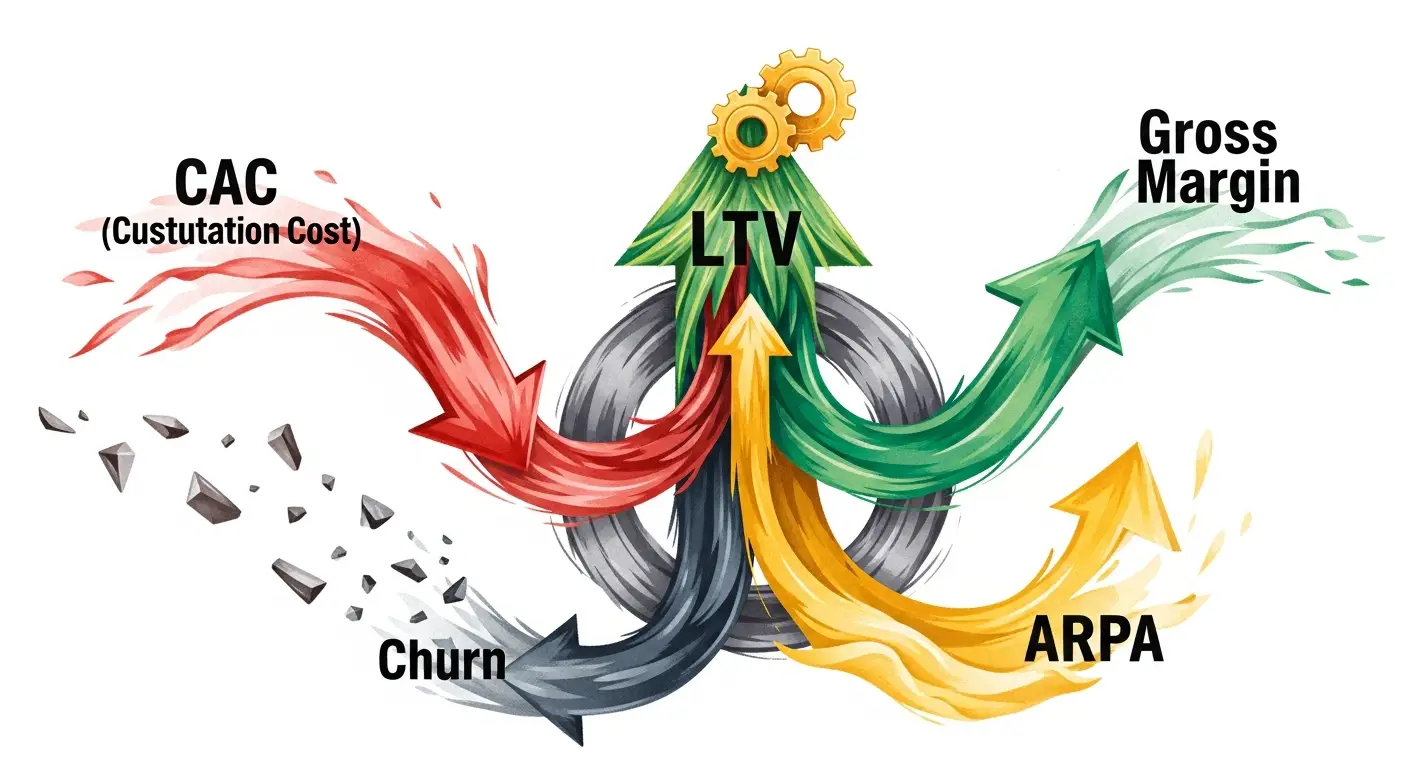
Underneath the revenue equation sit the unit economics — the per-customer math that determines whether your model is a compounding machine or a treadmill. Four numbers do most of the work.

Customer Acquisition Cost (CAC)
Customer Acquisition Cost (CAC) is the fully loaded cost of acquiring one new customer: all sales compensation, all marketing spend, the tooling that supports both, and the allocated overhead for those functions, divided by the number of new customers won.
CAC = Total Sales & Marketing Spend / Number of New Customers Acquired
If you spent $1,500,000 on sales and marketing in a period and signed 50 new customers, your CAC is $30,000. Use the fully loaded version — blended numbers that mix in organic, word-of-mouth customers flatter your CAC and lead to bad decisions. For the complete treatment, see our breakdown of SaaS unit economics and the LTV/CAC ratio.
Gross Margin
SaaS gross margin is what’s left of subscription revenue after the direct cost of delivering the service — cloud hosting, third-party data, customer support, and the like. Software’s structural advantage is that this margin is high: well-run SaaS companies run gross margins of 75% to 85%. That high margin is what makes the rest of the model work, because nearly every dollar of retained revenue drops toward the bottom line or funds growth.
Customer Lifetime Value (LTV)
Customer Lifetime Value (LTV), sometimes called CLV, is the total gross profit you earn from a customer across the entire time they stay.
LTV = ARPA × Gross Margin % × Average Customer Lifespan
Where ARPA (Average Revenue Per Account) is the monthly recurring revenue per customer, and Average Customer Lifespan = 1 / Monthly Churn Rate. (See calculating LTV for SaaS for the full method and common mistakes.)
LTV/CAC Ratio
The single number that tells you whether the machine works is the ratio of the two:
LTV/CAC = Customer Lifetime Value / Customer Acquisition Cost
The benchmark is 3.0× — meaning each dollar spent acquiring a customer returns three dollars in lifetime gross profit. Below 1.0× you are losing money on every customer you acquire. Above 5.0× you are probably under-investing in growth and leaving the market to competitors.
Here is the full worked example for a representative $10M ARR company:
| Input | Value |
|---|---|
| ARPA (monthly) | $1,000 |
| Gross Margin | 80% |
| Monthly Churn Rate | 1.5% |
| CAC (fully loaded) | $30,000 |
| Average Customer Lifespan (1 / 0.015) | 66.7 months |
| LTV ($1,000 × 0.80 × 66.7) | $53,333 |
| LTV/CAC ($53,333 / $30,000) | 1.78× |
| CAC Payback ($30,000 / ($1,000 × 0.80)) | 37.5 months |
This company has a problem. An LTV/CAC of 1.78× is below the 3.0× benchmark, and a CAC Payback Period of 37.5 months means it takes more than three years just to recover the cost of acquiring a customer. The model is technically working — LTV exceeds CAC — but barely, and the capital is locked up far too long. The fix is almost never “sell more.” It is to attack the underlying inputs.
Why Retention Is the Whole Game
Look back at that example and notice which input has the most leverage. CAC matters, ARPA matters, but the variable that quietly controls everything is churn — because it determines customer lifespan, and lifespan multiplies straight into LTV.
Watch what happens when the same company cuts monthly churn from 1.5% to 1.0%:
| Metric | At 1.5% Monthly Churn | At 1.0% Monthly Churn |
|---|---|---|
| Average Customer Lifespan | 66.7 months | 100 months |
| LTV ($1,000 × 0.80 × lifespan) | $53,333 | $80,000 |
| LTV/CAC | 1.78× | 2.67× |
A half-point reduction in monthly churn lifts LTV by 50% and pushes the LTV/CAC ratio from “concerning” to “nearly healthy” — without acquiring a single additional customer, without raising prices, without spending another dollar on marketing. This is why I tell founders to fix churn before optimizing anything else. It is the highest-leverage number in the entire model.
One nuance that trips people up: monthly and annual churn are not linear. You cannot multiply monthly churn by 12. The correct conversion compounds:
Annual Churn = 1 − (1 − Monthly Churn)¹²
So 1.5% monthly churn is not 18% annual churn — it is 1 − (0.985)¹² = 16.6% annual churn. At 1.0% monthly, it’s 1 − (0.99)¹² = 11.4% annual. The compounding cuts both ways: small monthly improvements produce outsized annual results. (For the benchmarks and how to measure it, see average churn rate for SaaS and how to reduce SaaS churn.)
The retention metric that ties it all together is Net Revenue Retention (NRR) — the percentage of recurring revenue you keep from your existing base over a year, after accounting for expansion, contraction, and churn:
NRR = (Starting MRR + Expansion MRR − Contraction MRR − Churned MRR) / Starting MRR × 100%
NRR above 100% is the holy grail of the SaaS business model: it means your existing customer base grows on its own, even if you never sign another new customer. Below 100% means you are running up a down escalator — you have to acquire new customers just to stand still. (We cover the full benchmarks in what is NRR in SaaS and the related net revenue retention guide.)
The Main SaaS Pricing Archetypes
The “SaaS business model” is really a family of revenue structures, distinguished mostly by how you price. The pricing archetype you choose shapes your CAC, your expansion potential, and your churn profile — so it is a strategic decision, not a billing detail. Here are the dominant archetypes and the tradeoffs of each.
| Archetype | How It Works | Best For | The Tradeoff |
|---|---|---|---|
| Flat-rate | One price, one product, full access | Simple products, early-stage | No expansion lever; leaves money on the table with large accounts |
| Per-seat | Price scales with number of users | Collaboration and workflow tools | Expands as the customer's team grows, but can incentivize seat-sharing |
| Tiered | Good/better/best feature bundles | Broad markets with varied buyers | Strong upgrade path; complexity can confuse buyers |
| Usage-based | Pay for consumption (API calls, storage, transactions) | Infrastructure and platform products | Revenue scales with customer value but is less predictable |
| Freemium | Free tier converts to paid over time | Bottom-up, viral adoption | Low CAC at the top, but conversion rates are often brutal |
| Hybrid | Base subscription plus usage or seats | Mature products serving mixed segments | Maximum flexibility; hardest to communicate clearly |
There is no universally correct archetype. The right one depends on how customers derive value and how that value grows over time. The strategic test is simple: does your pricing model expand revenue automatically as the customer succeeds? Per-seat, usage-based, and tiered models all build in an expansion lever, which is how the best SaaS companies achieve NRR above 100%. Flat-rate pricing, by contrast, caps your revenue per account no matter how much value the customer extracts — which is why most companies eventually graduate away from it. (For a deeper treatment, see our guides on SaaS pricing models, usage-based pricing, and pricing strategy.)
One principle cuts across all archetypes: pricing power. Can you raise prices and keep your customers? It is one of the easiest levers in the entire model to improve profitability, because a price increase flows almost entirely to gross margin. Most founders are far too timid here, leaving real EBITDA on the table out of a fear of churn that rarely materializes when the product genuinely delivers value.

The Second Sale Is Where the Money Is
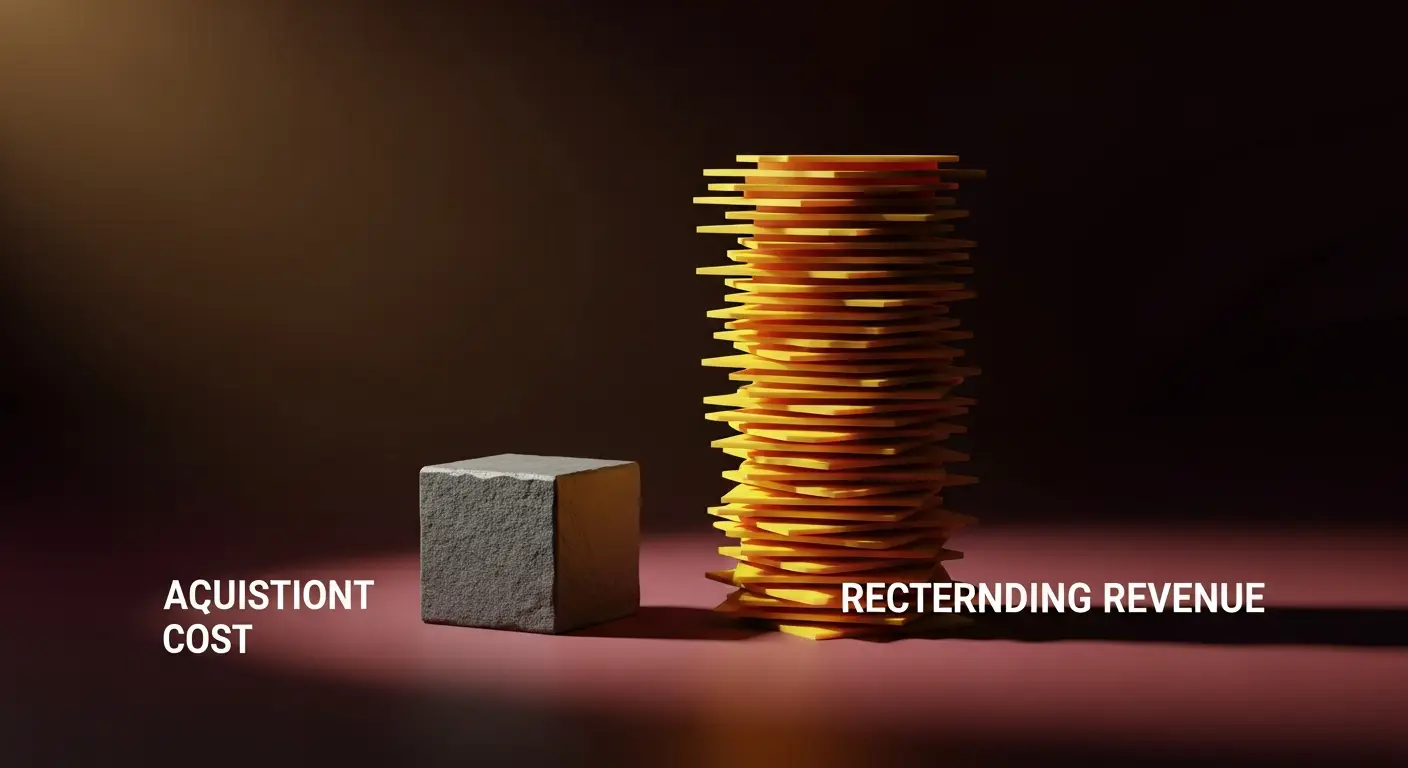
There is a reason the recurring structure matters so much beyond predictability, and it goes back to a principle I have taught for decades in a non-SaaS context: the second and third sales to an existing customer are often several times more profitable than the first. The first sale has to carry the full weight of your acquisition cost — all the marketing, all the sales overhead. Every sale after that comes with no acquisition cost attached.
This is the deep logic of the SaaS business model. When you acquire a customer, you make a large, painful upfront investment. The subscription structure is what lets you earn that investment back many times over — but only if you focus as hard on the renewal and the expansion as you did on the original sale. Most companies do the opposite. They pour resources into closing new logos and treat retention as an afterthought handled by an understaffed support team. In a recurring revenue business, that is exactly backward.
The strategic reframe is this: in a SaaS company, a booking is not a win. A booking that churns in six months is a loss — you spent the CAC and never recovered it. The metric that matters is not revenue booked but lifetime value realized. The companies that internalize this build their entire organization around the customer’s ongoing success rather than the initial transaction, and their unit economics reflect it.
Building for Scale: The Sales Motion Matters
A subtle but decisive part of the SaaS business model is how you sell, because it determines whether you can scale predictably. There are broadly two ways to build a sales organization. One is the superstar model: hire a small number of exceptional rainmakers who close large, complex deals through sheer skill and relationships. It works, but it is expensive, hard to replicate, and fragile — when a superstar leaves, their pipeline leaves with them.
The other is what I call the role-player model — the McDonald’s approach. You build a repeatable sales process that competent, trainable people can execute from a playbook. No individual is irreplaceable, and you can add capacity by hiring and training rather than by recruiting unicorns. For most SaaS businesses, this is the far better path, because it makes growth a function of process rather than personality.
The endgame of the role-player model is a genuine sales machine: a system predictable enough that you can put a dollar of sales and marketing spend in one end and reliably get a known amount of bookings out the other. Once you reach that point, growth stops being a sales problem and becomes a capital allocation problem. That transition — from intuition-driven selling to a statistical, predictable engine — is one of the highest-leverage things a SaaS CEO can build, and it directly de-risks the business in the eyes of any future acquirer. (For more on this transition, see scaling a SaaS business.)
Why Recurring Revenue Commands a Premium at Exit
Here is the payoff that makes all of this matter for a founder building toward an exit: recurring revenue businesses sell for dramatically higher multiples than transactional ones. The reason is simple — contractually recurring revenue is predictable and, in many cases, legally obligated. An acquirer paying a multiple of revenue is really buying the certainty of that future revenue, and nothing is more certain than a contracted subscription with a track record of renewals.
This is one of six factors that drive your valuation multiple, and most founders only think about three of them:
- Revenue nature — how recurring and contractual your revenue is. The single biggest lever, and the one the SaaS model is built around.
- Growth rate — how fast ARR is growing.
- Margins — gross margin and EBITDA margin.
- Risk — the gap between your forecast and reality. Key-person dependency, customer concentration, and unpredictable sales execution all crush multiples.
- Competitive advantage durability — could a well-funded team replicate you with $10M and 24 months? If yes, your multiple suffers.
- Market size — is there room left to grow into?
The founders who only optimize for growth and margin leave enormous value on the table. The ones who maximize the recurring percentage of their revenue, de-risk their execution, and build a durable advantage capture the full premium the model is capable of producing. This is also why the related metrics matter so much to buyers — your Rule of 40 score, your NRR, and your overall SaaS company valuation all flow directly from how well your business model’s underlying economics actually perform.
The deeper point is that the SaaS business model is not just a way to run a company — it is a way to build an asset. Every improvement you make to retention, expansion, and predictability compounds twice: once in your operating cash flow today, and again in the multiple a buyer will pay for that cash flow tomorrow. According to SaaS Capital’s research on private SaaS company valuations, retention and growth efficiency are among the strongest predictors of where a company lands in the valuation range — confirming with data what the unit economics predict in theory.
Common Mistakes That Break the Model
For all its elegance, the SaaS business model is easy to get wrong. The most common failures I see fall into a few categories:
- Treating the subscription as the strategy. The model is the starting point, not the advantage. If your unit economics don’t work, switching to a subscription doesn’t fix anything — it just spreads the loss over more months.
- Counting one-time revenue as ARR. Implementation fees and professional services inflate your ARR and mislead you about your real recurring base. Acquirers will catch this in diligence and discount you for it.
- Under-measuring retention. Most founders can recite their bookings number but not their NRR by segment. You cannot fix what you don’t measure, and retention is the highest-leverage number you have.
- Ignoring segmentation. Blended, company-wide metrics hide the truth. Your LTV/CAC, churn, and NRR almost always vary dramatically by vertical, contract size, and acquisition channel — and the averages mask both your best and worst segments.
- Optimizing the first sale and neglecting the second. In a recurring model, the renewal and the expansion are where the profit lives. Building your whole organization around new-logo acquisition is fighting the model instead of riding it.
SaaS Business Model FAQ
What is the SaaS business model in simple terms?
The SaaS (Software-as-a-Service) business model delivers software over the cloud and charges customers a recurring subscription fee — monthly or annually — instead of a one-time license. The customer rents ongoing access rather than buying and owning the software, which means the vendor only earns the full value of a customer if they keep renewing.
How does a SaaS business actually make money?
A SaaS business makes money by acquiring a customer at an upfront cost (CAC) and then earning high-margin recurring revenue for as long as that customer stays. The model is profitable when the lifetime value of the customer exceeds the acquisition cost — the benchmark is an LTV/CAC ratio of at least 3.0× — and when retention and expansion grow the revenue base over time.
What metrics matter most in the SaaS business model?
The four foundational numbers are Customer Acquisition Cost (CAC), gross margin, churn rate, and Average Revenue Per Account (ARPA) — which combine into Customer Lifetime Value (LTV) and the LTV/CAC ratio. Beyond those, Net Revenue Retention (NRR), CAC Payback Period, and the Rule of 40 are the metrics acquirers scrutinize most closely.
What are the main SaaS pricing models?
The dominant pricing archetypes are flat-rate, per-seat, tiered (good/better/best), usage-based, freemium, and hybrid models that combine a base subscription with seats or usage. The best choice depends on how your customers derive value — and ideally the model builds in an expansion lever so revenue grows automatically as the customer succeeds.
Why do SaaS companies sell for higher valuations?
SaaS companies command higher valuation multiples because contractually recurring revenue is predictable and often legally obligated, which lowers risk for an acquirer. The more recurring your revenue, the stronger your retention, and the more predictable your growth, the higher the multiple — recurring revenue is the single biggest of the six factors that drive a SaaS valuation.
Related Reading:
- SaaS Unit Economics
- LTV/CAC Ratio
- Net Revenue Retention
- SaaS Pricing Models
- Rule of 40
- SaaS Company Valuation
- Scale a SaaS Business