

Most SaaS CEOs trying to figure out how to sell SaaS B2B are solving the wrong problem. They believe their sales team needs better training, more discipline, sharper scripts, or a new VP. What they actually need is to face an unwelcome fact: B2B SaaS selling is a unit-economics problem dressed up as a people problem. Hire harder, pay more, and add scripts — none of it scales if your Annual Contract Value (ACV) and Customer Acquisition Cost (CAC) don’t match.
This article is the playbook I give first-time CEOs at $2M–$25M Annual Recurring Revenue (ARR) who feel their sales engine is leaky but can’t name why. We’ll cover what makes B2B SaaS different, how to map the buying committee, how to define a tight enough ideal customer profile (ICP), how to choose your motion (Product-Led Growth, Sales-Led, or Hybrid) based on ACV thresholds, the sales numbers acquirers actually check, and how to build the team stage by stage. By the end you’ll know whether your engine is healthy and what to fix first if it isn’t.
What Makes Selling B2B SaaS Different (and Harder)
Selling business-to-business Software as a Service (B2B SaaS) is structurally harder than three obvious alternatives:
| Dimension | B2B SaaS | B2C SaaS | On-Premise Enterprise Software | Professional Services |
|---|---|---|---|---|
| Buyer | Multi-person committee (avg. 6.8 people, per Gartner) | One consumer | One CIO + procurement | One client decision-maker |
| Cycle length | 30 days–18 months by ACV | Minutes–hours | 12–24 months | 7–30 days |
| Decision drivers | ROI, risk, integration, security, compliance, vendor risk | Convenience, price | Capability, control, security | Trust, capacity |
| Revenue shape | Recurring monthly/annual | Recurring (lower ARPU) | Lump-sum + maintenance | Hours billed |
| Failure cost | Churn destroys LTV/CAC ratio | Low | Sunk implementation cost | Lost client |
Three structural differences cause the most damage:
1. The buying committee. You aren’t selling to a person; you’re selling to a group. The economic buyer cares about ROI and budget. The technical buyer cares about security, integration, and operational risk. The functional buyer cares about whether the product solves the problem his team actually has. The end user cares about whether his life gets better. Any one of them can kill the deal. None of them can close it alone.
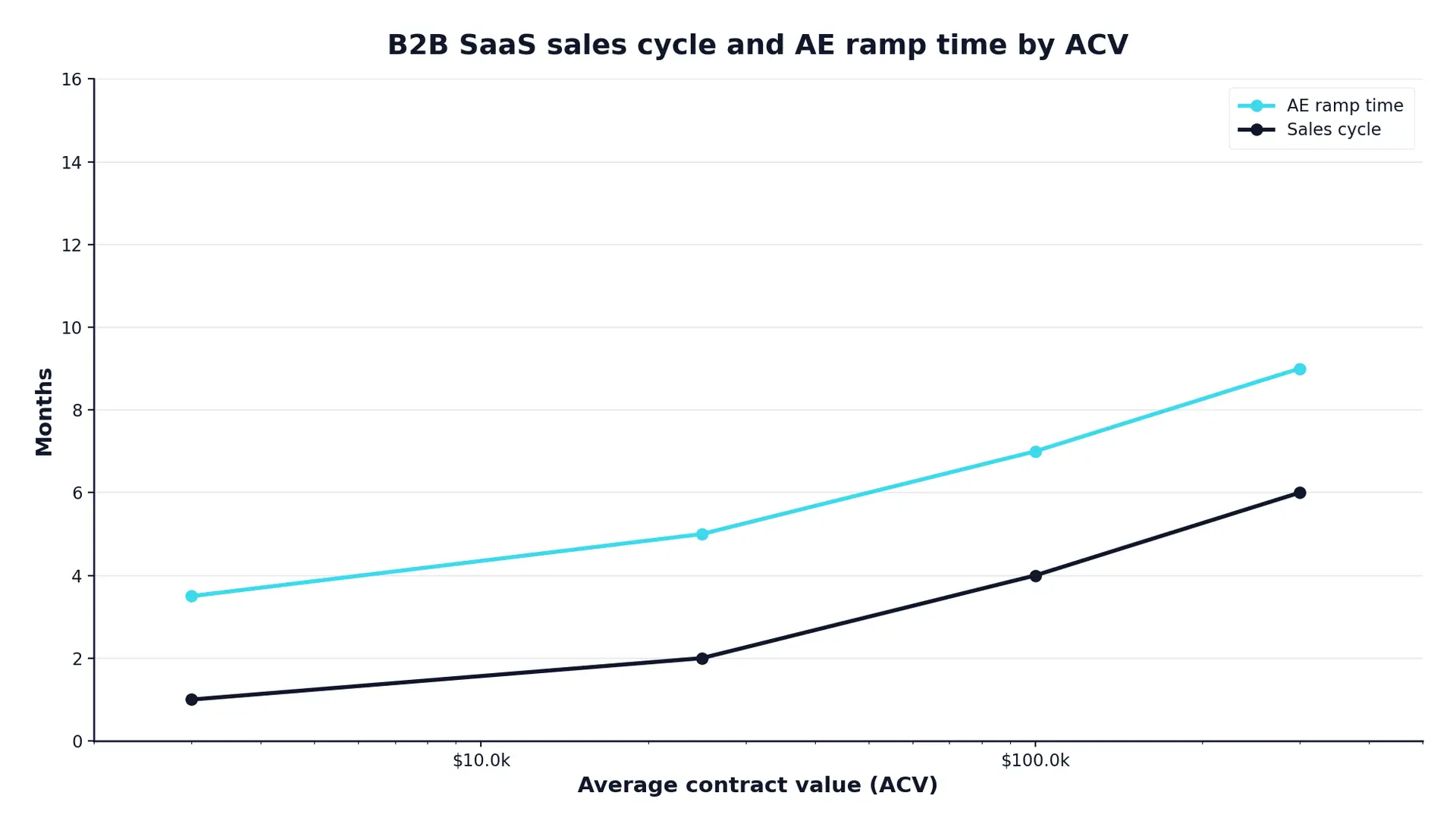
2. Long, asymmetric cycles. A $5K Annual Contract Value (ACV) deal closes in 14 days. A $250K ACV deal takes 9 months. The same sales rep can close 60 small deals or 4 enterprise deals in a year. The motion, the rep profile, the comp plan, and the unit economics are all different — and using one motion for the wrong ACV band silently destroys CAC payback (the months it takes to recover the cost of acquiring a customer).
3. Recurring revenue means selling never stops. Year-one closing is 30–50% of the customer’s total economic value. The other 50–70% comes from renewal and expansion. Closing without reducing churn is a treadmill. Expansion through a strong net revenue retention (NRR) program is the only way the math actually works.
If you remember nothing else from this article, remember this: you can never outgrow bad unit economics. Bad unit economics means CAC is too high or LTV is too low relative to the deal. Fix that, and you have a business. Don’t fix it, and you have a money-burning growth machine that looks great on a slide deck and dies the moment the funding runway ends.
Map the B2B SaaS Buying Committee Before You Do Anything Else
Every meaningful B2B SaaS deal has at least three people in the buying committee and frequently has seven or more. Each plays a distinct economic role:
| Persona | Title (typical) | What they care about | What kills the deal for them |
|---|---|---|---|
| Economic buyer | CFO, COO, sometimes CEO | ROI in months, total cost of ownership, displacement of an existing cost | "Couldn't quantify the payback" |
| Technical buyer | CTO, CIO, VP Engineering | Security, integrations (especially with their CRM, ERP, identity provider), scalability, vendor risk | "Implementation looked risky" |
| Functional buyer | VP Sales, VP Marketing, VP Operations, VP Finance | Will this solve my team's specific problem better than the workaround we have now? | "Didn't see daily-workflow fit" |
| End user | Manager, analyst, individual contributor | Is this easier than what I do today? Will I look good using it? | "Felt like more work, not less" |
| Procurement | Procurement / vendor management | Cost negotiation, contract terms, vendor onboarding | "Couldn't justify the price vs. alternatives" |
| Security / compliance | CISO, compliance officer | SOC 2, ISO 27001, data residency, GDPR/HIPAA where applicable | "Failed security review" |
| Legal | General counsel or outside counsel | Data processing agreement (DPA), liability caps, indemnification | "Contract terms unacceptable" |
A scenario makes this concrete. A $75K ACV deal at a 800-person mid-market manufacturer:
Scenario #1 — The Single-Threaded Loss. Your AE (Account Executive) builds a strong relationship with the VP of Operations (the functional buyer). The VP of Operations is excited. Demos go well. Three months in, the deal “just disappears.” What happened: the CFO never got a one-page ROI brief, IT raised an integration concern in the last meeting your AE wasn’t in, and procurement decided to bundle the purchase decision with a CRM contract that goes to procurement review in February — six months later. The deal isn’t dead. It’s frozen because the AE was single-threaded.
Scenario #2 — The Multi-Threaded Win. Same deal, different AE. By month two, your AE has talked to the VP Operations, an analyst on his team, the CFO’s controller, an IT director, and procurement. Each conversation is shaped to that person’s economic concern. The ROI brief lands on the CFO’s desk before he asks for it. IT has a one-pager on integration with their existing ERP. Procurement has a side-by-side with the two competing solutions. The deal closes in month five.
The rule. For every deal over $25K ACV, identify and have direct conversations with at least the economic buyer, the technical buyer, and the functional buyer. Single-threaded deals at this ACV band lose 60–70% of the time even when “everything looked great with the champion.” Multi-threaded deals close 50–65%.
Define an ICP Tight Enough to Sell To
ICP — ideal customer profile — is the most under-priced lever in B2B SaaS sales. Wrong ICP wrecks every downstream metric: CAC, win rate, cycle length, churn, NRR, and expansion. The pattern at $2M–$10M ARR is consistent: founders define ICP as “B2B companies between $10M and $1B in revenue” and then wonder why their sales velocity is one-fifth of what it should be.
A useful ICP has five dimensions:
- Firmographics: Industry vertical, company size range (employees AND revenue), geography, growth stage. Tight: “B2B SaaS companies, 50–500 employees, $5M–$50M ARR, North America.” Loose: “Mid-market tech companies.”
- Technographics: What tools they use. The integration adjacency matters because it predicts both fit and cycle length. “Companies using HubSpot CRM and Salesforce Marketing Cloud” is a tight technographic; “companies with a modern tech stack” is not.
- Trigger event: What just happened in their business that makes them ready to buy? New VP of X joined, hit a revenue milestone, raised a Series B, lost a major customer, missed a quarter. Without a trigger event, even a fit account is not in-market.
- Pain symptom: The specific operational symptom your product solves — phrased the way the prospect would describe it (“our reps are losing 6 hours a week on data entry”), not the way you describe your category (“we’re a sales productivity platform”).
- Economic profile: ACV range, expansion potential, gross margin profile, expected payback period.
The discipline isn’t writing this down. The discipline is using ICP fit as a gate — saying no to deals that don’t match. The fastest way to wreck a young sales org is to chase every opportunity that comes in. The reps work harder, win less, and slowly demoralize themselves. Segment everything, then sell to your highest-yield segment first.
The Sales Process That Actually Closes B2B SaaS Deals
A B2B SaaS repeatable sales process has six stages with measurable conversion rates between each. The exact stage names matter less than the gates between stages — what has to be true to move a deal forward.
| Stage | Definition | Exit criterion (move to next) | Median conversion to next stage |
|---|---|---|---|
| 1. Qualified Lead (MQL → SQL) | Inbound or outbound contact who matches ICP and shows intent | Discovery call scheduled and held | 30–40% MQL→SQL |
| 2. Discovery | Conversation that uncovers pain, quantifies impact, identifies stakeholders | Pain quantified in dollars; 2nd meeting set with second stakeholder | 50–60% |
| 3. Demo / Solution Validation | Tailored demo or Proof of Concept (POC) | Solution fit confirmed; technical evaluation scheduled | 60–70% |
| 4. Technical / Security Evaluation | IT review, integration scoping, security questionnaire | Technical approval given; pricing requested | 70–80% |
| 5. Proposal & Negotiation | Pricing presented, contract redlined, procurement engaged | Verbal commitment, contract in legal | 60–75% |
| 6. Closed-Won | Signed contract, billing started | Onboarding kickoff scheduled | n/a |
End-to-end win rate (Lead → Closed-Won) for a healthy mid-market B2B SaaS org is 15–25%. End-to-end win rate for an immature org is 3–8%. The difference is almost never lead quality; it’s the rigor of the qualification at Stage 1–2 and the stakeholder mapping at Stage 3.
Two rules that compound over the life of the org:
Document each gate. A stage isn’t a stage if the criterion to leave it is “the AE thinks the deal is moving.” A stage is real when the criterion is observable and uniform across reps. New hires hit ramp 2–3× faster on real stages than on vibes-based stages.
Inspect, don’t believe. Pipeline reviews where the AE narrates each deal in his own words are theater. Pipeline reviews where the manager asks “what’s the documented exit criterion of this stage, and which of those are met for this deal?” produce reality. Most stuck deals are stuck at Stage 2 or 3 because no one quantified the pain in dollars and no one mapped the committee — and no one is willing to say so out loud.
How to Choose Your B2B SaaS Sales Motion: PLG, Sales-Led, or Hybrid
There are three motions to sell B2B SaaS:
Product-Led Growth (PLG). Users sign up themselves, use a free trial or free tier, hit value, and upgrade. The product does the selling. Examples: Slack, Notion, Calendly, early Zoom. Sales reps enter the picture later — at the team upgrade or annual contract stage.
Sales-Led Growth. Sales Development Reps (SDRs) and AEs drive outbound, qualify, demo, negotiate, and close. The product is delivered after the sale, and CSMs (Customer Success Managers) take over onboarding. Examples: Salesforce (historically), Marketo, Gainsight.
Hybrid. PLG for the bottom of the market (self-serve under some threshold); Sales-Led for the top (enterprise > some threshold). Examples: HubSpot, Datadog, Atlassian, Notion (post-IPO).
The mistake is treating “which motion” as a strategy debate. It’s not. It’s a math problem with one input: ACV.
Use these four filters to decide:
- ACV. Below $5K, PLG only — sales reps cannot pay for themselves. $5K–$50K, inside sales works. $50K–$150K, hybrid (inside + occasional field). Above $150K, field sales required.
- Sales cycle tolerance. PLG can close in days. Inside sales: 30–90 days. Field sales: 4–12 months. If your runway demands cash in 90 days, you cannot start a field sales motion now.
- Product complexity. Self-explanatory product (Calendly, Loom, Notion) → PLG works. Configurable, vertical-specific, or integration-heavy product → needs sales support.
- Buying committee size. 1 buyer → PLG plausible. 3+ buyers → needs sales motion. 6+ buyers → needs hybrid or field sales.
If you fail filter 1 (your ACV doesn’t support the motion you’re running), the other filters don’t matter. Sales rep on-target earnings (OTE) at mid-market is $120K–$180K. Quota at 4× OTE means each AE needs to close $480K–$720K of new ARR per year. If your ACV is $8K, each AE needs to close 60–90 new logos per year. That isn’t a sales motion. That’s a hot-leads churn machine that needs PLG underneath it.
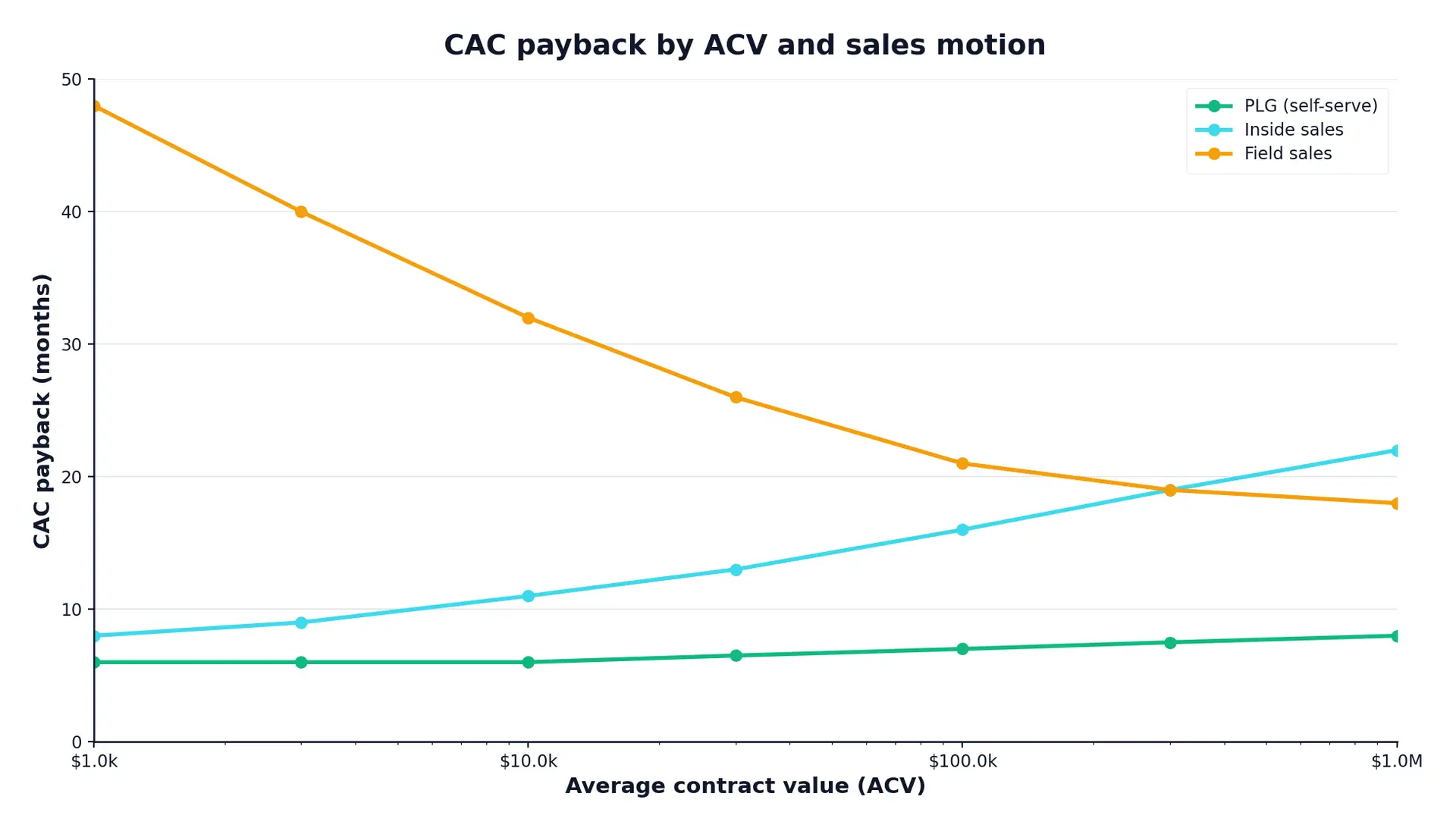
ACV Determines the Sales Model: A Decision Framework
The decision rule, applied:
| ACV band | Motion | Sales team profile | Typical cycle | Coverage model |
|---|---|---|---|---|
| < $5K | PLG only | No sales reps; growth/marketing-led | Hours–days | Self-serve checkout |
| $5K–$15K | Inside Inbound | 1 SDR : 2 inside AEs, lead is qualified by ICP signals | 14–60 days | Pooled accounts |
| $15K–$50K | Inside Outbound + Inbound | 2 SDRs : 1 AE | 60–120 days | Named-account list per AE |
| $50K–$150K | Inside / Hybrid | 1.5 SDRs : 1 AE, occasional in-person travel | 90–180 days | Named accounts + territories |
| $150K–$500K | Field Sales | 1 SDR : 1 AE : 0.5 Sales Engineer | 4–9 months | Named accounts, smaller list |
| > $500K (Enterprise) | Field + Account Pursuit | 1 AE : 1 SE : 0.25 Industry SME, executive sponsor | 6–18 months | Strategic account plan |
A scenario. A $7M ARR company with a $22K average ACV is running a field sales motion (3 AEs in different cities, OTE $180K each, no SDRs). Math: 3 × $720K quota = $2.16M new ARR target. Actual: $1.1M (51% of quota). CAC payback at 38 months. The diagnosis isn’t “we need better AEs.” The diagnosis is “we are running the wrong motion for our ACV — we should have 2 inside AEs and 4 SDRs based out of a single hub, and our reps would have far more ramp on a higher volume of repeatable deals.” The fix is a motion change, not a hiring change.
For more on choosing between specific go-to-market options, see SaaS sales models and the SaaS go-to-market strategy template.
The Numbers That Tell You If Your B2B SaaS Sales Engine Is Working
Six metrics matter. The rest is noise.
1. Customer Acquisition Cost (CAC). Total sales + marketing spend in a period, divided by new logos acquired in that period.
CAC = (Sales spend + Marketing spend) / New Customers Acquired
A $5M ARR SaaS company spending $1.5M on sales + $900K on marketing and adding 80 new logos has a CAC of $30K per customer.
2. CAC Payback Period. The months to recover CAC from gross-margin contribution.
CAC Payback (months) = CAC / (ACV × Gross Margin / 12)
With $30K CAC, $24K ACV, and 78% gross margin: CAC Payback = $30K / ($24K × 0.78 / 12) = $30K / $1,560 = 19.2 months.
Healthy B2B SaaS: 12–18 months. Strong: <12. Worrying: 18–24. Broken: >24. At 19 months we’re in the worrying band — manageable but a sign the motion is slightly mismatched to the ACV.
3. LTV / CAC Ratio. Lifetime value over CAC. LTV = ACV × Gross Margin × (1 / Annual Gross Logo Churn). Use LTV/CAC, never CAC/LTV.
For a customer paying $24K ACV at 78% gross margin with 12% annual gross churn: LTV = $24K × 0.78 / 0.12 = $156K. LTV/CAC = $156K / $30K = 5.2×.
Healthy: 3:1 floor. Strong: 5:1. Above 8:1 may mean you are underinvesting in growth — your product is so good and your CAC so low that adding sales investment would generate more ARR than it costs. 5.2× is in the strong band; this company could push more aggressively if cash allows.
For the underlying mental model, see SaaS unit economics and customer lifetime value.
4. Sales Velocity. How fast new ARR comes out of the pipeline.
Sales Velocity = (# Qualified Opportunities × Avg Deal Size × Win Rate) / Sales Cycle (months)
A team with 240 SQOs/year, $24K avg deal size, 22% win rate, 4.5‑month cycle: Velocity = (240 × $24K × 0.22) / 4.5 = $281K of new ARR per month, or $3.4M annualized. Compare against ARR target.
5. Pipeline Coverage. Open pipeline (sum of deal sizes in active stages, weighted or unweighted depending on convention) divided by the quota for that period.
Pipeline Coverage = Open Pipeline ($) / Quarterly Quota ($)
Universal rule: 3× coverage is the floor for a healthy quarter. Below 2.5×, the quarter is at risk regardless of what reps tell you. Above 4×, reps are likely sandbagging — deals that should be in a more advanced stage are being held back.
6. Net Revenue Retention (NRR). Of the dollars you had last year from this set of customers, how many do you have this year, including upsells, downsells, and churn?
NRR = (Starting ARR + Expansion − Contraction − Churn) / Starting ARR
Healthy: 105–115%. Strong: 115–130%. Best-in-class: >130%. Below 100% means your customer base is shrinking in dollars and you are running up a down escalator. NRR is the single most predictive metric of future valuation multiple. Before optimizing acquisition, fix NRR if it’s under 100% — see revenue retention and gross revenue retention for the underlying math.
A related composite worth tracking: the SaaS Magic Number, which captures how much new ARR each dollar of sales-and-marketing spend produces. Magic Number above 1.0 generally signals healthy sales efficiency.
Building the B2B SaaS Sales Team by Stage
Your sales team org at $2M ARR is unrecognizable next to your sales team org at $25M ARR. The transitions are predictable; the pain at each transition is also predictable.
| Stage | ARR | Sales team | Founder role | Key transition pain |
|---|---|---|---|---|
| Founder-led | $0–$2M | Founder closes every deal; 1 part-time SDR or none | 80% of every deal | "I can't take a vacation; the pipeline collapses" |
| First reps | $2M–$5M | 1–2 AEs, 1 SDR, founder still on every late-stage call | 30–50% of late-stage; coaches reps | "My reps close at 8% and I close at 30% — what am I doing differently and how do I teach it?" |
| Sales leader | $5M–$10M | 4–6 AEs, 3 SDRs, 1 sales manager (often a senior rep) | Strategic deals only; quarterly sales reviews | "We need real systems and I don't know what they are" |
| Systematized | $10M–$25M | 8–15 AEs across 2–3 segments, 6–10 SDRs, VP Sales, RevOps, Sales Enablement | Major strategic accounts + investor narrative | "VP Sales hires aren't working; org chart issues" |
| Multi-segment | $25M–$50M | Segmented teams (SMB / Mid-Market / Enterprise), each with its own AE/SDR ratio and motion | Top-of-funnel partnerships + a few flagship customers | "Mid-market motion is collapsing margins; enterprise cycle is killing cash" |
| Predictable engine | $50M+ | Full GTM org (~25–40 sales staff per $50M ARR) | Capital allocator | Predictable, but margin and segment mix become the lever |
The founder-led exit ramp is the most fragile transition. The instinct is to “hire a VP of Sales” at $3M ARR, hand off, and go work on the product. The pattern that fails: founder hires senior VP, VP brings playbook from a $50M-ARR company, the playbook doesn’t fit a $3M-ARR company, two quarters later the VP is gone and so is the trust. The pattern that works: founder hires a senior AE-turned-manager first (not a VP), keeps closing the top 30% of deals himself for another year, builds the playbook with that person, then promotes (or replaces) into a VP role at $8–10M ARR when the playbook is documented and reproducible.
The deeper reason is what I call the founder-to-CEO skill gap: founders are intuitive and opportunistic; CEOs are data-driven and systematic. Both stances are right at different stages. The transition is the biggest single obstacle to scaling a B2B SaaS sales org.
Two principles independent of stage:
Hire in pairs. Hiring one rep means you cannot tell if a poor result is the rep or the territory. Hiring two means you have a comparison.
Study the outliers. Whoever is your top closer is doing 3–5 things differently. Find out what. Document it. Train the rest of the team on it. This is the single highest-leverage process improvement available in the first $25M of ARR.
Outbound vs. Inbound: Where Each One Earns Its Keep
Inbound and outbound are not “channels you choose between.” They are different shapes of pipeline that should run in parallel.
Inbound — content, SEO, paid ads, webinars, communities, organic referrals. Leads come to you. Conversion rates are higher (people are already self-qualified), but you can’t direct who shows up. Inbound is dominant when your category is mature enough that prospects search for solutions. It is invisible when the category is new.
Outbound — SDR prospecting, cold email, LinkedIn outreach, intent-data-driven account-based marketing (ABM). You go to the prospect. Conversion rates are lower, but you choose the accounts. Outbound is dominant when you have a tight ICP and a defined named-account list, and when the prospect doesn’t know they need your solution yet.
The decision isn’t either/or. The decision is what mix fits your ACV and stage:
| ACV band | Inbound:Outbound mix | Why |
|---|---|---|
| < $5K | 95:5 | Outbound math doesn't work at this ACV |
| $5K–$15K | 70:30 | Mostly inbound, outbound for select target accounts |
| $15K–$50K | 50:50 | Balanced; outbound builds the named-account base |
| $50K–$150K | 30:70 | Outbound carries the load; inbound supplements |
| > $150K | 15:85 | Strategic-account selling; inbound rarely produces enterprise leads |
For B2B SaaS at $15K+ ACV, see outbound lead generation services for B2B SaaS for the operational playbook on cold outreach, SDR ramp, and ABM coordination.
Leveraging Partnerships and Distribution Channels
Direct sales is one of several SaaS distribution channels. The others — channel partners, integration ecosystems, marketplaces, and resellers — can lower CAC dramatically when they fit your motion and raise it when they don’t.
Channels make sense when:
- Your prospects already cluster around an ecosystem (Salesforce AppExchange, HubSpot App Marketplace, Microsoft AppSource).
- You have an integration that materially expands the partner’s product offering.
- A consulting or implementation partner is already in the conversation when your product would be useful.
- Your product is too specialized for direct outbound to find economically.
Channels destroy CAC when:
- You spend more building partner enablement than the channel actually returns.
- Partners sell competing products and yours becomes a low-priority option.
- Your product requires hands-on selling that partner reps can’t deliver.
A pragmatic rule: channels work as a force multiplier on an already-functional direct motion. Channels do not replace direct selling at the start. Build direct first, then add channels when you have a documented playbook the partner can carry.
Customer Success Is a Revenue Engine, Not a Cost Center
In the original article we said “customer success isn’t just retention — it’s a revenue driver.” That’s directionally right but doesn’t go far enough. Here’s the operational frame:
Customer Success in a healthy B2B SaaS org produces 30–50% of new ARR through expansion, cross-sell, and upsell — not as a side effect of good service, but as a deliberate revenue function with quotas, comp, and pipeline.
The four levers of a customer-success-as-revenue function:
- Time to first value (TTFV). The fastest path from contract-signed to “the customer got the result we promised.” Below 30 days for SMB and mid-market; below 90 days for enterprise. Slow TTFV destroys NRR faster than churn.
- Usage and engagement monitoring. Define what “healthy usage” looks like for an account (weekly active users, key feature adoption, integration depth) and intervene the moment it drops.
- Renewal motion. Renewals start 120 days before the renewal date, not 30. Treating them as administrative rather than commercial is the #1 cause of avoidable churn in mid-market B2B SaaS.
- Expansion motion. Identify expansion triggers (new team adoption, new use case, organizational growth), staff CSMs against those triggers, and pay on expansion quota.
A healthy NRR of 110–120% means each customer is worth 10–20% more revenue this year than last, before any new logo acquisition. Compounded, this is the single most powerful lever in B2B SaaS. See the SaaS customer success metric for the operational definition of healthy customer success, and reduce SaaS churn for the retention side of the equation. Both feed into the eventual SaaS exit strategy because acquirers pay a premium for proven recurring expansion.
B2B SaaS Sales Benchmarks (2025–2026)
A reference table for benchmarking your team. Numbers are operational averages across the $2M–$50M ARR mid-market B2B SaaS segment, drawn from SaaS Capital, OpenView, and KeyBanc industry surveys.
| Metric | SMB ACV ($5K–$25K) | Mid-Market ACV ($25K–$100K) | Enterprise ACV ($100K+) |
|---|---|---|---|
| Sales cycle (median) | 30–60 days | 90–150 days | 6–12 months |
| Win rate (qualified → closed) | 20–30% | 18–25% | 12–20% |
| AE ramp time | 3–4 months | 4–6 months | 6–9 months |
| AE quota attainment | 55–65% | 50–60% | 45–55% |
| Pipeline coverage (target) | 3× | 3–4× | 4–5× |
| CAC payback | 8–14 months | 14–22 months | 18–30 months |
| LTV / CAC | 4–6× | 3–5× | 2.5–4× |
| Gross logo churn (annual) | 8–15% | 5–10% | 3–7% |
| NRR | 100–115% | 110–125% | 115–135% |
| AE OTE (USD) | $120K–$150K | $150K–$200K | $200K–$280K |
| Quota multiplier (Quota/OTE) | 4–5× | 4–5× | 5–8× |
A team performing in the middle bands of each row is healthy. Two or more rows in the bottom quartile means the motion needs reworking, not the people. One specific row in the bottom quartile (e.g., low quota attainment with everything else healthy) usually means a specific local problem — bad territories, wrong AE-to-SDR ratio, missing enablement.
Common Mistakes When Selling B2B SaaS
The same mistakes show up at every $5–10M ARR company I work with.
1. Selling to anyone, not your ICP. The biggest single cause of bad unit economics. Reps win deals, churn rate climbs, NRR drops, the math stops working. Saying no to non-ICP deals is the highest-yield discipline in early-stage sales.
2. Single-threaded enterprise deals. Champion gets promoted or leaves; deal dies. Always have at least three named relationships in each $50K+ ACV deal.
3. Confusing motion with effort. “We need to work harder” is what teams say when they haven’t faced that the motion is wrong for the ACV. Working harder on a $10K ACV with a field-sales motion changes nothing; switching to inside sales changes everything.
4. Demos before discovery. Reps love demos because they feel like progress. Demos before discovery sell the rep’s vision of the customer’s problem rather than the customer’s actual problem. Result: the customer doesn’t see himself in the demo and the deal stalls.
5. Skipping pricing discipline. Discounting reflexively, no playbook for procurement, no walk-away thresholds. Procurement people are trained to detect indecision. Reps who hold price on principle outperform reps who match every objection.
6. Hiring a senior VP of Sales too early. Founders at $3M ARR hire a $300K-OTE VP from a $50M-ARR company. The VP’s playbook is for a different stage. He tries to install it. It doesn’t fit. Six quarters of pain. The fix is a senior manager first, then a VP at $8–10M ARR.
7. Treating customer success as cost recovery. CSMs sized for “answering tickets” rather than “expanding accounts.” Result: NRR stuck under 100% even when product is good.
8. Pipeline narrative theater. Forecast calls where AEs tell stories instead of citing stage-exit criteria. Quarterly forecast accuracy ±25%. Real pipeline reviews use observable criteria and produce ±10% accuracy.
9. Failing to invest in product-market fit before scaling sales. Hiring 5 AEs into a product that doesn’t have product-market fit burns $1M in 12 months and learns nothing.
10. Treating churn as a customer success problem. Most churn originates in the sales process — wrong ICP, oversold features, missed expectations. Fix the sales process and churn drops without doing anything to retention itself.
B2B SaaS Sales FAQ
How long does it take to sell B2B SaaS at $50K ACV? Median is 90–150 days from qualified opportunity to closed-won. Below 90 days suggests insufficient stakeholder mapping (you’ll see it in elevated 6‑month churn). Above 150 days suggests the deal is stuck at the proposal or procurement stage.
What’s a healthy CAC payback for B2B SaaS? 12–18 months is healthy. Under 12 is strong (and may indicate you can deploy more growth capital). Over 24 means the motion is mismatched to the ACV or the product isn’t ready to scale.
How do I know if I should switch from outbound to PLG? Two signals. First, your ACV is under $15K and your AE quota attainment is below 50%. Second, you have telemetry showing prospects are willing to self-serve through your product. If both, design a PLG tier. If just the first, run experiments before fully migrating.
When do I hire my first VP of Sales? Not at $3M ARR. Hire a sales manager (often a promoted senior AE) at $3–5M. Hire a true VP at $8–12M ARR, after the manager has built a playbook that’s reproducible. Skip a step and the transition rarely works.
What does it mean if my LTV/CAC is above 8×? Usually one of three things. (a) You are underinvesting in growth and your reps are fishing in a barrel. (b) You’re not counting all the costs in CAC (loaded headcount, allocated marketing, customer success). © You’re mis-measuring LTV (using ARR instead of gross-margin contribution, or using a too-low churn assumption). Investigate (b) and © first.
What’s the right SDR-to-AE ratio? For inbound-heavy SMB: 1 SDR per 2 AEs. For balanced mid-market: 1.5–2 SDRs per AE. For outbound-heavy mid-market or enterprise: 2–3 SDRs per AE. Below 1:2 and AE reps spend too much time prospecting; above 3:1 and your SDRs outrun the AEs’ capacity to demo.
How much should I spend on sales and marketing as a percentage of revenue? At $5–25M ARR growing 30–60% per year, healthy is 40–60% of new ARR spent on sales + marketing, which translates to roughly 30–50% of total revenue. Above 60% of new ARR signals an efficiency problem; below 30% may signal underinvestment.
Should I use a free trial or a freemium model? Freemium when the marginal cost of an additional user is near zero and the product has natural team-collaboration virality. Free trial (14–30 days) when the product requires onboarding to demonstrate value. Most B2B SaaS at $25K+ ACV does better with structured 14–30 day trials, not freemium.
The Bottom Line
Selling B2B SaaS profitably is a unit-economics problem first and a sales-execution problem second. Get the ACV-to-motion match right, define an ICP tight enough to disqualify on, multi-thread every deal above $25K ACV, measure CAC payback and NRR honestly, and build the team in stages. Get those right and your sales engine compounds. Get them wrong and no amount of effort, comp, or coaching will fix it.
The path forward, in order:
- Tighten your ICP. Say no to non-ICP deals for one quarter and watch what happens to win rate and cycle length.
- Compute CAC payback, LTV/CAC, and NRR honestly. If any are in the broken band, fix that one first.
- Audit your motion against your ACV. If they’re mismatched, change the motion, not the headcount.
- Build customer success as a revenue function with expansion quotas. NRR is the most predictive metric of your eventual valuation multiple.
- Document the sales process. Make every stage gate observable. Make pipeline reviews about criteria, not stories.