

Picking the wrong SaaS sales model is the most expensive go-to-market mistake a founder can make, and it almost never looks like a sales model problem at the time. It looks like a hiring problem, or a pricing problem, or a “we just need more leads” problem. The truth is that your sales model sets a hard ceiling on your unit economics — change the model and every other lever has to be recalibrated.
This guide walks through the seven SaaS sales models in use today, the annual contract value (ACV) ranges where each one is economically viable in 2026, and a four-filter framework for choosing between them at your stage. The audience is the SaaS CEO running a $2M to $25M ARR business who is either picking a first sales model, layering on a second, or unwinding one that has stopped working.
The single most important sentence in this article: you cannot afford a salesperson who costs $250,000 fully loaded to sell a $5,000 contract. That one constraint — the marriage of sales-model economics to price point — explains roughly 80% of sales model selection. The other 20% is market stage, customer feedback needs, partner access, and channel conflict. Both halves matter, and we will cover both.
What Is a SaaS Sales Model?
A SaaS sales model is the combination of who sells your software and how the sale gets made. It includes the people, the technology, and the commercial structure that move a prospect from “doesn’t know you exist” to “is a paying customer.” The phrase is used interchangeably with “saas distribution channels” and “go-to-market motion” (GTM).
There are seven SaaS sales models in common use, grouped into two categories — direct and indirect — and most mature SaaS companies run two or three at once.
The sales model decision is strategic because it cascades into almost every other choice you’ll make. It dictates:
- Pricing power. A field sales rep can defend a $250,000 ACV; a checkout page cannot.
- Product design. A product-led growth (PLG) motion forces an instant-onboarding product; a field sales motion can support a six-month implementation.
- Cost structure. Sales and marketing as a percentage of revenue varies from 15% (PLG, mature) to 60% (early enterprise field).
- Speed. Self-service closes in minutes; enterprise field closes in 9 to 18 months.
- Total addressable market access. The right partner can give you instant reach to a market that would take you a decade to build direct.
The first decision is whether you have a direct relationship with the customer or an indirect one. The test is the merchant of record — when the customer’s credit card is charged, does the receipt say your company name or a third party’s?
There must be strategic alignment between the customer, the sales model, and the product. Depending on which customer segment you target and which model you pick, you build the product differently. This is the alignment many founders miss on the way to becoming a professional CEO.
At-a-Glance: The 7 SaaS Sales Models
| # | Sales Model | Category | Typical ACV (2026) | Best For |
|---|---|---|---|---|
| 1 | eCommerce / PLG (Self-Service) | Direct | $0 – $10,000 | High-volume SMB and prosumer; product sells itself |
| 2 | Inside Sales — Inbound | Direct | $5,000 – $50,000 | Mid-market with marketing-qualified pipeline |
| 3 | Inside Sales — Outbound | Direct | $15,000 – $250,000 | Mid-market and enterprise with identifiable target accounts |
| 4 | Field Sales | Direct | $150,000 – $1M+ | Enterprise; relationship-based, complex sales |
| 5 | Reseller | Indirect | Any ACV | Volume access via a platform marketplace |
| 6 | OEM (Embedded) | Indirect | Any ACV | Component play within someone else's product |
| 7 | Sell-With / Sell-Through Services | Indirect | $100,000 + | Implementation-heavy enterprise SaaS |
A common mistake is to treat the table as a menu and pick whatever sounds best. The right move is to start from your ACV and work backwards — the channel economics either work at your price point or they don’t.
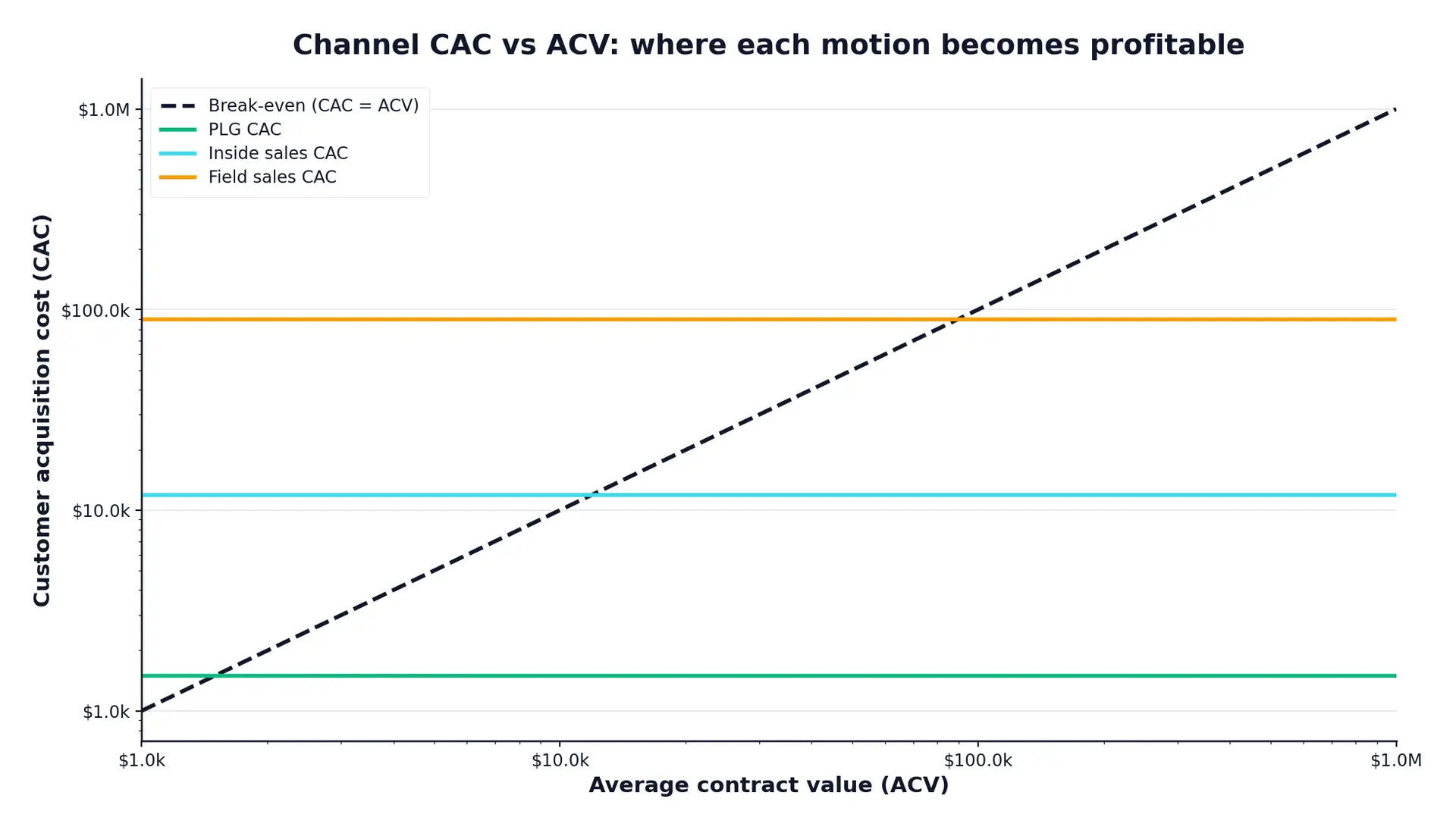
Sales Rep Economics: Why ACV Determines the Sales Model
Before walking the seven models, internalize the cost structure. Every sales-model decision boils down to whether the customer is worth more than the rep who sold them.
SaaS sales rep fully-loaded cost in 2026 (U.S. metropolitan markets, including base, commission, benefits, tooling, and overhead):
- SDR / BDR (sales development rep, business development rep): $80,000 – $120,000 per year. Books meetings; does not close.
- AE (account executive) — inside: $200,000 – $280,000 per year. Closes deals; some pipeline generation.
- AE — field / enterprise: $300,000 – $450,000 per year. Closes deals; full account ownership; travel.
- SE (sales engineer / solutions engineer): $250,000 – $350,000 per year. Pairs with AE on complex deals.
- VP of Sales: $400,000 – $700,000 per year fully loaded with equity.
A reasonable rule of thumb: a single inside AE needs to close approximately $1M – $1.5M in ACV per year to be net positive after their fully-loaded cost. That math sets the floor.
Per-deal economics. An inside AE who closes 50 deals per year at $20,000 ACV produces $1M in bookings — fine. The same AE asked to close 200 deals at $5,000 ACV is being asked to handle one new logo per work-day, which is not how complex deals close. Either the model breaks (rep can’t physically work that many deals) or the deals are not actually complex (in which case you should be selling them self-service, not assigning a rep). This is why the PLG cutoff sits around $10,000 ACV — above that, an inside rep starts to pencil out; below that, the rep is more expensive than the customer is worth.
The same logic governs every transition: from PLG to inside sales, from inside to field, from outbound prospecting to inbound. The numbers force the choice. Founders who ignore the numbers and “just hire more salespeople” learn this expensively.
Direct SaaS Sales Models
In a direct distribution channel, your company has the relationship with the customer. You know their name, billing address, and email. They perceive a direct relationship with you, the agreement is between you and them, and you bill them. When most people think of a sales force, they are picturing a direct sales model.
1. eCommerce / Product-Led Growth (Self-Service)
A self-service sales model contacts the customer, delivers the value, and closes the financial transaction entirely online. There is no human in the loop on the seller’s side. This is the dominant sales model for consumer and SMB (small- and medium-sized business) SaaS.
Two related but distinct motions live inside this model:
- Classic eCommerce subscription. The user lands on a marketing site, picks a plan, enters a credit card, and gets activated. Think Adobe Creative Cloud, Dropbox Plus, basic Salesforce starter editions. The sales process is a high-quality landing page plus a checkout flow.
- Product-led growth (PLG). The user signs up for a free or freemium product, gets value before paying, and converts to a paid plan inside the product. Think Slack, Notion, Figma, Linear, Loom. The sales process is the product itself — the marketing site exists, but most signups come from word of mouth and in-product virality.
PLG is the dominant sales motion for SaaS launched after 2015 because it solves the customer-trust problem that kills self-service at higher ACVs. A prospect will give you a credit card for $50/month with no demo because the risk is low. They will not do the same for $5,000/month — but if they used your product for free for two months first, they often will. PLG extends the self-service ACV ceiling from a hard $1,000 stop to a softer $10,000 ceiling for the right products.
Product-design implications. Self-service forces the product to onboard itself. Time-to-value (TTV) needs to be measured in minutes, not weeks. The free tier needs to deliver real utility, not a permanent demo. There needs to be a moment inside the product where the user hits a feature ceiling and has the budget authority to upgrade themselves. If your product needs a 30-minute setup call before it does anything useful, you cannot run PLG.
Economics. This is the cheapest sales model to operate per customer, but only after you have invested heavily in product engineering, content marketing, and growth experimentation. The CAC for PLG looks low in steady state and brutally high in year one. Most founders underestimate the engineering investment required to make a product PLG-ready.
ACV viability: $0 – $10,000. Above $10K, the PLG conversion rate falls off a cliff because the buyer needs a human conversation. A few exceptions exist (high-trust products, very technical buyers like Vercel and Linear) but treat them as exceptions, not the rule.
2. Inside Sales — Inbound
The next step up from self-service is an inside sales force handling inbound leads. The customer fills out a “Request a Demo” form or starts a free trial that flags them as a sales-qualified lead. An SDR qualifies them, an AE demos and closes. The entire sale happens by video call and email — no travel, no in-person meetings.
This is the workhorse of mid-market SaaS sales. It is the most common sales model for products in the $5,000 – $50,000 ACV range because the AE-cost-to-customer-value ratio works at those price points.
The pipeline source is critical here. Inside inbound sales is only as good as your marketing engine. If you cannot generate enough qualified leads, your AEs sit idle and your sales cost as a percentage of revenue explodes. This is why mature mid-market SaaS companies treat marketing as the bottleneck and AE capacity as the variable to flex against demand.
Inbound pipeline sources, ranked roughly by quality:
- Direct demo requests from the marketing site (highest intent)
- Free trial signups that convert to demos
- Content-marketing-sourced leads (long-form blog, podcast, newsletter)
- Webinar attendees
- Referrals from existing customers
- Paid search leads (variable quality, depends heavily on keyword)
- Display and retargeting (lowest intent)
The cost per lead (CPL) on these sources varies by orders of magnitude. Referrals are nearly free; paid search can run $300+ per qualified lead in competitive SaaS categories. Marketing-led pipeline tends to get more expensive on a per-lead basis as you push for volume because you are bidding up the same finite set of in-market buyers. You eventually hit a diminishing returns curve.
When that happens, you have three choices:
- Hold the line. Maintain the current pace of new customer acquisition at a LTV/CAC ratio you’re comfortable with.
- Improve LTV. Reduce churn, drive upsells, expand the customer’s contract over time. A higher LTV gives you room to spend more on CAC and push further out on the diminishing returns curve.
- Add outbound. When the marginal inbound lead gets more expensive than the marginal outbound lead, the math forces the switch.
In practice, this transition happens in the $15M – $25M ARR range for most B2B SaaS companies — but that is correlation, not causation. The ARR level does not cause the switch; the CAC math does. Companies with very high LTV (sticky enterprise products) and companies with very low LTV (SMB tools) hit the transition at different ARR levels.
3. Inside Sales — Outbound
The same inside sales force, now generating its own pipeline via prospecting. SDRs research target accounts, find the right contacts, send sequenced cold outreach (email, LinkedIn, occasional cold calls), and book qualified meetings for AEs. AEs run the sales process from first demo to closed-won.
Outbound lead generation is structurally harder than inbound because the prospect starts cold — they don’t know you, don’t have an immediate pain, and didn’t ask to be contacted. The conversion rates are 5x to 20x lower than inbound, and the cost per booked meeting is correspondingly higher.
Outbound becomes economically viable when either of two conditions is met:
- You’ve maxed out inbound. Your marginal inbound lead now costs $1,200 fully loaded. Your outbound SDR books a meeting for $800 fully loaded. Even with the lower conversion rate downstream, outbound is cheaper per closed deal.
- Your ideal customer profile (ICP) is enumerable. If your buyer is “the VP of Engineering at a 200-to‑2,000 person U.S. fintech company,” there are roughly 4,000 of them, you can list them by name, and outbound is the only efficient way to reach them. Waiting for the right 4,000 buyers to come to your marketing site is much slower than going to them.
ACV viability for outbound: $15,000 – $250,000. Below $15K, outbound math doesn’t work — the cost per meeting eats the entire LTV. Above $250K, the deals become complex enough that pure inside sales runs out of runway and you start needing a field motion (or at least a hybrid).
Hybrid inside sub-band ($50K – $150K ACV). A category exists between pure inside and pure field where deals close mostly by video but require occasional travel for executive meetings, customer summits, or onsite proofs of concept. The reps in this band are typically senior inside AEs ($280K – $350K fully loaded) with strong solution-selling skills and a willingness to travel one to two times per quarter. This is increasingly the standard motion for enterprise SaaS at $25M+ ARR — Zoom and Slack made enterprise customers comfortable with video-driven sales cycles, and the cost savings vs. pure field are significant.
4. Field Sales
A field sales force is the classic, “go-to” sales model for enterprise SaaS sales and is still the right answer for deals above $150,000 ACV. In the pre-SaaS era, this is what closed the $1 million to $20 million perpetual-license deals. Today it closes $150,000 to $1 million+ ACV recurring deals.
From the customer’s perspective, when you buy a product in the inside-sales ACV range, you are buying “the product.” When you buy a product in the field-sales range, you are buying the company as much as the product. The salesperson sells the product, herself, and her organization’s ability to deliver. The customer is making what’s effectively a “bet your career” purchase, and that purchase requires a relationship.
Years ago, when chief information officers (CIOs) and VPs of Sales wanted to switch from classic enterprise sales force automation (e.g., Siebel Systems) to Salesforce, it was a bet-your-career move. If you were wrong, you were fired and your reputation was damaged. That dynamic still operates today for any seven-figure SaaS purchase.
What field sales looks like in 2026:
- Multi-quarter cycles. 6 to 18 months from first meeting to closed-won is normal.
- Multi-threaded buying. 5 to 12 stakeholders on the customer side, each with different concerns and political position.
- Executive sponsorship. The CEO, CRO, or relevant C‑level on the vendor side meets the customer’s equivalent at least once. The customer wants to know that if something goes wrong post-sale, there are one or two people with authority they can escalate to.
- Technical complexity. Integration scoping, security review (SOC 2, ISO, often customer-specific questionnaires), procurement and legal, often a paid pilot before commercial close.
- Relationship-based. Strong field reps know their reputation travels with them. They push their own product and professional services teams hard to make sure post-sale promises are kept, because the customer will be a repeat buyer at their current and future employers if the rollout goes well.
Why this still works in a video-call world. It works because for deals of this size, the customer is buying assurance. The customer wants to know that the vendor will be there in person when something breaks. Even when most of the sales cycle happens by video, the in-person executive meetings — at customer offices, at conferences, at executive briefing centers — are where trust is built and tied off. The relationship is built more easily in person, and at this deal size the relationship is the product.
ACV viability for field sales: $150,000+. Below that, the field rep cost ($300K – $450K fully loaded plus SE support) eats the unit economics. Above $500K, a dedicated field motion is typically the only way to close.
Direct Sales Models Compared: Worked Unit Economics
Take a hypothetical $10,000 ACV SaaS product and model the unit economics across three direct sales models. Same product, same customer LTV (assume 3.5‑year average lifespan, modest expansion, gross margin 80% — LTV approximately $28,000):
| eCommerce / PLG | Inside Inbound | Inside Outbound | |
|---|---|---|---|
| Sales rep cost | $0 (engineering carries it) | $240K AE / 50 deals = $4,800/deal | $240K AE + $100K SDR / 30 deals = $11,300/deal |
| Marketing cost | $3,000/deal (paid + content) | $2,000/deal (warmer leads) | $1,500/deal (some inbound assist) |
| Total CAC | $3,000 | $6,800 | $12,800 |
| CAC payback (months) | 4.5 | 10.2 | 19.2 |
| LTV/CAC | 9.3 | 4.1 | 2.2 |
| Verdict | Profitable | Healthy | Marginal — only works if ACV climbs to $15K+ |
The outbound version doesn’t pencil out at $10K ACV — the channel cost exceeds 40% of the LTV. The same math at $20K ACV looks completely different: outbound CAC stays roughly the same in absolute dollars ($12,000-$14,000) while LTV doubles to $56,000, pushing LTV/CAC to a healthy 4.4. This is the kind of segment-level math the CEO has to run before deciding whether to add outbound — the aggregate channel mix can look fine while a specific channel-segment cell is destroying value.
The lesson generalizes: the channel either fits the ACV or it doesn’t, and the gap is rarely fixable by trying harder. If your math says inside outbound doesn’t work at $10K ACV, the answer is not to hire more SDRs; the answer is to raise ACV (via packaging, pricing, or ICP shift) or to switch to inside inbound.
Indirect SaaS Sales Models
Indirect sales models put another organization between you and the customer. The classic offline analogy is the retailer: Procter & Gamble (P&G) does north of $80 billion in annual revenue, but neither you nor I buy Tide detergent or Gillette razors directly from P&G. The receipt always says Walmart, Amazon, Target, or another retailer. That is a classic indirect distribution channel.
When you sell through another party, their needs shape your product, pricing, financial model, packaging, and go-to-market. Bounty paper towels are packaged in twelves or eighteens, in specific configurations within the plastic wrap, because of the warehousing, transportation, and shelving requirements of the retailer. Retail shelves are set at a specific height. If your six-pack packaging is too tall, it doesn’t fit on the shelf and the retailer won’t stock it. The same logic operates in SaaS — choosing an indirect sales model changes how you build and how you bill.
Indirect sales models come in three main flavors: reseller (someone else sells your product as-is), OEM (someone else embeds your product in theirs), and services partnerships (someone else sells your product alongside their consulting hours).
5. Reseller Channel
A reseller buys your software at a discount and resells it to their customers under their billing relationship. The simplest examples are the Apple App Store and the Google Play Store. The customer’s credit card gets charged by Apple; the developer gets a cut.
For B2B SaaS in 2026, the dominant reseller channels are platform marketplaces, not app stores:
- Salesforce AppExchange. The original B2B SaaS marketplace. Apps integrate with Salesforce CRM; customers buy via the AppExchange listing.
- AWS Marketplace. Customers can purchase SaaS subscriptions and have the cost flow through their existing AWS commitment, which is a meaningful procurement advantage at enterprise scale.
- HubSpot Marketplace. Smaller but growing fast; ideal for marketing and sales tools that integrate with HubSpot.
- Atlassian Marketplace. Apps for Jira, Confluence, and the broader Atlassian suite.
- Shopify App Store. Apps for Shopify-powered eCommerce stores.
- Microsoft AppSource and Azure Marketplace. Particularly strong for enterprise IT and integrations with Microsoft 365.
The reseller channel’s promise: access. P&G wants its product in Walmart because tens of millions of shoppers walk through Walmart every week. The bank robber explanation applies — “because that’s where the customers are.” Listing in AWS Marketplace gives you access to every enterprise IT buyer with an AWS contract, which is a large fraction of the Fortune 1000. You could spend a decade building that pipeline yourself.
The reseller channel’s two big costs:
- Restricted access to the customer post-sale. The marketplace owner controls the relationship. You may get the customer’s company name in your reporting; you often don’t get the end-user’s email, can’t market to them, and can’t easily survey them for product feedback.
- Customer perceives the relationship as being with the marketplace. I have 100 apps on my phone. I am a customer of Google, Dropbox, and Notion in my own mind. For the other 90 apps I have no idea who built them — the App Store solved my problem, not the developer. When the customer doesn’t perceive a relationship with your company, you lose the brand halo from a positive experience, you can’t run direct expansion campaigns, and you have far less leverage if the marketplace owner decides to compete with you.
The Amazon-versus-third-party-seller dynamic is the textbook case: Amazon has all the sales data, and if your product sells well, Amazon often releases a private-label version to compete with you. You accept this risk in exchange for access. At this point, if a consumer product is not on Amazon, most shoppers assume it doesn’t exist.
When to use a reseller channel: When the marketplace owner has a critical mass of your ideal customers that you cannot otherwise reach efficiently, AND your product complements rather than competes with the marketplace owner’s strategic priorities, AND you have a separate motion to build direct relationships for upsell or feedback.
6. OEM Channel (Embed Your Product Inside Someone Else’s)
OEM stands for original equipment manufacturer, a term inherited from hardware. The canonical OEM example is what Intel and Microsoft did during the PC era: Intel sold microprocessors and Microsoft sold the Windows operating system to PC manufacturers like Dell, who assembled and sold the finished computer to the end customer. “Intel Inside” was the marketing campaign that gave Intel brand visibility despite never having a direct customer relationship.
In SaaS, OEM means another company embeds your service inside their product and sells the combined whole to their customer. Common patterns:
- Sales tax calculation (e.g., Avalara, TaxJar) embedded inside eCommerce platforms.
- Email delivery (e.g., Postmark, SendGrid) embedded inside any product that sends transactional emails.
- Identity (e.g., Auth0, Okta CIAM) embedded inside customer-facing apps.
- Search (e.g., Algolia) embedded inside content sites and eCommerce stores.
- Payments (e.g., Stripe Connect) embedded inside vertical SaaS for industries from gyms to landscapers.
- AI / LLM APIs (e.g., OpenAI, Anthropic) embedded inside roughly half of all software products shipping in 2026.
Infrastructure-as-a-service (IaaS) providers like AWS, Microsoft Azure, and Google Cloud Platform are themselves OEM-like — they are embedded inside virtually every SaaS product. Most Netflix users have no idea that much of their streaming experience is delivered through Amazon Web Services.
To know when OEM makes sense, return to Geoffrey Moore’s “whole product” framework. Your product is what you sell. The whole product is everything the customer needs in order to get the outcome they want from your product — including documentation, training, support, integrations, and complementary services. The whole product often includes things that aren’t yours and never will be.
A Fortune 500 CIO once said to me, “I can’t buy your product even though I think it’s the best one out there. You aren’t suable enough for us. We want suppliers big enough that, if we are really unhappy, we can sue you or credibly threaten to. That’s how we get support tickets taken seriously.” For that customer, “being suable” was a whole-product requirement. Being easy to sue was not on my product roadmap.
When some other company in the ecosystem already provides a greater critical mass of the whole product, embedding your product inside theirs is often the only way to reach the end customer at scale. The OEM customer (the company doing the embedding) is your real customer — and they will pay you on a wholesale basis or a usage basis, not retail.
ACV in OEM is misleading. Per-end-user revenue can be tiny ($0.001 per API call), but the OEM partner contract can be in the millions. The model is volume play; success is measured in partner count and embedded usage, not retail ACV.
7. Sell-With and Sell-Through Services Partners
The third indirect model leverages services firms — systems integrators (SIs), consulting firms, and managed service providers — to sell your SaaS alongside or inside their billable services.
Sell-with (side-by-side). Your SaaS and a partner’s implementation services are sold concurrently to the same customer. A Fortune 500 buys a $1 million ACV SaaS product from you and, in the same procurement cycle, signs a $2 million statement of work with Deloitte or Accenture to do the integration. The two deals are commercially linked — neither makes sense without the other. The customer perceives a “solution set,” which is Moore’s whole product made concrete.
The customer typically buys the software directly from you (preserving the option to fire the integrator if implementation goes badly) and buys the services from the SI. The vendors coordinate their sales and marketing in a co-sell motion. Your reps and the SI’s reps work the same accounts together. The SI gets paid for the hours they bill; you get paid for the subscription you sell.
Sell-through (embedded in services). Your SaaS is embedded inside a service provider’s bundled offering. The canonical example is QuickBooks Online sold via certified public accountants (CPAs). The CPA’s client doesn’t care which general ledger system the CPA uses; they want to call the CPA and get their books done. The CPA might buy 100 QuickBooks subscriptions for her 100 accounting clients. There is no direct billing or legal relationship between Intuit (QuickBooks) and the CPA’s clients — Intuit is selling 100 subscriptions to one CPA firm, and the SaaS cost is embedded in the CPA’s service fee.
Sell-through is structurally similar to OEM (someone else’s offering wraps yours), except the wrapping is billable hours rather than another piece of software. It works particularly well for vertical SaaS sold to industries where a trusted advisor (CPA, lawyer, agency, consultant) controls the technology decision on behalf of the end customer.
Cost and complexity. Both sell-with and sell-through require partner enablement — your product, sales collateral, training, certifications, and support all need to be partner-ready. This is non-trivial product and operations investment, and it is often the reason SaaS companies underestimate how long it takes to spin up a services partnership channel. Expect 12 to 24 months to see meaningful revenue from a new SI relationship.
ACV viability: Above $100,000 ACV for sell-with (the deal needs enough revenue to justify the partner’s margin and the implementation budget). Sell-through works at any ACV but is most common for $5,000 – $50,000 ACV vertical products.
How to Choose Your SaaS Sales Model: The 4‑Filter Framework
There is no universal answer to which sales model is right at a given moment. There is a framework — apply these four filters in order and most of the ambiguity falls out.
Filter 1: ACV Determines What’s Economically Possible
Start with what your customer is worth. ACV is the hardest constraint — if a model’s cost structure does not fit your price point, no amount of effort makes it work.
| ACV Range | Models That Fit | Models That Don't |
|---|---|---|
| Under $1,000 | PLG only | Everything else (rep cost exceeds customer value) |
| $1,000 – $10,000 | PLG, Inside Inbound (low end) | Outbound, Field |
| $10,000 – $50,000 | Inside Inbound, light Outbound | Field (rep cost too high) |
| $50,000 – $150,000 | Inside Outbound, Hybrid Inside | Pure PLG (buyer needs a person) |
| $150,000 – $500,000 | Field, Hybrid Inside, Sell-With | Pure inside (deal complexity needs onsite) |
| $500,000+ | Field, Sell-With Services | Everything else |
ACV is not a customer attribute — it is a packaging and pricing choice. If your current ACV puts you in a sales model that doesn’t fit your strategy (e.g., you want field-rep economics but your ACV is $20K), the question is whether you can move ACV before forcing the model.
Filter 2: Market Stage Determines What’s Strategically Right
Where are you in the product market fit and growth journey?
- Pre-PMF. You need direct customer feedback to figure out what to build. Direct sales models (any flavor) give you that feedback; indirect models hide it. Avoid reseller and OEM channels until PMF is locked in.
- Early growth (post-PMF, under $5M ARR). Focus on one direct channel and operate it well. Adding a second channel before the first is a repeatable sales process is the most common reason early-stage sales orgs implode.
- Scaling ($5M – $25M ARR). Layer in a second channel only after the first is repeatable. The classic moves: PLG -> Inside Inbound (when ACV climbs), Inside Inbound -> Inside Outbound (when inbound saturates), Inside -> Field (when an enterprise segment emerges).
- Late scaling ($25M – $100M ARR). Channel mix becomes strategic. Reseller, OEM, and services partnerships start to make sense as a layer on top of your direct motion, primarily to reach segments you can’t reach efficiently direct.
- Maturity ($100M+ ARR). Most large B2B SaaS companies operate four to six sales models concurrently. Channel conflict becomes an active management problem at this stage.
Filter 3: Customer Feedback Need
How much do you still need to learn from the customer? PLG and Inside Inbound give you the most data (every signup, every demo, every objection is captured). Field sales gives you deep but narrow data (you learn a lot from your 30 customers, but you don’t know what the 3,000 you didn’t close were thinking). Reseller and OEM channels give you almost no customer data — the partner has it.
If you’re still iterating on the product, value proposition, ICP, or pricing, prioritize sales models with high feedback density. Switch to channels with low feedback density only after the core product and positioning are stable.
Filter 4: Partner Access
Some markets have a small number of partners (a marketplace owner, a dominant SI, a CPA network, a single distributor) who already have a near-monopoly relationship with your ideal customer. If that’s true in your market, the question is not whether to use the indirect channel — it is what terms to use it on.
If 3 SIs have 100% of your TAM under contract, building a parallel direct sales force is structurally a bad idea. You will spend a decade replicating relationships those SIs already have, and the same buyers won’t take your direct call when their trusted SI is in the room. The smart move is to partner with the SIs and accept the margin trade.
Stage-by-ARR Sales Model Mix
This is the model-mix progression most successful B2B SaaS companies follow. Treat it as a starting hypothesis, not a script — your industry and ICP may dictate a different sequence.
| Stage / ARR | Primary Model | Secondary Model | Avoid |
|---|---|---|---|
| Pre-PMF / pre-revenue | Founder-led direct sales (effectively Field) | — | Indirect, PLG |
| $0 – $2M | One direct model; usually Inside Inbound or PLG depending on ACV | — | Adding a second channel |
| $2M – $5M | Same primary model, scaling | Light experiments only | Channel proliferation |
| $5M – $15M | Inside Inbound (mid-ACV) OR PLG with sales assist | Inside Outbound for target accounts | Reseller/OEM |
| $15M – $25M | Inside Inbound + Outbound | Hybrid Inside emerging | Field unless ACV justifies |
| $25M – $50M | Inside + Hybrid + Field (segmented by ACV) | Reseller / Marketplace listing | Sell-Through without proven enabled partners |
| $50M – $100M | Full direct stack | Reseller, Marketplace, light Sell-With | Adding sell-through to fix a sell-with shortfall |
| $100M+ | Full direct stack at scale | All indirect channels active and managed | Letting channel conflict go unresolved |
Channel Conflict: Four Rules to Avoid Self-Inflicted Wounds
Once you operate two or more sales models, channel conflict is inevitable. The classic case: a self-service customer signs up for $99/month, then a sales rep sees them in usage data and tries to upsell them to a $30,000 annual contract. The customer says, “I already pay you. I’m fine.” Or worse: a reseller closes a deal at a 30% margin; the next week your direct rep tries to sell to the same buyer at a discount; the buyer plays you off each other and both deals lose margin.
Four rules to prevent most channel conflict damage:
- Segment by ACV band, not by buyer. Decide that PLG owns $0–$10K, Inside owns $10K–$150K, Field owns $150K+. Reps don’t poach down; products don’t push up unless the buyer self-identifies as wanting it.
- Register the deal first, decide ownership second. Every channel partner registers deals before working them. Direct reps register the accounts they’re working. The system, not politics, decides who owns the deal.
- Set explicit overlap rules. If a marketplace partner brings in a deal and your direct rep was already working it, the contract specifies who gets credit and at what split.
- Track segment-level economics. Most channel conflict damage shows up as bad LTV/CAC in one cell of the channel-by-segment matrix. If you don’t track at the cell level, you’ll never see the damage until it’s quarters old.
Common Mistakes in Picking a SaaS Sales Model
Seven failure modes that show up repeatedly in SaaS companies under $50M ARR.
- Forcing PLG on a product that needs sales help. Most products don’t onboard themselves. If your free trial conversion is under 3% and your time-to-value is over a week, you don’t have PLG — you have a marketing site with a free trial. Add an inside sales motion or accept a slower growth ceiling.
- Hiring a VP of Sales before the sales process is repeatable. A VP can scale a repeatable process. They cannot invent one. Hiring a VP at $2M ARR to “figure out sales” is the single most common cause of CEO firing in early-stage SaaS. Build the repeatable process first, hire the VP second.
- Channel-pricing mismatch. Charging $30,000 ACV with a self-service checkout. Charging $5,000 ACV through a field rep. The model and the price have to fit each other; mismatched, you bleed money quietly. See the SaaS pricing models guide for related pricing tradeoffs.
- Layering on a reseller channel before direct works. Channel partners do not save broken direct sales motions — they amplify them. If your direct cost-of-sale is bad, the partner version is worse because you have to add margin for the partner.
- Hoping outbound will fix the inbound funnel. If your product doesn’t sell when prospects come to you, it definitely won’t sell when you go to them. Outbound is the answer when inbound saturates, not when it fails.
- Adding a second channel before the first is repeatable. Two half-built channels are worse than one mature one. Channel decisions are sequential, not parallel, until each one is operating at known economics.
- Ignoring channel-segment economics. The aggregate channel mix looks fine while a specific channel-segment cell is destroying value. Always segment everything — calculate LTV, CAC, and payback by channel and customer segment.
Channel Mix and Exit Valuation
Channel mix matters for valuation, not just operations. Acquirers price companies partly on the risk profile of their revenue:
- High channel concentration is a multiple killer. If 60% of your revenue comes through Apple App Store or AWS Marketplace, the acquirer is buying Apple’s distribution risk, not just your product. Multiples discount accordingly. The same applies to a single SI partner who controls a large slice of your customer base.
- Diversified direct revenue gets premium multiples. Companies with predictable direct sales motions, well-segmented by ICP and channel, get the highest revenue multiples. The buyer can model the future of each channel independently and price the business with confidence.
- Recurring partner revenue is fine if the contract is durable. A 10-year exclusive OEM deal with a Fortune 500 customer is worth more than a 1‑year deal with a startup. Channel concentration risk is partly a function of contract length and switching cost.
- PLG revenue can be premium or discount. A product with high PLG-driven NRR (the customer expands inside the product without a salesperson) is premium. A product with PLG-driven high churn (customers self-serve their way out as easily as they self-served in) is discount.
Plan the channel mix you want the acquirer to see 12 to 18 months before you exit. The valuation model the acquirer uses is built on the 12 months trailing revenue at deal time, so the channel-mix optimization window starts well before the bank pitch.
SaaS Sales Models FAQ
What is the best SaaS sales model for early-stage startups?
For pre-PMF and early post-PMF (under $5M ARR), one direct sales model is correct — usually founder-led inside sales for B2B SaaS in the $10K – $50K ACV range, or PLG for SMB and prosumer products under $10K ACV. Two channels at this stage is almost always a mistake.
How much does it cost to hire a SaaS account executive in 2026?
Fully loaded — base salary, on-target commission, benefits, equity, tooling, and overhead — an inside SaaS AE costs $200K to $280K per year. A field / enterprise AE costs $300K to $450K. Add an SDR ($80K – $120K) for inbound qualification and an SE ($250K – $350K) for technical deals.
When should a SaaS company add outbound sales?
When marginal inbound CAC exceeds marginal outbound CAC — not before. This commonly happens in the $15M – $25M ARR range for B2B SaaS, but the trigger is the math, not the ARR. Run a 6‑month outbound pilot with a single SDR before scaling.
What sales model do enterprise SaaS companies use?
Field sales is the default for ACVs above $150K, often hybrid inside for $50K – $150K, and almost always paired with a sell-with services partner motion above $250K ACV. Pure inside sales rarely closes seven-figure deals because the customer requires onsite executive engagement.
Can a SaaS company use multiple sales models at once?
Yes — most mature SaaS companies run three to six concurrent sales models segmented by ACV band and ICP. The discipline is segmenting by ACV (PLG below $10K, Inside Inbound $10K-$50K, Inside Outbound $50K-$150K, Field $150K+) and registering deals to prevent channel conflict.
What’s the difference between sell-with and sell-through services partnerships?
In a sell-with partnership, the customer buys software from the SaaS company and services from the SI separately (two contracts). In sell-through, the SaaS is embedded inside the SI’s services offering (one contract, one bill). Sell-with preserves your direct customer relationship; sell-through cedes it to the partner.
How does channel choice affect SaaS company valuation?
Acquirers discount revenue concentration through a single channel (marketplace, reseller, partner) because they are buying that channel’s risk along with the company. Diversified direct revenue with predictable segment economics commands the highest multiples. Plan the channel mix 12–18 months before exit to optimize the trailing-revenue picture acquirers use to set the price.
Picking Your Sales Model: The CEO’s Job
The sales model decision is not delegable. It is one of the four or five strategic choices that sit on the CEO’s desk and reshape every other decision in the company. The right sales model is the one whose economics fit your ACV, whose feedback density matches your product maturity, whose stage progression aligns with your ARR, and whose partner dependencies you are willing to live with at exit.
The wrong sales model destroys companies quietly. You see “underperforming sales reps,” “bad lead quality,” “longer sales cycles,” “softer demand” — every diagnosis except the right one. The right one is that the model was wrong for the price point, the stage, or the customer, and the CEO didn’t catch it in time.
Run the four filters honestly. Build one model well before you add a second. Track segment-level economics so the channel-by-ICP cells can’t hide losses. And revisit the choice every 12 months — the right SaaS sales model at $5M ARR is rarely the right one at $25M.