

SaaS onboarding gets treated like a post-sale courtesy at most software companies — a kickoff call, a few training videos, a handoff email from someone in customer success. Here’s a number that should change how you see it: at one B2B SaaS company I worked with, customers whose onboarding started the same day the deal closed churned at 4% in the first 30 days. Customers whose onboarding start dragged by a few days churned at 6%. That’s a 50% difference in early churn produced not by the product, not by pricing, not by competition — by scheduling.
That’s what this article is about: SaaS onboarding as a system the CEO owns, not a department the CEO delegates and forgets. I’ve written separately about customer onboarding as an account-level process — the kickoff-to-handoff playbook for a single new customer and the retention math behind it. This article zooms out to the program level: how to design, staff, measure, and systematize the onboarding function across your whole customer base. If you run a B2B SaaS company in the $2M–$25M ARR range, the sections below cover what broken onboarding actually costs, the highest-leverage fixes (most cost almost nothing), how to match your onboarding motion to your unit economics, and the handful of metrics that belong on your dashboard.

What Is SaaS Onboarding?
SaaS onboarding is the system that moves new customers from signed contract to first realized value — repeatably, measurably, and regardless of which employee runs it. It spans everything between “the deal closed” and “the customer achieved the outcome they bought the product for”: the sales-to-success handoff, account setup and configuration, data migration, training, and the first measurable win.
Three terms get used interchangeably in this space, and they shouldn’t be:
| Term | Scope | Primary Owner |
|---|---|---|
| SaaS onboarding | The company-wide program: motions, staffing, process, metrics across all new customers | CEO / head of Customer Success |
| Customer onboarding | The account-level process for one customer: kickoff, setup, training, first value, handoff | Customer Success (CS) manager or onboarding specialist |
| User onboarding | The in-product experience teaching an individual user the interface: tours, tooltips, checklists | Product team |
Most of what ranks for this topic online is written by product-tour software vendors, so it treats SaaS onboarding as a user-interface problem — welcome screens, progress bars, empty states. Those things matter, but they’re the smallest layer of the system. For a B2B SaaS company selling $10K–$100K contracts, onboarding outcomes are determined far more by speed, staffing, process consistency, and goal definition than by tooltip placement. That’s the layer this article covers, because it’s the layer with CEO-sized economics attached.
One definition you’ll need throughout: time to value (TTV) is the average number of days from contract signing to the customer achieving their first meaningful result with the product. Think of it like the payback clock on the customer’s side of the table — they made a bet on you, and TTV measures how long you keep them waiting before the bet visibly pays off.
Average Time to Value = Sum of Days to First Value Across New Accounts ÷ Number of New Accounts
Lower is better. Almost everything in this article is, one way or another, a method for driving TTV down and making it consistent.

Why SaaS Onboarding Is a Revenue Problem, Not a Support Problem
When a CEO finally digs into churn data — really digs, cohort by cohort — the same pattern shows up almost every time: first-year churn is heavily concentrated in the first 90 days. One client I worked with broke his first-year churn down by quarter and found the majority of cancellations happened in the first 90 days after signing. The customers weren’t leaving because the product failed them in month eight. They were leaving because they never got started.
That reframes the problem. A customer who cancels in month nine after declining usage is a retention problem with many possible causes. A customer who cancels in month two without ever completing setup is an onboarding failure, full stop. And here’s the brutal version of that math: a customer who never onboards churns at 100%. If they’re not using the software, they are all going to quit. The only question is which billing cycle.
This is why I treat SaaS onboarding as a revenue function, not a cost center. It sits at the head of the retention chain: onboarding quality drives time to value, time to value drives early churn, early churn drives customer lifetime value (LTV — the total gross profit a customer generates before cancelling), and LTV drives how much you can afford to spend acquiring customers. Get the first link wrong and every downstream number degrades. Fix the first link and everything downstream improves without touching your product roadmap or your ad budget.

What Broken SaaS Onboarding Actually Costs
Let’s put real numbers on it. Take a representative company in this audience’s range:
| Input | Value |
|---|---|
| ARR (Annual Recurring Revenue) | $10,000,000 |
| Customers | 500 |
| ACV (Annual Contract Value — average annual subscription per customer) | $20,000 |
| Annual gross revenue churn | 15% |
| Fully loaded CAC (Customer Acquisition Cost — total sales and marketing spend per new customer won) | $20,000 |
At 15% annual gross revenue churn, this company loses $10,000,000 × 15% = $1,500,000 of ARR per year to cancellations and downgrades. Now suppose that when you autopsy the churned accounts — and you should actually do this, account by account — 40% of the lost revenue traces back to onboarding failure: the customer never completed setup, never migrated data, never reached first value. That’s a realistic share for a company that has never engineered its onboarding; your number may be higher or lower, which is exactly why you audit.
That means onboarding failure is costing this company $1,500,000 × 40% = $600,000 of ARR every year. At a $20,000 ACV, that’s $600,000 ÷ $20,000 = 30 customers per year who paid you, started, and evaporated.
The damage doesn’t stop there, because every one of those customers has to be replaced just to keep revenue flat. At a fully loaded CAC of $20,000, replacing 30 customers costs 30 × $20,000 = $600,000 of sales and marketing spend — money that produces zero net growth. It refills a bucket that onboarding drilled holes in. This is the LTV/CAC problem in its rawest form: you paid full acquisition cost for customers whose lifetime value rounded to one or two billing cycles.
Now run the improvement case. Suppose a deliberate onboarding program — the fixes in the rest of this article — cuts onboarding-attributable churn in half:
| Line Item | Annual Impact |
|---|---|
| ARR retained (50% × $600,000) | +$300,000 |
| Replacement CAC avoided (15 customers × $20,000) | +$300,000 |
| Combined annual cash-flow impact | ~$600,000 |
And because retained recurring revenue compounds, the exit math is bigger than the annual math. Private B2B SaaS companies in this range commonly trade at revenue multiples around 3× to 6× ARR depending on growth, retention, and risk — call it 5× for a healthy company. The $300,000 of retained ARR is then worth roughly $300,000 × 5 = $1,500,000 of enterprise value. To be clear, that multiple is a market heuristic, not a formula output — see SaaS company valuation for the full driver list.
A note on the numbers: the churn rates, multiples, and cost figures in this article are illustrative and reflect typical market conditions at the time of writing. They’re included to show relative relationships — what improving onboarding does to the chain — not as current absolute benchmarks. Verify current figures for your market before making decisions.
The point of the exercise: a seven-figure swing in enterprise value is sitting inside a function most CEOs have never personally examined. The next four sections are the highest-leverage places to look.
Speed to Start: The Cheapest Churn Fix Most CEOs Never Find
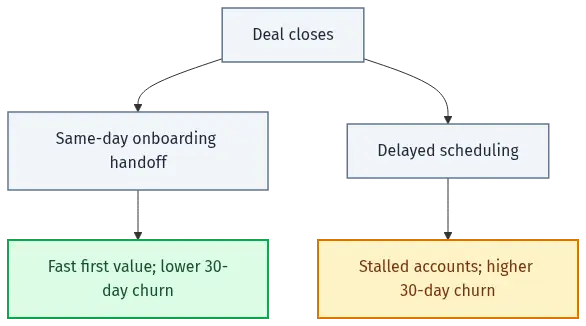
Here’s the full story behind the statistic in the opening paragraph. A B2B SaaS company noticed certain closed deals churned out faster than others and went looking for the root cause. The correlation they found wasn’t industry, deal size, or sales rep. It was the time gap between the sales close and the start of onboarding.
When a customer success agent happened to be free at the moment a deal closed, the salesperson did a warm phone transfer — “thank you for your business, let me hand you to the team that will get you live” — and onboarding started within seconds. Those customers churned at roughly 4% in the first 30 days. When no agent was available, the customer got the dreaded “someone will contact you to schedule your onboarding call.” Then came phone tag, email back-and-forth, calendar drift. Days passed, sometimes weeks. Some customers simply changed their minds and never onboarded at all. The delayed group churned at roughly 6%.
Only 20% of closed deals were getting the immediate transfer. The blended 30-day churn worked out to (20% × 4%) + (80% × 6%) = 5.6%.
Why was the gap there in the first place? Because customer success was staffed for cost efficiency — nobody wanted CS people “waiting around,” so their calendars were packed solid. Perfectly sensible from a utilization standpoint. Expensive from a revenue standpoint. The company changed its staffing model to hold capacity open so that most closed deals could move to an onboarding specialist immediately, accepting some idle time as the cost of speed.
The result: 30-day churn dropped from 5.6% toward the 4% the immediate-transfer cohort had always enjoyed — a relative reduction of about (5.6% − 4.0%) ÷ 5.6% ≈ 29%. When the company later sold, ballpark math attributed roughly $2 million of additional enterprise value to that one staffing change. Not a product change. Not a pricing change. A calendar change.
The general lesson: the single most dangerous moment in your customer’s lifecycle is the gap between signing and starting. Motivation peaks at the close and decays from there. Every day of delay converts a sold customer back into a prospect. If you measure nothing else this quarter, measure your median days-from-close-to-kickoff, then go look at how your CS team’s capacity model creates that number. This is one of the four or five highest-leverage moves to reduce SaaS churn, and it’s nearly free.

Match the Onboarding Motion to Your Unit Economics
There’s no universally correct way to onboard. There’s only the motion your unit economics can afford. SaaS onboarding comes in three motions, and the deciding variable is the gross profit a customer generates in year one versus what the motion costs to deliver.
| Motion | What It Looks Like | Typical Fit | Cost per Customer |
|---|---|---|---|
| High-touch | Named onboarding specialist or implementation manager, scheduled kickoff, guided data migration, role-based training sessions | ACV roughly $15K+ — enterprise and upper mid-market | $1,500–$5,000+ |
| Low-touch | Pooled CS team, group webinars, templated setup plans, office hours, escalation paths to humans | ACV roughly $3K–$15K — mid-market and SMB | $200–$1,500 |
| Tech-touch (self-serve) | In-product checklists, guided walkthroughs, lifecycle email sequences, help-center content, no scheduled humans | ACV under roughly $3K — SMB, product-led growth | Near-zero marginal cost |
Each motion deserves a fair look, because picking the wrong one fails in opposite directions.
High-touch is the right answer when contracts are large and implementation is genuinely complex. The math: a $20,000 ACV at an 80% gross margin produces $20,000 × 80% = $16,000 of first-year gross profit. Spending $2,000 of specialist time to onboard that customer is $2,000 ÷ $16,000 = 12.5% of first-year gross profit — easily justified when it materially moves retention. Its failure mode is applying it indiscriminately: burying small accounts in white-glove service you can’t afford, or letting “high-touch” become “slow-touch” because every step waits for a scheduled meeting.
Low-touch is the workhorse for the middle of the market. You keep humans in the loop where stakes are high (kickoff, data migration sign-off, first-value confirmation) and automate the rest. Its failure mode is being designed as cost reduction instead of value acceleration — if your group webinar exists to save CS hours rather than to get customers live faster, customers can tell.
Tech-touch is mandatory — not optional — at low price points. A $1,200 ACV at 80% gross margin produces $960 of first-year gross profit; even a cheap $500 human-assisted onboarding consumes $500 ÷ $960 ≈ 52% of it. You cannot staff your way out of that math. What IS available at that price point: invest the human effort once, in the design of the self-serve path — instrument the product so you know exactly where new customers stall, then fix those points with better defaults, checklists, and triggered emails. One good funnel analysis substitutes for a thousand kickoff calls. (This in-product layer is user onboarding, which deserves — and will get — its own article.)
Two program-level rules apply across all three motions. First, segment the decision: if you sell to both enterprises and SMBs, you need at least two motions running in parallel, because one blended process will be too expensive for the small accounts and too thin for the large ones. Second, revisit the boundaries annually — as your ACV mix and gross margin shift, the line between motions moves with them.

The One Question That Cuts Onboarding Churn
The highest-impact onboarding improvement I’ve ever seen wasn’t a tool, a playbook, or a hire. It was one question, asked on the first call.
A B2B SaaS company I worked with tracked churn by onboarding specialist — more on that practice in the next section — and found one customer success manager whose churn numbers were 27% better than all of her peers, consistently, for as long as she worked there. When we audited what she did differently, almost nothing stood out. Same call cadence, same agenda, same timing, same rhythm as everyone else. Except on the very first onboarding call, she asked one question nobody else asked:
“What were you hoping to accomplish within 90 days of buying our software? What would make you thrilled?”
Then she did something equally important with the answer: she simplified the entire onboarding to that goal. The other specialists were training every customer on everything — every module, every feature, every sophisticated capability of a genuinely powerful product. Their customers felt overwhelmed, and overwhelmed customers stall. Hers learned the shortest path to the one outcome they actually bought the product for. She’d even preface each subsequent request — for data, for a migration decision, for a stakeholder meeting — by tying it back to the customer’s stated goal: “to get you to the win you described, I need this file by Thursday.”
There are three durable lessons inside that story:
- Customers buy an outcome, not a product. Until they reach that outcome, your software is a cost and a chore. Onboarding’s job is not “teach the product” — it’s “deliver the first win.” Define the win explicitly, per customer, in their words, on day one.
- Comprehensiveness is the enemy. The instinct to demonstrate full product value during onboarding actively increases churn, because it raises the perceived effort of getting started. Teach the 10% of the product that produces the customer’s first win; the other 90% is expansion material for later.
- The goal doubles as a forcing function. When every onboarding task is framed as a step toward the customer’s own stated objective, customers do their homework faster. Stalled onboarding is usually stalled customer effort, and purpose beats nagging.
If your onboarding team doesn’t currently capture a written, customer-stated 90-day goal for every new account, that’s your highest-ROI fix this quarter. It costs nothing to implement.
Make SaaS Onboarding Person-Independent
Here’s a test I use to gauge the maturity of any business process, onboarding included: does the outcome depend on who does the work? If customers onboarded by Mary consistently retain better than customers onboarded by Bob, you don’t have an onboarding process — you have onboarding people. That distinction has two expensive consequences.
The first is operational: person-dependent results mean your average is being dragged down by everyone who isn’t your best. Run the math on a hypothetical four-person onboarding team, each handling 100 new customers a year, with 90-day churn rates of 4%, 7%, 8%, and 9%:
| Specialist | New Customers / Year | 90-Day Churn | Customers Lost |
|---|---|---|---|
| A (the outlier) | 100 | 4% | 4 |
| B | 100 | 7% | 7 |
| C | 100 | 8% | 8 |
| D | 100 | 9% | 9 |
| Team | 400 | 7% average | 28 |
If everyone performed at the outlier’s 4%, the team would lose 400 × 4% = 16 customers instead of 28 — twelve customers a year saved. At a $20,000 ACV that’s 12 × $20,000 = $240,000 of ARR retained annually, plus another $240,000 of replacement CAC avoided, from the same headcount doing the same number of onboardings. The variance between your best and worst onboarder isn’t an HR curiosity. It’s a line item.
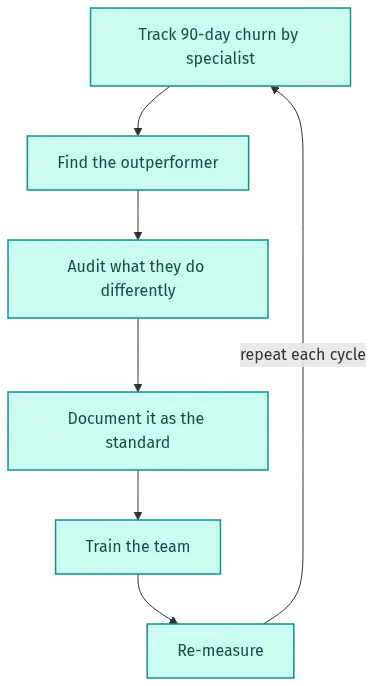
The method for capturing it is the same one I recommend for any repeatable process: study the outliers. Track retention by specialist, find the person who outperforms, audit what they actually do differently (it’s often one or two behaviors, like the 90-day-goal question above), document it as the standard, train everyone to it, and re-measure. Then repeat, because a new outlier will emerge.
The second consequence is strategic, and it matters most if you ever plan to sell the company. Acquirers price risk, and person-dependent processes are risk: if great onboarding outcomes live in two employees’ heads, those outcomes can resign with two weeks’ notice. A documented, trained, measured onboarding system — where a new hire reaches 90%+ of veteran effectiveness within a reasonable ramp — is worth more than the identical retention numbers produced by heroics. Systematization is de-risking, and de-risking shows up directly in your multiple. It’s also, not coincidentally, one of the core skill shifts in the founder-to-CEO transition: founders solve onboarding with effort; CEOs solve it with systems.
SaaS Onboarding Metrics for the CEO Dashboard
You don’t need twenty onboarding metrics. You need about six, segmented properly, reviewed monthly. (For how these metrics fit into the broader retention picture, see customer success metrics.)
| Metric | Definition | What Good Looks Like |
|---|---|---|
| Time to value (TTV) | Average days from contract signing to first customer-defined win | Trending down; consistent across specialists |
| Days from close to kickoff | Median gap between deal close and first onboarding activity | Same day to 2 days |
| Onboarding completion rate | % of new customers who reach the defined first-value milestone (not "finished the training") | 90%+ |
| 90-day cohort churn | % of new customers cancelled within 90 days of signing | Low single digits; falling cohort over cohort |
| % achieving promised ROI | Share of customers who hit the specific outcome promised in the sales process | Tracked at all — most companies don't |
| Customer satisfaction at day 0 / 30 / 90 | Same satisfaction question asked at purchase, mid-onboarding, and post-launch | No cliff between day 0 and day 30 |
Three usage notes, because the metrics are only as good as the cuts you view them in.
- Define “completion” as value, not activity. A customer who attended all four training sessions but never ran their first real workflow has not onboarded; they’ve been entertained. The milestone that counts is first value — the customer’s 90-day goal, achieved and acknowledged. Measuring attendance instead of outcomes is how onboarding dashboards stay green while cohorts quietly die.
- Segment everything. Blended onboarding metrics hide the truth the same way blended churn does. Cut TTV and 90-day churn by customer segment (size, vertical, acquisition channel) and by onboarding specialist. In my experience, 100% of the time there are significant variances between segments — and the variance is where the improvement plan lives. The specialist cut is what surfaces outliers; the segment cut is what tells you whether a particular customer profile should be onboarded differently — or not sold to at all.
- Connect the dashboard to dollars. Early churn compounds, so small movements matter more than they look. At a 2.5% monthly revenue churn rate, a year of compounding works out to 1 − (1 − 0.025)¹² ≈ 26.2% annual churn — note that you compound, never multiply by 12. Improve to 2.0% monthly and annual churn falls to 1 − (1 − 0.02)¹² ≈ 21.5%. Run that through LTV for a customer paying $2,000 a month at 80% gross margin: at 2.5% monthly churn, average customer lifespan is 1 ÷ 0.025 = 40 months and LTV = $2,000 × 80% × 40 = $64,000; at 2.0%, lifespan is 50 months and LTV = $2,000 × 80% × 50 = $80,000. A half-point of monthly churn — exactly the kind of movement a serious onboarding program produces — just raised every customer’s lifetime value by 25%. The mechanics of that calculation are in retention rate calculation.
Common SaaS Onboarding Mistakes
Most onboarding failures trace back to a handful of recurring mistakes. In rough order of how often I see them:
- Staffing customer success for utilization instead of speed. Packed CS calendars look efficient and quietly manufacture the close-to-kickoff gap that drives early churn. Hold open capacity; idle time is cheaper than dead accounts.
- No defined first-value milestone. If you can’t state, for each customer, what outcome marks “successfully onboarded,” then your completion rate is fiction and your team is optimizing for activity.
- Teaching everything to everyone. Comprehensive training overwhelms customers and delays the first win. Teach to the customer’s stated 90-day goal; defer the rest to expansion conversations.
- One motion for all segments. White-glove onboarding on $1,500 accounts burns gross margin; self-serve onboarding on $50,000 accounts burns relationships. Match the motion to the unit economics, per segment.
- Treating onboarding as a CS-only concern. The handoff from sales is half the game. If sales oversells outcomes or hands off context-free, onboarding starts in a hole. The fix is structural: shared handoff documentation, visible milestone tracking, and — if you want behavior to actually change — compensation that ties some CS (and even sales) incentive to 30-day adoption of the modules that predict retention.
- Nobody owns the number. Onboarding sits between sales, product, and CS, which in practice means it belongs to no one. Assign a single owner for TTV and 90-day cohort churn, and review those numbers at the executive level monthly.
- Onboarding wrong-fit customers harder. Some early churn isn’t an onboarding failure — it’s a targeting failure that onboarding inherits. If one segment consistently stalls no matter who onboards them, the fix is upstream in your ideal customer profile, not downstream in more training.
Where SaaS Onboarding Shows Up in Your Exit
A quick word on the long game, because onboarding is one of the few operational functions that touches nearly every driver an acquirer prices.
It shows up in your retention metrics: gross revenue retention (GRR — the share of existing revenue you keep before counting upsells) is heavily shaped by first-year cohort survival, and net revenue retention (NRR — retention including expansion) depends on customers reaching enough value to be expandable at all. Nobody upsells a customer who never finished setup. It shows up in your growth efficiency, because every onboarding save is a CAC dollar that funds net-new growth instead of replacement. Investors benchmark these compounding retention effects obsessively — Bessemer Venture Partners’ scaling benchmarks and their Cloud 100 benchmarks both treat retention efficiency as a defining trait of top-decile SaaS companies. And it shows up in risk: a documented, person-independent onboarding system with stable cohort metrics is exactly the kind of predictability that earns the higher end of the multiple range.
Onboarding won’t be the headline of your equity story. But it sits underneath the three numbers that are: retention, efficiency, and predictability. That’s why it deserves CEO attention — not weekly, but at the design level, the staffing level, and the dashboard level.

SaaS Onboarding FAQ
How long should SaaS onboarding take?
As short as the customer’s first win allows — measured, not assumed. For self-serve products, first value should arrive in minutes to days. For mid-market B2B SaaS, 2 to 6 weeks to a defined first-value milestone is typical; complex enterprise implementations run a quarter or more. The number that matters more than the absolute duration is the trend and the variance: TTV should fall over time and be consistent across specialists and segments. And the deadliest stretch isn’t the middle of onboarding — it’s the gap before it starts.
Who should own SaaS onboarding?
One named owner, accountable for time to value and 90-day cohort churn — usually the head of customer success, sometimes a dedicated head of onboarding/implementation once volume justifies it. The work is cross-functional (sales handoffs, product instrumentation, CS delivery), which is precisely why a single owner matters: shared metrics with no owner don’t move. The CEO’s job is to own the design — motion selection, staffing-for-speed, and the dashboard — and to review the numbers monthly.
What’s the difference between SaaS onboarding, customer onboarding, and user onboarding?
SaaS onboarding is the company-wide program: which motions you run, how you staff them, and how you measure the journey from closed deal to first value across all customers. Customer onboarding is that journey for a single account — kickoff, setup, training, first value, handoff. User onboarding is the in-product layer that teaches an individual user the interface through tours, checklists, and tooltips. They nest: user onboarding is a component of customer onboarding, which is an instance of your SaaS onboarding program.
Should you charge for SaaS onboarding?
Often yes, for high-touch motions — a paid implementation creates customer commitment and funds the specialist time. Two cautions. First, accounting: one-time setup and implementation fees are professional services revenue, not recurring revenue — never count them in ARR, and remember acquirers value recurring dollars at a substantial premium to services dollars. Second, incentives: a setup fee should buy the customer a faster first win, not subsidize a slow process. If your paid onboarding takes longer than your unpaid competitors’, you’re charging for your own bottleneck.
What is a good time to value in SaaS?
One that’s shorter than your customer’s patience and your competitors’ alternative — there’s no universal benchmark worth quoting because product complexity varies so widely. The practical standard: define first value per segment in the customer’s terms, measure days-to-first-value for every account, and drive the median down quarter over quarter. If you must anchor somewhere, anchor on this: customers should see demonstrable progress toward their stated goal within the first two weeks, whatever the full implementation timeline is. Visible momentum, not completion, is what keeps accounts alive.