

Most customer onboarding best practices articles give you the same list: send a welcome email, build a checklist, personalize the journey. None of it is wrong — but none of it explains why one SaaS company’s onboarding quietly retires its churn problem while another’s, running the same checklist, keeps refilling a leaky bucket every quarter. The customer onboarding best practices that actually change retention numbers tend to be discovered inside operating companies, usually by accident, when someone finally measures the right thing.
Here’s one example. A B2B SaaS company I worked with had roughly ten customer success managers running onboarding. One of them produced churn numbers 27% better than every one of her peers. Same product, same call cadence, same agenda, same playbook. When the company audited what she did differently, the answer was a single question she asked on the very first onboarding call — a question we’ll get to below, because it costs nothing to copy and it works.
This article is the operating playbook: 12 practices, each grounded in what actually happened inside real SaaS companies, plus a 30/60/90-day plan, the metrics that tell you whether any of it is working, and a worked example of what one staffing change in onboarding is worth in dollars. If you want the financial case for why onboarding deserves this much attention — the chain from time-to-value to churn to LTV to your exit multiple — that’s covered in the companion piece on the economics of customer onboarding. This article assumes you’re convinced and want to know what to do.
Why Most Customer Onboarding Best Practices Lists Fail in Practice
Generic onboarding advice fails for a specific reason: it describes activities, not outcomes. “Send a welcome email” is an activity. “Get the customer to their first measurable win inside 30 days” is an outcome. A team can execute every activity on a standard checklist and still onboard customers who never reach value — and customers who never reach value churn at rates that make the rest of your retention work irrelevant.
The test for whether a practice belongs in your onboarding process is blunt: does it change a number? Time-to-first-value, 30-day cohort retention, activation rate on your stickiest feature — if a practice doesn’t plausibly improve one of those, it’s decoration. The pattern holds across the industry’s own data: Paddle’s research on customer onboarding reaches the same conclusion — onboarding quality shows up directly in retention and willingness to pay, not in checklist completion rates.
The 12 practices below all pass that test. They cluster into four themes:
| Theme | Practices | The Number They Move |
|---|---|---|
| Speed | Start the moment the deal closes; transfer context from sales | Time-to-start, 30-day cohort churn |
| Focus | Ask the 90-day goal question; train to the goal; define first value; engineer sticky-feature usage | Time-to-first-value, activation rate |
| Consistency | Person-independent process; study your outlier; segment the playbook; pay on activation | Variance across specialists, churn by segment |
| Measurement | Instrument every stage; manage onboarding as a bottleneck | Time-in-stage, onboarding capacity |
What follows is each practice in detail: what it is, the evidence behind it, and how to implement it this quarter.
Start Onboarding the Moment the Deal Closes
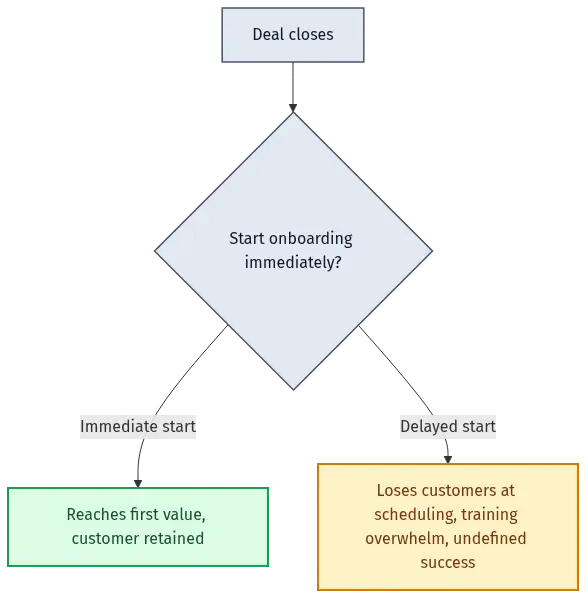
The single highest-leverage customer onboarding best practice costs nothing to understand and almost nothing to implement: collapse the gap between the signed contract and the first onboarding touch to as close to zero as possible.
One SaaS company I’ll keep anonymous discovered this by accident. Analyzing churn by cohort, they noticed that deals handed to onboarding immediately — the salesperson literally transferring the call to an available Customer Success (CS) agent within 30 seconds of close — churned at far lower rates at the 30-day mark than deals where the handoff took days.
The mechanism is mundane. When no CS agent was free, the salesperson said, “Someone will contact you to schedule an onboarding call.” Then came phone tag. Email back-and-forth. The customer got busy. Scheduling dragged from days into weeks — and some customers never onboarded at all. The churn rate for customers who never onboard and never use the software is 100%. Every single one eventually quits, because nobody keeps paying for software they don’t use.
When the company measured it, only 20% of closed deals were transferring to onboarding immediately; 80% took days or longer. The immediate-start cohort churned at 4.0% within 30 days. The delayed cohort churned at 6.0%. The blended rate was 5.6%. They changed the CS staffing model — deliberately carrying spare capacity so most closed deals could start onboarding on the spot — and cut 30-day churn by roughly 29%, from 5.6% toward 4.0%. When the company sold a couple of years later, the deal team’s ballpark estimate was that this one change had added about $2 million in enterprise value. Treat that figure as the company’s own estimate rather than derived math — but the direction is not in dispute.
Notice what the fix was not: a better welcome email, a prettier checklist. It was a staffing decision. The original model staffed CS for cost efficiency — keep everyone busy eight hours a day. The new model staffed for response time, the way an emergency room staffs for arrivals rather than average workload. Idle capacity in onboarding isn’t waste; it’s insurance on every dollar of customer acquisition cost you just spent.
Implementation is straightforward: book the kickoff call during the closing call, while the customer is still on the phone and motivation is at its peak. If your sales motion can’t do a live transfer, a same-day kickoff held within 24 hours is the next best thing. Measure the gap — days from close to first onboarding session — and treat anything over 48 hours as a defect.
Transfer Context From Sales So the Customer Never Repeats Themselves
The second speed practice protects the momentum the first one creates. By the time a customer signs, they have told your salesperson their goals, their stakeholders, their current workflow, and their timeline — sometimes across five or six conversations. If the first onboarding call opens with “So, tell me about your business,” you have just taught the customer that your company doesn’t talk to itself.
Fix it with a mandatory handoff document — a one-page internal brief the salesperson completes before commission is credited. It should capture:
- The business outcome the customer bought. Not the features they licensed — the result they expect, in their own words.
- The people involved. Economic buyer, day-to-day admin, the executive sponsor who approved the spend, and any skeptic who voted no.
- Commitments made during the sale. Promised integrations, timelines, or configurations. Onboarding inherits every promise sales made; better to inherit them in writing.
- Known constraints. The customer’s IT review process, data migration sources, busy seasons to avoid.
The onboarding specialist’s first call should demonstrate this knowledge — “You told our team the goal is cutting invoice processing time before your Q3 audit; here’s how we’ll get there” — rather than re-collecting it. The customer should never repeat themselves on the way from sales to value.

Ask the 90-Day Goal Question on the First Call
Now the question from the opening of this article. The customer success manager whose accounts churned 27% less than her peers’ ran the same calls, the same timing, the same agenda as everyone else — with one addition. On the very first onboarding call, she asked:
“What were you hoping to accomplish in the first 90 days? What would make you thrilled you bought this?”
Then she used the answer twice. First, she anchored the entire onboarding plan to that goal. Second — and this is the subtle part — she prefaced every subsequent request with it. When she needed data for migration, she didn’t say “I need the export file by Friday.” She said “To get you to that month-end close you told me about, I need the export file by Friday.” Every step the customer had to take was framed as progress toward the outcome they had named.
Why does this work? Because customers don’t buy software; they buy a result, and most onboarding processes lose sight of the result within one call. The goal question converts onboarding from your company’s checklist into the customer’s own project. People abandon vendors’ checklists. They rarely abandon their own goals.
This is the cheapest practice on this list. It requires one line on a kickoff agenda and the discipline to write the answer down where every later touchpoint can see it. If you implement nothing else from this article this week, implement this.
Train to the Customer’s Goal, Not Your Feature List
A different client found the same pattern from another angle. Breaking first-year churn down by quarter, the CEO saw that most of it occurred in the first 90 days. He went further and compared retention rates across the four or five people on his onboarding team. One specialist’s customers retained dramatically better than everyone else’s.
The audit found her secret was the goal question again — but with a second move attached: she simplified training to teach only what the customer needed to achieve their stated goal. Her colleagues were training every customer on everything the software could do. The product was powerful and complicated, and customers came away overwhelmed. Overwhelmed customers don’t feel empowered by all that capability — they feel behind, and people quietly walk away from things that make them feel behind.
The practical rule: build training paths by goal, not by feature inventory. If your product does 40 things and the customer’s 90-day goal requires six of them, the onboarding curriculum is those six things, taught in the order the goal requires. The other 34 belong in expansion conversations after first value — when they become upsell ammunition instead of cognitive load.
This inverts how most product-proud founders think about training. Showing off the full platform feels like delivering value. Measured by retention, it’s the opposite: comprehensiveness is a churn risk during onboarding and an asset only after the customer has won once.
Define “First Value” as a Measurable Milestone
Every onboarding process claims to deliver “value.” Almost none can answer the question: what specific event marks the moment this customer first received it?
First value (often called “time-to-value” when you measure the days it takes) is the first moment the customer achieves the outcome they bought the product for — not the moment training completes, not the go-live date, not the last task on your checklist. A useful first-value definition has three properties:
- It’s binary. It either happened or it didn’t — “first marketing campaign sent to a live list,” not “customer is comfortable with the platform.”
- It’s visible to the customer. The customer should recognize the moment as a win without you explaining that it was one.
- It traces to the purchase reason. It should be the first concrete instance of the 90-day goal from the kickoff call.
A well-known example: a CRM and marketing automation company found that customers who implemented and went live with their first marketing automation campaign churned at dramatically lower rates than customers who merely completed setup. That insight gave onboarding a finish line that mattered — not “trained,” but “first campaign live.” Everything in the process could then be sequenced and measured against that milestone.
Define the equivalent milestone for your product, instrument it, and report time-to-first-value weekly. It is the single best leading indicator of whether you’ll retain the customer — you’ll see churn coming months before the cancellation notice arrives.
Engineer Usage of Your Stickiest Feature
Some features retain customers. Most don’t. The companies that onboard best know exactly which is which — and build the entire onboarding process to drive adoption of the features that do.
One company I worked with sold B2B software with a module their customers used to communicate with their customers. When they analyzed churn by feature usage, the pattern was stark: customers actively using that module almost never left, because leaving meant their own customers would hit dead links and missing portals mid-deal. The module made the product operationally entangled with the customer’s revenue — the beginning of a system-of-record moat at the individual account level. So they rebuilt onboarding around one objective: get every new customer live on that module fast.
To find your version, run the analysis: segment your customer base by which features they actively used in the first 60 days, then compare 12-month retention across segments. One or two features will correlate with retention far more than the rest. Those are your sticky features — the ones whose absence makes you easy to cancel and whose presence makes cancellation operationally painful for the customer.
Then make sticky-feature activation an explicit onboarding milestone with a deadline, the same status as go-live. If the data says customers who activate the module within 30 days retain dramatically better, then “module active by day 30” is not a nice-to-have — it’s the job.
Run Onboarding on a Person-Independent Process
Here’s a diagnostic I use to assess the maturity of any onboarding operation: does customer outcome depend on which specialist did the work? If customers onboarded by Mary consistently do better than customers onboarded by Bob, you don’t have an onboarding process — you have Mary. And Mary can resign.
Person-dependency is more than an operations nuisance. It’s a valuation problem. Acquirers price predictability, and a function whose results swing on individual heroics is unpredictable by definition — the same reason a repeatable sales process commands a premium over a rainmaker-driven one. The test for whether you’ve genuinely systematized: a competent new hire should reach 90%+ of a veteran’s effectiveness within a reasonable ramp. If they can’t, what you call a process is actually tribal knowledge.
Getting there is unglamorous:
- Document the actual process — call agendas, email templates, milestone definitions, escalation rules — at the level of detail where a new hire could run it.
- Standardize the customer-facing sequence. Every customer gets the same call structure, the same milestone plan, the same cadence, regardless of who runs it.
- Assess proficiency before assigning accounts. New onboarding hires complete the curriculum and pass a practical assessment before they touch a live customer.
- Audit drift quarterly. Processes decay as individuals “improve” them privately. Review recorded calls against the playbook.
Standardization is also what makes every other practice on this list possible. You cannot find your outlier, instrument your stages, or trust your metrics if every specialist is running a private variant. Systematizing functions like onboarding is one of the prerequisites to scaling — skip it and every growth dollar you spend pours water into a bucket of unknown integrity.
Study Your Outlier
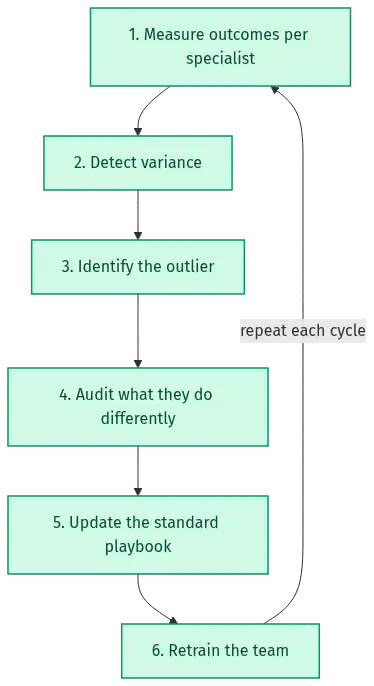
Both churn breakthroughs described earlier — the 90-day goal question and goal-scoped training — were discovered the same way: someone compared performance across individuals doing the same job and investigated the variance instead of averaging it away.
This is the highest-leverage process improvement method I know, and it applies to onboarding perfectly because results are so measurable. The procedure:
- Measure outcomes by specialist. Churn at 30/90/365 days, time-to-first-value, and sticky-feature activation rate for every account, attributed to the person who onboarded it.
- Find the outlier. With four or more specialists, someone is meaningfully better. The variance itself is the signal — if you can’t see variance, your instrumentation is too coarse.
- Audit the difference. Watch their calls. Read their emails. Most of what they do will match the playbook; you’re hunting for the one or two deviations that explain the gap. In the 27% case, the entire difference was one question.
- Fold the difference into the standard process and retrain everyone. The outlier’s edge becomes the new baseline.
- Repeat. A new outlier will emerge against the new baseline. This loop never finishes — that’s the point.
Note the dependency: this only works on top of the previous practice. If every specialist already runs a private process, everything is a deviation and nothing is a signal.
Instrument Every Stage of the Process
You cannot improve a process you can’t see. Most SaaS companies can tell you their overall churn rate; very few can tell you how many days a typical customer spends stuck in data migration, or which onboarding stage has the highest abandonment. The companies that run onboarding well measure it like a production line.
The minimum instrument panel:
| Metric | What It Tells You | Review Cadence |
|---|---|---|
| Time from close to first onboarding touch | Whether you're losing customers in the dead zone after signature | Weekly |
| Time in each onboarding stage | Where the process stalls (yours vs. customer-side delays) | Weekly |
| Time-to-first-value | The headline: how fast customers reach the milestone that predicts retention | Weekly |
| Onboarding completion rate | Share of new customers who reach first value at all | Monthly |
| Sticky-feature activation by day 30/60 | Whether you're building accounts that are hard to cancel | Monthly |
| Labor hours per onboarding | Your unit cost — the denominator for capacity planning | Monthly |
| 30/90-day cohort churn, by segment and by specialist | Whether any of the above is translating into retention | Monthly |
| Customer satisfaction at day 0, 30, and 90 | Whether the experience feels as good as the metrics claim | Each milestone |
Two notes on the panel. First, separate your delays from customer-side delays in stage timing — they need different fixes (process redesign vs. engagement tactics like goal-framing every request). Second, satisfaction at three points matters because trajectory beats level: a customer at day 30 who is less happy than at day 0 is flashing an early churn warning no single survey would catch. A simple Net Promoter Score or one-question satisfaction pulse at each milestone is enough — and feed the results into the same customer success metrics review your CS team already runs.

Segment the Onboarding Playbook by ICP
A single onboarding playbook applied to every customer is a blended average — and like all blended averages in SaaS, it hides the truth. Different segments onboard differently: an enterprise account with an IT review board and a 90-day data migration has nothing in common with a two-seat SMB self-serve signup, and pretending otherwise produces a process mediocre for both.
Three moves, in increasing order of ambition:
- Vary depth by Annual Contract Value (ACV). High-ACV accounts justify named specialists and custom milestone plans; low-ACV accounts get a templated, partly automated path. (For low-ACV customers, “less human touch” doesn’t mean “no path” — see the FAQ for what a tech-touch model includes.) The companion article on onboarding economics covers how to pick the model your gross margin can afford.
- Vary content by vertical or use case. Once a segment is large enough, dedicate playbooks — even specialists — to it. Large software companies run separate onboarding teams for manufacturing and retail; you can run separate playbooks long before you can afford separate teams. The constraint is volume: don’t fragment into five custom processes for five customers each.
- Let onboarding data discipline your ICP. This is the move almost nobody makes. One CEO I worked with spent years trying to fix onboarding for a segment of small, barely-committed customers who churned no matter what the team did. The eventual answer wasn’t better onboarding — it was to stop acquiring the segment. They restructured the entry-level package and pricing so that small-but-serious buyers still came in while tire-kickers self-selected out, and churn fell. If a segment consistently fails to onboard across playbook iterations, that’s not an onboarding problem; that’s an Ideal Customer Profile (ICP) problem wearing an onboarding costume.
Measure 90-day retention by segment, always. 100% of the time, there are significant variances — and each variance is either a playbook to write or a segment to fire.
Pay Your Team on Activation, Not Completion
Whatever you bonus is what you’ll get more of. If onboarding specialists are measured on checklist completion or tickets closed, you will get completed checklists — attached to customers who never activated and quietly churn in month seven, long after anyone connects the outcome to the onboarding.
The fix is to compensate on the outcomes this article keeps pointing at. One approach I’ve seen work: after identifying the sticky module that drove retention, the company bonused its entire CS team on whether new customers were actively using that module within 30 days. Not trained on it. Not configured. Using. They reinforced it commercially, too — charging a setup fee that bundled professional services to implement the module, which committed both sides to getting it live.
Design rules for onboarding incentives:
- Pay on the leading indicator you trust — sticky-feature activation by day 30, or first value reached by a deadline — not on activity volume.
- Make it team-level where work is shared. Individual bonuses on shared accounts create handoff fights; team bonuses create peer pressure in the right direction.
- Keep score visible. A weekly activation dashboard the whole team sees does half the work before any money changes hands.
The deeper principle: onboarding outcomes lag onboarding work by months, and compensation systems are how you import the future into this month’s behavior.
Treat Onboarding Like a Production Bottleneck
In any system, one constraint sets the pace of the whole — a principle from manufacturing (the “theory of constraints,” which says a factory can only move as fast as its slowest station) that maps cleanly onto SaaS growth. For many companies between $5M and $15M in Annual Recurring Revenue (ARR), the constraint isn’t lead generation or sales capacity. It’s onboarding: sales can close faster than the company can get customers live, so new ARR queues up in implementation, time-to-value stretches, and the early-churn mechanics from earlier in this article kick in.
If that’s you, two responses, in order:
- Increase throughput before adding headcount. Audit where onboarding hours actually go. Time each stage. Separate work that contributes directly to customer progress from internal friction — manual setup steps that could be automated, approval loops, waiting on internal resources. One CEO in my advisory group had a revenue-operations analyst with no onboarding experience shadow the head of onboarding for a full day; her naive questions surfaced more process waste than the team had found in a year. Fresh eyes beat familiar eyes at spotting friction.
- Then add capacity deliberately — and slightly ahead of demand. Once the process is efficient, staff it the way the deal-close story earlier demands: with enough slack that new customers start immediately. Plan it at the units-of-work level — onboardings per specialist per month against the sales forecast — not as a vague “we should hire another CS person” feeling.
And remember the law of constraints: fix onboarding and the bottleneck moves somewhere else — support, product, sales. That’s not failure. That’s the system telling you where to look next.
A 30/60/90-Day Customer Onboarding Plan
Customer onboarding best practices only become operational when they’re pinned to a calendar. Here’s how the 12 practices assemble into a timeline — calibrate stage lengths to your product’s complexity; the sequence and the exit criteria are the part to keep.
| Phase | Days | Objective | Exit Criteria |
|---|---|---|---|
| Kickoff & goal capture | 0–7 | First touch within 24 hours of close; sales context received; 90-day goal question asked and documented; milestone plan agreed | Written success plan: customer's goal, first-value milestone, dates, owners on both sides |
| Setup & goal-scoped training | 8–30 | Configuration, data migration, and training on only the features the goal requires | First value milestone reached — the customer has won once, visibly |
| Adoption & entrenchment | 31–60 | Sticky-feature activation; additional users onboarded; usage habits forming (logins without prompting) | Sticky feature in active use; agreed usage threshold met two weeks running |
| Goal review & handoff | 61–90 | Review the 90-day goal against results in the customer's numbers; introduce the long-term CS owner with full context transferred | Customer confirms goal met (or revised plan agreed); handoff complete with no repeated questions |
Two failure patterns to watch. Companies treat day 30’s go-live as the finish line and disband attention precisely when habit formation — the actual retention event — is half done. And the day 61–90 handoff recreates the sales-to-onboarding context loss this article opened with; hold the handoff to the same “never repeats themselves” standard.
The Math: What Faster Onboarding Is Worth
Best practices earn their place by changing numbers, so let’s run the numbers on the first practice — eliminating the dead zone between close and kickoff — for a company in this audience’s range. The figures below are illustrative assumptions chosen to be realistic for a B2B SaaS company at this stage, not benchmarks to adopt; plug in your own data before making staffing decisions.
| Input | Value |
|---|---|
| ARR | $9.6M (400 customers × $24,000 ACV) |
| ARPA (Average Revenue Per Account) | $2,000/month |
| New customers | 25/month (300/year) |
| 30-day cohort churn, immediate onboarding start | 4.0% |
| 30-day cohort churn, delayed start | 6.0% |
| Share of customers starting immediately | 20% today → 80% after the change |
| Monthly churn, established customers | 2.0% |
| Gross margin | 80% |
| CAC (Customer Acquisition Cost) | $12,000 |
| Fully loaded cost of one added onboarding specialist | $95,000/year |
(The 4.0% vs. 6.0% cohort spread comes from the company example earlier; “fully loaded” means salary plus benefits, payroll taxes, and tools — the true annual cost of the seat.)
Step 1 — blended 30-day churn. Today: (20% × 4.0%) + (80% × 6.0%) = 5.6%. After staffing for immediate starts: (80% × 4.0%) + (20% × 6.0%) = 4.4%.
Step 2 — customers saved. On 300 new customers a year, 5.6% means 16.8 lost in the first 30 days; 4.4% means 13.2. The change preserves 3.6 customers per year.
Step 3 — what they’re worth. Immediate ARR preserved: 3.6 × $24,000 = $86,400 per year. But the real prize is lifetime value. With 2.0% monthly churn, average customer lifespan = 1 ÷ 0.02 = 50 months. Using LTV = ARPA × Gross Margin % × Average Lifespan = $2,000 × 0.80 × 50 = $80,000 per customer in lifetime gross profit. The 3.6 saved customers represent 3.6 × $80,000 = $288,000 per annual cohort.
Step 4 — against the cost. One added specialist at $95,000 fully loaded, providing the slack capacity that makes immediate starts possible: $288,000 ÷ $95,000 ≈ 3.0× return — and that’s a fresh $288,000 from each year’s cohort, against the same $95,000 seat, before counting the CAC you stop writing off. At a $12,000 CAC and $1,600 monthly gross profit ($2,000 × 80%), CAC payback is $12,000 ÷ $1,600 = 7.5 months — so every 30-day churn is acquisition spend torched at month one. The change cuts that annual write-off from 16.8 × $12,000 = $201,600 to 13.2 × $12,000 = $158,400, recovering $43,200 a year on its own.
This is one practice, conservatively modeled — the new customers’ churn improvement alone, ignoring the LTV/CAC ratio improvement that compounds across your whole acquisition engine and the expansion revenue that well-onboarded customers generate later. Bain & Company’s research has found that a 5% improvement in customer retention can increase profits by 25% to 95% — a market finding rather than a formula, but a useful sanity check on why the multiple looks so large. Onboarding is where retention improvements are cheapest to buy. For the full chain from these numbers to your customer lifetime value and exit valuation, see the economics companion article.

Common Customer Onboarding Mistakes (and What They Cost)
The inverse of the customer onboarding best practices above shows up so consistently across companies that it’s worth naming each failure directly:
| Mistake | What It Looks Like | The Fix |
|---|---|---|
| The post-signature dead zone | Kickoff scheduled "soon," held in week two or three | Book kickoff during the closing call; treat >48 hours to first touch as a defect |
| Firehose training | Every customer trained on every feature; customers feel overwhelmed and behind | Goal-scoped curriculum: teach the six features the 90-day goal requires, sell the rest later |
| Go-live worship | "Implemented" celebrated as done; usage decays from week five | Define first value and habit-formation milestones past go-live; onboarding ends at the 90-day goal review |
| Averaged-away variance | Churn measured company-wide only; nobody knows specialist or segment differences | Attribute outcomes by specialist and segment; investigate variance instead of blending it |
| Hero dependence | One brilliant specialist carries results; process lives in their head | Document, standardize, assess — then study the hero and clone the difference |
| Onboarding as cost center | Function staffed for full utilization, no slack, reporting into support | Staff for response time; own a retention number, not a ticket queue |
Every one of these mistakes is invisible in a company-wide churn rate and obvious the moment you instrument the process. If you recognize three or more, the instrumentation panel above is your starting point — you can’t fix what you can’t see, and most of these cost less to fix than one month of the churn they cause. For how that churn compounds at the company level, see how churn rate actually works.
Customer Onboarding Best Practices FAQ
How long should customer onboarding take?
As long as it takes to reach first value and not a day longer — calendar targets follow from product complexity, not industry convention. A simple tool should produce first value in days; an enterprise platform with data migration might legitimately take 60–90 days. The discipline is measuring your time-to-first-value baseline and shortening it release over release. Treat any stage where the customer is waiting on you as the first thing to cut.
Who should own customer onboarding?
A dedicated function with a retention number — typically inside CS, sometimes a standalone implementation team — never “whoever in support is free.” The owner should report on time-to-first-value and 90-day cohort retention, not ticket throughput. The economics companion article linked above covers the ownership models in more depth.
What’s the difference between customer onboarding and user onboarding?
User onboarding is the in-product experience teaching an individual the interface — tours, tooltips, checklists. Customer onboarding is the account-level process of getting the buying organization to the outcome it purchased. User onboarding is one component of customer onboarding; the practices in this article operate at the account level, where churn decisions are actually made.
What’s a good time-to-first-value?
Shorter than your competitor’s, and short enough that the customer’s executive sponsor sees a win before they stop paying attention — in practice, well inside the first 90 days, because that’s where churn concentrates. The more useful question is directional: is your median time-to-first-value falling each quarter? If it’s not measured, start there.
What if we can’t afford high-touch onboarding for every customer?
You almost certainly can’t, and you shouldn’t try — high-touch onboarding on low-ACV accounts destroys gross margin. What is available at every price point: a templated milestone plan, the 90-day goal question asked via a short kickoff form or survey instead of a call, recorded goal-based (not feature-based) training paths, in-app checklists pointed at the first-value milestone, automated nudges triggered by stalled progress, and weekly group office hours instead of 1:1 calls. Tech-touch onboarding still implements the same principles — speed, goal focus, a defined first-value milestone, instrumentation. It changes the delivery mechanism, not the playbook.
When is onboarding actually finished?
When the customer has hit first value, formed a usage habit, and reviewed their 90-day goal against real results — not when your checklist is complete or training is delivered. If you want a single operational definition: onboarding ends when the customer’s own numbers prove the purchase decision correct. Everything after that is net revenue retention’s job.
The First 30 Days Decide the Next Three Years
Strip the 12 practices to their logic and you get three sentences. Customers decide whether to keep you long before they cancel, so speed to a real first win is everything. The first win only happens reliably when the entire process is aimed at the customer’s stated goal instead of your feature list. And none of it scales — or survives your best specialist’s resignation — unless the process is documented, instrumented, and improved by studying whoever is quietly beating the average.
None of this requires new software. The 90-day goal question costs one line on an agenda. The handoff document costs a page. The instrumentation costs a spreadsheet to start. Even the staffing change in the worked example returns roughly 3× its cost per cohort. What it requires is treating customer onboarding as what the data says it is — the most leveraged 90 days in the customer relationship — and running it with the same discipline you’d demand of your sales pipeline.
Start with the goal question on Monday’s kickoff calls. Then go measure your close-to-kickoff gap. The rest of the playbook will tell you what to do from there.