

Two SaaS companies each added $10,000 in net new monthly recurring revenue last month. One is a great business. The other is quietly dying. The number that tells them apart is the SaaS quick ratio — and most CEOs have never calculated it.
The SaaS quick ratio measures how much recurring revenue you add for every dollar you lose. It is the single cleanest read on whether your growth is real or whether you are just running fast enough on a treadmill to look like you are moving. A high net new MRR figure can hide a leaking bucket; the quick ratio exposes the leak. This guide gives you the formula, the benchmarks by company stage, a worked example, and — more importantly — what to actually do when your number comes back ugly.
One note before the math: this is the growth quick ratio, not the accounting “quick ratio” (the acid-test liquidity measure of current assets over current liabilities). Same two words, completely different metric. If you searched for the one that tells you whether you can cover next month’s bills, that is the accounts-receivable and current-asset question, not this one.
What Is the SaaS Quick Ratio?
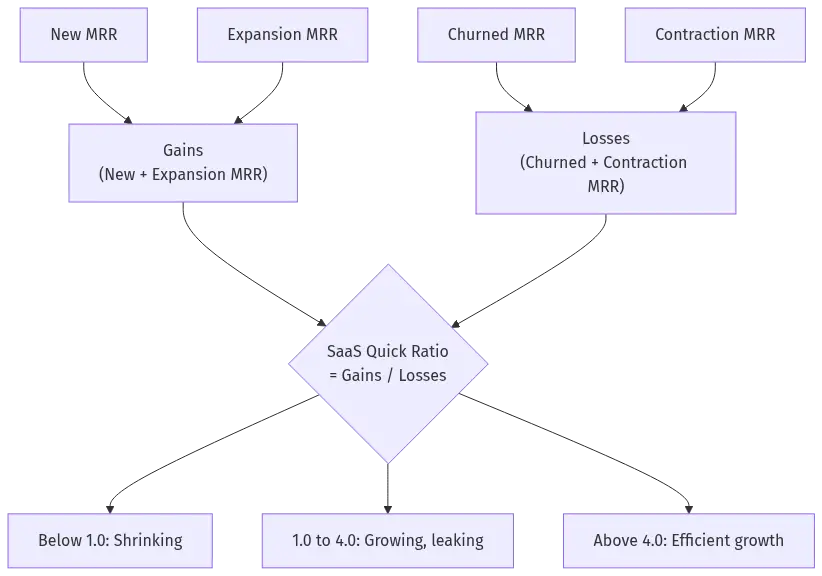
The SaaS quick ratio compares the recurring revenue you gained to the recurring revenue you lost over the same period. Gains come from two places: new customers and existing customers spending more. Losses come from two places: customers who left and customers who downgraded.
The formula:
SaaS Quick Ratio = (New MRR + Expansion MRR) ÷ (Churned MRR + Contraction MRR)
Each input is plain English once you name it:
- New MRR — recurring revenue from brand-new customers this period.
- Expansion MRR — additional recurring revenue from existing customers (upsells, cross-sells, seat or usage increases).
- Churned MRR — recurring revenue lost from customers who cancelled entirely.
- Contraction MRR — recurring revenue lost from customers who stayed but downgraded.
A quick ratio of 4 means you added $4 of recurring revenue for every $1 you lost. A quick ratio of 1 means you replaced exactly what you lost and stood still. A quick ratio below 1 means you are shrinking, even if your sales team is busier than ever.
You can run the same formula on annual recurring revenue (ARR) instead of MRR — the ratio is identical because the units cancel. Use whichever you report internally. If you are still fuzzy on the difference, start with what MRR and ARR actually mean.
How to Calculate the SaaS Quick Ratio (Worked Example)
Take a $6M ARR business — $500,000 in MRR — looking at a single month:
- New MRR from new logos: $40,000
- Expansion MRR from upsells: $20,000
- Churned MRR from cancellations: $10,000
- Contraction MRR from downgrades: $5,000
Plug it in:
Quick Ratio = ($40,000 + $20,000) ÷ ($10,000 + $5,000) = $60,000 ÷ $15,000 = 4.0
This company adds $4 for every $1 it loses. Healthy.
Now here is why the metric matters more than net new MRR. Net new MRR for this company is $60,000 − $15,000 = $45,000. Hold that $45,000 net new figure constant and look at three different businesses that all “grew by $45,000”:
| Company | New + Expansion MRR | Churned + Contraction MRR | Net New MRR | Quick Ratio |
|---|---|---|---|---|
| A — efficient | $54,000 | $9,000 | $45,000 | 6.0 |
| B — healthy | $60,000 | $15,000 | $45,000 | 4.0 |
| C — leaky | $90,000 | $45,000 | $45,000 | 2.0 |
All three posted the same net new MRR. Company A keeps almost everything it wins. Company C has to win twice as much gross revenue to land the same net result, because half of it pours straight back out through churn and contraction. Company C is spending far more on sales and marketing to stand in the same place — and the day acquisition slows, its growth collapses fastest. The quick ratio is the only one of these numbers that surfaces that difference.
What Is a Good SaaS Quick Ratio?
The most-cited benchmark comes from investor Mamoon Hamid (then at Social Capital, now Kleiner Perkins), who said publicly he won’t invest in a SaaS company with a quick ratio below 4 — add at least $4 of revenue for every $1 lost. That “4” became the industry shorthand. Here is the fuller picture:
| Quick Ratio | What It Means |
|---|---|
| Below 1.0 | Shrinking. Churn and contraction outpace everything you win. |
| 1.0 to 2.0 | Treading water to barely growing — and inefficiently. |
| 2.0 to 4.0 | Growing, but losing too much out the back. Fixable. |
| Above 4.0 | Efficient, durable growth. The zone investors reward. |
But “4 is good” is where most articles stop, and it is exactly where a CEO should get skeptical. Two cautions matter more than the threshold itself.
First, the benchmark is stage-dependent. A young company with a tiny revenue base posts a high quick ratio almost automatically — there is very little installed revenue to churn, so the denominator stays small. As you scale, the denominator grows with your base, and the ratio naturally compresses. A study by InsightSquared found the fastest-growing SaaS companies averaged a quick ratio near 3.9 — not a sky-high number, because they were already at scale.
Second, a “good” quick ratio can hide a bad churn problem. Tomasz Tunguz at Redpoint showed that a quick ratio of 4 can coexist with 5%+ monthly churn — roughly 46% annual churn — as long as you are acquiring fast enough to outrun it. That is a company buying its way past a structural retention problem. It looks healthy on this one metric and is anything but.
So calibrate the benchmark to where you are:
| ARR Stage | Reasonable Quick Ratio Target | Why |
|---|---|---|
| Under $1M (early) | Above 4 — often much higher | Tiny revenue base, almost no churn denominator yet |
| $1M–$5M | 4+ | The classic "prove the engine works" zone |
| $5M–$15M | 3.0–4.0 with strong retention | Base is large enough that the denominator bites |
| $15M+ (scale) | 2.5–3.5 if churn is low and NRR is high | Mature base; quality of growth beats raw ratio |
A scaled business sitting at 3.0 with low churn and strong net revenue retention is in better shape than a younger one flashing a 5 built on heavy discounting and a one-month-old customer base.

The Quick Ratio Is Directional, Not an Efficiency Metric
Here is the part almost nobody tells you. The quick ratio describes the quality of your growth — gains versus losses — but it says nothing about what that growth cost you. There is no sales-and-marketing spend anywhere in the formula.
You could post a beautiful quick ratio of 6 and still be lighting money on fire to get it, if your customer acquisition cost is bloated and your payback period is two years. The quick ratio would never tell you. It treats a $1 of new MRR won cheaply and a $1 won at a brutal loss as identical.
That is why the quick ratio belongs alongside your efficiency metrics, not instead of them. Read it together with:
- CAC payback period — how many months to earn back the cost of acquiring a customer.
- LTV/CAC ratio — lifetime value over acquisition cost; 3:1 or better is the standard.
- SaaS Magic Number — net new ARR divided by prior-period sales and marketing spend; this one does measure spend efficiency.
- Burn multiple — net cash burned per dollar of net new ARR; the bluntest read on capital efficiency.
The quick ratio tells you whether your bucket leaks. The efficiency metrics tell you what it costs to fill it. You need both.
Quick Ratio vs. Net Revenue Retention vs. Magic Number
These metrics get confused constantly because they all touch growth and churn. They answer different questions and you look at them at different moments. Here is the clean head-to-head:
| Metric | What It Measures | Includes New Customers? | Best Question It Answers |
|---|---|---|---|
| Quick Ratio | Gains vs. losses across the whole business, one period | Yes | "Is the growth I'm posting real or am I treading water?" |
| Net Revenue Retention | Revenue change within the existing customer base only | No | "Does my installed base grow on its own without new sales?" |
| Magic Number | Net new ARR per dollar of S&M spend | Yes | "Is my sales and marketing spend efficient?" |
| Rule of 40 | Growth rate + profit margin | Yes | "Am I balancing growth and profitability the way investors want?" |
The quick ratio is a whole-business, single-period read that includes your new logos. Net revenue retention deliberately strips new customers out to ask whether your existing base expands or decays on its own. They are complementary: a strong quick ratio with weak NRR means new sales are masking an expansion-or-retention problem inside your base — exactly the kind of thing a company-wide average will hide.
Of all of these, NRR is the one that compounds into enterprise value. The math is not intuitive — it works the same way a contagious-disease spread rate does — which is why operators consistently underrate it. A $20M ARR business at 80% NRR is worth a fraction, over a decade, of the same business at 120% NRR, with no change to new-customer acquisition at all. The companies worth over a billion dollars in SaaS frequently run net revenue retention around 140%. The quick ratio is how you catch a retention problem early; NRR is the lever that pays off when you fix it.
How to Improve a Low SaaS Quick Ratio
When the number comes back low, the instinct is to sell harder — pour more into acquisition to lift the numerator. That is usually the wrong first move. A leaky bucket does not get fixed by pouring water in faster; you patch the holes first, because every dollar of retained revenue is cheaper than a dollar of newly acquired revenue.
Work the four inputs in this order:
- Cut churn first (shrink the denominator). This is the highest-leverage move because retained revenue costs nothing to re-win. Find why customers leave — onboarding gaps, missing value realization, the wrong customers signed in the first place. Start with the real reasons SaaS customers churn.
- Cut contraction (shrink the denominator). Downgrades are quieter than cancellations but they hit the same denominator. Usually a pricing-and-packaging or value-delivery problem, not a product problem.
- Drive expansion (grow the numerator efficiently). Expansion revenue is the cheapest revenue you will ever book — you already won the customer. A land-and-expand motion lifts the numerator and pushes NRR above 100%.
- Then improve new-customer acquisition. Last, not first — and only after you have confirmed the bucket holds water. Otherwise you are scaling a leak.
The order matters because of where the money is. A point of churn reduction shows up in the denominator every single month going forward and costs you nothing in acquisition spend. A point of new MRR has to be bought again and again.
Segment the Ratio to Find the Leak
A company-wide quick ratio is an average, and averages lie. A blended 2.5 almost always hides a wide spread — one segment running a healthy 5 and another bleeding out at 1. The fix for each is completely different, and the blended number points you at neither.
Calculate the quick ratio separately for your meaningful cuts:
- By plan tier — is the leak in your self-serve low tier or your enterprise tier?
- By vertical or ideal customer profile — are you retaining the customers you are actually built for and churning the ones you should never have sold?
- By acquisition channel — some channels deliver customers who stick; others deliver tourists.
- By cohort — did a pricing or product change break retention for everyone who signed after a certain date?
Almost every time you segment, you find the leak is concentrated, not spread evenly. That changes the work entirely: instead of a vague “improve retention” initiative across the whole company, you get a specific “this vertical churns at triple the rate — stop selling into it or fix the fit.” The blended number tells you something is wrong; the segmented number tells you what and where.
When the SaaS Quick Ratio Misleads You
No single metric survives contact with a clever operator, and the quick ratio has three honest failure modes worth naming:
- Hidden high churn. As Tunguz showed, a strong ratio propped up by fast acquisition can mask brutal underlying churn. Always read the quick ratio next to your raw churn rate, not instead of it.
- Discounting and timing games. Aggressive discounts inflate the numerator in the short term, and the timing of annual contract renewals can swing a single month’s ratio hard. Look at a rolling trend, not one noisy month.
- Too small a base. Below roughly $1M ARR, or with a customer base under a year old, the denominator is so small that one cancellation whipsaws the ratio. Pre-product-market-fit, the number is mostly noise — focus on reaching product-market fit first and let this metric matter later.
Treat the quick ratio as a trend line and a diagnostic prompt, never as a target to optimize in isolation. The moment a metric becomes a goal, someone finds a way to game it.

Frequently Asked Questions
What is a good SaaS quick ratio?
Above 4 is the widely cited benchmark — adding at least $4 of recurring revenue for every $1 lost — popularized by investor Mamoon Hamid. But it is stage-dependent: early companies easily exceed 4 on a tiny base, while scaled companies running 2.5–3.5 with low churn and strong retention are often healthier than a younger company flashing a higher number.
How do you calculate the SaaS quick ratio?
Add new MRR and expansion MRR (your gains), add churned MRR and contraction MRR (your losses), and divide gains by losses. For example, ($40,000 + $20,000) ÷ ($10,000 + $5,000) = 4.0. You can use ARR instead of MRR; the ratio is the same.
What is the difference between the SaaS quick ratio and net revenue retention?
The quick ratio measures gains versus losses across your whole business in one period, including new customers. Net revenue retention measures only your existing customer base and excludes new logos. The quick ratio tells you if your overall growth is efficient; NRR tells you whether your installed base grows on its own.
Is the SaaS quick ratio the same as the accounting quick ratio?
No. The accounting quick ratio (acid-test) measures liquidity — current assets minus inventory over current liabilities. The SaaS quick ratio measures growth efficiency. They share a name and nothing else.
Can you use ARR instead of MRR for the quick ratio?
Yes. Because the units appear in both the numerator and denominator, they cancel out, so the ratio is identical whether you use monthly or annual recurring revenue. Use whichever you report internally.
What does a SaaS quick ratio below 1 mean?
It means you are losing more recurring revenue than you are adding — your business is contracting, regardless of how active your sales team looks. A ratio below 1 is a signal to stop everything and fix retention before spending another dollar on acquisition.
The SaaS quick ratio earns its place because it answers a question raw growth numbers cannot: is the growth real, or are you just refilling a leaky bucket? Calculate it, segment it to find where the leak is, read it alongside your efficiency metrics and your retention numbers — and remember that the cheapest revenue you will ever book is the revenue you simply do not lose.