

Most founders pick a SaaS revenue model the way they pick a database: whatever felt obvious at the start, never revisited. That decision is quietly setting your exit valuation years before you ever take a meeting with an acquirer. Two B2B software companies can do the exact same $10M in sales this year and sell for prices that differ by 3× or more — and the gap usually traces back not to growth rate, but to the SaaS revenue model underneath the number.
Here is the part nobody tells you in the “pick subscription vs. usage-based” listicles: the model you run doesn’t just determine how you collect money. It determines how predictable that money is, how much of it compounds without new sales effort, and therefore what multiple of revenue a buyer will pay. A dollar of one-time implementation revenue and a dollar of contractually recurring, expanding revenue both spend the same at the grocery store. They are not remotely worth the same on a term sheet.
This guide does two things the generic guides skip. First, it walks through the actual revenue model types and the math that separates them — subscription, usage-based, hybrid, freemium, and transaction/marketplace — with realistic numbers for a $5M–$15M ARR company. Second, it connects each model directly to the lever that pays you: the revenue multiple an acquirer applies. By the end you’ll be able to look at your own revenue line, name exactly which model you’re running, and see where you’re leaving valuation on the table.
What a SaaS Revenue Model Actually Is
A SaaS revenue model is the structure that determines how your software company earns money from customers over time — what you charge for, how you charge for it, and how often the money comes back. It is the answer to a deceptively simple question: when a customer pays you, what exactly are they buying, and what makes them pay you again next month?
That “again next month” part is the whole game. Traditional software was a transaction — you bought a license once, the way you’d buy a widget. You hand over the cash, you get the goods, the relationship is done. SaaS replaced that with an ongoing relationship: the customer signs a contract, you deliver the software month after month, and they keep paying as long as you keep delivering value. The revenue model is the contract design that governs that relationship.
It helps to separate three things that often get jammed together:
- Revenue model — the high-level structure of how you monetize (subscription, usage-based, transaction-based, etc.). This is what an acquirer cares about most.
- Pricing model — how you set and scale the price within that structure (per-seat, per-feature, tiered, flat-rate). This is a lever inside the revenue model.
- Pricing level — the actual dollar figure you charge. This is the easiest to change and the least strategic.
Most “SaaS revenue model” content blurs all three. The distinction matters because they sit at different altitudes. You can change your pricing level next quarter. Changing your revenue model is a multi-year repositioning of the entire business. Get the altitude right and the rest of this guide will make a lot more sense.
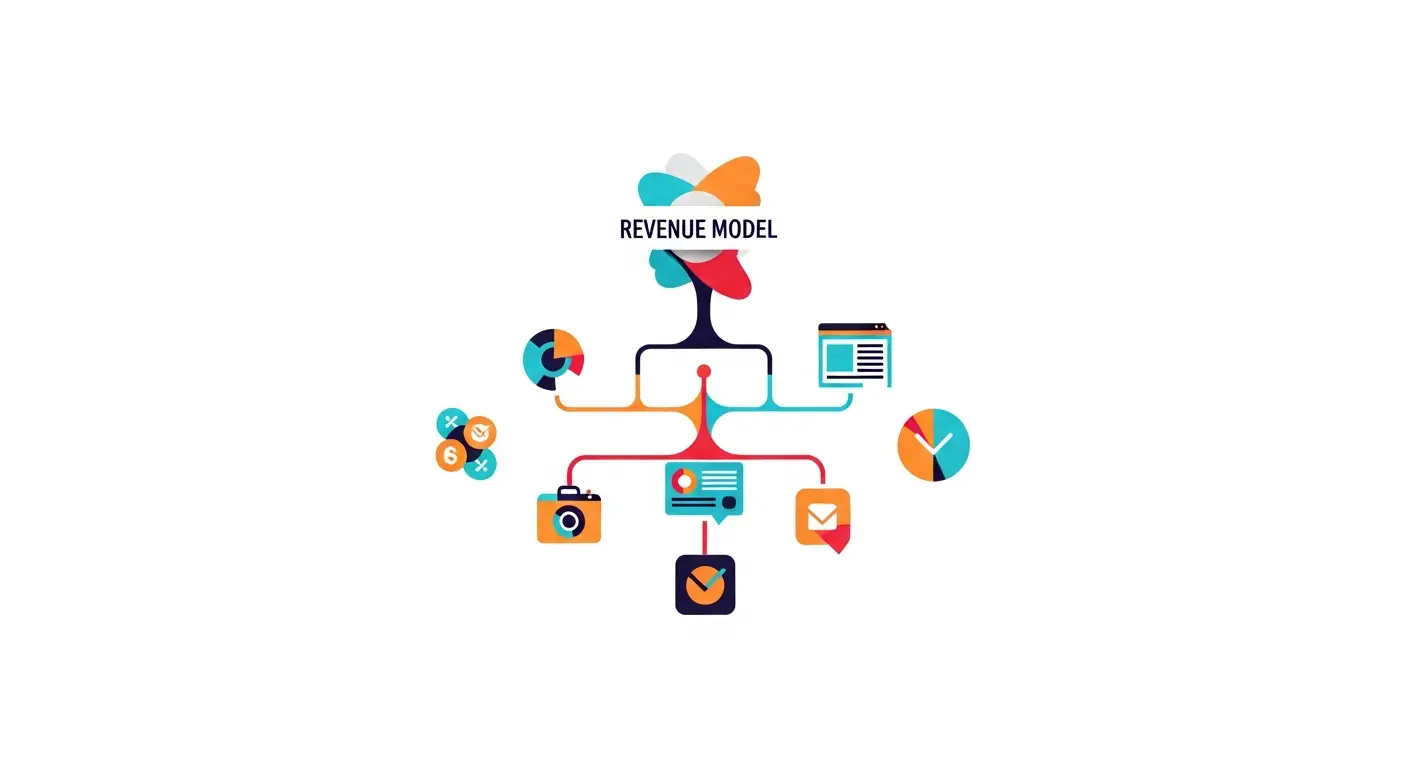
Why the Model Decides Your Ceiling, Not Just Your Cash
Think of your revenue model as a factory. The inputs are customers and sales-and-marketing spend. The outputs are recurring revenue, gross margins, and retention. A well-designed revenue model is a machine that takes a dollar of acquisition cost in one end and produces many dollars of compounding, predictable revenue out the other end. A poorly designed one leaks at every seam — revenue that doesn’t recur, customers that don’t expand, margins eaten by services.
The reason this matters more than growth rate alone is that acquirers don’t buy your trailing revenue. They buy the durability and trajectory of your future revenue. The model is what makes future revenue believable. That’s the thread running through every section below.
The Five SaaS Revenue Model Types
There are really five structures that cover the vast majority of B2B software companies. Most companies run one as their core and bolt on pieces of another. Here’s each one, who it fits, and the tradeoffs that matter for unit economics and valuation.
Subscription (Recurring) Revenue
The subscription model is the default for a reason: the customer pays a fixed, recurring fee — monthly or annual — to keep using the software. It produces the cleanest version of the thing acquirers prize most, recurring revenue: predictable, contractually obligated, and easy to forecast.
This is the model that gave SaaS its valuation premium in the first place. When a customer signs a 12-month contract for a $12,000 annual subscription, you can model that revenue forward with high confidence. You don’t have to re-win the sale every month. The work — and the cost — of acquiring that customer happens once, and the revenue recurs.
Subscription revenue splits into two flavors that matter for forecasting:
- Annual contracts — the customer commits for a year (or multiple years) up front. Higher commitment, lower churn risk, often paid annually in advance, which helps cash flow.
- Month-to-month — the customer can leave any time. Lower friction to land, but higher churn risk and weaker for valuation because the revenue is less locked in.
Most companies in the $5M–$15M ARR range run a blend. A typical split might be 50% annual contracts and 50% month-to-month. The blend itself is a valuation lever: shifting customers toward annual contracts makes your revenue more contractually recurring, which is worth real multiple points (more on that below).
Usage-Based (Consumption) Revenue
In a usage-based model, the customer pays for how much of the service they actually consume — API calls, data processed, messages sent, compute used. The price scales directly with usage, which is why it dominates infrastructure, AI, and developer tools where consumption varies wildly from one customer to the next.
The appeal is alignment: the customer’s bill tracks the value they’re getting, so there’s no sticker shock from paying for seats they don’t use. The land is easy because a customer can start tiny and grow. This is the classic “land and expand” engine — you get in cheap, and revenue grows as the customer’s usage grows, often without a single additional sales conversation.
The catch is variability. Usage-based revenue is harder to forecast than a fixed subscription because consumption fluctuates. A customer who cuts back usage in a slow quarter cuts your revenue with no formal cancellation. For valuation purposes, this is the central tension: pure usage-based revenue can show spectacular expansion, but it’s less predictable than fixed subscription, and predictability is what earns the multiple. The strongest usage-based companies solve this by adding a committed minimum — a floor the customer pays regardless of usage — which restores the contractual recurring base while keeping the expansion upside.
Hybrid (Subscription + Usage) Revenue
The hybrid model combines a recurring base subscription with usage-based charges on top. The customer pays a predictable platform fee plus variable fees tied to consumption or premium features. This is increasingly the default for modern SaaS because it captures the best of both: the forecastable, contractually recurring base that acquirers love, plus the uncapped expansion of usage-based pricing.
Picture a $2,000/month platform fee that covers a baseline, with overage charges once the customer crosses a usage threshold. The base gives you a predictable recurring floor; the overages give you expansion revenue that grows with the customer. Done well, this structure produces Net Revenue Retention (NRR) — the percentage of revenue you keep and grow from existing customers — well above 100%, because customers naturally consume more over time. That single metric, as we’ll see, may be the most valuable thing your revenue model produces.
Freemium
Freemium offers a free tier with limited functionality, then charges for upgrades to paid plans. It’s a customer-acquisition engine more than a revenue model in its own right — the free tier is a top-of-funnel machine that converts a small percentage of users into paying customers (Dropbox, Slack, and Trello are the canonical examples).
The economics only work under two conditions. First, the marginal cost of serving a free user has to be near zero, or the free tier bleeds you. Second, the conversion rate from free to paid has to be high enough, and the paid plans valuable enough, to fund the whole operation. For most B2B companies at $5M–$15M ARR, freemium is a lead-generation layer feeding a subscription or hybrid model underneath — not the core revenue model. Treat it as a customer-acquisition channel, and measure it on the Customer Acquisition Cost (CAC) it produces, not on signups.
Transaction / Marketplace Revenue
In a transaction-based model, you take a cut of the money that flows through your platform — a percentage of each payment, booking, or transaction. Marketplaces and payments-embedded SaaS run on this. Revenue scales tightly with platform volume, which can be explosive when the platform is growing.
The tradeoff is that transaction revenue is often less contractually recurring than subscription — it depends on the customer choosing to transact, not on a signed commitment. It can also carry lower gross margins if there are payment-processing or partner costs embedded in each transaction. For valuation, the key question is whether the transaction flow is sticky and recurring in practice (a system the customer can’t operate without) or merely volume the customer could route elsewhere.
Here’s the comparison side by side:
| Revenue Model | How You Charge | Predictability | Expansion Potential | Best Fit | Valuation Note |
|---|---|---|---|---|---|
| Subscription | Fixed recurring fee | High | Moderate (upsell/seats) | Most B2B SaaS | Highest-quality recurring revenue |
| Usage-Based | Per unit consumed | Low–Moderate | High | Infrastructure, AI, dev tools | Strong expansion, weaker predictability |
| Hybrid | Base fee + usage | High | High | Modern platform SaaS | Often the best of both |
| Freemium | Free tier + paid upgrades | Moderate | Moderate | Bottom-up, viral products | A funnel, not a core model |
| Transaction | % of volume | Low–Moderate | High | Marketplaces, payments | Sticky only if system-of-record |

How Each Model Plays Out in Unit Economics
A revenue model isn’t good or bad in the abstract. It’s good or bad relative to the unit economics it produces — the per-customer math of what it costs to acquire a customer versus what that customer is worth. You can never outgrow bad unit economics; the model sets the ceiling. Let’s put real numbers on it.
Start with the two metrics that determine whether any model can scale:
- LTV (Customer Lifetime Value) — the total gross profit a customer generates over their lifetime. The clean formula is LTV = ARPA × Gross Margin % × Average Customer Lifespan, where ARPA is Average Revenue Per Account (monthly) and Average Customer Lifespan = 1 / Monthly Churn Rate.
- CAC (Customer Acquisition Cost) — total sales and marketing spend divided by the number of new customers acquired.
The number acquirers and operators actually watch is the LTV/CAC ratio (always LTV divided by CAC — never inverted). A ratio of 3.0× is the healthy benchmark; below 1.0× you’re losing money on every customer.
A Worked Example: Two Models, Same Top Line
Take a company with $1,200 monthly ARPA — a $14,400 annual contract — and figure out the per-customer economics under two different model assumptions. Assume a 75% gross margin throughout.
Model A — Subscription, lower churn. Strong annual contracts produce 1.5% monthly churn.
- Average Customer Lifespan = 1 / 0.015 = 66.7 months
- LTV = $1,200 × 0.75 × 66.7 = $60,000
Model B — Month-to-month, higher churn. Easier to land, but customers can leave any time, producing 3% monthly churn.
- Average Customer Lifespan = 1 / 0.03 = 33.3 months
- LTV = $1,200 × 0.75 × 33.3 = $30,000
Same ARPA. Same margin. The only difference is the churn that the contract structure produces — and the lifetime value of a customer is cut in half. If CAC is $12,000 in both cases, Model A gives you an LTV/CAC of 5.0× (excellent) while Model B gives you 2.5× (marginal). One business can pour fuel on the fire; the other can barely cover its operating costs. The revenue model — annual contract vs. month-to-month — drove the entire difference.
CAC Payback: How Fast the Model Recycles Capital
The other half of unit economics is how quickly you get your acquisition money back. CAC Payback Period = CAC / (ARPA × Gross Margin %), in months.
Using Model A’s numbers: $12,000 / ($1,200 × 0.75) = $12,000 / $900 = 13.3 months. That’s solidly in the healthy 12–18 month range. The faster the payback, the faster you can redeploy capital into acquiring the next customer — which is exactly how a revenue model becomes a growth engine rather than a cash trap. A hybrid model with a committed base plus expansion often shortens effective payback further, because expansion revenue arrives after the customer is already acquired, at near-zero incremental CAC.
One note on these figures: the specific dollar amounts, churn rates, and margins here are illustrative, chosen to show the relative difference between models rather than to represent any single company. Run the formulas on your own numbers before making decisions.

The Part Generic Guides Miss: Your Revenue Model Sets Your Multiple
Here’s where the analysis usually stops in the listicles — and where the real money is. The revenue model you run is the single biggest input into the revenue multiple an acquirer applies to your business. Most founders think about three drivers of that multiple: revenue type, growth rate, and margins. There are actually six, and the three they miss are just as important:
- Revenue nature — how recurring and contractual it is
- Growth rate
- Margins — gross and EBITDA
- Risk — how predictable your forecast is versus reality
- Competitive advantage durability — could someone replicate you?
- Market size cap — is there room to keep growing?
Your revenue model directly drives drivers 1, 3, 4, and 5. That’s four of the six. This is why two companies with identical revenue sell for wildly different prices.
Recurring Revenue Is the Premium
Contractually recurring revenue gets the highest multiples because it’s predictable and legally obligated. The more of your revenue that is genuinely recurring — not one-time implementation fees, not professional services, not “annual” contracts with a 30-day-out clause — the higher your multiple. This is why the subscription and hybrid models, which maximize contractual recurring revenue, command premiums over models heavy with one-time or purely volume-dependent revenue.
The practical move: audit your revenue line and separate true recurring revenue from everything else. One of the most common mistakes is lumping all revenue together in a single bucket. Break it out by type — recurring vs. non-recurring — and you’ll often discover that a chunk of what you’ve been calling “ARR” is actually implementation revenue or services that an acquirer will discount heavily or strip out entirely.
NRR Is the Lever That Moves Everything
Of all the metrics your revenue model produces, Net Revenue Retention is the one that swings valuation the hardest — and it’s the number an outside investor will ask about in the first casual conversation. NRR above 100% means your existing customer base grows on its own, without acquiring a single new customer. Below 100% means you’re decaying and have to run just to stand still.
The hybrid and usage-based models are NRR machines because expansion is built into how the customer pays. As the customer consumes more, your revenue grows automatically. Let me show you why this is the most important sentence in this entire guide, with the math.
Take a $20M ARR business adding $6M in new bookings a year, at a 6× revenue multiple, with the multiple held constant. Run the enterprise value forward ten years at different NRR levels and the spread is staggering. (These figures illustrate the mechanism — exponential compounding of retained revenue — not a specific market quote.)
| NRR | Approximate Enterprise Value (10 years out) | What Changed |
|---|---|---|
| 80% | ~$175M | Base case — losing 20% of the base annually |
| 90% | ~$284M | One driver: retention |
| 100% | ~$500M | Base now self-sustaining |
| 110% | ~$1B | Base grows on autopilot |
| 120% | ~$2B | Elite expansion engine |
Nothing in that table changes except one number: NRR. No new salespeople. No new logos. No price increases. No new product lines. Just retention and expansion of the existing base — which is exactly what your revenue model determines. The reason the human mind underestimates this is that it’s exponential math, and we’re terrible at exponential math in our heads. The professional CEO does the math instead of guessing.
The directional reason a 120% NRR business is worth multiples of an 80% NRR business: at 120%, the existing base compounds upward every year, so ten years of geometric growth (1.20 per year) stacks on top of the base. At 80%, that same base geometrically decays (0.80 per year). The difference between compounding up and compounding down, run over a decade, is the difference between $2B and $175M. Your revenue model is what puts the customer on the “up” side of that curve — and the most direct way to get there is a model with built-in expansion.
Risk: The Quiet Multiple Killer
The fourth driver your model controls is risk — the gap between your forecast and what actually happens. A revenue model that produces lumpy, hard-to-predict revenue (pure usage-based with no committed floor, or transaction revenue with no contractual base) introduces forecast risk, and acquirers discount risk heavily. The same usage-based business with committed minimums — so there’s a contractual floor under the variable upside — carries far less forecast risk and earns a better multiple for the identical top line. The structure of the contract, not the size of the revenue, is doing the work.
How to Choose (or Evolve) Your SaaS Revenue Model
You rarely get to pick your model on a blank sheet of paper — you inherit one and evolve it. Here’s the decision framework, in priority order.
Start With the Value You Create and the Cost to Deliver It
Work backward from two numbers: the value your product creates for the customer, and what it costs you to deliver that value. The right model scales the customer’s payment with the value they receive and scales your revenue with your costs. If a feature is expensive for you to deliver, the customer who uses it heavily should pay more — which points toward usage-based or hybrid. If the value is roughly constant per customer, flat subscription is cleaner.
Don’t Let the Model Discourage the Behavior You Want
This is the trap that sinks per-seat pricing. If you charge per user but you want company-wide adoption, you’ve built a model that punishes the exact behavior you’re trying to create — every new user raises the customer’s bill, so they ration access. If broad adoption is your moat, a usage-based or platform-fee model that doesn’t tax adoption will serve you better. Match the incentive in the model to the outcome you want.
Maximize the Recurring, Contractual Share
Whatever core model you choose, bias every decision toward making more of your revenue contractually recurring. Convert one-time fees to subscriptions where you can. Move month-to-month customers to annual contracts. Add committed minimums under usage-based revenue. Each of these shifts a dollar of revenue up the quality ladder toward the kind acquirers pay the highest multiple for.
Build Expansion Into the Model
The single highest-leverage design choice is building a path for revenue to grow from existing customers without new sales effort — tier progression, usage growth, add-on features, seat expansion. This is what drives NRR above 100%, and NRR above 100% is what turns your customer base into a compounding asset. A model with no built-in expansion caps your NRR and, with it, your ceiling.
Segment Before You Decide
One company-wide model often hides the truth. The right model for your enterprise segment may be wrong for your SMB segment. Calculate LTV/CAC, churn, and NRR by segment — by vertical, contract size, channel, and geography — before locking in a single model. Almost every time, there are significant variances across segments, and the blended view masks a segment that’s subsidizing a money-loser. Different segments may warrant different packaging or even different models entirely.
For more on the metrics that should drive these decisions, see the guides on SaaS unit economics, LTV/CAC, and net revenue retention.

Metrics That Tell You If Your Model Is Working
Once your model is live, a handful of metrics tell you whether it’s a well-built factory or a leaky one. Track these by segment, not just company-wide.
| Metric | What It Tells You About the Model | Healthy Benchmark |
|---|---|---|
| MRR / ARR | Size and trajectory of recurring revenue | Growing, with recurring share rising |
| NRR | Whether the base grows on its own | 100%+; 110%+ is strong |
| GRR (Gross Revenue Retention) | How much revenue you keep before expansion | 90%+ |
| LTV/CAC | Whether the model can scale profitably | 3.0×+ |
| CAC Payback Period | How fast the model recycles capital | Under 18 months |
| Gross Margin | How scalable the revenue is | 70%+ |
| Recurring Revenue % | How much of revenue an acquirer will credit | As high as possible |
A quick read of these tells you where the model is leaking. Low GRR means the model isn’t sticky enough — fix retention before anything else, because everything else breaks until you do. Low recurring revenue percentage means too much of your revenue is one-time and won’t earn the multiple. NRR below 100% means the model has no expansion engine. Each leak points to a specific structural fix in how you charge.
The broader point: these aren’t just operating metrics, they’re the inputs an acquirer plugs into their own model to price your company. The professional CEO watches them not because a dashboard says to, but because each one is a dial on the exit valuation. For a fuller treatment, see the guides on SaaS metrics and SaaS company valuation.

Common SaaS Revenue Model Mistakes
A few errors show up over and over in companies at $5M–$15M ARR. Each one quietly suppresses the multiple.
- Calling non-recurring revenue “ARR.” Counting implementation fees, professional services, or cancellable “annual” contracts as recurring revenue inflates your ARR on paper, but acquirers strip it out in diligence — and the gap between your number and theirs erodes trust on every other number too.
- Recognizing all of a contract up front. When a 12-month, $12,000 contract is signed, you’ve earned $1,000 of revenue per month as you deliver, not $12,000 in month one. Spreading it (accrual accounting) is what produces the clean MRR trend investors expect to see.
- Per-seat pricing that punishes adoption. Charging per user when you want everyone in the org using the product caps your own expansion and raises churn risk as the bill climbs.
- Ignoring NRR. Founders obsess over new bookings and never calculate the one number that swings valuation hardest. If you don’t know your NRR, calculate it this week.
- One blended model across all segments. A single company-wide model hides the segment where your unit economics are actually broken. Segment everything.
- Optimizing pricing level before fixing model structure. Tweaking the dollar figure is the easiest and least strategic lever. If the structure leaks — non-recurring revenue, no expansion path, adoption-punishing pricing — a price change won’t save it.

Frequently Asked Questions
What is the most common SaaS revenue model?
The subscription (recurring) model is the most common, where customers pay a fixed monthly or annual fee for access. It’s the default because it produces predictable, contractually recurring revenue that’s easy to forecast and earns the strongest valuation multiples. Most companies at $5M–$15M ARR run subscription as their core, often blended with usage-based components.
Is usage-based or subscription pricing better for SaaS?
Neither is universally better — it depends on your product and your goals. Usage-based pricing aligns the customer’s bill with the value they get and produces strong expansion (high NRR), but it’s less predictable. Subscription is more forecastable and earns a cleaner valuation multiple but can leave expansion revenue on the table. Many modern companies run a hybrid model — a recurring base plus usage charges — to capture both the predictability and the expansion.
How does a SaaS revenue model affect company valuation?
It’s the biggest single input. Your revenue model directly drives four of the six revenue multiple drivers: how recurring and contractual your revenue is, your margins, your forecast risk, and your competitive durability. A model that maximizes contractually recurring revenue and builds in expansion (driving NRR above 100%) can earn a multiple several times higher than a model heavy with one-time fees or unpredictable transaction revenue — on the exact same top-line revenue.
What is a good NRR for a SaaS revenue model?
NRR above 100% means your existing customer base grows on its own without new customer acquisition. 100–110% is healthy, 110–130% is strong, and above 130% is elite. Below 100% means your revenue base is decaying and you have to acquire new customers just to stand still. NRR is the metric that swings exit valuation the hardest, so the best revenue models build expansion directly into how customers pay.
Can I change my SaaS revenue model after launch?
Yes, but it’s a multi-year evolution, not a quarterly tweak. Most companies evolve their model over time — adding usage-based components to a subscription base, introducing committed minimums under usage-based revenue, or shifting customers from month-to-month to annual contracts. The key is to bias every change toward more contractually recurring revenue and built-in expansion, since those are what raise your multiple. Change the pricing level freely; change the model structure deliberately.
The Bottom Line
Your SaaS revenue model is not a billing detail — it’s the machine that converts customers into compounding enterprise value, and it sets your exit ceiling years before an acquirer ever runs the numbers. Pick the structure that maximizes contractually recurring revenue, build expansion into how customers pay so your base compounds upward, and measure the model by segment on NRR, LTV/CAC, and recurring revenue percentage. Do that, and you stop leaving multiple points on the table — which, on a $10M business, is the difference between a good outcome and a life-changing one.
For the broader strategy of building toward that outcome, see the guides on how to scale a SaaS business and SaaS pricing models.