

Most founders treat venture capital pitch decks like marketing collateral. That is the single most expensive mistake in fundraising. A pitch deck is not a brochure. It is a decision document — engineered to walk a stranger from “I have never heard of this company” to “I am willing to defend a check inside our partnership meeting” in roughly 12 slides and 22 minutes.
The rules for what works inside venture capital pitch decks have changed sharply since 2021. The bar for what counts as a Series A is now what counted as a Series B four years ago. Capital is more expensive, partners are pickier, and the average partner spends two minutes and 14 seconds on a first-pass deck review before deciding whether to take a meeting. Decks longer than 15 slides see roughly 40% lower engagement.
This guide covers what a venture capital pitch deck actually is, the 12-slide structure that gets meetings in the current funding environment, the metrics every SaaS CEO must hit on the page, and the five mistakes that quietly kill rounds. A worked $8 million annual recurring revenue (ARR) example shows the math investors expect to see. The numbers below are illustrative — they reflect conditions at the time of writing in 2026 and exist to show relative benchmarks, not absolute targets you should plug into your own deck without verifying current conditions.
The reader who gets the most out of this is a SaaS chief executive officer (CEO) somewhere between $3 million and $20 million ARR, preparing to raise a Series A or B, who has either never raised institutional capital or has raised once and felt the round was harder than it should have been. If that is you, the next 15 minutes will save you eight weeks of recycled drafts and missed partner introductions.
1. What Venture Capital Pitch Decks Actually Are
A venture capital pitch deck is a structured 10- to 15-slide presentation whose only purpose is to move a specific stranger — a venture capital (VC) partner — from “no” to “tell me more.” That is the entire job. Not “explain the company.” Not “tell our story.” Not “build excitement.” Move them from no to tell-me-more.
Think of the deck like a sales letter, not a product spec sheet. A sales letter has one job: get the reader to take the next action. Every paragraph either advances that goal or it gets cut. The pitch deck is the same artifact at higher stakes — the next action you want is “schedule a partner meeting,” and the cost of slides that don’t earn their place is a stranger losing interest in the time it takes to sip coffee.
There are three reasons the deck format dominates fundraising, even though it is a worse medium for nuance than a written memo:
- VCs review dozens of decks per week. Partners screen volume by skimming visuals, not by reading paragraphs. A deck format forces the founder to compress the argument into a shape that a busy partner can absorb between two other meetings.
- Decks are designed to be forwarded. When a partner likes your deck, she sends it to one or two other partners or to a sector specialist. PDFs forward; long memos don’t.
- The discipline of slide-making exposes weak logic. If your unit economics fit on one slide, you understand them. If they need three slides, you do not.
Notice what is missing from that list: “the deck wins the round.” It does not. The deck gets the meeting. The partnership meeting and the investment memo win the round. (For the role of the investment memo and how to write your own pre-mortem version, see the companion guide on investment memos.)
2. The 12-Slide Structure That Gets Meetings
Forget 10-slide minimalist decks and forget 25-slide kitchen-sink decks. Both fail in the current environment for the same reason: they treat all slides as equally important. They are not.
A pitch deck has a primary spine and an optional appendix. The primary spine is 12 slides. The appendix carries diligence-grade backup that the partner can flip to during a deep-dive call. Everything inside the spine answers one of five investor questions in a strict order.
| Slide | Title | The Question It Answers | Where Founders Most Often Fail |
|---|---|---|---|
| 1 | Cover | "What does this company do, in one sentence?" | Aspirational tagline instead of literal product description |
| 2 | Problem | "Why does this need to exist?" | Lists symptoms instead of naming the structural cause |
| 3 | Solution | "What did you build?" | Feature laundry list instead of the core insight |
| 4 | Why Now | "Why is this the moment?" | Vague macro trends instead of a specific catalyst |
| 5 | Market | "How big can this get?" | Top-down TAM with no path to capture |
| 6 | Product | "What does it actually look like?" | Static screenshots that show UI, not value |
| 7 | Traction | "Does it work?" | Vanity metrics instead of capital-efficiency proof |
| 8 | Business Model | "How do you make money?" | Pricing slide instead of unit economics |
| 9 | Go-to-Market | "How do you scale it?" | A list of channels, not a repeatable motion |
| 10 | Competition | "Why won't you lose?" | A 2x2 matrix with you in the top right and no honest acknowledgment of competitors |
| 11 | Team | "Why you?" | Resume bullets instead of why-this-team-for-this-problem |
| 12 | The Ask | "What do you want?" | Vague raise amount with no use-of-funds breakdown |
That sequence is not arbitrary. It mirrors how a partner reads a deck: in roughly 30 seconds she is trying to answer the first two questions (“what is this and why does it exist?”). In the next 90 seconds she is gauging market size and traction. If she is still reading after slide seven, she is mentally arguing for or against the deal — and the back half of the deck is what she will cite in that argument.

3. What Each Slide Must Actually Contain
The structure above is the skeleton. The flesh is what determines whether the deck earns a meeting. Below is what each slide must contain — and the substitution most founders make that costs them the round.
Slide 1 — Cover
What it needs: company name, a one-sentence literal description of what you do, your stage (e.g., Series A), and your contact info.
What founders write instead: a mission statement. “Empowering the future of work.” “Reinventing how teams collaborate.” That tells the partner nothing about what you do, and partners do not read deeper to find out.
The fix is to write the one sentence as if explaining the company to a smart 12-year-old. “We sell HR software to companies with 50 to 500 employees that don’t have a head of HR.” Boring is the right setting on this slide.
Slide 2 — Problem
What it needs: the structural reason something is broken in the world, illustrated with a specific buyer’s pain. Not a list of inconveniences — the underlying cause.
A 50-person company that hires its tenth salesperson can no longer track quota attainment in a spreadsheet. The CEO loses 4 hours per week reconciling pipeline reports. That is a symptom. The problem is that mid-market revenue operations live in the gap between Excel and Salesforce — too small for an enterprise rollout, too large to manage manually.
The structural framing is what makes the slide investable. Symptoms produce features; structural causes produce categories.
Slide 3 — Solution
What it needs: the core insight that makes your solution different — not a feature list. One sentence, then a single supporting visual.
The mistake to avoid is reading the feature roadmap onto the slide. Every founder thinks her features are the differentiation. The investor does not care about features at the pitch stage; she cares about the insight that suggests features will keep arriving. “We replaced the rules engine with a learned model that gets cheaper to run as more customers adopt it” is the kind of sentence that earns Slide 3.
Slide 4 — Why Now
What it needs: a specific recent change — regulatory, technological, demographic, or behavioral — that makes your solution possible (or necessary) in a way it was not three years ago.
“AI is changing everything” does not count. “The 2024 EU AI Act requires every company processing more than 100,000 candidate applications to document their hiring model’s bias testing — and existing applicant tracking systems can’t do it” counts.
If you cannot name a specific catalyst dated within the last 24 months, the partner will assume the market was equally addressable five years ago and that the absence of a successful competitor today means the market is harder than you think.
Slide 5 — Market
What it needs: total addressable market (TAM), serviceable addressable market (SAM), and the segment you target first (sometimes called the beachhead).
This is where 80% of decks lie. A founder pulls a Gartner number (“the global HR software market is $40 billion”) and calls it TAM. Investors know that number is the entire HR software universe — including payroll, learning management, and legacy on-premise installs that will never be replaced. It is not the addressable market for a new mid-market SaaS startup.
The credible alternative is bottom-up. Count the buyers. “There are 47,000 U.S. companies with 50–500 employees and no dedicated head of HR. At our current $24,000 average contract value, that is a $1.1 billion serviceable market.” Bottom-up TAM is harder to construct but impossible to dismiss.
Slide 6 — Product
What it needs: a single screenshot or short workflow that shows the value moment — the place where a user goes from frustrated to relieved. Not the home screen.
If you cannot point at a single screen and say “this is where the customer realizes we solved their problem,” you do not understand your own product well enough to pitch it.
Slide 7 — Traction
What it needs: the metrics that prove the business works, in the order an investor would ask for them. For a SaaS company at $3M to $20M ARR, that order is:
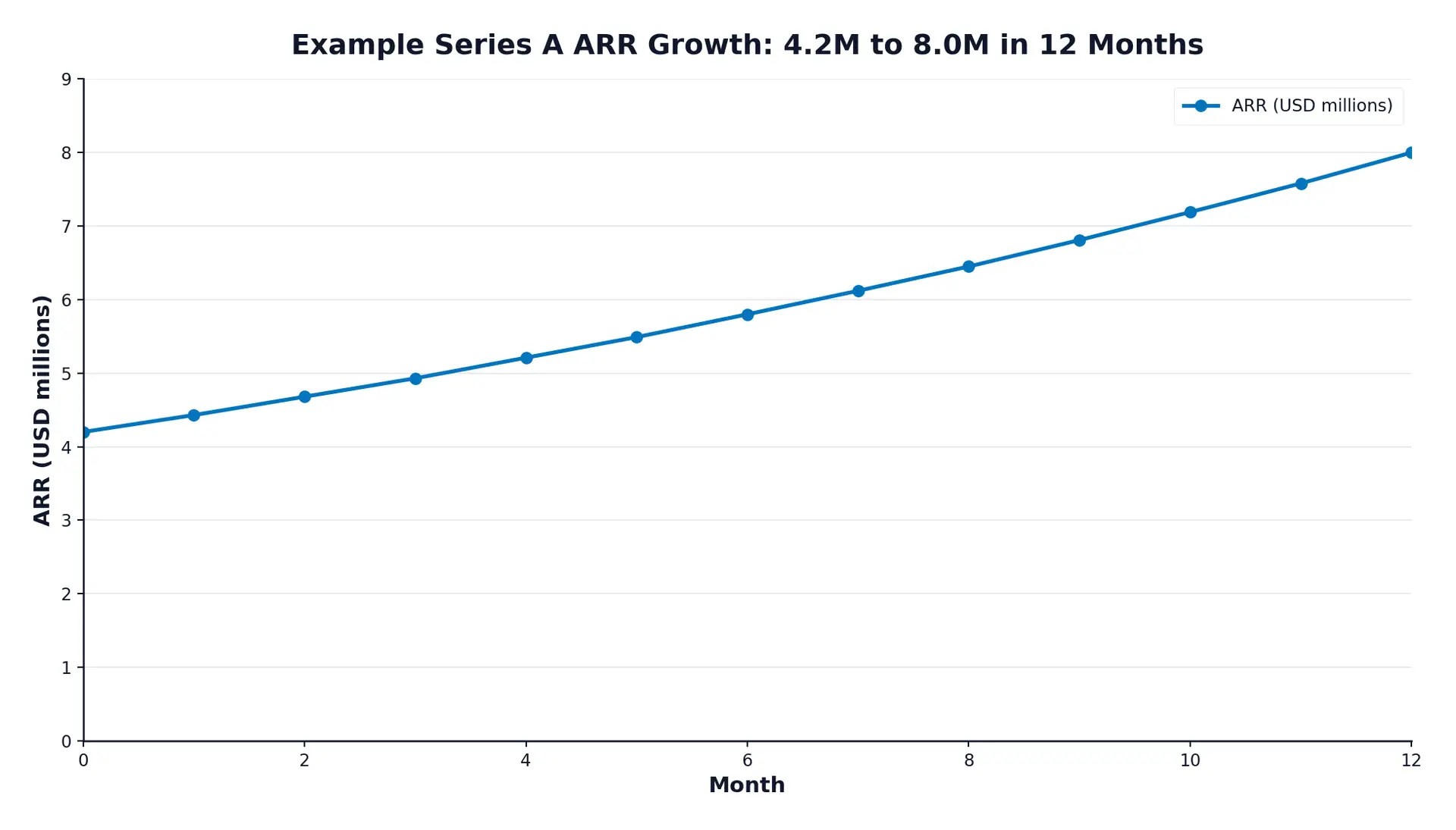
- ARR with month-over-month growth chart (last 12 months)
- Net revenue retention (NRR) — should be above 110% to indicate a healthy land-and-expand motion
- Gross revenue retention (GRR) — should be above 85% (logo-level retention)
- CAC payback period — the months it takes to recoup the cost of acquiring a customer through gross margin; should be under 18 months for a Series A
- Lifetime value to customer acquisition cost ratio (LTV/CAC) — should be above 3:1
- Customer count and average contract value (ACV)
Note the ratio direction: LTV/CAC means lifetime value divided by acquisition cost. A ratio of 3 means you earn three dollars of gross profit over a customer’s lifetime for every dollar you spend acquiring them. Inverting the ratio (CAC/LTV) is a recurring beginner error that signals you have not stress-tested your own numbers.
These metrics are not negotiable. A 2026 Series A SaaS deck without NRR, CAC payback, and LTV/CAC will be passed on the first read. The investor will assume the numbers are bad and the founder is hiding them.
Slide 8 — Business Model
What it needs: pricing tier(s), average contract value, contract length, and gross margin. One slide.
The mistake is to make this a pricing slide that mirrors your public website. The investor wants to see unit economics. Show that a typical customer pays you $24,000 per year on a 12-month contract, that you collect annually upfront (a working-capital advantage), and that your gross margin is 78%. That is four numbers — but the four numbers that determine whether your business has the economic shape of a SaaS company or the economic shape of a services firm pretending to be one.
Slide 9 — Go-to-Market
What it needs: the channel mix that produced your traction and the channel mix that will produce the next year’s growth, with the math.
Founders often list channels — “outbound, inbound, partnerships, referrals” — without ratios. The investor wants to see: “Today, 60% of new ARR comes from outbound sales development representatives (SDRs) at a fully-loaded CAC of $8,400 per customer. 30% comes from organic inbound at a CAC of $1,200. 10% comes from partner referrals at $0. Over the next 12 months, we are doubling SDR capacity from four to eight people, which produces a forecasted $3.6M in new ARR at a blended CAC payback of 14 months.”
That sentence answers the partner’s actual question, which is not “what channels do you use” but “what specifically will you do with my $15 million.”
Slide 10 — Competition
What it needs: an honest acknowledgment of who else is in the market and a defensible answer for why you win against each one — not why they don’t exist.
The 2x2 matrix with the four competitor logos in the bottom-left and the founder’s logo in the top-right is a meme. Partners see it 20 times a week. It signals “I do not respect my competition,” which signals “I have not done the market work to know which competitors actually matter.”
The credible alternative is a table:
| Competitor | What They Do Well | Where They Lose | Why We Win Customers from Them |
|---|---|---|---|
| Incumbent A | Brand, sales reach | Built for 5,000+ employee firms | We are priced and configured for the 50–500 segment |
| Startup B | Better UI than us | Charges 3x our price | Our pricing fits the mid-market budget reality |
| Internal tools | Free (spreadsheets) | Break at 10+ salespeople | Customers come to us when the spreadsheet stops working |
That is a slide that says “I have thought about this.” The 2x2 says “I have not.”
Slide 11 — Team
What it needs: why this team is uniquely qualified to win this market. Not where you worked — what you learned that makes you the right person to solve this specific problem.
“Stanford computer science, two years at Google” is a resume. “I built the rules engine that processes 14 million applicant decisions per year inside Workday — and watched the EU AI Act make our approach legally obsolete in 18 months” is a story that makes the partner believe you can see the next move.
If your bench is thin, do not pad with advisors. List two or three real operators and explain what they bring. Partners see through padded teams immediately.
Slide 12 — The Ask
What it needs: the raise amount, the milestones it funds, and a use-of-funds breakdown.
The use-of-funds is the slide founders most often skip. They write “$15M to scale go-to-market” and stop. The investor wants the table:
| Category | Allocation | Outcome |
|---|---|---|
| Sales (8 new account executives, 16 SDRs) | $7.2M | Lift new ARR run-rate from $3.6M to $9M/year |
| Engineering (12 new engineers) | $4.4M | Ship the analytics module and SOC 2 compliance |
| Customer success (4 new managers) | $1.8M | Lift NRR from 112% to 120% |
| G&A and runway buffer | $1.6M | 24 months of runway, ending Q4 2027 at $18M ARR |
Twenty-four months of runway, ending the period at a specific ARR number, with a path to the next round — that is what the slide must show. Vague is what gets passed on.

4. The Capital-Efficiency Era: Metrics That Cannot Be Skipped
The thing that has changed most about venture capital pitch decks since 2021 is the metric bar. In 2021, a Series A could be raised on $1M ARR and a credible team. In 2026, the same round typically requires $1.5M to $4M ARR, demonstrable product-market fit, and a clear path to capital efficiency.
Capital efficiency is not jargon. It is the ratio of net new ARR added to net new dollars burned. If you added $4M of ARR last year and burned $6M of cash to do it, your burn multiple is 1.5. Anything under 2 is considered efficient at Series A; anything under 1 is exceptional.
The seven metrics every 2026 SaaS deck must hit:
- ARR with 12-month growth trajectory. Show the chart, not just the number. Partners want to see whether your growth is accelerating, plateauing, or recovering from a recent dip.
- Net revenue retention (NRR) above 110%. NRR measures revenue from existing customers over the prior year, including expansion and net of churn. Above 110% means your installed base grows on its own. Below 100% means you are decaying and need to acquire new logos faster than you lose old ones.
- Gross revenue retention (GRR) above 85%. GRR strips out expansion to show the pure logo-level retention. If GRR is below 80%, you have a churn problem that no amount of acquisition will fix.
- CAC payback under 18 months. This is months-to-break-even on the gross-profit cost of acquiring a customer. Calculate as: customer acquisition cost divided by (monthly recurring revenue per customer × gross margin). For an $8M ARR SaaS company with a $2,000 monthly ACV, $10,000 CAC, and 75% gross margin, payback is $10,000 ÷ ($2,000 × 0.75) = 6.7 months.
- LTV/CAC above 3:1. Lifetime value calculated as monthly recurring revenue per customer × gross margin × average customer lifespan in months — never as monthly churn × 12, which understates lifespan dramatically. A 3:1 ratio means the business has the headroom to grow without external financing once acquisition is paid back.
- Burn multiple under 2.0. Net cash burned divided by net new ARR added. A burn multiple of 2 means it costs you $2 to add $1 of recurring revenue — sustainable. A burn multiple of 5+ is what shut down the 2022 “growth at all costs” era.
- Rule of 40 above 40%. Revenue growth rate plus profitability (EBITDA margin or free cash flow margin, depending on the firm’s preference) should sum to 40% or more. A company growing 60% with a ‑10% margin scores 50 on the Rule of 40 and clears the bar. A company growing 25% with a ‑25% margin scores 0 and does not.
If your deck does not put these seven numbers in front of the partner by Slide 8, the partner will assume you are hiding bad ones — which means a pass on the first read, no matter how good the rest of the deck is.
For deeper coverage of the underlying mechanics, see the guides on SaaS unit economics, net revenue retention, and the LTV/CAC ratio. For benchmark context across stages, see SaaS growth metrics. The OpenView 2024 SaaS Benchmarks Report is the most-cited industry benchmark source investors will assume you have read.
5. A Worked $8M ARR Example: What the Slides Actually Look Like
Walking through the math on a hypothetical company makes the standards concrete. Meet Acme HR Software, a fictional $8M ARR Series A candidate.
The company:
- Vertical: HR software for U.S. mid-market companies (50–500 employees, no dedicated head of HR)
- Founded: 2022, currently 28 employees
- ARR at end of last month: $8.0M
- ARR 12 months ago: $4.2M (90% year-over-year growth)
Unit economics:
- Average contract value (ACV): $24,000/year
- Contract length: 12 months, annual upfront billing
- Gross margin: 78%
- Monthly recurring revenue (MRR) per customer: $2,000
- CAC: $14,400
- CAC payback: $14,400 ÷ ($2,000 × 0.78) = 9.2 months
- Average customer lifespan: 48 months (from cohort data)
- LTV: $2,000 × 0.78 × 48 = $74,880
- LTV/CAC: $74,880 ÷ $14,400 = 5.2
Retention:
- Net revenue retention (NRR): 118%
- Gross revenue retention (GRR): 91%
Burn:
- Net cash burned last 12 months: $5.8M
- Net new ARR added last 12 months: $3.8M
- Burn multiple: $5.8M ÷ $3.8M = 1.5
Rule of 40:
- Revenue growth: 90%
- EBITDA margin: ‑42%
- Rule of 40 score: 90 — 42 = 48 (clears the 40 bar)
The ask:
- Raise: $18M Series A at a $90M post-money valuation
- Lead: TBD
- Use of funds: $9M sales expansion, $5M engineering, $2M customer success, $2M G&A and runway buffer
- Forecast outcome: 24 months of runway, ending at $20M ARR, ready for Series B at $80M+ valuation
Every single number above appears somewhere in the 12-slide deck. The cover names the company and the stage. The traction slide carries the growth chart and the four retention/payback metrics. The business model slide carries the ACV, contract length, and gross margin. The competition slide names the three competitors Acme wins against. The team slide explains why Acme’s CEO — a former Workday rules-engine engineer — saw this category early. The ask slide carries the table above.
Without the math, the deck is a story. With the math, the deck is a memo on slides — which is what 2026 partnership meetings expect.
There are three decision points where the partner mentally branches between advance and pass. Knowing where they are tells you which slides need to be unmistakably strong:
| Decision Point | What the Partner Is Asking | Pass Trigger | Advance Trigger |
|---|---|---|---|
| ~30 seconds in (after Slide 2) | "Do I understand what this is and why it exists?" | Vague tagline, no clear problem | Specific buyer, structural cause |
| ~90 seconds in (after Slide 7) | "Do the metrics back up the story?" | Vanity metrics, missing NRR/CAC payback | ARR + NRR + LTV/CAC + payback all on one slide |
| End of Slide 10 | "Can this scale and is it defensible?" | 2x2 competitive trick, no real moat | Honest competitor table, defensible insight |
Three short conversations inside the partner’s head. Three places where the deck either earns the meeting or loses it. Every slide you build either reinforces one of those three answers or it costs you airtime — and airtime is the scarcest resource in the room.
6. The 5 Mistakes That Kill Rounds
Five recurring mistakes account for most of the deals that get passed on the first read. None of them are about the underlying business. All of them are about the deck doing the wrong job.
Mistake 1 — Treating the Deck Like a Brochure
The deck’s job is to advance the next conversation. A brochure tries to be self-contained. A pitch deck deliberately leaves curiosity gaps — the partner should finish the deck wanting to ask three specific questions. If she has no questions left, you over-explained. If she has 20 questions, you under-explained. Three is the sweet spot.
Mistake 2 — Vanity Metrics on Slide 7
User counts, downloads, press mentions, awards, and total signups are vanity metrics. They tell the partner nothing about whether the business works. ARR, NRR, GRR, CAC payback, and LTV/CAC are the metrics that signal a real business. If your traction slide leads with “1.2 million users” and buries ARR in slide 17 of the appendix, you are signaling that the ARR number is small or the unit economics are bad. Lead with the metrics that matter.
Mistake 3 — Top-Down TAM Math
“The HR software market is $40 billion. We only need to capture 0.1% to be a $40 million business.” Every partner has seen this slide hundreds of times. It is the universal signal that the founder has not done bottom-up market work. The credible alternative is to count buyers, multiply by your average contract value, and show the math. Bottom-up takes a week of work. Top-down takes five minutes. Partners can tell which one you did.
Mistake 4 — Burying the Ask
Founders sometimes hide the raise amount, the valuation, and the use of funds — either because the round is undefined or because they hope the partner will name a number. This wastes everyone’s time. The partner cannot evaluate the deal without knowing what you are asking for. State the round size, the valuation range, and the use of funds explicitly on Slide 12. If you are flexible on valuation, say so — but the number on the slide is the anchor for the conversation.
Mistake 5 — No Story Spine
The 12-slide structure above is a logical sequence, not a narrative one. A deck that hits every slide but has no story spine reads like a checklist. The story spine is the one-sentence answer to: why is the world about to change in a way that makes this company inevitable? Every slide either reinforces that spine or it gets cut. The cover sets up the spine (“we sell HR software to mid-market firms”). The problem slide names the structural cause (“the category gap between Excel and Workday”). The why-now slide names the catalyst (“AI compliance regulation in 2024”). By Slide 12, the partner has heard one coherent story told seven different ways — that repetition is what builds conviction, and what makes the deal investable.
7. Frequently Asked Questions
How long should a venture capital pitch deck be?
The primary spine is 12 slides. The appendix carries 5–15 additional slides for diligence-grade detail (cohort retention curves, detailed financial model, customer references, founder bios, competitive landscape detail). The 12 slides are what you send when a partner asks for “your deck.” The appendix is what you share after the second meeting.
Decks longer than 15 spine slides see roughly 40% lower partner engagement. The 12-slide structure is the upper bound of what a busy partner will read on a Wednesday afternoon.
Should I send the deck before the first meeting?
Yes — unless you have a warm introduction that explicitly says “the partner wants to meet you cold.” For everyone else, send the deck 48–72 hours before the meeting. Partners who have already read the deck come to the meeting with specific questions, which produces a higher-quality first conversation. Partners who walk in cold spend the first 20 minutes asking surface questions, which leaves no time for the depth that converts to a follow-up meeting.
What is the right valuation range to put on Slide 12?
The credible answer depends on your stage and metrics. For 2026 Series A SaaS, a reasonable post-money valuation is roughly 8–15x ARR if your NRR is above 110% and your burn multiple is under 2.0. Below 110% NRR or above 2.5 burn multiple, the range compresses to 5–8x ARR. The numbers above are illustrative, not guarantees — verify against current SaaS valuation multiples (SaaS Capital publishes a quarterly index) before anchoring your deck to a specific number.
If you do not want to anchor a number, say “we are targeting a $18M Series A; we expect valuation to land between $80M and $120M post-money depending on lead investor and terms.” That gives the partner a range to work within without locking you in.
Do I need a video version of the deck?
For an inbound partner pitch, no. For a first-touch outreach to a cold investor, a 90-second Loom walking through the deck dramatically improves response rates. The Loom should not narrate every slide — it should answer the one question that the slides cannot (“who are you and why should I take this meeting?”). Keep it under 120 seconds.
How do I handle the team slide if my team is thin?
If you are a solo founder or have only one technical co-founder, do not pad. List the two of you, the specific advisors who actually advise (with frequency — “weekly,” not “available”), and your hiring plan for the first three roles you will fill with the round.
A thin team is a fact, not a fatal flaw. Pretending you have a deeper bench than you do is what kills the deal. Partners ask reference questions; padding gets discovered immediately.
8. What to Build This Week
If you are reading this with a fundraise on the horizon, the highest-leverage work this week is:
- Write the one-sentence cover description. If you cannot do it in one sentence that a 12-year-old would understand, you do not understand your own positioning well enough to raise.
- Compute the seven metrics in Section 4. Put them on a single page. If any are missing or worse than the benchmarks, identify the operational fix before pitching.
- Build the bottom-up market math. Count the buyers in your beachhead segment. Multiply by your ACV. That number — not Gartner’s — is the SAM you put on Slide 5.
- Draft the 12 slides as bullet points first. Not in a presentation tool. In a text document. The bullet-point draft surfaces the slides where you do not have a clear answer to the question the slide is supposed to answer.
- Stress-test the use-of-funds table. Make sure it produces a specific ARR outcome at 24 months that justifies the raise amount. If the math does not work, the raise size is wrong.
Pitch decks fund companies, but only if they do the right job. The right job is moving a stranger from “no” to “tell me more” in 22 minutes. Every slide either advances that goal or it costs you the round. Build the deck that earns the meeting — and let the investment memo, the partnership conversation, and the diligence call do the rest.
Related Reading
- Investment Memo: The Playbook Behind Every SaaS Funding Round
- SaaS Unit Economics: What Acquirers Check First
- Net Revenue Retention: Why 110% Is the New 100%
- LTV/CAC: The Ratio That Decides Whether You Can Scale
- SaaS Venture Capital: What CEOs Need to Know Before Raising
- Venture Capital vs Bootstrapping: The Decision Framework
- Venture Debt: When It Makes Sense for SaaS
- SaaS Growth Metrics: The Operating Dashboard