

In a SaaStr survey of more than 1,200 SaaS executives, only 7% said an outsourced SDR engagement really worked for them. Another 26% said it sort of worked — and roughly half reported losing money on the arrangement. Yet outsourced SDR firms keep growing, because the problem they solve is real: most founders are terrible SDR managers, and an unmanaged SDR — in-house or rented — produces almost nothing.
This article is about outsourcing one specific function: the SDR (sales development representative) role, the person who does cold outreach and books qualified meetings for your closers. It is not about outsourcing your entire sales function — account executives, deal closing, account management. That is a different decision with different math, and I cover it separately in the guide to outsourced SaaS sales. Here we’ll define what an outsourced SDR team actually does, what it costs in 2026, and — the part most coverage skips — the cost-per-opportunity math that tells you whether renting prospecting capacity beats building it.
What an Outsourced SDR Team Actually Does
An SDR (sales development representative) sits at the top of your sales funnel. The role exists to do one job: turn a list of strangers into qualified meetings on your account executives’ calendars. Done well, the function carries real weight — Crunchbase reports that sales development teams can generate 30–45% of new business revenue at B2B companies. A traditional SDR researches target accounts, personalizes outreach, sends cold emails and LinkedIn messages, makes cold calls, follows up persistently, and qualifies whoever responds before handing them to a closer.
An outsourced SDR team is a third-party firm you pay to run that function for you. Depending on the model, the firm supplies the people, the outreach technology, the contact data, the scripts, and — in the better arrangements — the management layer that keeps daily activity on track.
What the firm does not supply is the strategy underneath the activity: who to target, what problem to lead with, and what counts as a qualified meeting. Those stay your job, and as we’ll see, that’s where most engagements quietly die.
A useful mental model: the SDR function is not really sales. It’s a factory that produces qualified meetings. It has inputs (contact lists, messaging, hours of outreach activity), a production process, and a measurable output rate. When you outsource SDRs, you are renting factory capacity. Renting capacity from someone else’s factory works fine — but only if you know exactly what the machine is supposed to produce and you inspect the output every week.

Outsourced SDR vs. Outsourced Sales: Two Different Decisions
These two get conflated constantly, and conflating them leads to bad contracts. The distinction matters because the risk profiles are completely different.
| Dimension | Outsourced SDR (this article) | Outsourced full sales function |
|---|---|---|
| What you hand over | Prospecting and meeting booking only | Prospecting, demos, negotiation, closing |
| Who talks to buyers about money | Your own account executives | The vendor's closers |
| Product knowledge required | Moderate — enough to earn a meeting | Deep — enough to win a deal |
| Damage when it fails | Wasted budget, weak pipeline for a quarter | Burned prospects, mispriced deals, brand damage |
| Reversibility | High — turn it off, pipeline source ends | Low — customer relationships live outside your company |
Outsourcing the SDR layer is a bounded, reversible experiment: the vendor never negotiates price, never signs contracts, and your AEs (account executives — the salespeople who run demos and close deals) keep every buyer conversation that involves money. Outsourcing the full sales motion hands a stranger your revenue engine. If you’re weighing the bigger decision, read the outsourced SaaS sales guide — the failure modes there are more severe and the preconditions stricter.
What Outsourced SDR Services Cost
The outsourced SDR market in 2026 spans a wide price range because “outsourced SDR” describes at least four distinct service models.
A note on the numbers: the prices below are illustrative figures reflecting market conditions at the time of writing. They’re included to show the relative differences between models — verify current pricing with vendors before budgeting.
| Model | Typical monthly price | What you get | Watch out for |
|---|---|---|---|
| Full-service SDR firm (US-based) | $7,000–$10,000 | Dedicated SDR plus a fractional manager who runs their daily activity | Highest price; quality varies by which rep you're assigned |
| Offshore / nearshore SDR | $2,500–$5,000 | Dedicated rep in a lower-cost region, usually with shared management | Accent, time zone, and product-fluency friction on phone-heavy motions |
| Lead generation agency (email/LinkedIn) | $2,000–$5,000 | Campaign-based outreach at volume; replies routed to you | You still do the qualifying; volume can burn your domain reputation |
| Pay-per-meeting appointment setting | $200–$1,500 per held meeting | You pay only for meetings that happen | Incentive is meeting quantity, not quality — qualification bar erodes |
Two structural details matter more than the sticker price.
- Whether management is included. The most useful innovation in the category is the firm that rents you an SDR and a fractional SDR manager together. SDRs by themselves don’t perform — the role has a daily accountability cadence that most founders have neither the time nor the skill to run. If the quote doesn’t include a named manager doing daily activity review, you are buying an unmanaged junior employee who happens to sit somewhere else. Expect to pay more for included management; it’s usually worth it.
- Who owns the data and the domain. Outreach runs on contact data, email sending domains, and sequencing tools. If the vendor owns all three, switching costs are high and a sloppy vendor can damage your email deliverability (the percentage of your emails that actually reach inboxes instead of spam folders). Insist on outreach from subdomains you control and export rights to every contact touched.
The Math: Outsourced SDR vs. In-House SDR
Vendors sell against the salary of an in-house SDR. That comparison is wrong in both directions — it understates the true cost of in-house, and it ignores the quality difference in what each option produces. Let’s do it properly, with realistic numbers for a B2B SaaS company in the $5M–$15M ARR range.
The true cost of an in-house SDR
The salary is the visible piece. The fully loaded cost — what the role actually costs your P&L once you count everything attached to it — looks like this:
| Cost component | Annual amount |
|---|---|
| On-target earnings (OTE — base salary plus bonus at full quota; ~$55K base + ~$25K variable) | $80,000 |
| Benefits and payroll taxes (~20% of OTE) | $16,000 |
| Tools and data (sequencer, dialer, contact database, LinkedIn seat) | $12,000 |
| Management allocation ($140K SDR manager spread across 7 reps) | $20,000 |
| Fully loaded annual cost | $128,000 |
That’s $10,667 per month — roughly 2.3 times the monthly base salary the vendor quoted against.
But the fully loaded monthly cost still understates reality, because an in-house SDR is not productive every month you pay them. Two adjustments:
- Ramp time. A new SDR takes about 3 months to reach full productivity.
- Tenure. SDR is a high-turnover role; assume roughly 15 months of average tenure, plus about $5,000 in recruiting cost per hire.
So each hire gives you 15 paid months, of which about 12 are fully productive:
Effective monthly cost = (15 months × $10,667 + $5,000 recruiting) ÷ 12 productive months ≈ $13,750
At a realistic 12 qualified meetings held per productive month:
In-house cost per qualified meeting = $13,750 ÷ 12 ≈ $1,146
The outsourced comparison
Now the outsourced SDR at $8,500/month all-in (mid-range full-service firm, management included), ramping in about a month and booking 10 held meetings per month:
Outsourced cost per qualified meeting = $8,500 ÷ 10 = $850
The vendor’s pitch writes itself: $850 versus $1,146 — about 26% cheaper per meeting, no recruiting, no ramp, no turnover risk, cancel any time. On cost per meeting, outsourcing genuinely wins.
But cost per meeting is the wrong unit of analysis.

The Number That Decides It: Cost per Opportunity
A meeting is not revenue. A meeting is an input to your AEs’ calendars. What you actually want to buy is sales-qualified opportunities — meetings where the prospect fits your ICP (ideal customer profile — the narrow definition of who your product is actually for), has the problem you solve, and engages in a real evaluation. Meeting quality is where outsourced SDR engagements are won or lost, because the vendor’s rep knows your product and your market less deeply than your own people do.
Extend the same example. Suppose 50% of your in-house SDR’s meetings convert to real opportunities, while the outsourced meetings convert at 35% — a typical gap when an external rep is qualifying against a checklist instead of genuine understanding:
| Metric | In-house SDR | Outsourced SDR |
|---|---|---|
| Effective monthly cost | $13,750 | $8,500 |
| Qualified meetings held / month | 12 | 10 |
| Cost per meeting | $1,146 | $850 |
| Meeting-to-opportunity rate | 50% | 35% |
| Opportunities / month | 6.0 | 3.5 |
| Cost per opportunity | $2,292 | $2,429 |
The 26% per-meeting advantage just evaporated. At a 35% meeting-to-opportunity rate, the outsourced option costs more per opportunity than the in-house rep — and every downstream number inherits the difference. At a 20% opportunity-to-close rate, the prospecting cost baked into each new customer is about $11,458 in-house versus $12,143 outsourced (these figures cover the prospecting layer only — AE time and marketing sit on top, and all of it eventually rolls up into your CAC and LTV/CAC ratio).
Run the break-even on quality and you get the single most useful number in this entire decision:
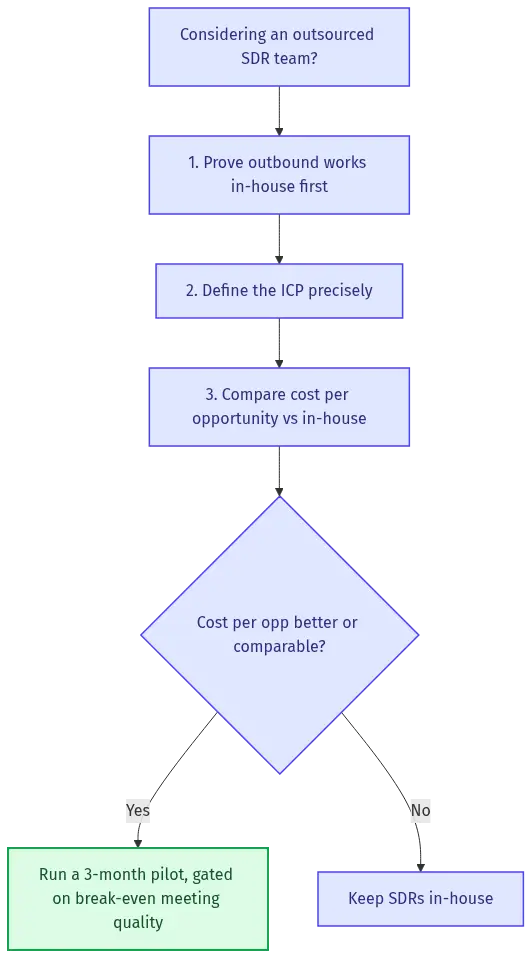
Break-even meeting quality = $850 ÷ $2,292 ≈ 37%
If at least 37% of the vendor’s meetings turn into real opportunities, the outsourced SDR beats your in-house economics in this example. Below that, you’re paying a premium for the appearance of pipeline. And if a vendor can match in-house quality — 50% conversion — the math swings hard in their favor: $1,700 per opportunity versus $2,292, a 26% advantage.
That’s the whole game. The decision isn’t “outsourced versus in-house” in the abstract. It’s: what meeting-to-opportunity rate will this specific vendor achieve against my specific ICP, and is it above my break-even? Everything you do to manage the engagement — the targeting, the scorecard, the weekly inspection — exists to push that one number above the line. Your numbers will differ; the structure of the calculation won’t. (If you want to see where these assumptions come from, the deeper treatment is in SaaS unit economics.)
When Outsourced SDR Works
The pattern in the success stories is consistent. Outsourced SDR works when:
- You’ve already proven the outbound motion yourself. Someone inside your company — often the founder — has personally sent the emails, made the calls, and booked meetings at a repeatable rate. You know the reply rates, the objections, and the message that lands. The vendor is scaling a recipe, not searching for one. This is the same principle behind building a repeatable sales process before hiring closers.
- Your ICP is narrow and written down. A defined universe — “digital agencies between 20 and 200 employees in North America” — gives the vendor a finite list to work and gives you a clean way to audit whether they’re calling the right people. If you can’t articulate your ideal customer profile precisely, an outsourced team will spray your message across whoever their database coughs up.
- The meeting is easy to earn relative to deal size. Products with a clear, recognizable problem statement and a sales cycle measured in weeks suit rented prospecting. The first conversation doesn’t require deep product fluency — it requires disciplined outreach volume and a crisp pitch.
- You’re testing a new segment or region. Want to know whether mid-market healthcare responds to your message before committing headcount? A 3‑month outsourced SDR pilot is a cheaper, faster experiment than hiring, and shutting it down costs you nothing but the notice period.
- You treat the rented team as part of the core team. The companies that get this to work micromanage it — they review the lists, edit the scripts, join the vendor’s weekly calls, and inspect call recordings. The ones who “set and forget” fund the vendor’s other clients’ success stories.
Note what’s not on the list: “we don’t have time to do outbound.” Lack of time is the most common reason CEOs sign these contracts, and it’s the single best predictor of failure — because the engagement needs more of your attention in the first 90 days, not less.
When Outsourced SDR Fails
The failure data is blunt: 7% clear success, 26% partial, roughly half losing money. The causes cluster into four patterns.
- Outsourcing a motion you never figured out in-house. This is the big one. The companies most eager to outsource SDRs are usually the ones who couldn’t make the SDR model work internally — which means they’re handing a vendor an unsolved problem and paying retail for the discovery process. If outbound has never worked for you, an outsourced team gives you scale on a thing that doesn’t work. You can’t outsource what you haven’t figured out.
- Complex products with long cycles. When buyers expect product depth in the very first conversation — common in enterprise SaaS sales and technical platforms — a script-driven external rep gets filtered out by exactly the buyers you most want. High average order value plus sophisticated buyer is the worst-fit profile for rented prospecting.
- Quality decay behind a healthy dashboard. The meetings-booked number stays green while meeting quality quietly collapses: wrong titles, wrong company sizes, prospects who agreed to a meeting to end the phone call. You discover it a quarter later when AE conversion drops and your pipeline turns out to be theater. This is why the scorecard below tracks conversion through the funnel, not booked meetings.
- Vendor incentive misalignment. Pay-per-meeting pricing rewards volume; monthly retainers reward renewal. Neither rewards opportunities-that-close unless you build the contract around that definition. The fix isn’t finding a saintly vendor — it’s defining “qualified” contractually and auditing against it weekly.
There’s also a structural failure mode worth naming: rented pipeline doesn’t compound. An in-house SDR who stays becomes an AE who knows your market cold; the call recordings, objection patterns, and messaging lessons accumulate inside your company. With a vendor, that learning walks out the door at contract end — which is also why an acquirer doing diligence will discount pipeline that depends on a third party they can’t retain. Treat that as a real cost even though it never shows up on an invoice.
How to Manage an Outsourced SDR Firm
Remember the factory model: the SDR function is a meeting factory with measurable throughput at every stage. Managing an outsourced SDR firm means inspecting that throughput on a fixed cadence — daily activity inside the vendor’s team (their manager’s job), weekly results review with you (your job, 30–45 minutes, non-negotiable).
The weekly scorecard needs only six numbers:
| Metric | What it tells you | Healthy signal |
|---|---|---|
| Outreach activities per day (calls + emails + LinkedIn touches) | Is the machine running? | Consistent with the contracted volume |
| Reply rate | Is the message landing? | Stable or improving week over week |
| Meetings booked | Top-line output | At or above the contracted pace |
| Meeting show rate | Are these real prospects? | Roughly 70%+ of booked meetings actually happen |
| Meeting-to-opportunity rate | The quality number | Above your break-even (~37% in our example) |
| Cost per opportunity | The decision number | At or below your in-house benchmark |
Beyond the scorecard, four practices separate the 7% from the rest:
- Audit the list before anyone touches it. Review the first 200 accounts against your ICP. Every bad-fit account you remove before outreach saves a wasted touch and protects your market’s perception of you.
- Listen to call recordings — two per week minimum. SDR management is verification: the quality of the research before the call, the quality of the conversation on it. You cannot verify what you don’t hear.
- *Run the engagement off your CRM (customer relationship management system — the database where your deals live).* If results live in the vendor’s reporting portal, you lose the data on exit and can’t trace meetings through to closed revenue.
- Pre-commit your exit criteria. Before signing, write down the 90-day numbers that mean “scale,” “fix,” or “exit.” Decided in advance, these are data; decided in month three, they’re a negotiation with your own sunk costs. (Sunk costs — money already spent that you can’t recover, and that humans reliably overweight when deciding whether to continue.)
If this sounds like more work than you expected to delegate away, recalibrate: you’re delegating the execution — the 300 daily touches — not the accountability. The same is true of every outsourced function in your sales model, and it rhymes with why hiring a VP of Sales to “figure out sales for you” fails so often. Execution delegates; ownership doesn’t.

What About AI SDRs?
The SDR role is being unbundled by AI, and any outsourcing decision made in 2026 has to account for it.
Look at what a traditional SDR actually does all day: research the contact, personalize a message, send the email, send the LinkedIn message, leave the voicemail, log the activity. AI tooling now handles most of that — personalization at scale, multi-channel sending, even automated voicemail drops — with no labor beyond setup. What AI doesn’t yet do well is decide who to contact (strategy), have the live qualifying conversation (judgment), and adapt the message when the market shifts (taste).
Three practical implications:
- Don’t pay human prices for automatable work. If a vendor’s value proposition is “we send a lot of emails,” that’s now a software subscription, not a $7,000/month service. The vendors worth premium pricing are selling judgment: list strategy, message iteration, live phone conversations, and management discipline.
- Ask any prospective vendor how they use AI. A firm running AI-assisted research and personalization can deliver more touches per dollar. A firm that hasn’t changed its process since 2022 is selling you yesterday’s cost structure at today’s prices.
- The hybrid is often the right first move. AI sales tools plus a part-time internal owner can run the founder-led outbound test that proves your motion — at a fraction of either an outsourced contract or a full-time hire. Prove the recipe cheaply, then decide who scales it.
AI compresses the execution cost of prospecting toward zero. It does nothing to the strategy cost — knowing who to target and what to say. Which means the part of the SDR function you could safely outsource is shrinking, and the part you can’t is becoming the whole job.

A Decision Framework by ARR Stage
Where outsourced SDR fits depends mostly on what you’ve already proven and what management capacity you actually have.
| Stage | Default answer | Reasoning |
|---|---|---|
| Under $1M ARR | No — founder-led outbound | You're still searching for the message and the ICP. That discovery can't be delegated; a vendor amplifies whatever you give them, including noise. Use AI tooling to multiply your own outreach instead. |
| $1M–$5M ARR | Pilot, if the motion is proven | If founder-led outbound books meetings at a known rate, a 3-month outsourced SDR pilot is a legitimate way to scale it before committing headcount. If outbound is unproven, fix that first. |
| $5M–$15M ARR | Either — decide on cost per opportunity | You have the deal flow to measure quality quickly and the management capacity to inspect weekly. Run the break-even math from this article against real vendor quotes; let the number decide. Hybrids work well here: in-house SDRs for the core segment, outsourced for new-segment tests. |
| Above $15M ARR | Mostly in-house; outsource at the edges | At this scale the compounding value of an internal team — SDR-to-AE promotion pipeline, accumulated market knowledge — usually dominates the convenience of renting. Vendors still earn their keep on new-region entry and overflow capacity. |
One refinement at every stage: outsourced SDR competes not just against in-house SDRs but against every other way to generate qualified pipeline — demand generation, content, partnerships, paid acquisition. Before signing, compare the vendor’s projected cost per opportunity against the cost per opportunity of your best existing lead generation channel. Sometimes the honest answer is that another $8,500/month into a channel that already works beats opening a new one that might.
Common Mistakes
- Buying meetings instead of opportunities. The contract is priced and reported in meetings; your economics run on opportunities. Define “qualified” in writing — title, company profile, problem acknowledgment — and reconcile every booked meeting against it.
- Skipping the in-house cost baseline. If you don’t know your own fully loaded cost per opportunity, you can’t tell whether $8,500/month is a bargain or a tax. Do the twenty minutes of math before the first sales call with a vendor.
- Judging the pilot on month one. Even a good vendor needs 4–6 weeks to tune lists and messaging. Judge at 90 days — but on the pre-committed numbers, not on optimism.
- Letting the vendor own the assets. Contact data, sending domains, CRM records, call recordings. If you can’t take it with you, you’re building the vendor’s business, not yours.
- Outsourcing to avoid learning sales. The CEOs who get this to work could run the SDR function themselves and choose not to. The ones who get burned are hoping the vendor knows something about their market that they don’t. The vendor never does — and per the outbound lead generation services guide, this principle applies to the entire category, not just SDRs.
Frequently Asked Questions
How much does an outsourced SDR cost?
As of this writing: $7,000–$10,000 per month for a US-based dedicated SDR with management included, $2,500–$5,000 for offshore or nearshore reps, $2,000–$5,000 for campaign-based lead generation agencies, and $200–$1,500 per held meeting under pay-per-meeting models. The spread reflects management depth, rep location, and who carries the meeting-quality risk.
Is an outsourced SDR worth it?
Only if two things are true: you’ve personally proven the outbound motion works for your product, and the vendor’s meeting-to-opportunity rate clears your break-even (in our worked example, about 37%). Survey data suggests most engagements fail — but the failures concentrate among companies that outsourced an unproven motion and managed it loosely.
How long should an outsourced SDR pilot run?
Three months. Shorter samples are noise — too few meetings to judge quality. Define success criteria before signing: meetings held, show rate, meeting-to-opportunity rate, and cost per opportunity versus your in-house baseline.
What’s the difference between an outsourced SDR firm and a lead generation agency?
An outsourced SDR firm supplies named people who work your list across email, phone, and LinkedIn, and usually books meetings directly onto your AEs’ calendars. A lead generation agency runs campaigns — typically email or LinkedIn at volume — and routes replies to you for qualification. The SDR firm sells you a function; the agency sells you a channel.
Can I outsource SDRs for enterprise sales?
Usually a poor fit. Enterprise buyers expect product fluency from the first touch, and the multi-stakeholder, long-cycle motion punishes script-driven outreach. If your average deal runs well into six figures, build the prospecting muscle in-house and aim outsourced experiments at your mid-market segment instead.
Should I hire an in-house SDR or outsource first?
If your motion is proven and you have management capacity (or will rent the vendor’s), outsourcing first is a reasonable way to buy speed — a vendor ramps in weeks versus the roughly 4 months of recruiting plus ramping a hire. If nobody has ever booked outbound meetings for your product, neither option is ready; run founder-led outbound first.
The Bottom Line on Outsourced SDR
Outsourced SDR is a legitimate tool with a lousy base rate. The economics are decided by one number — the vendor’s meeting-to-opportunity rate against your ICP — and that number is determined far more by what you bring (a proven message, a narrow ICP, weekly inspection) than by anything on the vendor’s website.
Do the math before the demo calls: compute your fully loaded in-house cost per opportunity, derive the break-even meeting quality a vendor must hit, and pre-commit your 90-day exit criteria. If you’ve proven the motion and you’re willing to manage the factory you’re renting, an outsourced SDR team can compress your time-to-pipeline meaningfully. If you’re hoping to delegate a problem you haven’t solved, you’ll fund someone else’s case study — the 7% who make this work earn their way in before they ever sign.