

Most SaaS founders think about bundle pricing as a discount — a way to sweeten a deal by throwing three products together and knocking a bit off the total. That framing is exactly why bundling so often lifts the logo count and quietly caps the margin. Done well, bundle pricing is not a discount at all. It is a mechanism to force adoption of the one module that actually keeps customers, to capture buyers whose willingness to pay is split across your product line, and to raise your average revenue per account (ARPA) without acquiring a single new customer. Done badly, it is a machine for cannibalizing the upsells you would have earned anyway and training your best customers to pay you less.
Bundle pricing is the practice of combining two or more products, modules, or features and selling them together for a single price — usually lower than the sum of the parts bought separately, but not always. The word most founders skip is architecture. A bundle is not a bag of stuff at a discount. It is a deliberate structure that decides which products travel together, what the bundle costs relative to its components, and what behavior you are trying to produce in the customer. If you cannot say what the bundle is supposed to do — drive adoption, raise ARPA, simplify a confusing buy, or block a competitor — you do not have a bundle. You have a coupon.
This guide covers what bundle pricing actually is and the three structures it comes in, the economics that make bundling work (explained without the graduate-school jargon), the retention play that separates SaaS bundling from the fast-food “meal deal” version most articles stop at, a fully worked example on a company climbing from $8M toward $15M annual recurring revenue (ARR), the five ways bundling destroys enterprise value, how to actually price the bundle, and a decision framework you can run against your own product line this week. The reader who gets the most from the next fifteen minutes is a SaaS chief executive officer (CEO) between $3M and $20M ARR who has more than one thing to sell and is trying to decide whether to package those things together — and, if so, how to price the package without leaving money on the table.
What Bundle Pricing Actually Is
Bundle pricing sells a set of products as one unit at one price. In SaaS, the “products” are usually modules, feature tiers, or add-ons that live on the same platform, which makes bundling far more natural than it is for a business that has to physically pack a box. The cost of adding one more module to a customer’s account is close to zero, so the entire question becomes one of packaging and price, not logistics.
There are three structures worth knowing, and they imply very different businesses.
- Pure bundling. The customer can only buy the package — the individual components are not sold separately. This simplifies the decision to a single yes or no, and it maximizes how much of your product each customer touches. The risk is that a buyer who wants only one piece walks away entirely, because you refused to sell it to them alone.
- Mixed bundling. The customer can buy the bundle at a discount or buy the components individually at their standalone prices. This is the lower-risk structure and the right default for almost every SaaS company at this stage. You set the standalone prices high enough that the bundle is the obvious choice for most buyers, while still capturing the buyer who genuinely wants just one module.
- Leader bundling. A high-demand flagship product is packaged with lower-profile modules to pull them into use. The flagship does the selling; the riders come along for the exposure. This is the structure to reach for when you have one product everyone wants and several that deliver real value but never get bought on their own.
A useful way to see the difference: pure bundling is a resort where one price buys the room, the meals, and the activities and you cannot decline any of it. Mixed bundling is the phone-internet-TV package where you can still buy just the internet if that is all you need. Most SaaS companies think they want pure bundling — one simple package — and discover in practice that mixed bundling wins more revenue, because it stops handing the single-module buyer to a competitor.
Why Bundling Works: The Economics Without the Jargon
Bundling is not a discount trick. It is a way to capture value that is scattered across your customer base in a pattern you cannot see one product at a time. Here is the mechanism, stripped of the economics-textbook vocabulary.
Imagine two customers and two products. Customer A would happily pay $70 a month for your analytics module but only $30 for your reporting module. Customer B is the mirror image — $30 for analytics, $70 for reporting. If you price each module at $70 to capture the customer who values it highly, you lose the other customer on that module entirely. If you price each at $30 to keep everybody, you leave $40 on the table with each customer on the product they love. Either single price is wrong for half your base.
Now bundle both modules for $100. Customer A values the pair at $70 + $30 = $100. Customer B values the pair at $30 + $70 = $100. Both buy. You collected $100 from each — $200 total — versus the $120 you would have collected selling each module separately at $30 to keep everyone, or the patchy coverage you would have gotten at $70. The bundle worked because it averaged out the differences in what each customer would pay for each piece. Economists call this price discrimination through bundling; you can just call it capturing the value that is already there but hidden. (For the formal version, the price discrimination framework at the Corporate Finance Institute lays out how sellers sort buyers by willingness to pay.)
This is not a SaaS invention. General Electric generated more than $20 billion in new revenue by noticing that customers spent heavily maintaining GE equipment but bought nothing more from GE after the initial purchase, so GE began bundling maintenance contracts, extended warranties, and repair services across its major product lines. The lesson generalizes into a rule worth memorizing: if you bundle a commodity product with a unique product, you get a unique bundle that can sometimes be sold for more than the combined price of both products sold independently. The unique component gives the bundle pricing power the commodity component never had on its own. That is the difference between a bundle that lifts your margin and a bundle that just moves inventory.
There is a second, subtler benefit that matters enormously in SaaS: bundling raises switching costs. A customer using one module is easy to replace with a cheaper point solution. A customer using four modules that share data, workflows, and logins is bound to you in four places at once. Every additional module a bundle pulls into active use is another reason the customer cannot casually leave — which is the real reason bundling belongs in a conversation about net revenue retention, not just average deal size.
The Real Reason to Bundle: Driving Adoption of Your Stickiest Module
Here is where SaaS bundling diverges hard from the meal-deal version every generic article stops at — and where most of the money is.
Segment your gross revenue retention by which module customers actually use, and a pattern shows up almost every time: one module drives retention far more than the others. In one real case, a B2B SaaS company found that customers who used a particular module within the last 30 days retained at 98% — nearly perfect — while customers who used nothing tended to leave. That module was the one that let the customer’s own clients interface with them; it was the primary communication channel, so turning it off meant the customer’s clients could no longer reach them in the way they were used to. Using that one module roughly doubled revenue retention. And yet it was not mandatory, and only about 20% of customers had adopted it.
Sit with that. The single strongest retention lever in the entire business was switched off for four out of five customers. Every one of those non-adopters was a churn risk hiding in plain sight, paying full price for a product they were quietly on their way to leaving.
This is the highest-value use of bundle pricing in SaaS, and almost nobody frames it this way: bundle to force adoption of the module that keeps customers. If your stickiest module only gets adopted when a customer stumbles into it, you are leaving your retention to chance. Put that module inside the default bundle — ideally the one most new customers buy — and adoption stops being optional. You are not bundling to raise the deal size (though you will). You are bundling to make sure every customer touches the thing that makes them stay.
To find the module worth building the bundle around, run this analysis before you design anything:
- Segment retention by module usage. For each module, calculate gross revenue retention (GRR) for customers who use it versus customers who do not. The module with the largest retention gap is your anchor.
- Segment retention by which plan or package customers buy. In one teaching example, overall GRR was 70%, but customers on the $500–$1,000/month plan retained at 88% while customers under $200/month churned at 70% (30% retention) — most of them gone within a year. The package a customer buys predicts whether they stay. Bundle to move more customers into the plan that retains.
- Confirm the anchor module is under-adopted. If the sticky module is already used by everyone, bundling it changes nothing. The opportunity exists precisely when the module that keeps customers is the one most of them never turn on.
Do this and bundle design stops being a pricing exercise and becomes a retention exercise. That reframe is the whole game, and it is why bundling connects directly to SaaS churn and to the ideal customer profile work that tells you which customers are worth keeping in the first place.
How to Decide: A Worked Example at $8M ARR
Abstractions do not change behavior. Math does. Walk through a realistic case.
Northstar is a B2B SaaS company at $8M ARR selling a marketing platform with three modules: a flagship Campaigns module that everyone buys, an Analytics module, and an Automation module that — critically — is the one that drives retention, because once a customer wires their workflows into Automation, ripping the platform out means rebuilding all of it. Today the three modules are sold à la carte at $60, $30, and $30 per seat per month respectively. Most customers buy Campaigns and stop there. Automation, the sticky module, is adopted by only 25% of the base.
Northstar’s fully-loaded cost to serve all three modules for one seat — hosting, support, and the slice of the product and infrastructure team attributable to serving customers — is $18 per seat per month. That number is the floor beneath everything that follows: a bundle priced below it loses money on every seat, no matter how good the retention story sounds.
Northstar designs a mixed bundle: all three modules for $90 per seat per month, versus $120 to buy all three à la carte. Campaigns still sells standalone at $60 for the buyer who wants only that. The bundle is priced above the $60 flagship alone (so it lifts ARPA) and below the $120 sum of parts (so it reads as a genuine deal), and comfortably above the $18 cost to serve.
First, confirm the bundle makes money per seat.
| Scenario | Price/seat/mo | Cost to serve/seat/mo | Gross profit/seat/mo | Gross margin |
|---|---|---|---|---|
| Campaigns only (à la carte) | $60 | $10 | $50 | 83.3% |
| All three à la carte | $120 | $18 | $102 | 85.0% |
| Three-module bundle | $90 | $18 | $72 | 80.0% |
Cost to serve for the Campaigns-only customer is lower ($10) because that customer touches less infrastructure; serving all three modules costs $18. The bundle runs an 80.0% gross margin — a few points below the full à la carte margin, which is the price Northstar pays to make the package attractive. This is the well-designed version: a bundle that is discounted enough to move buyers but never underwater.
Now the behavior change. Today Northstar’s typical new customer lands on Campaigns only at $60. The bundle’s job is to move that same customer to $90 and get the sticky Automation module switched on. Say the bundle lifts the share of new customers who take all three modules from 25% to 70%, and lifts blended ARPA on new deals from $75 (a mix weighted toward Campaigns-only) to $90.
| À la carte (before) | Bundle (after) | |
|---|---|---|
| Blended ARPA/seat/mo (new customers) | $75 | $90 |
| Share adopting the sticky Automation module | 25% | 70% |
| Gross revenue retention (blended) | 82% | 90% |
The ARPA lift alone is 20% — from $75 to $90 per seat per month — earned with zero additional customer acquisition cost (CAC), which means it drops almost entirely to gross profit and shortens CAC payback. But the ARPA lift is the small prize. The retention lift is the large one. Moving blended GRR from 82% to 90% changes the entire trajectory of the business, because retention compounds where a one-time ARPA bump does not.
Watch the compounding. Take $1 of ARR and let it decay each year at the churn rate implied by each retention level. Over five years, revenue retained at 82% GRR (an 18% annual revenue churn) decays to roughly 37 cents on the dollar from the starting cohort. At 90% GRR (10% churn), it decays to about 59 cents. That gap — 59 versus 37 — is a 60% larger retained revenue base from the same starting cohort, five years out, produced by an eight-point retention improvement that the bundle drove by forcing adoption of one module. The bundle looked like a pricing decision. It was actually the highest-leverage retention decision Northstar made all year.
The number this whole strategy lives or dies on is not ARPA — it is whether the customers the bundle pulls in actually use the sticky module and stay. If Northstar bundles Automation into the package but customers never wire their workflows into it, the retention lift never arrives and the bundle is just a 25% discount on the à la carte total. The bundle creates the opportunity for retention; onboarding and customer success have to convert it. Pricing structure and adoption work are two halves of one machine.
Pure vs. Mixed vs. Tiered: Which Structure Fits
Three packaging structures get confused constantly, and the confusion is expensive because each implies different customer behavior. Here is the clean separation.
| Structure | How it works | Best fit | Core risk |
|---|---|---|---|
| Pure bundle | Only the package is sold; no standalone components | A tightly integrated suite where the modules are near-useless apart | The single-module buyer walks away entirely |
| Mixed bundle | Package at a discount, or components at standalone prices | Almost every SaaS company at $3M–$20M ARR | Weak standalone prices make the bundle look like a giveaway |
| Tiered pricing | Good/better/best levels, each itself a bundle of features | Products with a natural progression as customers grow | Too many tiers create decision fatigue and stall the sale |
Bundling and tiering are not rivals; most SaaS companies use both. The standard pattern is two or three tiers — good, better, best — where each tier is a bundle of features, and higher tiers add the modules that drive expansion. One CEO described packaging his product into “a pharmacy automation suite” with three tiers where the vast majority of customers sat on tier one while tiers two and three were still in development, creating “a lot of upsell opportunity in those additional tiers” over the following year. That is bundling and tiering working together: the bundle simplifies the buy, and the tiers create the expansion path that drives ARR growth. For the full menu of approaches and where each fits, see the SaaS pricing strategy playbook and the companion breakdown of SaaS pricing models.
The Five Ways Bundle Pricing Destroys Value
Bundling fails in predictable ways. Every one of these is avoidable, and every one has quietly compressed a company’s margin while the founder was celebrating a higher average deal size.
- It cannibalizes revenue you would have earned anyway. This is the big one. If customers were already going to buy your modules separately at full price, bundling them at a discount just hands those customers a price cut for nothing. The bundle only creates value when it changes behavior — pulling in adoption or buyers you would not have won at à la carte prices. Prevent it by measuring incremental adoption, not total bundle sales: the question is not “how many bought the bundle” but “how many bought more than they otherwise would have.”
- You bundle products that do not belong together. A bundle of unrelated modules feels like being forced to buy things you do not need, and it depresses conversion instead of lifting it. A company bundling its HR software with an unrelated design tool will struggle to sell the package, because no single buyer wants both. Prevent it by bundling only modules that share a buyer and solve a connected problem — the bundle has to feel like a solution, not a clearance shelf.
- You over-discount the bundle. Price the package too low and you undercut the perceived value of every component inside it, shrink your margin, and train customers to see the standalone prices as fiction. The bundle should read as a fair deal, not a fire sale. Prevent it by anchoring the discount to real value: the floor is your cost to serve, and the discount should be the smallest number that reliably changes the buying decision.
- You bury the buyer in options. Offer too many bundles and tiers and prospects freeze — decision fatigue stalls the sale as effectively as a high price does. Prevent it by keeping the structure to two or three clear choices. If a prospect needs a spreadsheet to understand your packaging, you have already lost some of them.
- You let the bundle hide a weak segment. A blended ARPA that rises after bundling can mask a cohort that is churning underneath — the customers who took the bundle for the discount, never adopted the sticky module, and are on their way out. Prevent it by tracking retention and expansion by acquisition cohort, not as a single blended number, so the low-quality cohort cannot hide inside the average. This is the same discipline that protects customer lifetime value from being flattered by a blended figure.
The thread connecting all five: bundling changes behavior, and if you are not measuring the behavior change, you cannot tell a value-creating bundle from an expensive discount. The logo count looks identical either way.
How to Price the Bundle
The price of the bundle is where the strategy is won or lost. Three numbers bound the decision, and every good bundle price sits between them.
- The floor is your cost to serve. Never price a bundle below what it costs to deliver every module in it. In the Northstar example, that floor was $18 per seat per month. A bundle underwater on cost is a subsidy with no expiration date, and no amount of retention narrative fixes negative unit economics. This is the same discipline that governs all of SaaS unit economics — you can never outgrow a price that loses money on every seat.
- The ceiling is the sum of the standalone parts. A mixed bundle has to cost less than buying the components separately, or there is no reason to take it. The gap between the bundle price and the sum of the parts is the customer’s visible saving — the thing that makes the bundle the obvious choice.
- The anchor is the price of your flagship alone. The bundle should cost more than your single most popular module bought standalone, so that moving a customer from the flagship to the bundle lifts ARPA. In the example, the bundle was $90 against a $60 flagship — a 50% ARPA lift on any customer who upgrades from Campaigns-only to the full package.
Set the standalone prices deliberately, because they do the persuading. If your components are priced weakly on their own, the bundle discount looks trivial and nobody upgrades. If the standalone prices are set at full value, the bundle’s saving is vivid and the package sells itself. In mixed bundling, the standalone prices are not an afterthought — they are the frame that makes the bundle look like a deal.
One more discipline, and it is the one most founders skip: test the price before you assume you have to discount at all. Most SaaS companies at $5M–$15M ARR discover, when they finally run a real price test on new deals, that they were underpriced rather than overpriced. A bundle is a lever for capturing more value, not for surrendering it. If your instinct is to bundle in order to lower the effective price, stop and confirm you are not simply giving away pricing power you never tested — the pricing power you leave on the table compounds into a lower valuation at exit.
When to Use Bundle Pricing — and When to Skip It
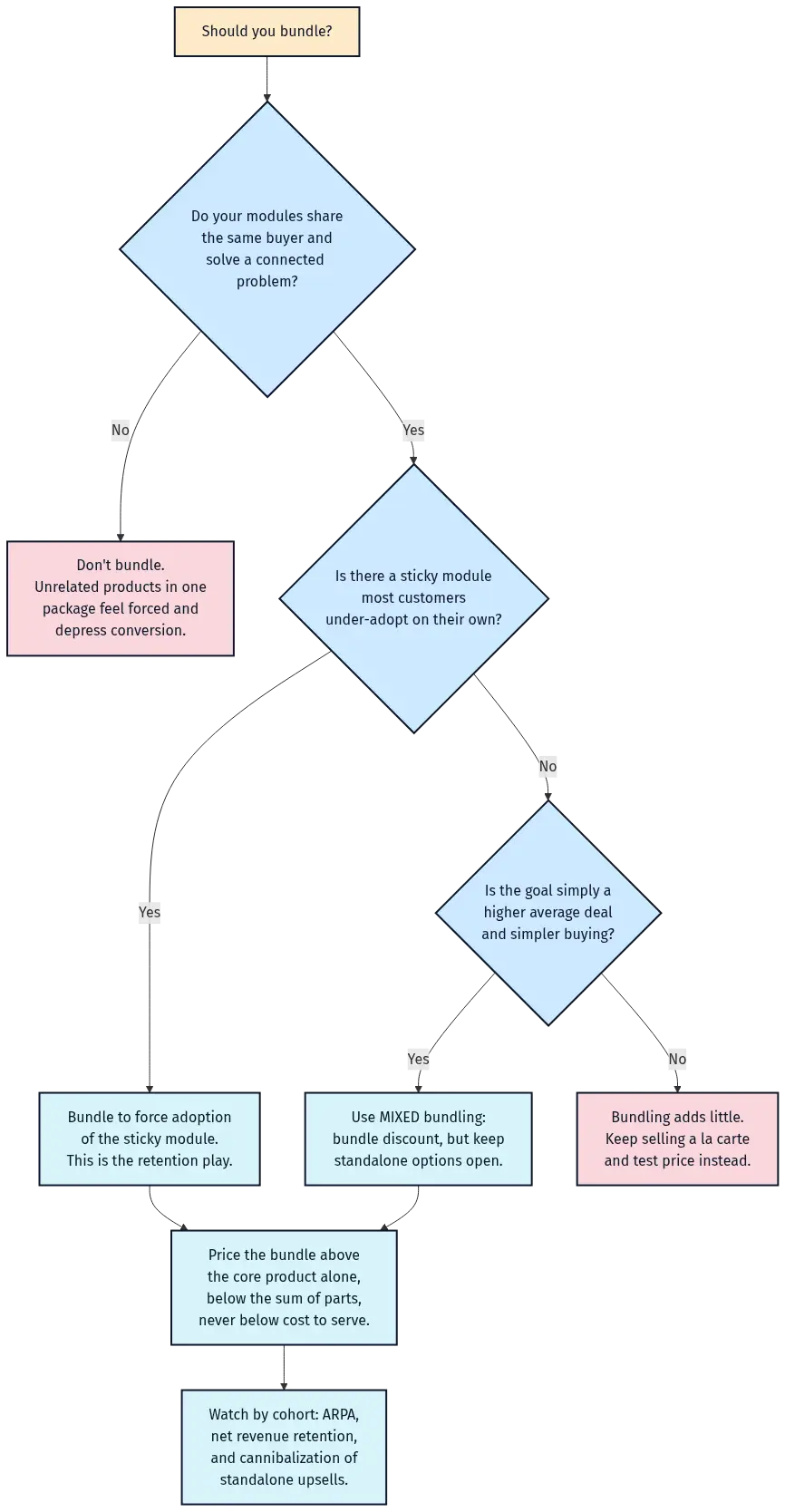
Pull the strategy off the shelf only when the situation genuinely fits. Here is the honest split.
Use bundle pricing when: your modules share the same buyer and solve a connected problem; you have a sticky, under-adopted module whose usage drives retention; your marginal cost to add a module is near zero (true for almost all SaaS); customers are underusing your platform and churning before they discover its full value; or too many à la carte choices are creating decision fatigue and stalling deals. When those conditions hold, bundling can lift ARPA and — far more valuably — pull customers into the module that keeps them.
Skip bundle pricing when: your modules serve different buyers who would never want them together; your customers overwhelmingly want a single product and forcing a bundle would push them to a competitor who sells it standalone; your discount would drag the bundle below cost to serve; or you have not yet tested whether you are simply underpriced. In those cases, bundling adds friction without capturing value.
If bundling is not the right move, you are not out of options — that is the important part. For products where value scales with customer success, usage-based pricing grows the account as the customer grows, without a single renegotiation. For high-volume seat expansion, volume pricing rewards larger commitments with a per-unit break. For a new product entering a crowded category, penetration pricing buys share deliberately with a planned climb back up. And in nearly every case, the disciplined first move is to run a real price test on new deals rather than assume you must package your way to a lower number. The tool most founders reach for — a discount dressed up as a bundle — is often the opposite of the tool the business actually needs.
Bundle Pricing FAQ
What is bundle pricing in simple terms? Bundle pricing is combining two or more products, modules, or features and selling them together for a single price, usually lower than buying each separately. In SaaS, the goal is rarely just the discount — it is to raise average revenue per account, simplify a confusing buy, and pull customers into the modules that make them stay. A good bundle is a deliberate structure with a job to do, not a bag of products at a markdown.
What is the difference between pure bundling and mixed bundling? Pure bundling sells only the package — you cannot buy the components separately, which simplifies the decision but risks losing the buyer who wants just one piece. Mixed bundling offers the package at a discount and keeps the components available at their standalone prices, so you capture both the bundle buyer and the single-module buyer. For most SaaS companies at $3M–$20M ARR, mixed bundling is the lower-risk default because it never hands the single-module customer to a competitor.
How does bundle pricing differ from tiered pricing? They overlap and usually work together. Bundle pricing groups products at one price; tiered pricing offers good/better/best levels, each of which is itself a bundle of features. Tiers add an expansion path — customers grow into higher levels over time — while a single bundle mainly simplifies the initial buy and raises the entry deal size. Most SaaS companies run two or three tiers where each tier is a bundle, getting both benefits at once.
Does bundle pricing increase or decrease revenue? It depends entirely on whether the bundle changes behavior. If it pulls in adoption or buyers you would not have won at à la carte prices, it increases revenue and retention. If your customers were going to buy the components separately anyway, bundling them at a discount cannibalizes revenue you would have earned at full price. The way to tell the difference is to measure incremental adoption by cohort — how much more customers bought because of the bundle — not total bundle sales.
How much should I discount a SaaS bundle? The floor is your cost to serve every module in the bundle — never price below it, or you lose money on every seat. The ceiling is the sum of the standalone prices, since a mixed bundle has to save the customer something. Within that range, the right discount is the smallest one that reliably changes the buying decision. A bundle that reads as a fair deal beats one that reads as a fire sale, because over-discounting undercuts the perceived value of every component inside it.
How does bundle pricing affect churn and retention? This is where SaaS bundling earns its keep. If you bundle in the module that drives retention — the one customers get locked into once they adopt it — you force adoption that would otherwise have been left to chance, and retention improves across the base. In practice, one module often drives far more retention than the others; segment your gross revenue retention by module usage to find it, then build the bundle around it. The net revenue retention lift usually dwarfs the ARPA lift.
How does bundle pricing affect my company’s valuation? Indirectly, through the numbers acquirers pay for. Executed well, bundling raises ARPA, drives adoption of sticky modules, and lifts net revenue retention — all of which push SaaS revenue multiples up. Executed badly, it leaves you with a discounted base that never adopted the sticky module and churns underneath a flattering blended ARPA, which drags the multiple down. Same logo count, opposite valuation — the difference is whether the bundle changed behavior or just cut the price.
The Bottom Line
Bundle pricing is one of the most misunderstood levers in SaaS, and the misunderstanding almost always runs the same direction: founders treat it as a discount to close deals, when its real power is to raise ARPA and — far more valuably — to force adoption of the module that keeps customers from leaving. Used as a discount, it cannibalizes revenue you would have earned anyway and hides a churning cohort inside a rising average. Used as architecture — modules that belong together, priced above the flagship and below the sum of parts and never below cost to serve, built around the stickiest module in the product — it lifts both the deal size and the retention that actually drives value.
The test is the same one that governs every pricing decision worth making. Can you state what the bundle is supposed to do, which module it is built around, and how you will measure whether it changed behavior rather than just the price? If yes, you may have a real bundle. If no, you have a coupon — and a coupon has never once shown up on a cap table as a higher multiple. Decide which one you are running before your customers decide for you.
For the machinery underneath any pricing decision, see SaaS unit economics, LTV/CAC, and the Rule of 40. For the full menu of pricing approaches, see the SaaS pricing strategy playbook and SaaS pricing models. For the downstream impact on retention and exit value, see net revenue retention and SaaS revenue multiples.