

Enterprise SaaS sales is where most $5M–$15M ARR companies decide their future — and where roughly two out of three of them quietly stall. The math looks irresistible: a single $250K Annual Contract Value (ACV) deal replaces 50 customers paying $5,000 per year. The reality is that enterprise win rates sit at 15–20%, sales cycles run 6–18 months, and 7–10 stakeholders can each kill the deal. Move upmarket the wrong way and you get a 30% gross margin business pretending to be a software company.
This is the field guide I wish more CEOs had read before they hired their first enterprise Account Executive. It covers when enterprise SaaS sales is the right motion for your stage, the seven structural shifts the company has to make to survive it, the unit economics that determine whether you can scale, and the most common ways the move upmarket destroys an otherwise-healthy SMB business.

What Enterprise SaaS Sales Actually Means
The term gets used loosely. Vendors selling $30K annual deals call themselves “enterprise” because their target customers are large companies. Sales reps selling $1.5M deals call themselves “enterprise” because their cycles are 18 months long. These are not the same motion, and conflating them is the first mistake.
For this article, enterprise SaaS sales means a sales motion with all of the following structural traits:
| Trait | Threshold |
|---|---|
| Annual Contract Value (ACV) | $100,000+ per customer per year |
| Sales cycle | 6 to 18 months from first contact to signed contract |
| Stakeholders involved | 7 to 13, including at least one C-suite signer and one technical evaluator |
| Procurement and legal review | 4 to 12 weeks, usually with a vendor security questionnaire and a redlined MSA |
| Customer Acquisition Cost (CAC) | $50,000 to $300,000+ per customer |
| Customer success motion | A named Customer Success Manager (CSM), formal Quarterly Business Reviews, and an annual renewal conversation |
If your motion only matches three or four of these traits, you are not running enterprise sales. You are running mid-market sales (typically $25K–$100K ACV) or a hybrid SMB-with-larger-deals motion. The distinction matters because every framework in this article — pipeline math, hiring sequence, compensation design, valuation premium — assumes you actually have the structural traits of enterprise, not just the aspiration.
The other useful definition is what enterprise SaaS sales is not: it is not selling SMB software to enterprise buyers at a slightly higher price. Enterprise buyers expect a different product, a different security posture, a different contract structure, and a different post-sale experience. If you sell them your SMB product at 5× the price, they will sign once, hate you for a year, and then either churn or extract free professional services until your margin disappears. The Ideal Customer Profile (ICP) for enterprise has to be defined narrowly and built into the product roadmap — not bolted on after the first $250K deal closes.
Note on benchmark figures. The cost, ACV, and cycle-length ranges throughout this article reflect 2026 market conditions for US-based B2B SaaS. The numbers are illustrative and meant to show the shape of the economics — not as a current rate sheet. Get vertical-specific benchmarks before you build your model.
Why Move Upmarket At All?
Before walking through the how, walk through the why. The case for enterprise SaaS sales is real, but it is narrower than most CEOs assume.
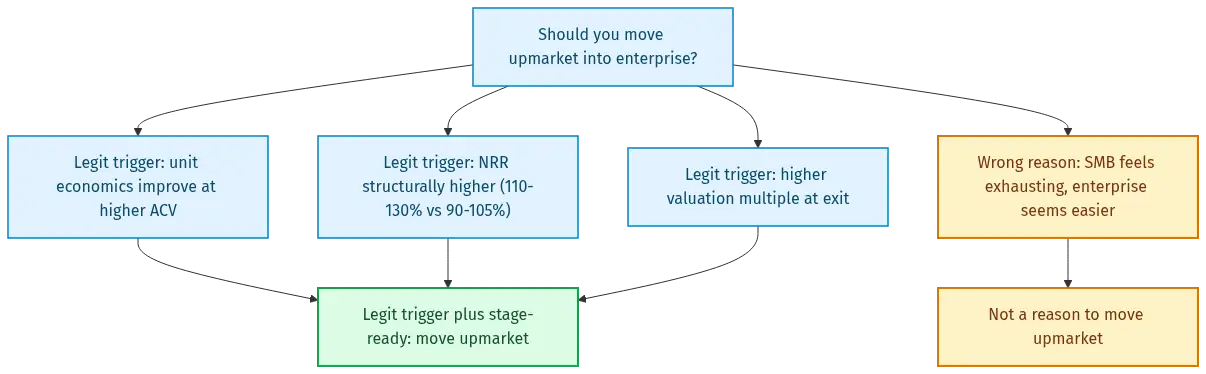
There are three legitimate reasons to move upmarket. There is one common reason that is wrong.
- Unit economics improve at higher ACVs. A $250K customer has roughly the same support cost as a $25K customer, but produces 10× the revenue. If your gross margin on a $25K customer is 75%, your gross margin on a $250K customer is often 82–85%. The marginal dollar of enterprise revenue is more valuable than the marginal dollar of SMB revenue, provided you don’t blow it on implementation cost.
- Net Revenue Retention (NRR) is structurally higher. SMB SaaS typically runs 90–105% NRR. Enterprise SaaS typically runs 110–130% NRR. The difference compounds: a company at 120% NRR doubles its installed base every four years without acquiring a single new customer. A company at 100% NRR doesn’t.
- Valuation multiples are meaningfully higher. All else equal, a SaaS company with $20M of enterprise ARR sells for a higher revenue multiple than a SaaS company with $20M of SMB ARR. Acquirers pay for predictability, and 100-customer enterprise bases are more predictable than 10,000-customer SMB bases. This is one of the six revenue-multiple drivers that determines what a buyer will actually pay at exit.
The bad reason, which I hear monthly in coaching conversations: “SMB customers are exhausting; enterprise will be easier.” This is wrong. Enterprise customers are not easier — they are differently hard. SMB customers churn on a credit card. Enterprise customers don’t churn on a credit card; they churn on a Steering Committee decision after eight months of internal politics, and they take $400K of ARR with them.
If the underlying reason to move upmarket is exhaustion with SMB sales, the move will fail. You will run into a different set of problems that you are less equipped to solve. Move upmarket because the unit economics, retention, and exit math say to — not because SMB feels hard.

The Stage Question: Are You Ready For Enterprise SaaS Sales?
The single most common mistake I see is moving upmarket too early. A $3M ARR company that hires a “VP of Enterprise Sales” because the CEO read a blog post about ACV expansion is almost always wasting 18 months and $1.5M.
There is a stage-readiness test. Walk through these five gates honestly.
| Gate | Threshold | Why It Matters |
|---|---|---|
| 1. SMB or mid-market motion is repeatable | You can hire an Account Executive (AE), ramp them in 90 days, and they hit 80%+ of their first-year quota. | If your current motion isn't repeatable, enterprise won't fix it — it will hide it under a longer cycle. |
| 2. ARR is at least $5M | Below $5M, you can't fund the 6–18 month cash burn on enterprise deals before they close. | Enterprise sales has long payback. You need a working SMB engine to fund the enterprise engine's ramp. |
| 3. Net Revenue Retention is ≥105% | If existing customers don't expand, enterprise won't either. | Enterprise customers expand more, but only if your product is built to expand. NRR below 100% is a structural problem the new motion will not solve. |
| 4. The product can pass a SOC 2 Type II audit | If not, you have a 4–8 month gap before you can credibly sell enterprise. | Enterprise buyers will not sign a contract without SOC 2 evidence. Plan the audit before hiring the AEs. |
| 5. The founder has had at least three real enterprise sales conversations themselves | You should personally have closed (or come close to closing) two or three enterprise deals before delegating the motion. | You cannot hire someone to run a motion you don't understand yourself. The first enterprise AE you hire will fail if you can't tell good enterprise pipeline from bad. |
If you don’t pass at least four of the five gates, you are not ready. The path forward is not “skip the gates and hope” — it is to spend 6–18 months getting through the gates first.
The exception worth naming: if your product is already being bought by enterprise customers through inbound (some product-led growth motions accidentally surface enterprise demand), then the question shifts. You are not deciding whether to move upmarket. You are deciding whether to formalize the enterprise motion that already exists. That is a different — and much easier — decision.
The Unit Economics of Enterprise SaaS Sales
Most CEOs underestimate the cost of acquiring an enterprise customer by roughly 2×. Here is the math you actually need.
The fully-loaded CAC for one enterprise customer with $250K ACV looks like this:
- Account Executive (AE) compensation. Base salary $140K–$180K + on-target commission $140K–$180K = $280K–$360K On-Target Earnings (OTE). Allocated across roughly 4 closed deals per year (the realistic enterprise AE quota at this ACV), that’s $70K–$90K per deal in AE comp.
- Sales Development Representative (SDR) support. One SDR per 2–3 AEs, fully-loaded cost $150K. Allocated per deal sourced: $15K–$25K.
- Solutions Engineer (SE) or Pre-Sales Engineer. One SE per 2–3 AEs to handle technical evaluations, demos, and Proof-of-Concept (POC) builds. Fully-loaded $200K–$250K. Allocated: $25K–$40K per closed deal.
- Marketing-sourced pipeline cost. Enterprise marketing — Account-Based Marketing (ABM) platforms, content, events, executive briefings — runs roughly 15% of new-business ACV. On a $250K deal: $37K.
- Sales leadership overhead. A VP of Sales and a Revenue Operations function, allocated per deal: $15K–$25K.
- Tools and infrastructure. Salesforce, Outreach, Gong, ZoomInfo, contract lifecycle management. Per deal: $5K–$10K.
Total fully-loaded CAC per enterprise deal: $167K–$230K. Call it $200K.
Now the LTV side. A $250K ACV customer with 110% Net Revenue Retention and 90% Gross Revenue Retention has an expected customer lifetime of roughly 7–10 years and an LTV that compounds with expansion. Using a standard SaaS LTV calculation with 80% gross margin:
LTV ≈ ACV × Gross Margin / (1 − NRR) when NRR > Gross Retention churn rate
Plugging in: $250K × 80% / (10% gross churn − 20% NRR expansion contribution) — this formula breaks down because NRR > 100% gives an infinite series. The simpler practical calculation: at 110% NRR and 80% gross margin, a $250K starting ACV customer produces roughly $2.2M–$3.0M of gross profit over 7–10 years, before discounting.
LTV/CAC ratio: roughly 11× to 15×. That is excellent — provided you actually achieve those retention and expansion numbers.
The same $250K customer with 95% NRR (slow expansion) and 80% Gross Revenue Retention produces about $800K of lifetime gross profit. LTV/CAC drops to 4×. Still acceptable, but no longer the heroic ratio that justifies the move upmarket.
The thing that determines whether enterprise SaaS sales works for your company is not the CAC. It is the NRR. Get retention and expansion above 110%, and the unit economics carry the whole strategy. Stay below 100%, and enterprise becomes a hamster wheel where you acquire expensive customers, lose them at renewal, and never compound. This is why reducing SaaS churn is the highest-leverage investment most companies can make before they move upmarket.
The Seven Structural Shifts You Have To Make
Moving upmarket is not a sales hire. It is seven shifts that all have to happen roughly in parallel. Skipping any one of them is what kills most upmarket pushes.
- Hire two enterprise AEs, not one. A single AE has no calibration point. If they miss quota, you can’t tell if it’s the product, the territory, the comp plan, or the rep. Two AEs hired in parallel give you a comparison and let you fire one without restarting the whole motion. Budget $700K of fully-loaded comp for the pair. Plan for a 9–12 month ramp before either is productive.
- Stand up a Customer Success Manager (CSM) function before the first enterprise customer signs. Enterprise customers expect a CSM. If you don’t have one, the AE will try to do the role, and you’ll burn out your most expensive employee on implementation and adoption work. CSM hire #1 lands before AE deal #1 closes — not after.
- Get SOC 2 Type II certified. Budget 4–8 months and $40K–$80K for the audit and remediation. There is no enterprise buyer in 2026 who will sign a $250K contract without SOC 2 evidence and a current penetration test report. Treat this as a gating prerequisite, not a parallel workstream.
- Hire a Solutions Engineer. Enterprise buyers will demand a technical evaluation — Proof-of-Concept, integration test, security review, scale test. Your AE cannot run these alone. The SE is the most under-budgeted role in early enterprise motions; founders consistently try to skip it and end up running technical evaluations themselves. That works for the first three deals and breaks at the fourth.
- Rebuild the contract. Your SMB MSA is one page and click-through. The enterprise MSA will be 25 pages, redlined heavily, and will include a Service Level Agreement (SLA) with financial penalties, a data-processing addendum, indemnification clauses, and a Most-Favored-Nation provision the prospect’s procurement team will absolutely ask for. Hire a contracts lawyer who has done 100 SaaS deals — not your general corporate counsel.
- Build the procurement runway. Enterprise procurement teams have a vendor onboarding process that runs 4–8 weeks after the verbal “yes.” Build the runway: vendor questionnaires, SOC 2 packet, insurance certificates, business continuity plan, references, anti-bribery attestations. Have all of this on a SharePoint or virtual data room before you start negotiating your first deal — not after the prospect asks for it on day 60 of the cycle.
- Move the founder out of every deal except the largest. Enterprise sales attracts founders because every deal feels important and the AE will lean on you. The pattern fails the company: the founder ends up running every cycle, no one else learns the motion, and the company never builds a Sales Machine — the predictable system that turns dollars in to bookings out. This is exactly the founder-to-CEO transition that determines whether the company can scale past $20M ARR. Pick a deal-size threshold (e.g., $500K+) above which the founder shows up for the final-stage executive conversation only. Below that, the AE owns the deal end-to-end and asks for help, not co-piloting.
The companies that move upmarket successfully do these seven things in parallel, in 9–12 months, before the first enterprise deal closes. The companies that fail do them sequentially, after problems surface — by which point the AE has missed quota, two prospects have churned, and the SMB engine has started to wobble from neglect.

The Enterprise Sales Pipeline Math
Most SMB founders think about pipeline as a ratio: 3× pipeline coverage, 25% close rate, 90-day cycle. Enterprise pipeline math is different from the SaaS sales cycle you may be used to in ways that catch operators off guard.
The core ratios for enterprise SaaS sales at the $250K ACV level:
| Metric | SMB Benchmark | Enterprise Benchmark |
|---|---|---|
| Pipeline coverage ratio (pipeline / quota) | 3× | 4× to 5× |
| Win rate (closed-won / closed-decided) | 22%–30% | 15%–20% |
| Sales cycle (days from Stage 1 to closed) | 30–90 | 180–540 |
| Demo-to-opportunity conversion | 30%–40% | 15%–25% |
| Opportunity-to-close conversion | 25%–35% | 15%–22% |
| Average stakeholders per deal | 2–4 | 7–13 |
The implication: an enterprise AE carrying a $1M quota needs $4M–$5M of qualified pipeline, sourced 12–18 months ahead of the year they need to hit. That has two consequences most founders miss.
Consequence one: the first 12 months of an enterprise hire produce roughly zero revenue. You are paying $300K of OTE for an AE who is filling pipeline, not closing deals. If you can’t fund that runway from your existing SMB or mid-market book, the hire is premature.
Consequence two: pipeline forecasting is harder, not easier. With 90-day SMB cycles, a deal that doesn’t close this month closes next month. With 540-day enterprise cycles, a deal that slips can slip two quarters and take a real chunk of next year’s plan with it. The forecasting discipline has to be tighter — not looser — than it was in SMB.
The single highest-leverage practice for managing enterprise pipeline is multi-threading: building relationships with 3–5 stakeholders per deal instead of 1. According to Gartner research on B2B buying behavior, the typical enterprise software purchase now involves 6–10 decision-makers, each armed with their own data. Single-threaded enterprise deals close at 15–20 percentage points lower than multi-threaded ones of the same size. If your AE has one champion at the prospect company and that champion leaves (which happens roughly 25% of the time over an 18-month cycle), the deal dies. Multi-threading is insurance.

Common Failure Modes
The pattern repeats. Here are the five most common ways enterprise SaaS sales destroys an otherwise-healthy SMB business.
- The “stuck in the middle” trap. The company stops investing in SMB to fund the enterprise build-out. SMB growth slows. Enterprise hasn’t ramped yet. Total ARR growth drops from 40% to 15% for 18 months. The board panics. The CEO either over-corrects (firing the enterprise team) or doubles down (cutting SMB harder). Either move makes it worse.
- The “first big deal” curse. A $400K logo lands in month 6 — usually from inbound, often from the CEO’s personal network. The whole company celebrates. The product team starts building the custom features the customer asked for. Other deals stall because engineering capacity is now consumed. The “first big deal” becomes 30% of revenue and 70% of the roadmap. The next four enterprise deals don’t close because the product diverged.
- Margin collapse via professional services. The enterprise customer asks for an implementation. Then a custom integration. Then a quarterly on-site. None of these were in the contract. The CSM and the AE keep saying yes because the customer is “strategic.” Gross margin on that account is now 35%. Multiply by five accounts, and the company’s overall gross margin drops from 78% to 64%. Acquirer multiples drop with it.
- Compensation plan failure. The enterprise AE has a 12-month cycle and a 12-month commission plan. Month 11, no deals have closed. The AE — a top performer at their previous company — quits to go somewhere they can earn. You restart the ramp. Variable compensation in enterprise has to be designed around the actual cycle length, with mechanisms like draws, ramp commissions, and milestone payments at signed POCs or contract redlines.
- The “we’ll figure out renewals later” mistake. The first cohort of enterprise customers renews in year two. The renewal team — which doesn’t exist yet — is the AE who closed them, who is now busy on new business. Renewals happen badly. Two customers leave, taking $600K of ARR. The “growth” the enterprise motion produced turns out to be net flat once you net out the churn. Build the renewal motion before the first cohort renews, not after.
The common thread across all five: founders treat enterprise SaaS sales as a sales problem. It is a company problem. The sales motion is downstream of product, retention, services, finance, and operations all changing at the same time.
Pricing and Contract Structure
Enterprise SaaS sales pricing looks nothing like SMB pricing. The published price list is a starting point, not a transaction. Three things matter most.
Per-seat versus consumption-based versus platform. Enterprise buyers generally prefer consumption-based SaaS pricing models in 2026 — pay for what you use, with a committed minimum and an overage rate. This benefits the buyer in soft years and benefits you in usage-growth years. The structural advantage for the SaaS company: consumption-based revenue grows organically with the customer’s success, which is the highest-leverage form of expansion. Per-seat pricing creates a procurement adversarial relationship at every renewal because seat counts are something the buyer can squeeze.
Multi-year contracts with rate locks. Three-year contracts at a 7–12% discount versus annual are common. They lock revenue, reduce churn, and improve the metrics that matter at exit. But they require careful structuring: build in an annual price escalator (typically 3–5%) so the third year isn’t priced at 2026 rates. Without the escalator, you’re locking in inflation. The right SaaS pricing strategy for enterprise treats price as a renegotiation that happens every year, not a number you set once.
The Most-Favored-Nation (MFN) clause. Enterprise procurement teams will routinely ask for MFN — a contract clause that says “if you give any other customer a better price, you have to give it to us too.” Never sign MFN. It removes pricing flexibility for the rest of your company’s life. If procurement insists, decline the deal. There are other customers; there is no version of “fine, I’ll just sign MFN this once” that doesn’t come back to hurt you in year three.
Anti-pattern to avoid: the “POC discount.” A prospect asks for 50% off year one in exchange for being a “reference customer.” This sounds reasonable. It is not. The discount sets the anchor for year-two pricing and every other enterprise prospect who hears about it (and they will hear about it — enterprise buyer communities are remarkably tight). Instead, give pilot scope reductions or limited-feature trials, not headline price discounts.
Compensation Design for Enterprise AEs
Enterprise AE comp plans are different in three structural ways from SMB plans:
| Plan element | SMB approach | Enterprise approach |
|---|---|---|
| Base/variable split | 50/50 | 50/50 to 60/40 (more base, less variable, to bridge the long cycle) |
| Quota | 5× to 7× of OTE | 4× to 5× of OTE |
| Accelerators | Kick in at 100% of quota | Kick in at 80% of quota, scale aggressively past 100% |
| Ramp period | 90 days | 9–12 months with a guaranteed draw |
| Spiff structure | Single-month spiffs | Milestone spiffs tied to POC signed, contract redlined, security review passed |
| Multi-year credit | 100% of Year 1 ACV | 100% of Year 1 ACV plus 50% of Year 2 and Year 3 ACV at signing |
The most-debated of these is the multi-year credit. SMB-thinking CEOs object: “I don’t want to pay commission on revenue I haven’t recognized yet.” The enterprise answer is: you absolutely do, because multi-year deals are vastly more valuable to your company than annual deals, and your AE’s behavior has to be aligned with closing them. An AE who gets the same commission for a 1‑year and a 3‑year contract will close 1‑year contracts every time.
The other principle: pay quickly. Enterprise AEs who wait six months for commission after a deal closes will quit and go work for a company that pays in the month the deal signs. The cash-flow cost is real but small relative to the cost of replacing a productive enterprise AE.

Comparing Enterprise SaaS Sales to Mid-Market and SMB
A side-by-side at $5M–$15M ARR helps clarify which motion to invest in. The honest answer for many companies is: don’t choose enterprise yet — choose mid-market and execute it well.
| Dimension | SMB ($5K–$25K ACV) | Mid-Market ($25K–$100K ACV) | Enterprise ($100K+ ACV) |
|---|---|---|---|
| Sales cycle | 7–45 days | 60–180 days | 180–540 days |
| Stakeholders per deal | 1–2 | 3–5 | 7–13 |
| Win rate (qualified pipe) | 22%–30% | 18%–28% | 15%–20% |
| CAC per customer | $2K–$10K | $15K–$50K | $50K–$300K |
| Months to AE productivity | 60–90 days | 4–6 months | 9–12 months |
| Net Revenue Retention (typical) | 85%–105% | 100%–115% | 105%–130% |
| Gross margin | 70%–80% | 75%–82% | 78%–88% |
| Average revenue multiple at exit | 4×–8× | 6×–10× | 8×–15× |
The honest read: mid-market is where most $5M–$15M ARR SaaS companies should focus. It has most of the unit-economics and retention advantages of enterprise without the cycle length, organizational complexity, and execution risk. Some companies can leap from SMB straight to enterprise — usually with a product that is structurally enterprise (heavy security, complex deployment, regulatory tie-in). Most should not.
If you are currently SMB and want to be enterprise, mid-market is the bridge, not the detour. Spend 18–24 months running a successful mid-market motion before you attempt enterprise. The skills, hiring, retention, and contract patterns transfer. The reverse — leaping from SMB to enterprise — almost never works. The SaaS sales models you build at mid-market are the same models you’ll extend to enterprise; the ones you build at SMB usually aren’t.

Building Toward Exit: Why Enterprise SaaS Sales Matters at the Sale
Setting aside the operational question of whether to move upmarket, there is a valuation question. A SaaS company with $20M of ARR will be valued very differently by an acquirer depending on the ACV mix. The full SaaS company valuation framework picks this apart, but the headline matters here.
The acquirer is buying predictability. A company with 100 customers each paying $200K is more predictable than a company with 8,000 customers each paying $2,500. Customer concentration matters in the wrong direction — a single $5M customer is risky — but a portfolio of 80–150 enterprise customers paying $100K–$500K each is the structural sweet spot acquirers pay the highest multiples for.
The valuation premium for enterprise revenue mix breaks down roughly like this, holding other variables constant:
- Pure SMB ($5K–$25K ACV): baseline revenue multiple
- Mostly SMB with some mid-market: baseline × 1.2 to 1.4
- Mostly mid-market with some enterprise: baseline × 1.5 to 1.8
- Mostly enterprise with diversified customer base: baseline × 2.0 to 2.5
These aren’t theoretical numbers. They map to what private-equity buyers actually pay for SaaS books in the $20M–$80M ARR range. The implication for a CEO building toward a $50M–$100M+ exit: the move upmarket isn’t just about growth — it’s about who can afford to buy the company, and what they will pay.
The catch is that you have to do the move upmarket well enough that the enterprise customers stay. A company with $20M of enterprise ARR and 85% Gross Revenue Retention is worth less than a company with $20M of mid-market ARR and 95% Gross Revenue Retention. Acquirers do the math: ARR × Net Revenue Retention is closer to what you actually own than ARR alone.
Frequently Asked Questions
How long does it take to move from SMB to enterprise SaaS sales?
For a company starting at $5M ARR with a working SMB motion, the realistic timeline is 18–30 months to a functioning enterprise motion that produces 25%+ of new ARR. The first 9–12 months are infrastructure (SOC 2, contracts, CSM hire, AE ramp). The next 9–18 months are pipeline build-out and the first cohort of closed deals. Faster than this is usually a sign someone is taking shortcuts that will surface as a quality problem in year two.
What’s the right Customer Acquisition Cost (CAC) for enterprise SaaS sales?
Total fully-loaded CAC of 0.8× to 1.2× of first-year ACV is healthy. Above 1.5×, you’re either pricing too low or selling too small. Below 0.6× is unusual and usually means you’re harvesting inbound demand rather than running a real outbound motion — fine if it persists, dangerous if it doesn’t. The LTV/CAC ratio is the more useful guardrail at the company level — aim for 3× or better on a fully-loaded basis.
How do I know if my product is enterprise-ready?
Three structural tests. (1) Can it pass a SOC 2 Type II audit without major remediation? (2) Does it have role-based access control, audit logs, and Single Sign-On (SSO) via SAML or OIDC? (3) Can it scale to 5,000+ named users in a single tenant without performance degradation? If you can’t answer yes to all three, the product needs 4–8 months of engineering work before you start serious enterprise sales — and trying to sell without it will burn the brand with the buyers who matter most.
What’s the right sales hierarchy for a $10M ARR SaaS adding enterprise?
VP of Sales (often the founder for the first 12 months), one or two enterprise AEs, one SDR per 2–3 AEs, one Solutions Engineer per 2–3 AEs, one CSM per 8–12 enterprise customers, and one Revenue Operations analyst. Resist the urge to hire a Chief Revenue Officer (CRO) before you have $25M+ of ARR — CROs at smaller companies tend to be expensive and under-utilized.
How do enterprise SaaS sales compensation plans handle long cycles?
With a guaranteed draw against commission in months 1–9, then transition to pure variable. Some companies use milestone payments — partial commission paid when a contract is signed for redlines, when SOC 2 is approved by the prospect’s security team, when a POC closes successfully. The principle is to give the AE cash flow during the long cycle so they don’t quit before the first deal closes.
Should the founder be involved in every enterprise deal?
No. The founder should be involved in the first three to five enterprise deals (to learn the motion firsthand), then move to an executive-sponsor role on the largest deals only. A useful threshold is “founder shows up for final-stage executive conversations on deals above $500K.” Below that, the AE owns the deal. Founders who stay in every deal create a Sales Machine they themselves are the gating constraint of — which kills both their time and the company’s ability to scale.

What To Do This Quarter
If you’re a CEO at $5M–$15M ARR considering whether to move into enterprise SaaS sales, here is the 90-day checklist:
- Honestly score yourself against the five readiness gates above. Don’t grade on a curve.
- Calculate your current LTV/CAC and NRR by customer segment, not in aggregate. If you don’t have segment-level numbers, that’s the first thing to build. Segmenting your SaaS growth metrics is non-negotiable — company-wide averages hide the truth.
- Have three conversations with CEOs running enterprise motions in your space who are 2–3 years ahead of you. Specifically ask what they wished they’d done differently in their first 12 months upmarket.
- Decide whether the next move is enterprise or mid-market. For most $5M–$15M ARR companies, the right answer is mid-market — and that’s not a step down, it’s the bridge.
- If the answer is enterprise, start with the SOC 2 audit and the CSM hire. Not the AE hire. Hiring the AE before the infrastructure exists is the single most common way this fails.
Enterprise SaaS sales done right is the single highest-leverage motion change in the SaaS playbook. It can take a $10M ARR business to a $50M ARR business at higher gross margins, higher retention, and a higher exit multiple. Done wrong, it can take a healthy $10M ARR business and stall it for two years while burning $5M of cash. The difference between the two outcomes is rarely the sales hire. It’s whether the company is structurally ready when the sales hire shows up.