

Most founders I work with between $5M and $15M Annual Recurring Revenue (ARR) think their B2B SaaS sales problem is a talent problem. They believe the next rep, the next VP, or the next hot script will fix the lumpy quarters. It almost never does. B2B SaaS sales is not a people problem you solve by hiring — it is a system you build, measure, and tune until it produces predictable bookings from predictable inputs. The companies that stall at $10M are not short on effort. They are running a personal performance that happens to involve salespeople, instead of an engine that would keep producing if the founder left for a month.
Here is the part most people miss. The thing that makes B2B SaaS sales hard is not the selling — it is that you are closing a committee, financing an upfront cost you only recover over years, and signing a contract whose real value depends on whether the customer is still there in year three. Get any one of those three wrong and the deal that looked like a win on the board slide quietly loses you money. This guide walks through what separates B2B SaaS sales from every other kind of selling, how to match your sales motion to your deal size, the unit-economics math you must run before you hire, and the four mistakes that cap most companies right where you are now.
What B2B SaaS Sales Actually Is
A workable definition: B2B SaaS sales is the repeatable, measurable process of identifying the right business buyers, proving quantified value to a buying committee, closing a subscription contract, and engineering the conditions under which that subscription renews and expands. Strip out any one of those clauses and you have something less durable than a SaaS business.
Three features make B2B SaaS sales structurally different from selling a one-time product or a consumer app, and each one changes how you should build the engine.
You sell to a committee, not a person. A meaningful B2B deal is approved by a buying group — a champion who feels the pain, an economic buyer who controls the budget, a technical evaluator who can veto on security or integration grounds, and often a procurement or legal gatekeeper who appears late and slows everything down. The larger the deal, the larger the committee. You are not persuading one person; you are arming your champion to win an internal argument you will never be in the room for.
You finance the customer. In B2B SaaS you spend the full cost of acquiring a customer up front — the rep’s time, the marketing that sourced the lead, the sales engineer on the demo — and you earn it back over months or years of subscription revenue. That timing gap is why SaaS unit economics sit underneath every sales decision. You are effectively a lender who gets repaid in monthly installments, and a customer who churns before payback is a loan that defaulted.
The sale is not over at the close. Closing a $50,000 ARR deal is worth roughly $400,000 of lifetime value at a healthy multi-year SaaS lifespan — if the customer renews and expands. The same deal is worth about one year of revenue and a wasted acquisition cost if it churns. Everything you do below the signature — onboarding, success, the expansion motion — is what separates a real B2B SaaS sale from a transaction that flatters this quarter and bleeds out next year.
Throughout this guide, a lead is a contact who has shown interest but isn’t qualified, an opportunity is a qualified deal in active pursuit, pipeline is the aggregate weighted value of active opportunities, and the sales motion is the end-to-end process from first touch to signed contract. Most content online uses these interchangeably. They are not the same thing, and conflating them is the first sign of an org that can’t forecast.

Why B2B Buying Is Different From Selling
The defining feature of B2B SaaS sales is the buying committee, and it deserves its own treatment because almost every sales mistake at $5M–$15M ARR traces back to selling to one person when a group is deciding.
Consider what actually happens inside a mid-market deal. Your champion — usually the person who runs the function your product serves — gets excited on the demo. But the champion rarely controls the budget. To get the deal done, they have to walk your business case to a vice president who is comparing your line item against three other priorities, survive a security review run by someone who has never met you, and then hand a contract to a procurement team whose entire job is to extract a discount and add legal terms. Your rep talks to the champion. The other three people decide whether the deal closes.
This changes how you build the motion in three concrete ways.
- Sell the business case, not the feature set. The champion buys features; the economic buyer buys a return. Your motion has to produce a quantified business case — dollars saved, revenue gained, risk reduced — that your champion can defend without you present. A demo that dazzles the champion but produces no number for the VP is a deal that stalls in “we’re still evaluating.”
- Map the committee early and explicitly. A disciplined motion identifies, by name and role, every person who can say no before the deal is half done. The most common reason a forecasted deal slips a quarter is a stakeholder nobody mapped — a security reviewer, a finance partner, a skeptical peer of the champion — surfacing at the eleventh hour.
- Treat procurement as a stage, not a surprise. In deals above roughly $50,000 in annual contract value (ACV) — the annualized recurring value of a single contract — procurement and legal are a predictable phase that adds weeks. Build it into your SaaS sales cycle and your forecast. Reps who are blindsided by procurement every single time do not have a procurement problem; they have a process gap.
The practical test is simple: if your reps can only describe the deal from the champion’s point of view, you are selling to a person. If they can name the economic buyer, the likely technical objections, and the procurement timeline before the second call, you are selling to a committee — which is the only way B2B SaaS sales scales past the founder.
Start With the Math, Not the Motion
Before you touch your sales motion — before you hire, before you pick a methodology, before you write a script — you have to know whether the economics can carry a sales team at all. You can never outgrow your unit economics. If a customer costs more to acquire and serve than they are worth, scaling your B2B SaaS sales team just helps you lose money faster and more confidently.
Two numbers decide whether you have an engine worth scaling.
The first is your LTV/CAC ratio — Customer Lifetime Value (LTV) divided by Customer Acquisition Cost (CAC). It tells you how many dollars of gross profit each customer returns for every dollar you spend to win them.
LTV/CAC = Customer Lifetime Value ÷ Customer Acquisition Cost
The second is your CAC payback period — how many months of gross profit it takes to earn back what you spent acquiring the customer.
CAC Payback Period (months) = CAC ÷ (Monthly ARPA × Gross Margin %)
Here ARPA is Average Revenue Per Account. Use these benchmarks — broadly consistent with the spreads published in independent SaaS research such as OpenView’s SaaS benchmarks — to judge where you stand before you spend a dollar scaling.
| LTV/CAC | What It Means | CAC Payback | What It Means |
|---|---|---|---|
| < 3.0 | Weak — fix before scaling | > 24 months | Concerning — capital intensive |
| 3.0 | Healthy industry baseline | 18–24 months | Acceptable if retention is strong |
| 3.0–5.0 | Strong, efficient engine | 12–18 months | Good — typical healthy SaaS |
| > 5.0 | Possibly under-investing in growth | < 12 months | Excellent — fast capital recycle |
Make it concrete. Say a customer pays you $2,000 per month, your gross margin is 80%, and the average customer stays 30 months. That customer’s lifetime value is:
LTV = $2,000 × 80% × 30 = $48,000
Now suppose it costs $12,000 in fully loaded sales and marketing to acquire that customer. Your LTV/CAC is:
$48,000 ÷ $12,000 = 4.0
And your CAC payback is:
$12,000 ÷ ($2,000 × 80%) = $12,000 ÷ $1,600 = 7.5 months
That is a strong, scalable engine — 4.0× returns with capital recycled in under eight months. You can pour fuel on it. But change one input — say customers stay 12 months instead of 30 — and LTV drops to $19,200, LTV/CAC falls to 1.6, and the exact same sales motion that looked brilliant now destroys capital on every deal. Same reps, same script, completely different reality.
This is why the order of operations matters: fix retention before you scale sales. A leaky bucket does not need a bigger hose. For the mechanics, see the guides on reducing SaaS churn and net revenue retention — the metric that ultimately sets your ceiling. The full treatment of these inputs lives in calculating LTV for SaaS and the LTV/CAC deep dive.
Segment Before You Build Anything
Here is the trap that company-wide unit economics sets for you: the average hides the truth. One hundred percent of the time, there are significant variances between segments. Your blended LTV/CAC of 3.5 might be one segment running at 6.0 quietly subsidizing another running at 1.2 — and if you scale the blended number, you scale the loss along with the win.
Calculate your unit economics separately by segment. The dimensions that almost always reveal something:
- Vertical or industry. The same product often performs wildly differently across industries.
- Contract size (ACV). Small and large accounts have different acquisition costs and different retention curves.
- Lead source. Inbound and outbound rarely share the same economics.
- Sales channel. Partner-sourced, self-serve, and direct deals each carry their own math.
- Buyer persona. The job title of the person who signs changes cycle length, deal size, and churn.
When you segment, one of two things happens: you find a hidden profit center you have been under-investing in, or you find a money-losing segment you have been mistaking for growth. Both are decision-changing. Segmentation is how you point your entire B2B SaaS sales motion at the customers who actually make you money — which leads directly to the most leveraged decision you will make.
Get the ICP Right or Nothing Else Matters
Your Ideal Customer Profile (ICP) — the precise definition of the customer you are built to serve — is the single highest-leverage decision in B2B SaaS sales, and most founders get it wrong by being too broad. “We serve everyone” is not a strategy; it is the absence of one, and it tanks unit economics in three ways at once.
A wrong ICP gives you longer sales cycles (you are educating people who were never a fit), higher CAC (you are spending to chase deals that will not close or will not last), and worse churn (the customers you do close leave because the product was never built for them). A precise ICP improves all three at the same time. The discipline is uncomfortable because it means saying no to revenue — but a customer who churns in six months and consumes a quarter of your support team is not revenue, it is a liability that happens to wire you money for a while.
A useful test: if you cannot describe your best customer in one sentence — the industry, the company size, the trigger that makes them buy, and the problem you solve better than anyone — your ICP is not precise enough yet. For the full method, read the guide on building an ideal customer profile.
Match the Sales Motion to the Deal
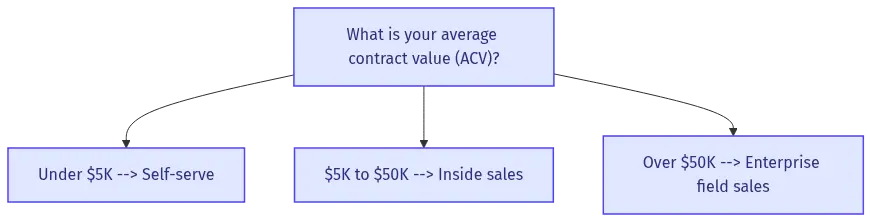
Once you know who you are selling to and that the economics work, you choose the motion — the structural way you reach and close customers. The non-negotiable rule of B2B SaaS sales is that the motion has to scale to your ACV. The cost of the motion must be affordable relative to the deal. You cannot fly an account executive to an on-site meeting for a customer paying you $4,000 a year; the math does not work, and no amount of effort fixes math.
| Motion | Typical ACV | How It Works | Best Fit |
|---|---|---|---|
| Self-serve / PLG | < $5K | Customer buys without talking to a human; the product does the selling | Low ACV, simple product, large market |
| Inside sales | $5K–$50K | Reps sell remotely by phone and video; shorter cycles, pooled success | Mid-market, repeatable, moderate complexity |
| Field / enterprise sales | $50K+ | Multi-stakeholder deals, longer cycles, dedicated reps, in-person where it pays | High ACV, complex buying committees |
| Partner / channel | Varies | Third parties resell or refer; you trade 20%–40% margin for reach | When partners own the customer relationship |
The most common motion mistake at $5M–$15M ARR is running one that is too expensive for the deal. If your ACV is $8,000 and you are sending account executives on-site, the motion costs more than the deal is worth, your CAC payback balloons past 24 months, and the strategy is dead on arrival. The reverse is just as costly — trying to close $150,000 enterprise deals through a self-serve signup form leaves enormous value on the table because nobody is in the room to manage the committee.
You can run more than one motion, but the second most common mistake is running two at once without separating the teams. The same rep tries to close a $10,000 credit-card deal in the morning and a $250,000 enterprise deal in the afternoon. The compensation does not work, the deal economics do not work, and the rep’s time fragments across deal sizes that demand fundamentally different skills. The correct path is almost always to dominate one motion before adding a second — and when you add it, run it as a separate team with its own quota, territory, and comp plan. For the deeper structural comparison, see SaaS sales models and, when you are ready to move upmarket, enterprise SaaS sales.
The Quota Math You Must Run Before Hiring the Next Rep
The single most expensive mistake in scaling B2B SaaS sales is hiring a rep whose quota has no math behind it. You have seen the pattern: the company hires a rep at $150,000 base on $300,000 on-target earnings (OTE), assigns a $1M annual quota, and is surprised 12 months later when the rep closed $400,000, missed plan, and quit. The quota was never achievable. Nobody ran the math.
The math to run before you sign the offer letter is the quota capacity calculation, and it has four inputs.
- Average ACV. For an inside sales motion, say $25,000 — the midpoint of the $5K–$50K band.
- Win rate of qualified opportunities. A competent inside sales motion in an established market wins 20%–30%. Use 25%.
- Sales cycle length. Inside sales runs 30–60 days. Use 45 days, which means a rep can run roughly 8 cycles per year (365 ÷ 45).
- Opportunities a rep can carry at once. The inside-sales benchmark is 20–30 active opportunities. Use 25.
Now the math. A rep carrying 25 active opportunities that each run about 45 days handles roughly 25 × (365 ÷ 45) = 203 opportunity-cycles per year. At a 25% win rate, that is about 51 closed-won deals per year. At $25,000 ACV, that is roughly $1.27M in annual bookings — call it $1.3M of new ARR per rep at full ramp.
That is the rep’s capacity. The quota should be set at 70% to 80% of capacity, so the top reps can blow it out and the median rep can reasonably hit. A $1M quota on $1.3M of capacity is the right shape. The three ways founders get this wrong:
- Quota above capacity. A $1.5M quota on $1.3M of capacity means even your best rep cannot hit plan. Reps quit, morale collapses, and the founder wrongly concludes “we can’t hire reps.”
- Quota far below capacity. A $500K quota on $1.3M of capacity means the rep clocks $600K and coasts. The comp plan becomes a permission slip for under-performance.
- No math at all. They pick a number that “feels right” or matches a prior company with different ACV, win rates, and cycle lengths. None of that math transfers.
A note on the figures here: ACV, win rate, and cycle-length benchmarks reflect SaaS market conditions at the time of writing, and both the absolute numbers and the ratios move with the market. The point is the structure of the calculation — capacity, then quota as a percentage of capacity — not the specific dollars. Verify current benchmarks for your own segment before you plan against them.
Build the Sales Machine in Six Stages
A B2B SaaS sales strategy is not finished when you have an ICP and a motion. The strategy’s real job is to turn selling from an unpredictable people problem into a predictable system. I think of this as a sales machine that matures through six stages. Most $5M–$15M ARR companies are stuck around stage two or three, which is exactly why their growth feels lumpy.
- Define a repeatable process. The same stages, the same steps, every deal. If every rep sells differently, you do not have a process — you have a collection of individual artists. See building a repeatable sales process for how to map this concretely.
- Professionalize it. Write the playbooks. Document what a good discovery call sounds like, what qualifies a deal, and what each stage requires to advance. Onboard new reps against the documented system, not tribal knowledge.
- Make it statistical. Know the conversion rate at every stage. If you cannot tell me what percentage of demos become proposals and what percentage of proposals close, you cannot forecast and you cannot diagnose. This is where most companies plateau — they have activity data but no conversion math.
- Optimize it. With the numbers in hand, find the leaks and fix the stage where the most deals die. Study your outliers (more on that next).
- Hit your LTV/CAC targets. Prove the optimized machine clears the unit-economics bar reliably, not just in a good quarter. This is the moment the engine becomes investable.
- Make it predictable. The end state: you put $1M of sales and marketing spend in and reliably get roughly $1M of new bookings out. When you reach this stage, something profound happens — you stop talking to your VP of Sales about pipeline and start talking to your CFO about capital allocation.
That final stage is the goal of the entire B2B SaaS sales effort. For the disciplines that get a team there faster, the companion guides on SaaS sales strategy, sales methodology for SaaS, and SaaS sales training go deeper than there is room for here.
Study the Outliers to Find Your Leverage
The single highest-leverage improvement most B2B SaaS sales orgs can make costs almost nothing: find your top performer, figure out exactly what they do differently, document it, and train everyone else to do it.
The power is in the math of variance. I once worked with a 10-person sales team where one account executive was generating 60% of the qualified meetings. The difference was not talent — it was that this one rep booked five prospecting meetings a week while everyone else averaged half a meeting a week. If you get the other nine reps to match the outlier’s behavior, you do not get a 10% lift. You go from a team averaging roughly 0.5 meetings per rep to one averaging five — a tenfold increase in top-of-funnel activity from the same headcount.
The variance between your best and worst performers is your roadmap. It tells you precisely what “good” looks like, because someone on your team is already doing it. Most companies overlook this because they are busy hiring more reps when they should be cloning the one they already have.
A Worked Example: Leaky Pipeline vs. Tight Pipeline
To make the system concrete, run the same $5M ARR B2B SaaS company through two scenarios. Both have identical revenue, reps, and product. The only difference is the discipline applied to the engine.
| Metric | Company A — Leaky | Company B — Tight |
|---|---|---|
| Pipeline coverage (start of quarter) | 2.1× | 3.4× |
| Qualified-opportunity win rate | 17% | 26% |
| Average sales cycle | 78 days (was 60) | 55 days (stable) |
| Average ACV | $22K (was $28K) | $32K (slowly rising) |
| Net Revenue Retention (NRR) | 96% | 114% |
| Gross Revenue Retention (GRR) | 84% | 92% |
Both companies start the year at $5M ARR. Run the math forward 12 months.
Company A. New ARR is roughly $5M × 24% gross new = $1.2M. Subtract churn at 16% (1 − 84% GRR) on $5M = $800K, and subtract the further contraction implied by 96% NRR = about $200K. Net ARR growth = $1.2M − $800K − $200K = $200K. End-of-year ARR ≈ $5.2M — about 4% growth. The board is unhappy and the founder blames the VP of Sales.
Company B. New ARR is roughly $5M × 30% gross new = $1.5M. Subtract churn at 8% on $5M = $400K, then add net expansion to reach 114% NRR = about $700K. Net ARR growth = $1.5M − $400K + $700K = $1.8M. End-of-year ARR ≈ $6.8M — about 36% growth. The board is delighted.
The two companies started identical. They diverge by 9× in net ARR growth. The difference is not rep talent, product, or market — it is whether the engine is run with discipline. Most $5M–$15M ARR companies look like Company A and tell themselves a story about a tough market for four quarters in a row. The fix is the discipline, not the next hire.
The Four Mistakes That Cap Most B2B SaaS Sales Orgs at $10M
Every one of these traces back to skipping the system and reaching for a tactic.
- Hiring a VP of Sales to invent the motion. A great VP scales a working motion; they cannot conjure one from scratch in their first quarter. Write the motion, prove it with two reps’ worth of evidence, then hire someone to run the machine you designed. Hiring too early is the wrong VP of Sales story playing out on schedule.
- Scaling a motion with broken unit economics. If LTV/CAC is below 3.0, adding salespeople multiplies your losses. Fix the economics before you add headcount.
- Treating company-wide averages as truth. The blended number hides the profitable segment and the money-losing one. Segment everything, every time.
- Confusing activity with predictability. Dashboards full of calls and emails feel like progress, but until you know your stage-by-stage conversion rates, you cannot forecast or improve. Activity is not a statistical model.
How B2B SaaS Sales Connects to Your Valuation
For a founder building toward an exit, B2B SaaS sales is not just about hitting this year’s number — it is about building an asset. A buyer evaluating your company is really asking one question: how reliable is the forecast?
A predictable sales machine — known conversion math, documented process, results that do not depend on any single person — directly de-risks the business, and lower risk means a higher multiple. The same revenue produced by an unpredictable team of heroes gets discounted, because the buyer cannot trust it will continue after the deal closes. Every stage of maturity your engine climbs makes your revenue more predictable and less dependent on you, which is exactly what raises the price someone will pay for the whole company. Your B2B SaaS sales strategy and your SaaS exit strategy are the same project viewed from two ends — a point the broader literature on durable SaaS growth, including Bessemer’s State of the Cloud, reinforces from the investor’s side of the table.

Frequently Asked Questions
What is B2B SaaS sales?
B2B SaaS sales is the process of selling subscription software to other businesses — identifying the right business buyers, proving quantified value to a buying committee, closing a recurring contract, and then driving renewal and expansion. It differs from other selling because you close a group rather than a person, you pay the full acquisition cost up front and recover it over years, and the deal’s real value depends on whether the customer renews.
How is B2B SaaS sales different from regular B2B sales?
The recurring-revenue model is the difference. In traditional B2B sales the transaction is largely complete at the close. In B2B SaaS sales the close is the beginning — you have financed the customer’s acquisition up front and only earn a return if they stay, so retention and expansion are part of the sales system, not an afterthought. That is why unit economics like LTV/CAC and CAC payback govern every decision.
What sales motion should a B2B SaaS company use?
Match the motion to your average contract value. Under roughly $5,000 ACV, use self-serve or product-led growth. Between $5,000 and $50,000, inside sales works. Above $50,000, you need field or enterprise sales with dedicated reps who can manage a multi-stakeholder buying committee. Running a motion that is too expensive for the deal is the most common and costly mistake.
When should a B2B SaaS startup hire its first salesperson?
Hire your first rep once you have a repeatable, documented motion that you (as founder) can run predictably, and once your LTV/CAC is at or above 3.0. Hiring before the motion is written means the rep has nothing to follow and no quota math to make achievable. Founder-led selling should prove the playbook before you scale it.
What metrics matter most in B2B SaaS sales?
The few that actually predict the quarter: pipeline coverage ratio (target 3×–4× of quota), qualified-opportunity win rate (20%–30% in your core segment), average sales cycle length (watch for movement, not the absolute number), and Net Revenue Retention (target above 110%). Most companies that miss plan over-weight lagging indicators like bookings and under-weight leading indicators like pipeline coverage.
The Next Step
B2B SaaS sales rewards the founder who treats it as an engineering problem, not a hiring problem. Start with the math — confirm your LTV/CAC clears 3.0 and your CAC payback is under 18 months. Segment your economics and lock your ICP. Match the motion to your ACV. Then build the six-stage machine until you can put a dollar of spend in and pull a predictable dollar of bookings out. Do that, and you will not be the founder who is surprised when reps miss — you will be the one talking to the CFO about how much capital to deploy into a machine you trust.